
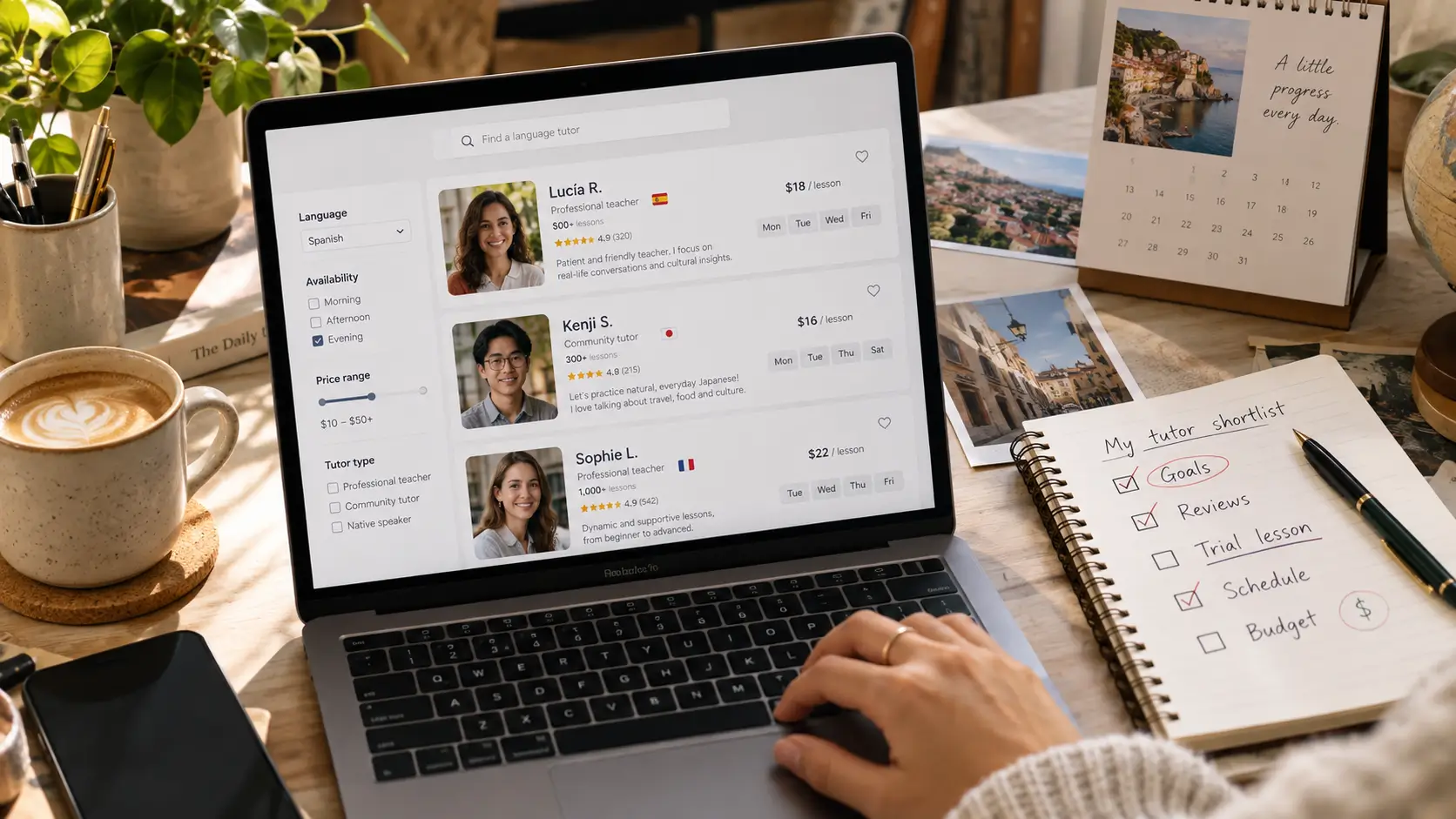
TL;DR: If you want to find a good language tutor on Italki, it comes down to understanding your goals, choosing the right tutor type, and finding someone whose teaching style matches your learning preferences. Take time to read reviews, watch introduction videos, and book trial lessons before committing long-term.
Finding a good language tutor on italki can completely transform your progress, but with thousands of tutors available, choosing the right one is not always easy. The best tutors do far more than teach grammar.
They help you speak naturally, build confidence, stay motivated, and improve in ways that actually fit your goals. In this guide, we’ll show you how to find the right italki tutor, avoid common mistakes, and get the most out of every lesson.
Get explanations like this for your English questions
Personalised to your native language and level. Free to start — no card needed.
Before booking lessons on italki, it’s important to understand what you actually want from a tutor.
The right teacher for a beginner may be completely different from the right teacher for someone preparing for exams, improving business communication, or trying to sound more natural in conversations.
Having clear goals will make it much easier to choose a tutor who fits your learning style, level, and long-term objectives
Identifying personal language learning objectives
Start by thinking about why you want to learn the language. Some learners want to travel more confidently; others need it for work, relationships, relocation, or personal growth.
Knowing your main motivation helps you find tutors who specialise in the areas that matter most to you.
Considering factors such as fluency level, specific skills (speaking, writing, etc.), and cultural knowledge
Not every tutor teaches the same way. Some focus on speaking and pronunciation, while others specialise in grammar, writing, exams, or business language.
You should also think about your current fluency level and whether you want to learn more about culture, slang, or real-world communication alongside the language itself.
Setting realistic expectations for progress
A good tutor can improve your learning experience dramatically, but fluency still takes time and consistency.
Progress usually happens gradually through regular speaking, listening, reading, and practice.
Setting realistic expectations from the beginning helps you stay motivated and makes it easier to recognise genuine improvement over time.
Exploring Italki’s Tutor Options
One of the biggest advantages of italki is the huge variety of tutors available. Whether you want structured lessons with a qualified teacher or relaxed conversation practice with a native speaker, the platform gives you plenty of options.
The differences between tutor types can help you avoid wasting time and money on lessons that do not match your learning goals.
Types of tutors available
Types of Tutors Available
Italki mainly offers two types of tutors: professional teachers and community tutors.
- Professional teachers usually have teaching qualifications, certifications, or formal classroom experience.
- Community tutors are typically native or fluent speakers who focus more on conversation practice and natural communication.
| Tutor Type | What They Typically Offer | Best For | Potential Drawbacks |
| Professional Teachers | Structured lessons, grammar explanations, homework, study plans, exam preparation, and formal teaching experience or certifications | Learners who want clear progression, detailed explanations, academic support, or structured learning | Usually more expensive and sometimes more formal in teaching style |
| Community Tutors | Relaxed conversation practice, natural communication, cultural insights, and everyday speaking experience | Learners focused on speaking confidence, listening skills, fluency, and casual conversation practice | May have less teaching experience or limited ability to explain complex grammar rules |
Benefits and drawbacks of each type
Professional teachers can be extremely valuable if you want structured progress, exam preparation, or detailed explanations of grammar and pronunciation.
However, they are usually more expensive and may feel more formal depending on their teaching style.
Community tutors are often cheaper and great for conversational fluency, listening skills, and building confidence in real-life communication. The downside is that some may have less teaching experience or a limited ability to explain complex language rules clearly.
How to navigate the iTalki platform to find tutors
Italki makes it easy to search for tutors based on language, price, availability, country, speciality, and lesson type.
You can watch introduction videos, read student reviews, compare lesson styles, and book trial lessons before committing long-term.
Taking time to explore profiles carefully will help you find a tutor who genuinely matches your personality, goals, and learning preferences.
Evaluating Tutor Profiles
Once you start browsing tutors on italki, it’s important to look beyond price alone.
A tutor might have hundreds of lessons completed, but that does not automatically mean they are the right fit for your learning style or goals.
Taking time to properly evaluate tutor profiles can help you find someone you genuinely enjoy learning with long-term
Key elements to look for in a tutor’s profile
A strong tutor profile should clearly explain the tutor’s experience, qualifications, teaching style, and lesson focus.
Some tutors specialise in beginners, while others focus on conversational fluency, business language, exam preparation, or pronunciation coaching.
You should also look for information about lesson structure, materials, and whether the tutor adapts lessons to individual students.
Importance of reading reviews and ratings from previous students
Student reviews can give you valuable insight into what lessons are actually like.
Look for repeated comments about patience, communication style, organisation, energy, and how helpful the tutor is during lessons.
High ratings are useful, but detailed reviews often reveal far more about whether a tutor is the right fit for your personality and goals.
Analysing the tutor’s introduction video for personality and teaching approach
The introduction video is one of the best ways to judge whether you will feel comfortable learning with a tutor.
Pay attention to how clearly they communicate, their energy, accent, friendliness, and overall teaching style. A tutor may look perfect on paper, but if their communication style does not suit you, lessons can quickly become less enjoyable and less effective.
Assessing Availability and Scheduling
Even the best tutor on italki may not be the right fit if their schedule does not match yours.
Consistency is one of the most important parts of language learning, so finding a tutor whose availability works with your routine can make a huge difference to your long-term progress and motivation
Checking tutor availability to match your schedule
Before booking lessons, check the tutor’s calendar carefully to see whether their available times fit naturally into your week.
Some tutors only teach part-time, while others may have limited evening or weekend availability. Choosing a tutor with flexible scheduling can make it easier to stay consistent over time.
Understanding time zone differences and flexibility in lesson times
Because italki connects learners and tutors from around the world, time zones can sometimes become confusing.
A tutor based in another country may have lesson slots that appear convenient at first but become difficult to maintain long-term. It’s important to check local time differences and see whether the tutor offers enough flexibility if your schedule changes.
Importance of consistent scheduling for language learning
Regular lessons help build momentum, improve retention, and make speaking feel more natural over time.
Studying once every few weeks is far less effective than maintaining a steady routine each week. Finding a tutor whose availability supports consistent practice is often just as important as finding someone with the right teaching style.
Get explanations like this for your English questions
Personalised to your native language and level. Free to start — no card needed.
Trial lessons on italki are one of the best ways to decide whether a tutor is actually right for you.
A tutor may look perfect on their profile, but the real learning experience often feels very different once the lesson starts.
Trial lessons give you the chance to test communication style, lesson structure, and overall compatibility before committing long-term.
The value of taking trial lessons to gauge compatibility
A trial lesson helps you understand whether you feel comfortable learning with the tutor.
Language learning requires confidence and regular interaction, so personality and communication style matter far more than many learners expect. Even highly qualified tutors may not suit your learning style, energy, or goals.
What to expect during a trial lesson
Most trial lessons focus on introductions, discussing your language goals, assessing your current level, and getting a feel for how the tutor teaches.
Some tutors may prepare structured activities, while others keep the session conversational and informal. The lesson should give you a clear idea of how future lessons will feel.
How to assess if the tutor meets your learning needs
After the lesson, ask yourself whether the tutor explained things clearly, listened carefully, and made you feel comfortable speaking.
Think about whether their teaching approach matched your goals and whether the lesson felt engaging and productive. If you leave the lesson feeling motivated and confident, that is usually a strong sign you have found a good fit.
Communication Style and Teaching Methods
Choosing the right tutor on italki is not only about qualifications or price.
The way a tutor communicates and teaches can have a huge impact on your confidence, motivation, and overall progress.
A teaching style that works perfectly for one learner may feel frustrating or ineffective for another.
Importance of finding a tutor whose communication style resonates with you
Language learning works best when you feel comfortable asking questions, making mistakes, and speaking naturally. Some tutors are highly energetic and conversational, while others are more structured and academic.
Finding someone whose communication style feels encouraging and easy to follow can make lessons far more enjoyable and productive over time.
Exploring different teaching methods
Tutors often use very different teaching approaches depending on their experience and specialities. Some focus heavily on grammar and correction, while others prioritise conversation, immersion, repetition, or real-world communication.
Exploring different teaching methods through trial lessons can help you discover which approach helps you learn most effectively.
Discussing your preferred learning style with potential tutors
Good tutors are usually willing to adapt lessons to suit your goals and learning preferences. If you prefer structured lessons, detailed corrections, conversation practice, or interactive activities, it’s worth discussing this early on.
When discussing your preferred learning style, clear communication from the beginning helps create lessons that feel more personalised, engaging, and useful for your long-term progress.
Italki Budget Considerations
One of the biggest advantages of italki is that there are tutors available for almost every budget.
However, cheaper lessons do not always mean better value, and the most expensive tutors are not automatically the best fit either. The right balance between affordability, consistency, and lesson quality is key to making long-term progress.
Pricing structures on Italki
Tutor prices on italki can vary significantly depending on experience, qualifications, demand, lesson type, and language.
Professional teachers generally charge more than community tutors, while specialised lessons such as business language or exam preparation may also cost extra. Some tutors offer discounted trial lessons or package deals for regular students.
How to find a tutor that fits your budget without compromising quality
A good tutor does not need to be the most expensive option on the platform. Many affordable tutors provide excellent lessons, especially newer teachers building their student base.
Reading reviews, watching introduction videos, and taking trial lessons can help you judge lesson quality before committing to regular sessions. Consistency is often more valuable than occasional expensive lessons.
Tips for maximising value from your tutoring sessions
Getting the most out of your italki lessons is not just about choosing the right tutor.
Small habits before, during, and after lessons can significantly improve your progress without increasing your budget.
- Arrive with clear goals, questions, or conversation topics
- Take notes during lessons and review corrections afterwards
- Practise between sessions to reinforce what you learned
- Focus on consistency rather than occasional long lessons
- Use lessons for active speaking, not passive listening
- Be honest with your tutor about what is and is not working
- Track your progress to stay motivated over time
Building a Productive Tutor-Student Relationship
A good tutor on italki does more than simply teach the language. The best learning experiences come from building a strong relationship based on communication, trust, and clear goals.
When both you and your tutor understand what you want to achieve, lessons become far more effective and enjoyable.
Importance of open communication and feedback
Clear communication helps tutors adapt lessons to your needs, strengths, and weaknesses.
If something feels too difficult, too easy, or simply not helpful, it’s important to speak honestly about it. Good tutors appreciate feedback and will often adjust their teaching style to help you learn more effectively.
Setting goals and tracking progress with your tutor
Having clear short-term and long-term goals makes it easier to stay focused and motivated.
Whether you want to improve speaking confidence, pronunciation, grammar, or exam performance, tracking progress over time helps you recognise improvement and stay committed to learning consistently.
How to maintain motivation and engagement throughout the learning process
Language learning can sometimes feel slow, especially during difficult periods where progress is less obvious. Keeping lessons engaging, celebrating small wins, and using the language in real-life situations can help maintain motivation.
A supportive tutor who understands your goals can also make the learning process feel far more enjoyable and sustainable long term.
Get explanations like this for your English questions
Personalised to your native language and level. Free to start — no card needed.
How do I choose the right tutor on italki?
The best tutor depends on your goals, learning style, budget, and current level. Reading reviews, watching introduction videos, and taking trial lessons can help you find someone who matches your needs.
Are professional teachers better than community tutors?
Not always. Professional teachers are usually better for structured learning, grammar, and exam preparation, while community tutors are often excellent for conversation practice and speaking confidence. The right choice depends on your goals.
How many italki lessons should I take each week?
Consistency matters more than intensity. For most learners, one to three lessons per week combined with regular self-study is enough to build steady progress over time.
Are trial lessons on italki worth it?
Yes. Trial lessons are one of the best ways to test compatibility with a tutor before committing long term. They help you evaluate teaching style, communication, and lesson structure.
Can I become fluent using italki alone?
Italki can significantly improve your language skills, especially speaking and listening, but fluency usually requires additional practice outside lessons through reading, listening, writing, and real-world exposure.