
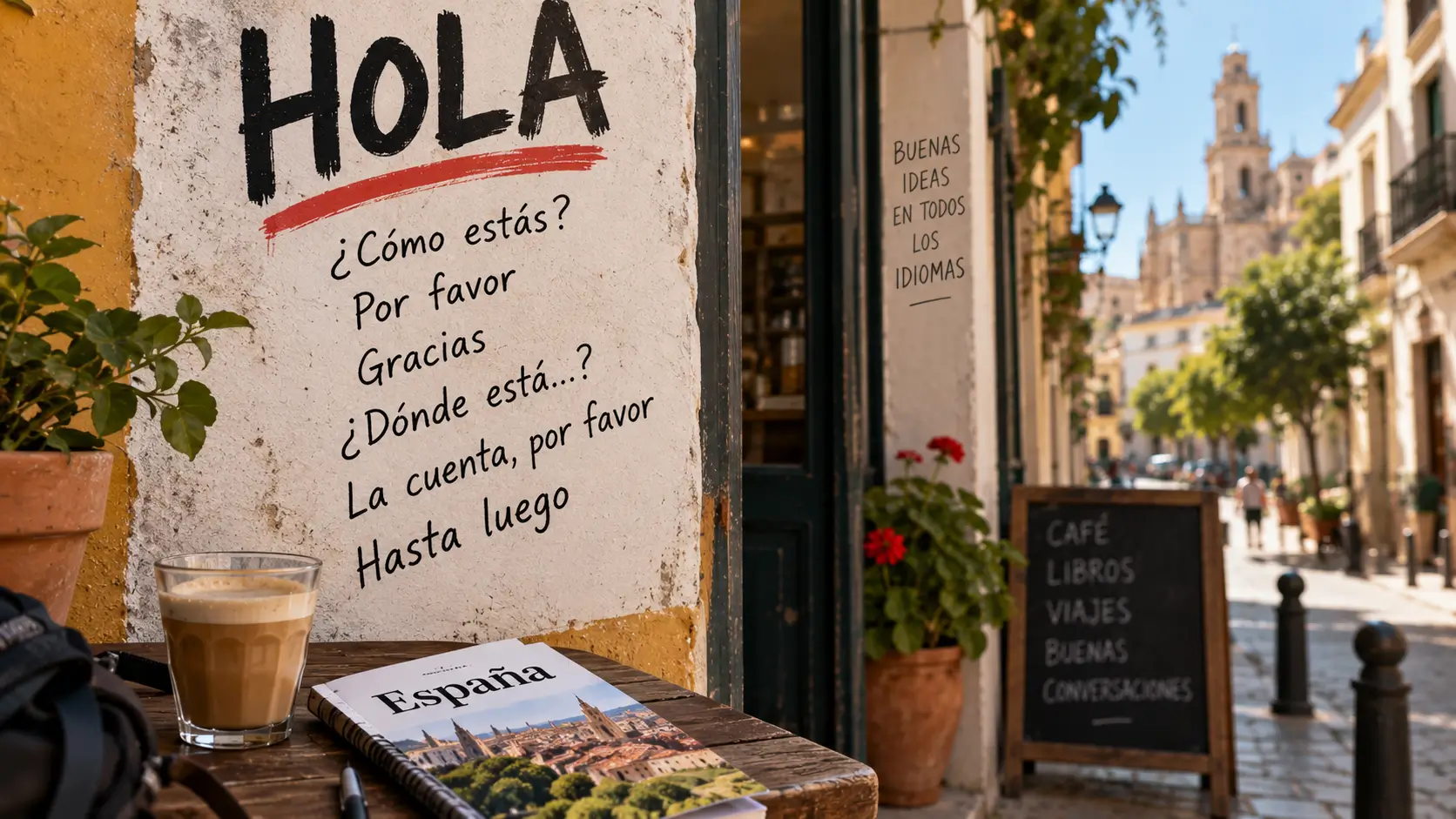
Hola is a good start, but it is not always the right greeting. Learning different Spanish greetings can help you choose the most appropriate one for each situation.
Walking into a morning meeting with a client and a casual hola might feel too relaxed. Say buenas noches when it is only the afternoon, and you may sound unsure.
Use ¿qué tal? with a close friend, and you will sound natural, but use it in the wrong formal situation, and it can feel slightly out of place.
That is because Spanish greetings are not just vocabulary. They depend on the time of day, the setting, the person you are speaking to, and whether you are in Spain, Latin America, a workplace, a shop, on a phone call, or in a casual conversation
The Essential Spanish Greetings
These are the Spanish greetings you will hear most often in real conversations. Some work almost anywhere, while others depend on the time of day, the level of formality, or the person you are speaking to.
| Spanish greeting | Pronunciation | Meaning | Context | Typical response |
| Hola | OH-lah | Hello / Hi | Universal, informal, any time of day. A safe greeting in most casual situations. | Hola / Hola, ¿qué tal? |
| Buenos días | BWEH-nos DEE-as | Good morning | Used until roughly midday. Best for polite, formal, or everyday public situations. | Buenos días |
| Buenas tardes | BWEH-nas TAR-des | Good afternoon / Good evening | Used from midday until sunset or early evening. Common in shops, workplaces, and polite conversations. | Buenas tardes |
| Buenas noches | BWEH-nas NO-ches | Good evening / Good night | Used after sunset. Works as both a greeting and a farewell. | Buenas noches |
| Buenas | BWEH-nas | Hi / Hello | Casual shorthand for buenos días, buenas tardes, or buenas noches. | Buenas |
| ¿Qué tal? | keh TAL | How’s it going? | Informal. Common with friends, classmates, colleagues, or people your own age. | Bien, ¿y tú? / Todo bien |
| ¿Cómo estás? | KOH-mo eh-STAS | How are you? | Informal. Use with people you address as tú. | Estoy bien, gracias. ¿Y tú? |
| ¿Cómo está usted? | KOH-mo eh-STA oos-TED | How are you? | Formal. Use with clients, older people, officials, teachers, or strangers in polite settings. | Estoy bien, gracias. ¿Y usted? |
A useful rule is this: hola is friendly and simple, but buenos días, buenas tardes, and buenas noches sound more polite and natural in formal or semi-formal situations.
For example, if you walk into a hotel, bank, office, or small shop in the morning, buenos días will usually sound better than just hola. With friends, however, hola, buenas, or ¿qué tal? will feel much more relaxed and natural.
Also remember that Spanish speakers often combine greetings:
Hola, buenos días.
Hello, good morning.
Buenas tardes, ¿cómo está usted?
Good afternoon, how are you?
Hola, ¿qué tal?
Hi, how’s it going?
These small combinations are one of the easiest ways to make your Spanish greetings sound more fluent.
Formal Spanish Greetings
Formal Spanish greetings are useful in professional settings, first meetings, interviews, hotels, offices, and conversations with older people or anyone you want to address respectfully. Many of these phrases use usted, the formal form of “you”.
| Spanish greeting | Pronunciation | Meaning | Context | Typical response |
| Mucho gusto | MOO-cho GOOS-toh | Nice to meet you | Used when meeting someone for the first time. Works in both formal and neutral situations. | Mucho gusto / Igualmente |
| Encantado/a de conocerle | en-kan-TAH-doh / dah deh koh-noh-SEHR-leh | Delighted to meet you | Formal and polite. Use encantado if you are male and encantada if you are female. | Igualmente / El gusto es mío |
| Es un placer | es oon plah-SEHR | It’s a pleasure | Polite phrase for first meetings, introductions, or professional conversations. | Igualmente / El placer es mío |
| Le saludo atentamente | leh sah-LOO-doh ah-ten-tah-MEN-teh | I greet you respectfully | Very formal written Spanish. More common in letters or emails than spoken conversation. | Usually followed by the message itself |
| ¿Cómo le va? | KOH-moh leh vah | How are things going? | Formal or polite. Good with clients, older people, teachers, or people you do not know well. | Muy bien, gracias. ¿Y a usted? |
| Bienvenido/a | byen-ben-EE-doh / dah | Welcome | Used to welcome someone to a place, event, home, company, or group. Use bienvenido for masculine and bienvenida for feminine. | Muchas gracias |
| Permítame presentarme | pehr-MEE-tah-meh preh-sen-TAHR-meh | Allow me to introduce myself | Very polite and formal. Useful in professional settings, speeches, meetings, or formal introductions. | Mucho gusto / Encantado/a |
In formal Spanish, it is safer to be slightly too polite than too casual, especially when meeting someone for the first time. Phrases like mucho gusto, ¿cómo le va?, and encantado/a de conocerle help you sound respectful without being overly stiff.
A simple formal introduction could sound like this:
- Buenos días. Mucho gusto. Permítame presentarme: me llamo Alex.
- Good morning. Nice to meet you. Allow me to introduce myself: my name is Alex.
For emails, remember that spoken greetings and written greetings are not always the same. Le saludo atentamente is highly formal and better suited to written communication than everyday conversation.
Casual & Slang Greetings
Once you know the basic and formal Spanish greetings, you can start using more relaxed phrases. These are the greetings you will hear between friends, classmates, younger people, close colleagues, and in casual everyday conversations.
The important thing is context. A phrase like ¿qué pasa? or ¿qué onda? can sound friendly and natural with people your age, but too casual in a job interview, hotel reception, or formal meeting.
Use these phrases when the relationship already feels relaxed.
| Spanish greeting | Pronunciation | Meaning | Context | Typical response |
| ¿Qué pasa? | keh PAH-sah | What’s up? / What’s happening? | Casual and informal. Common with friends or people you already know. | Nada, ¿y tú? / Todo bien |
| ¿Qué onda? | keh ON-dah | What’s up? / How’s it going? | Informal Latin American greeting, especially common in Mexico and parts of Central America. | Todo bien / Nada, ¿y tú? |
| ¿Qué hay? | keh eye | What’s up? / What’s new? | Casual and conversational. Used with friends or acquaintances, though it can sound regional. | Nada nuevo / Todo tranquilo |
| ¡Hola, tío/tía! | OH-lah TEE-oh / TEE-ah | Hi, mate! / Hey, dude! | Very informal Spain Spanish. Tío is used for a male friend and tía for a female friend. | ¡Qué pasa! / ¡Hola! |
| ¿Todo bien? | TOH-doh byen | All good? / Everything OK? | Casual and natural. Used as a quick greeting or check-in with friends, colleagues, or people you know. | Sí, todo bien / Todo tranquilo |
| ¡Buenas! | BWEH-nas | Hi! / Hello! | Short casual greeting. Common when entering a shop, joining a group, or greeting someone informally. | ¡Buenas! / Hola |
| Oye / Ey | OH-yeh / ey | Hey | Used to get someone’s attention rather than as a full greeting. Use carefully with strangers. | ¿Sí? / Dime |
| ¿Cómo andas? | KOH-moh AN-das | How are you doing? | Informal Latin American greeting. A relaxed way to ask how someone is getting on. | Bien, ¿y tú? / Ahí vamos |
A good way to think about casual Spanish greetings is that they are often less about asking a real question and more about opening a conversation.
For example, if someone says:
¿Qué pasa?
They are usually not asking for a detailed explanation of what is happening. A simple response like nada, ¿y tú? or todo bien is enough.
The same is true with:
¿Todo bien?
This can mean “Are you OK?”, but in many casual conversations it simply means “All good?” or “How’s things?” You can reply with:
Sí, todo bien. ¿Y tú?
Yes, all good. And you?
Todo tranquilo.
All calm / everything’s fine.
Spain vs Latin America
Some casual greetings are strongly regional. In Spain, you might hear:
¡Hola, tío!
Hi, mate!
¡Hola, tía!
Hi, mate!
In this context, tío and tía do not usually mean “uncle” and “aunt”. They are casual words used a bit like “mate”, “dude”, or “guy”. They are very informal, so avoid them with clients, teachers, older people, or anyone you have just met in a formal situation.
In Latin America, you are more likely to hear phrases like:
¿Qué onda?
What’s up?
¿Cómo andas?
How are you doing?
These sound natural in many Latin American countries, but usage changes by region. ¿Qué onda? is especially associated with Mexico and parts of Central America, while ¿cómo andas? is common in several Latin American countries as a relaxed way to ask how someone is.
Be careful with “oye”
Oye and ey are not full greetings in the same way as hola or buenos días. They are usually used to get someone’s attention.
For example:
Oye, ¿tienes un minuto?
Hey, do you have a minute?
Ey, ¿qué tal?
Hey, how’s it going?
With friends, these can sound natural. With strangers, oye can sometimes sound too direct, especially if your tone is strong. If you want to be polite, it is safer to begin with perdón, disculpe, or buenos días instead.
Natural casual greeting examples
Here are a few simple ways these greetings appear in real conversations:
A: ¡Buenas! ¿Todo bien?
B: Sí, todo bien. ¿Y tú?
A: ¿Qué pasa?
B: Nada, aquí tranquilo.
A: ¡Hola, tío! ¿Qué tal?
B: Bien, ¿y tú?
A: ¿Qué onda?
B: Todo bien, ¿y tú?
Casual Spanish greetings help you sound warmer and more natural, but they work best when the situation is already informal. When in doubt, start with hola, buenos días, or buenas tardes, then move into more casual phrases once the conversation feels relaxed. For a broader look at everyday Spanish vocabulary, see our guide on how to learn Spanish vocabulary.
Youth slang greetings in Spain vs Mexico vs Argentina
Youth slang changes quickly, but these are some of the most recognisable casual greetings you may hear:
In Spain, friends often say ¿qué pasa, tío? or ¿qué pasa, tía?, meaning “what’s up, mate?” You might also hear ¿todo guay?, which means “all good?” or “everything cool?”
In Mexico, ¿qué onda? is one of the most common informal greetings. With close friends, people may say ¿qué onda, güey?, but learners should use this carefully because güey is very informal.
In Argentina, che is often used like “hey” or “mate”. A natural greeting is che, ¿cómo andás?, meaning “hey, how are you doing?” You may also hear ¿qué hacés?, which can work like “what’s up?” in casual conversation.
As a learner, it is best to understand these first, then use them only when the situation feels clearly informal.
How to Say Goodbye in Spanish
Spanish goodbyes range from simple and neutral to warm, casual, or regionally specific. Some phrases, like adiós, work almost everywhere, while others, like chau, are more common in Latin America.
| Spanish goodbye | Pronunciation | Meaning | Formality | Regional usage |
| Adiós | ah-DYOS | Goodbye | Neutral | Used across the Spanish-speaking world. Can sound slightly final if used on its own. |
| Hasta luego | AS-tah LWEH-goh | See you later | Neutral | Very common in Spain and Latin America. Useful in shops, work, classes, and everyday conversations. |
| Hasta pronto | AS-tah PRON-toh | See you soon | Neutral / polite | Used when you expect or hope to see someone again soon. |
| Hasta mañana | AS-tah mah-NYAH-nah | See you tomorrow | Neutral | Used when you know you will see the person the next day. |
| Nos vemos | nos VEH-mos | See you / We’ll see each other | Casual / neutral | Common in everyday spoken Spanish with friends, classmates, colleagues, and people you know. |
| Cuídate | KWEE-dah-teh | Take care | Casual / warm | Used with friends, family, or people you know well. The formal version is cuídese. |
| Que te vaya bien | keh teh VAI-yah byen | Hope things go well for you | Friendly / polite | Common across many Spanish-speaking countries. Use que le vaya bien in formal situations. |
| Chao / Chau | chow | Bye | Casual | Borrowed from Italian. Chao is common in some areas; chau is especially common in parts of Latin America. |
A simple adiós is easy to remember, but it is not always the most natural goodbye. In many everyday situations, Spanish speakers prefer phrases like hasta luego, nos vemos, or chao/chau because they sound lighter and more conversational.
For example, when leaving a shop or café, you might say:
Gracias, hasta luego.
Thank you, see you later.
When saying goodbye to a friend, you could say:
Nos vemos, cuídate.
See you, take care.
And if you want to sound warm and polite, you can use:
Que te vaya bien.
Hope things go well for you.
The formal version is:
Que le vaya bien.
I hope things go well for you.
Use te with people you address informally, and le with people you address formally.
Greetings on the Phone in Spanish
Phone greetings in Spanish vary by country. If you are heading to a Spanish-speaking destination, it also helps to review essential Spanish travel phrases before you go. In English, you usually answer with “hello”, but in Spanish the most natural word depends on where you are.
| Phone greeting | Pronunciation | Meaning | Where it is common | Context |
| ¿Aló? | ah-LOH | Hello? | Many Latin American countries | A common way to answer the phone, especially in countries such as Colombia, Peru, Chile, and Venezuela. |
| ¿Bueno? | BWEH-noh | Hello? | Mexico | The standard way to answer the phone in Mexico. Literally means “good”, but on the phone it works like “hello?” |
| ¿Diga? | DEE-gah | Speak? / Hello? | Spain and some other regions | A direct but normal phone greeting. It comes from decir, meaning “to say” or “to tell”. |
| ¿Dígame? | DEE-gah-meh | Tell me? / Hello? | Spain | Slightly more polite than ¿diga?. Common in formal or professional phone calls. |
| Gracias por llamar. Hasta luego. | GRAH-syas por yah-MAR. AS-tah LWEH-goh | Thank you for calling. Goodbye. | General Spanish | Polite way to end a phone call, especially in professional or customer-service situations. |
| Hablamos pronto. | ah-BLAH-mos PRON-toh | We’ll speak soon. | General Spanish | Friendly and natural when you expect to speak again soon. |
| Que le vaya bien. | keh leh VAI-yah byen | Hope things go well for you. | General Spanish | Polite formal ending. Use le for formal situations and te with friends or people you know well. |
| Nos vemos. Chao/Chau. | nos VEH-mos. chow | See you. Bye. | Latin America / casual Spanish | Relaxed ending for friends, classmates, colleagues, or informal calls. |
In Spain, you will often hear ¿diga? or ¿dígame? when someone answers the phone. In Mexico, ¿bueno? is the most typical option. In many parts of Latin America, ¿aló? is common. If you want to understand fast-spoken Spanish in real conversations, our guide on understanding fast spoken Spanish can help.
For learners, the safest general option is ¿aló?, especially if you are speaking with people from Latin America. If you are in Spain, ¿dígame? is a polite and natural choice.
To end a phone call politely, you can use:
Gracias por llamar. Hasta luego.
Thank you for calling. Goodbye.
Muy bien, hablamos pronto.
Great, we’ll speak soon.
Perfecto, muchas gracias. Que le vaya bien.
Perfect, thank you very much. I hope things go well for you.
Vale, nos vemos. Chao.
Okay, see you. Bye.
In formal phone calls, use hasta luego, muchas gracias, and que le vaya bien. With friends, nos vemos, chao, or hablamos pronto will sound more relaxed and natural.
Formal vs Informal: Quick Decision Guide
Choosing the right Spanish greeting depends on the person, the place, and the level of respect you want to show. When in doubt, start slightly more formal, then become more casual if the other person does.
| Situation | Use this greeting | Avoid this |
| At work with someone you just met | Buenos días. ¿Cómo está usted? | ¿Qué onda? |
| Meeting a client or older person | Mucho gusto. ¿Cómo está usted? | ¿Qué pasa? |
| With close friends | Hola, ¿qué tal? / ¿Todo bien? | Buenos días if it feels too stiff |
| Entering a shop | Buenas / Buenos días | Saying nothing |
| Speaking to a teacher or official | Buenos días. ¿Cómo está usted? | Ey / ¿Qué pasa? |
| Joining a casual group | ¡Buenas! / Hola, ¿qué tal? | Overly formal introductions |
| Answering the phone in Spain | ¿Dígame? | ¿Qué onda? |
| Answering the phone in Mexico | ¿Bueno? | Hola, tío |
| Writing a formal email | Estimado/a… / Le saludo atentamente | Hola, ¿qué tal? |
| Leaving a formal conversation | Hasta luego. Que le vaya bien. | Chao, tío |
The usted/tú distinction and why it matters for greetings
The main difference is tú versus usted. The distinction is a core feature of Spanish grammar, defined and described by the Real Academia Española (RAE).
Use tú in informal situations, such as with friends, family, children, classmates, and people your own age. That is why you say:
¿Cómo estás?
How are you?
Use usted in formal situations, such as with clients, older people, officials, teachers, strangers, or anyone you want to address respectfully. That is why you say:
¿Cómo está usted?
How are you?
The same idea appears in goodbyes:
Que te vaya bien is informal.
Que le vaya bien is formal.
In many Spanish-speaking countries, using usted can make you sound more polite and respectful. In some places, people move to tú quickly once the conversation feels friendly.
The safest rule for learners is simple: use usted first in formal situations, then follow the other person’s lead.
Cultural Greeting Customs in Spanish-Speaking Countries
Spanish greetings are not just about the words you use. Body language matters too. Cultural context is an important part of communication, and resources like the Instituto Cervantes offer deeper guidance on Spanish culture and language use.
In many Spanish-speaking countries, people greet friends, relatives, and sometimes new acquaintances with el beso: a light kiss on the cheek. This is a normal social greeting, not a romantic gesture.
- Customs change by country. In Argentina, one cheek kiss is very common.
- In Spain, two kisses were traditionally common in many social situations, but one kiss or no kiss may also happen depending on the region, age, and setting.
- Across Latin America, one cheek kiss is common in many places, but it is not universal.
In business situations, a handshake is usually safer. If you are meeting a client, teacher, official, or older person, start with a polite greeting like buenos días or mucho gusto, then follow their lead.
One important rule: greet people individually.
If you enter a small group, do not just say one quick hola to the room and ignore everyone else. In many Spanish-speaking cultures, people greet each person one by one, especially at family gatherings, meals, small parties, or friendly social events.
The safest approach is simple: be warm, greet everyone, and copy the level of formality around you.
Mistakes to avoid when greeting Spanish speakers
Even simple Spanish greetings can sound awkward if you use them in the wrong situation. Understanding Spanish verb conjugations alongside greetings can help you form natural responses. Here are the main mistakes to avoid.
Using slang too soon
Phrases like ¿qué onda?, ¿qué pasa?, and ¿qué pedo? can sound natural with friends, but too casual with strangers, clients, teachers, or older people.
Safer option: start with hola, buenos días, or buenas tardes.
Forgetting the time of day
Buenos días, buenas tardes, and buenas noches depend on the time. Saying buenos días late in the evening will sound unnatural.
Safer option: use hola if you are unsure.
Using tú when usted is more appropriate
With friends, ¿cómo estás? is fine. But with clients, older people, officials, or people you have just met, ¿cómo está usted? sounds more respectful.
Safer option: use usted first in formal situations, then follow the other person’s lead.
Saying nothing when entering a room or shop
In many Spanish-speaking places, especially in smaller shops or social settings, it can seem rude to enter without greeting anyone.
Safer option: say buenas, buenos días, or hola.
Translating directly from English
English speakers often say “how are you?” automatically. In Spanish, some greetings are quick social openers, not invitations for a long answer.
For ¿qué tal?, ¿todo bien?, or ¿cómo estás?, a short reply is usually enough:
Bien, gracias. ¿Y tú?
Good, thanks. And you?
Overusing adiós
Adiós is correct, but it can sometimes sound too final. In everyday situations, Spanish speakers often use lighter goodbyes.
Safer option: use hasta luego, nos vemos, or chao/chau depending on the context.
Ignoring regional differences
A greeting that sounds normal in Mexico may sound unusual in Spain or Argentina. For example, ¿qué onda? is common in Mexico, while che, ¿cómo andás? is strongly associated with Argentina.
Safer option: learn the local greeting style for the country you are visiting or the people you speak with most.
Quick Reference Table: 30 Spanish Greetings
| Spanish | Pronunciation | Meaning | Formal / Informal | Region |
| Hola | OH-lah | Hello / Hi | Informal / neutral | Universal |
| Buenos días | BWEH-nos DEE-as | Good morning | Formal / neutral | Universal |
| Buenas tardes | BWEH-nas TAR-des | Good afternoon / Good evening | Formal / neutral | Universal |
| Buenas noches | BWEH-nas NO-ches | Good evening / Good night | Formal / neutral | Universal |
| Buenas | BWEH-nas | Hi / Hello | Informal / neutral | Spain and Latin America |
| ¿Qué tal? | keh TAL | How’s it going? | Informal | Spain and Latin America |
| ¿Cómo estás? | KOH-mo eh-STAS | How are you? | Informal | Universal |
| ¿Cómo está usted? | KOH-mo eh-STA oos-TED | How are you? | Formal | Universal |
| Mucho gusto | MOO-cho GOOS-toh | Nice to meet you | Formal / neutral | Universal |
| Encantado/a de conocerle | en-kan-TAH-doh / dah deh koh-noh-SEHR-leh | Delighted to meet you | Formal | Universal |
| Es un placer | es oon plah-SEHR | It’s a pleasure | Formal / polite | Universal |
| Le saludo atentamente | leh sah-LOO-doh ah-ten-tah-MEN-teh | I greet you respectfully | Very formal | Written Spanish |
| ¿Cómo le va? | KOH-mo leh vah | How are things going? | Formal / polite | Universal |
| Bienvenido/a | byen-ben-EE-doh / dah | Welcome | Formal / neutral | Universal |
| Permítame presentarme | pehr-MEE-tah-meh preh-sen-TAHR-meh | Allow me to introduce myself | Formal | Universal |
| ¿Qué pasa? | keh PAH-sah | What’s up? | Informal | Spain and Latin America |
| ¿Qué onda? | keh ON-dah | What’s up? / How’s it going? | Informal | Latin America, especially Mexico |
| ¿Qué hay? | keh eye | What’s new? / What’s up? | Informal | Regional |
| ¡Hola, tío/tía! | OH-lah TEE-oh / TEE-ah | Hi, mate! | Very informal | Spain |
| ¿Todo bien? | TOH-doh byen | All good? | Informal | Spain and Latin America |
| Oye / Ey | OH-yeh / ey | Hey | Informal | Spain and Latin America |
| ¿Cómo andas? | KOH-mo AN-das | How are you doing? | Informal | Latin America |
| Adiós | ah-DYOS | Goodbye | Neutral | Universal |
| Hasta luego | AS-tah LWEH-goh | See you later | Neutral | Universal |
| Hasta pronto | AS-tah PRON-toh | See you soon | Neutral / polite | Universal |
| Hasta mañana | AS-tah mah-NYAH-nah | See you tomorrow | Neutral | Universal |
| Nos vemos | nos VEH-mos | See you | Informal / neutral | Universal |
| Cuídate | KWEE-dah-teh | Take care | Informal / warm | Universal |
| Que te vaya bien | keh teh VAI-yah byen | Hope things go well for you | Friendly / polite | Universal |
| Chao / Chau | chow | Bye | Informal | Latin America, also heard elsewhere |
Spanish Greetings FAQ
What is the most common Spanish greeting?
The most common Spanish greeting is hola, which means “hello” or “hi”. It works at any time of day and is understood everywhere Spanish is spoken. To build on your Spanish further, explore our list of common Spanish phrases.
In polite everyday situations, buenos días is also extremely common, especially in the morning when entering shops, cafés, offices, hotels, or classrooms.
How do you say hi in Spanish casually?
The easiest casual way to say hi in Spanish is hola.
You can also use:
¿Qué tal?
How’s it going?
¿Qué pasa?
What’s up?
Buenas
Hi / hello
For beginners, hola and ¿qué tal? are the safest casual greetings because they sound natural without being too slangy. You can also check SpanishDict for audio pronunciation of any of these greetings.
How do you greet someone formally in Spanish?
A good formal Spanish greeting is:
Buenos días. ¿Cómo está usted?
Good morning. How are you?
You can use this with clients, older people, teachers, officials, or anyone you want to address respectfully. For more phrases suited to polite situations, visit our article on basic Spanish words and phrases every beginner should know. In the afternoon, use buenas tardes. In the evening, use buenas noches.
What does ¿Qué tal? mean?
¿Qué tal? means “How’s it going?”, “How are things?”, or simply “What’s up?” depending on the context. If you are building your vocabulary alongside greetings, our guide to basic Spanish words and phrases is a useful next step.
It is casual, friendly, and very versatile. A natural answer is:
Bien, ¿y tú?
Good, and you?
Or, more casually:
Todo bien.
All good.