
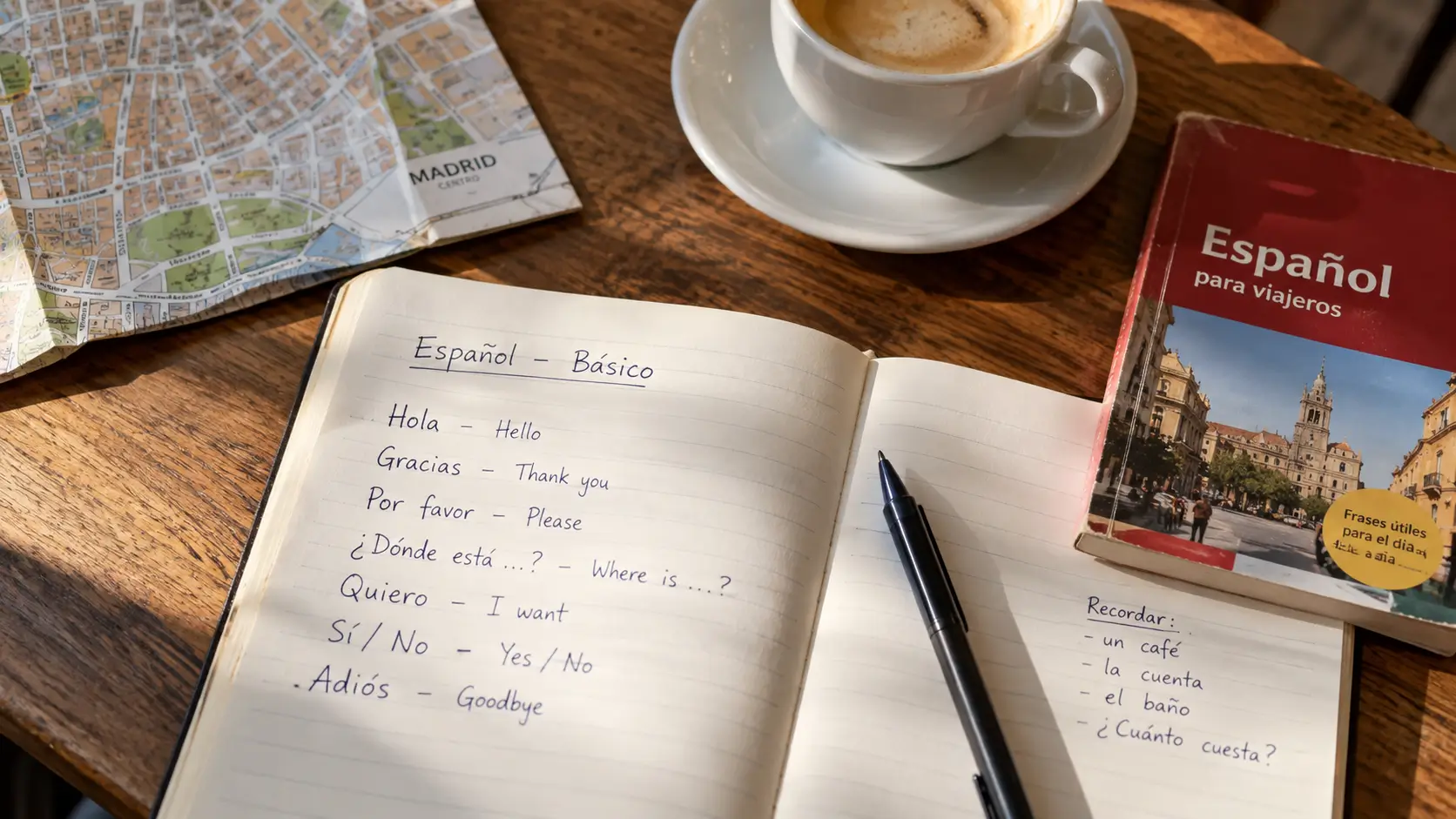
TL;DR: Start with the most common Spanish words first. Learn basic greetings, numbers, pronouns, everyday nouns, key verbs, question words, and simple connector words like y, pero, and porque. With just 100+ essential Spanish words and phrases, you can start building real sentences such as quiero agua, necesito ayuda, and ¿Dónde está el hotel?
Learning Spanish does not begin with memorising endless grammar rules. It begins with the words you can actually use.
Whether you want to order food, greet someone, ask for directions, understand signs, or hold your first simple conversation, a small set of basic Spanish words can take you surprisingly far. You do not need to know everything at once; you need the right words first.
Start with these essentials, practise them often, and you’ll build the foundation for real Spanish conversations from day one.
Why Start With the Most Common Spanish Words?
The fastest way to learn Spanish is not to memorise random word lists. It is to learn the words you will actually hear and use every day.
A small number of high-frequency Spanish words appear again and again in normal conversation. These words help you understand greetings, questions, directions, menus, messages, and simple sentences much faster.
That is why basic words like hola (hello), gracias (thank yo), sí (yes), no (no), quiero I want, and dónde (where) are so powerful. With just a few essentials, you can already build useful phrases:
Quiero agua: I want water.
¿Dónde está el baño? Where is the bathroom?
Gracias, adiós: Thank you, goodbye.
To use this list properly, do not just read it. Say each word out loud, repeat the examples, and try making your own short sentences. The more you use these basic Spanish words in context, the quicker they will stick.
Numbers: 1–20 and Key Spanish Numbers
Numbers are some of the most useful basic Spanish words to learn early. You will need them for prices, times, dates, phone numbers, addresses, ages, quantities, and ordering food or drinks.
Here are the Spanish numbers from 1 to 20:
| Number | Spanish |
| 1 | uno |
| 2 | dos |
| 3 | tres |
| 4 | cuatro |
| 5 | cinco |
| 6 | seis |
| 7 | siete |
| 8 | ocho |
| 9 | nueve |
| 10 | diez |
| 11 | once |
| 12 | doce |
| 13 | trece |
| 14 | catorce |
| 15 | quince |
| 16 | dieciséis |
| 17 | diecisiete |
| 18 | dieciocho |
| 19 | diecinueve |
| 20 | veinte |
Two more key numbers worth learning straight away are:
| Number | Spanish |
| 100 | cien |
| 1,000 | mil |
You can use these numbers in simple everyday phrases:
- Tengo dos hermanos: I have two brothers.
- Quiero tres cafés: I want three coffees.
- Cuesta diez euros: It costs ten euros.
- Tengo veinte años: I am twenty years old.
Tip: Learn Spanish Numbers Properly
Once you know 1–20, the next step is learning how Spanish numbers work after twenty, including numbers like treinta thirty, cincuenta fifty, and cien one hundred.
For a complete breakdown, see our full guide to Numbers in Spanish.
Greetings and Basic Spanish Expressions
Greetings are some of the first basic Spanish words every beginner should learn. They help you start conversations politely, say goodbye, thank people, apologise, and sound more natural in everyday situations.
| Spanish | English |
| Hola | Hello |
| Adiós | Goodbye |
| Buenos días | Good morning |
| Buenas tardes | Good afternoon |
| Buenas noches | Good evening / Good night |
| Por favor | Please |
| Gracias | Thank you |
| De nada | You’re welcome |
| Lo siento | I’m sorry |
| Perdón | Sorry / Excuse me |
These simple Spanish expressions are useful from day one. You can use them in shops, restaurants, hotels, classrooms, messages, and casual conversations.
- Hola, buenos días: Hello, good morning.
- Un café, por favor: A coffee, please.
- Gracias: Thank you.
- Perdón, ¿dónde está el baño?: Excuse me, where is the bathroom?
- Lo siento: I’m sorry.
Spanish greetings are fairly direct and easy to use, but context still matters. For example, buenos días is used in the morning, buenas tardes in the afternoon, and buenas noches in the evening or when saying good night.
For comparison, you can also read our guide to French greetings, which shows how greetings change depending on formality, culture, and situation.
Essential Spanish Pronouns
Pronouns are small words, but they are essential for building Spanish sentences. They help you say who is doing the action: I, you, he, she, we, or they.
| Spanish | English | Notes |
| Yo | I | Used when talking about yourself |
| Tú | You | Informal singular “you” |
| Él | He | Used for a man or masculine noun |
| Ella | She | Used for a woman or feminine noun |
| Nosotros / Nosotras | We | Nosotros for mixed or masculine groups; nosotras for all-female groups |
| Vosotros / Vosotras | You all | Informal plural “you” used mainly in Spain |
| Ustedes | You all | Used across Latin America and also formal in Spain |
| Ellos / Ellas | They | Ellos for mixed or masculine groups; ellas for all-female groups |
One important word to know is usted, which means you in a formal way. Use usted when speaking politely to someone older, someone you do not know well, or in more formal situations, such as with a teacher, doctor, customer, or official.
Here are a few simple examples:
- Yo soy Alex: I am Alex.
- Tú hablas español: You speak Spanish.
- Ella vive en España: She lives in Spain.
- Nosotros aprendemos español: We are learning Spanish.
- ¿Usted habla inglés?: Do you speak English?
The Most Common Spanish Verbs (20 verbs)
Verbs are action words, and they are essential if you want to build real Spanish sentences. Once you know a few common verbs, you can talk about what you are, what you have, what you want, where you go, and what you do every day.
One important thing to know early: Spanish has two verbs for “to be”, ser and estar. In simple terms, ser is often used for identity or permanent traits, while estar is often used for location, feelings, or temporary states.
| Infinitive | English | Yo Form | Example Sentence |
| Ser | To be | soy | Yo soy estudiante: I am a student. |
| Estar | To be | estoy | Estoy en casa: I am at home. |
| Tener | To have | tengo | Tengo una pregunta: I have a question. |
| Querer | To want | quiero | Quiero agua: I want water. |
| Poder | Can / to be able to | puedo | Puedo ayudarte: I can help you. |
| Ir | To go | voy | Voy al trabajo: I am going to work. |
| Hacer | To do / to make | hago | Hago la cena: I am making dinner. |
| Decir | To say / to tell | digo | Digo la verdad: I tell the truth. |
| Ver | To see | veo | Veo una casa: I see a house. |
| Saber | To know | sé | Sé la respuesta: I know the answer. |
| Llegar | To arrive | llego | Llego tarde: I arrive late. |
| Salir | To leave / to go out | salgo | Salgo a las ocho: I leave at eight. |
| Volver | To return / to come back | vuelvo | Vuelvo mañana: I come back tomorrow. |
| Comer | To eat | como | Como pan: I eat bread. |
| Beber | To drink | bebo | Bebo café: I drink coffee. |
| Dormir | To sleep | duermo | Duermo bien: I sleep well. |
| Trabajar | To work | trabajo | Trabajo mucho: I work a lot. |
| Hablar | To speak / to talk | hablo | Hablo español: I speak Spanish. |
| Comprar | To buy | compro | Compro comida: I buy food. |
| Necesitar | To need | necesito | Necesito ayuda: I need help. |
These verbs are some of the most useful Spanish words for beginners because they let you create simple sentences straight away.
Try changing the nouns at the end of each example to make your own phrases, such as quiero café, necesito dinero, or hablo inglés.
Everyday Spanish Nouns: People and Relationships
People words are some of the most useful basic Spanish words because they help you talk about family, friends, strangers, and everyday social situations.
| Spanish | English | Example Sentence |
| Familia | Family | Mi familia es grande: My family is big. |
| Madre | Mother | Mi madre habla español: My mother speaks Spanish. |
| Padre | Father | Mi padre trabaja mucho: My father works a lot. |
| Hermano / Hermana | Brother / Sister | Tengo un hermano: I have a brother. |
| Amigo / Amiga | Friend | Ella es mi amiga: She is my friend. |
| Señor | Mr / Sir / Gentleman | Buenos días, señor: Good morning, sir. |
| Señora | Mrs / Madam / Lady | Gracias, señora: Thank you, madam. |
| Niño / Niña | Boy / Girl / Child | El niño está en casa: The boy is at home. |
| Hombre | Man | El hombre vive aquí: The man lives here. |
| Mujer | Woman | La mujer trabaja allí: The woman works there. |
| Persona | Person | Es una buena persona: He / she is a good person. |
In Spanish, many people words change depending on gender. For example, amigo means male friend, while amiga means female friend. The same pattern appears in words like hermano / hermana and niño / niña.
Everyday Spanish Nouns: Places and Objects
These everyday Spanish nouns are useful for travel, shopping, work, food, and simple conversations.
Learn these early and you’ll start recognising them everywhere, on signs, menus, maps, apps, and in real conversations.
| Spanish | English | Example Sentence |
| Casa | House / Home | Estoy en casa: I am at home. |
| Coche / Auto | Car | Tengo un coche: I have a car. |
| Trabajo | Work / Job | Voy al trabajo: I am going to work. |
| Tienda | Shop / Store | La tienda está abierta: The shop is open. |
| Restaurante | Restaurant | El restaurante es bueno: The restaurant is good. |
| Agua | Water | Quiero agua, por favor: I want water, please. |
| Comida | Food | La comida está rica: The food is tasty. |
| Dinero | Money | Necesito dinero: I need money. |
| Tiempo | Time / Weather | No tengo tiempo: I do not have time. |
| Libro | Book | Leo un libro: I am reading a book. |
| Ciudad | City | La ciudad es grande: The city is big. |
| País | Country | España es un país bonito: Spain is a beautiful country. |
| Calle | Street | La calle está cerca: The street is nearby. |
| Aeropuerto | Airport | Voy al aeropuerto: I am going to the airport. |
| Hotel | Hotel | El hotel está aquí: The hotel is here. |
A quick note: coche is commonly used in Spain for “car”, while auto is more common in many parts of Latin America. Both are understood, but the word you hear most will depend on where you are.
Spanish Adjectives, Describe the World Around You
These everyday Spanish nouns are useful for travel, shopping, work, food, and simple conversations. Learn these early and you’ll start recognising them everywhere, on signs, menus, maps, apps, and in real conversations.
| Spanish | English | Example Sentence |
| Casa | House / Home | Estoy en casa: I am at home. |
| Coche / Auto | Car | Tengo un coche: I have a car. |
| Trabajo | Work / Job | Voy al trabajo: I am going to work. |
| Tienda | Shop / Store | La tienda está abierta: The shop is open. |
| Restaurante | Restaurant | El restaurante es bueno: The restaurant is good. |
| Agua | Water | Quiero agua, por favor: I want water, please. |
| Comida | Food | La comida está rica: The food is tasty. |
| Dinero | Money | Necesito dinero: I need money. |
| Tiempo | Time / Weather | No tengo tiempo: I do not have time. |
| Libro | Book | Leo un libro: I am reading a book. |
| Ciudad | City | La ciudad es grande: The city is big. |
| País | Country | España es un país bonito: Spain is a beautiful country. |
| Calle | Street | La calle está cerca: The street is nearby. |
| Aeropuerto | Airport | Voy al aeropuerto: I am going to the airport. |
| Hotel | Hotel | El hotel está aquí: The hotel is here. |
A quick note: coche is commonly used in Spain for “car”, while auto is more common in many parts of Latin America. Both are understood, but the word you hear most will depend on where you are.
| Spanish | English | Example Sentence |
| Hoy | Today | Hoy trabajo: Today I work. |
| Mañana | Tomorrow | Mañana voy al restaurante: Tomorrow I am going to the restaurant. |
| Ayer | Yesterday | Ayer estuve en casa: Yesterday I was at home. |
| Ahora | Now | Ahora necesito ayuda: I need help now. |
| Después | Later / Afterwards | Después voy al hotel: Later, I am going to the hotel. |
| Siempre | Always | Siempre bebo agua: I always drink water. |
| Nunca | Never | Nunca llego tarde: I never arrive late. |
| ¿Qué? | What? | ¿Qué quieres?: What do you want? |
| ¿Dónde? | Where? | ¿Dónde está el baño?: Where is the bathroom? |
| ¿Cuándo? | When? | ¿Cuándo sales?: When are you leaving? |
| ¿Cómo? | How? | ¿Cómo estás?: How are you? |
| ¿Por qué? | Why? | ¿Por qué estudias español?: Why are you studying Spanish? |
| ¿Cuánto? | How much? / How many? | ¿Cuánto cuesta?: How much does it cost? |
In Spanish, question words usually have an accent when they are used in direct or indirect questions: qué, dónde, cuándo, cómo, por qué, and cuánto.
You will also see Spanish questions written with an upside-down question mark at the start, such as ¿Dónde está…?
H2: Time Words & Question Words (12 words)
Time words and question words are essential Spanish basics because they help you understand when something happens and ask for the information you need.
These are especially useful for travel, lessons, conversations, and everyday plans.
| Spanish | English | Example Sentence |
| Hoy | Today | Hoy trabajo: Today I work. |
| Mañana | Tomorrow | Mañana voy al restaurante: Tomorrow I am going to the restaurant. |
| Ayer | Yesterday | Ayer estuve en casa: Yesterday I was at home. |
| Ahora | Now | Ahora necesito ayuda: I need help now. |
| Después | Later / Afterwards | Después voy al hotel: Later, I am going to the hotel. |
| Siempre | Always | Siempre bebo agua: I always drink water. |
| Nunca | Never | Nunca llego tarde: I never arrive late. |
| ¿Qué? | What? | ¿Qué quieres?: What do you want? |
| ¿Dónde? | Where? | ¿Dónde está el baño?: Where is the bathroom? |
| ¿Cuándo? | When? | ¿Cuándo sales?: When are you leaving? |
| ¿Cómo? | How? | ¿Cómo estás?: How are you? |
| ¿Por qué? | Why? | ¿Por qué estudias español?: Why are you studying Spanish? |
| ¿Cuánto? | How much? / How many? | ¿Cuánto cuesta?: How much does it cost? |
In Spanish, question words usually have an accent when they are used in direct or indirect questions: qué, dónde, cuándo, cómo, por qué, and cuánto.
You will also see Spanish questions written with an upside-down question mark at the start, such as ¿Dónde está…?
Spanish Connector Words, Make Real Sentences
Connector words help you move beyond single words and start building real Spanish sentences. They let you join ideas, explain reasons, compare things, and add more detail to what you want to say.
| Spanish | English | Example Sentence |
| Y | And | Quiero café y agua: I want coffee and water. |
| O | Or | ¿Quieres té o café?: Do you want tea or coffee? |
| Pero | But | Quiero ir, pero no puedo: I want to go, but I can’t. |
| Porque | Because | Estudio español porque es útil: I study Spanish because it is useful. |
| Si | If | Si tengo tiempo, voy: If I have time, I’ll go. |
| También | Also / Too | Yo también hablo inglés: I also speak English. |
| Muy | Very | La comida está muy rica: The food is very tasty. |
| Más | More | Quiero más agua: I want more water. |
| Menos | Less | Quiero menos azúcar: I want less sugar. |
| Con | With | Voy con mi amigo: I am going with my friend. |
These small words are powerful because they help you sound more natural.
Instead of saying quiero café I want coffee, you can say quiero café y agua I want coffee and water, or quiero café, pero no tengo dinero I want coffee, but I don’t have money.
Once you know a few basic Spanish words, connector words help you turn them into proper sentences.
How to Start Putting These Words Together
Learning individual Spanish words is useful, but the real progress starts when you put them into simple sentences. You do not need complex grammar at the beginning. Start with basic patterns you can reuse again and again.
The easiest structure is:
Subject + verb + object
For example:
Yo quiero agua: I want water.
Ella tiene un libro: She has a book.
Nosotros hablamos español: We speak Spanish.
Once you understand this pattern, you can swap in different words from this list to create your own sentences.
5 Beginner Spanish Sentence Templates
Use these simple templates to start practising:
| Spanish Template | English Meaning | Example |
| Yo quiero _____. | I want _____. | Yo quiero comida: I want food. |
| Necesito _____. | I need _____. | Necesito ayuda: I need help. |
| Voy a _____. | I am going to _____. | Voy al hotel: I am going to the hotel. |
| Tengo _____. | I have _____. | Tengo dinero: I have money. |
| ¿Dónde está _____? | Where is _____? | ¿Dónde está el restaurante?: Where is the restaurant? |
The key is to learn Spanish words in context, not in isolation. Instead of memorising agua as “water”, practise saying quiero agua, necesito agua, and agua, por favor. Phrases are easier to remember because they feel useful straight away.
Start small, repeat often, and build from words into sentences one step at a time.
Spanish Vocabulary List
A Spanish vocabulary list is one of the easiest ways to review these basic Spanish words regularly. Use the table below as a quick reference when practising pronunciation, building sentences, or revising before a lesson or trip.
| Spanish Word | Pronunciation | English | Example |
| Hola | OH-lah | Hello | Hola, ¿cómo estás?: Hello, how are you? |
| Gracias | GRAH-syahs | Thank you | Gracias por ayudarme: Thank you for helping me. |
| Agua | AH-gwah | Water | Quiero agua: I want water. |
| Comida | koh-MEE-dah | Food | La comida está rica: The food is tasty. |
| Casa | KAH-sah | House / Home | Estoy en casa: I am at home. |
| Amigo / Amiga | ah-MEE-goh / ah-MEE-gah | Friend | Ella es mi amiga: She is my friend. |
| Quiero | KYEH-roh | I want | Quiero un café: I want a coffee. |
| Necesito | neh-seh-SEE-toh | I need | Necesito ayuda: I need help. |
| ¿Dónde? | DON-deh | Where? | ¿Dónde está el hotel?: Where is the hotel? |
| ¿Cuánto? | KWAN-toh | How much? | ¿Cuánto cuesta?: How much does it cost? |
Spanish Words & Phrases FAQ
What are the most important Spanish words to learn first?
The most important Spanish words to learn first are greetings, numbers, question words, and common verbs. Start with words like hola hello, gracias thank you, sí yes, no no, uno one, dos two, quiero I want, tengo I have, and necesito I need. These give you the basics for simple conversations straight away.
How many Spanish words do you need to have basic conversations?
You can start having basic Spanish conversations with around 300–500 high-frequency words, especially if you learn them in useful phrases. You do not need to know thousands of words to begin speaking. Focus first on the most common Spanish words for greetings, food, travel, people, questions, and everyday actions.
What is the most common word in Spanish?
Some of the most common words in Spanish are de of / from, que that / what, and y and. These small words appear constantly in everyday Spanish and help connect ideas. For beginners, they may not seem exciting, but they are essential for understanding real sentences.