
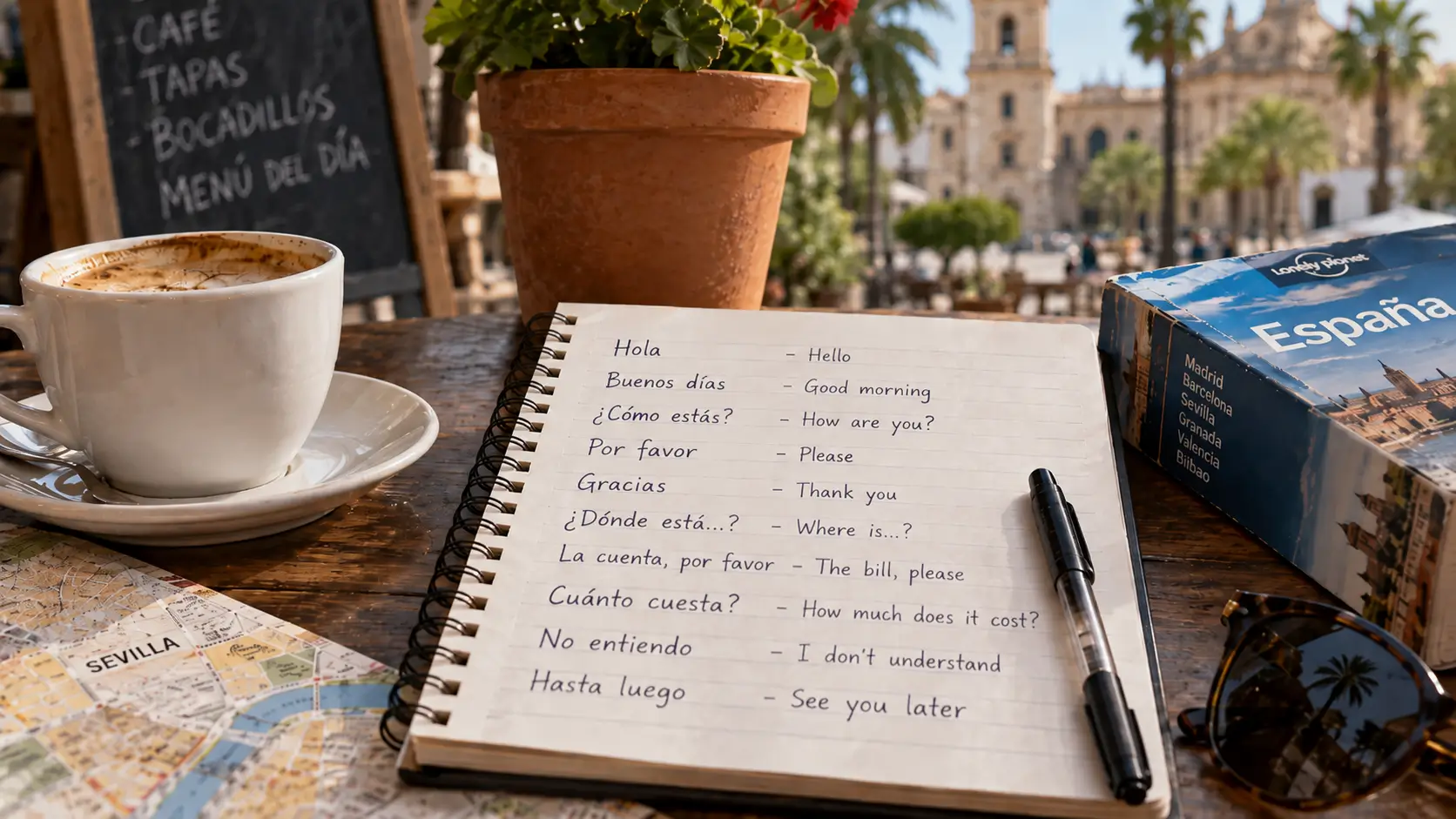
Knowing Spanish grammar is useful, but travel is where the language becomes real. That’s why learning some Common Spanish Phrases can make your experience much smoother and more enjoyable.
It is one thing to understand verb endings. It is another to order food in Mexico City, ask for directions in Madrid, check into a hotel, or explain a problem when you are in a hurry.
This guide gives you 75 Common Spanish Phrases for travel and everyday conversation, covering greetings, directions, hotels, restaurants, shopping, emergencies, and more.
You will also find an easy pronunciation guide after each phrase, written in a simple style like (proh-nun-see-AH-see-on), so you can say the words with more confidence even if you are still a beginner.
Essential Spanish Greetings and Introductions
These are the Common Spanish Phrases you will use at the start and end of almost every conversation. They are simple, polite, and understood in every Spanish-speaking country.
| Spanish | Pronunciation | English meaning | Usage note |
| Hola | (OH-lah) | Hello / Hi | The easiest and most common greeting. Suitable in almost any situation. |
| Buenos días | (BWEH-nohs DEE-ahs) | Good morning | Use this in the morning, especially in shops, hotels, cafés, and formal situations. |
| Buenas tardes | (BWEH-nahs TAR-dehs) | Good afternoon / Good evening | Usually used from midday until early evening. |
| Buenas noches | (BWEH-nahs NOH-chehs) | Good evening / Good night | Use this at night, either when greeting someone or saying goodbye. |
| ¿Cómo estás? | (KOH-moh ehs-TAHS) | How are you? | Informal. Use with friends, people your age, or people you are speaking to casually. |
| Estoy bien, gracias | (ehs-TOY byen GRAH-syahs) | I’m fine, thank you | A simple, polite answer to ¿Cómo estás? |
| ¿Cómo te llamas? | (KOH-moh teh YAH-mahs) | What’s your name? | Informal and friendly. Literally means “What do you call yourself?” |
| Me llamo… | (meh YAH-moh…) | My name is… | Use this to introduce yourself. For example: Me llamo Alex. |
| Mucho gusto | (MOO-choh GOOS-toh) | Nice to meet you | Very common after someone introduces themselves. |
| Encantado / Encantada | (ehn-kahn-TAH-doh / ehn-kahn-TAH-dah) | Pleased to meet you | Use encantado if you are male, encantada if you are female. |
| ¿De dónde eres? | (deh DOHN-deh EH-rehs) | Where are you from? | Informal. Useful when meeting people while travelling. |
| Soy de… | (soy deh…) | I’m from… | Use this to say where you are from. For example: Soy de Inglaterra. |
| Hasta luego | (AHS-tah LWEH-goh) | See you later | A friendly and common way to say goodbye. |
| Adiós | (ah-DYOHS) | Goodbye | A standard goodbye, slightly more final than hasta luego. |
| Nos vemos | (nohs VEH-mohs) | See you | Casual and natural. Use with people you expect to see again. |
Useful goodbye phrases:
- Hasta luego (AHS-tah LWEH-goh) means “See you later”.
- Adiós (ah-DYOHS) means “Goodbye”.
- Nos vemos (nohs VEH-mohs) means “See you”.
Get answers like this for your language questions
Your personal AI language tutor — adapts to your native language, your level, and the words that actually trip you up.
Polite Expressions & Basics (Phrases 13–22)
These Common Spanish Phrases help you sound polite, ask for help, and keep a conversation going even when you do not fully understand what has been said.
| Spanish | Pronunciation | English meaning | Usage note |
| Por favor | (por fah-VOR) | Please | Use this whenever you ask for something politely. |
| Gracias | (GRAH-syahs) | Thank you | Useful in shops, restaurants, hotels, and everyday conversations. |
| De nada | (deh NAH-dah) | You’re welcome | The standard reply when someone says gracias. |
| Lo siento | (loh SYEN-toh) | I’m sorry | Use this to apologise or show sympathy. |
| Perdón | (per-DOHN) | Sorry / Excuse me | Useful if you bump into someone, interrupt, or need someone’s attention. |
| Disculpe | (dees-KOOL-peh) | Excuse me | More polite than perdón. Good for staff, strangers, or formal situations. |
| ¿Puede repetir? | (PWEH-deh reh-peh-TEER) | Can you repeat that? | Use this when someone speaks too quickly or you miss what they said. |
| No entiendo | (noh ehn-TYEN-doh) | I don’t understand | Useful when you are lost in a conversation. |
| ¿Habla inglés? | (AH-blah een-GLEHS) | Do you speak English? | Polite and useful when you need help. |
| Hablo un poco de español | (AH-bloh oon POH-koh deh ehs-pah-NYOL) | I speak a little Spanish | Shows that you are trying, even if your Spanish is limited. |
| No sé | (noh seh) | I don’t know | A simple everyday phrase for when you are unsure. |
Getting Around: Travel & Directions
When you are travelling in a Spanish-speaking country, knowing the right directions and transport phrases quickly becomes essential for getting around confidently.
Whether you are asking where the train station is, buying a ticket, getting into a taxi, or checking f somewhere is nearby, these phrases will help you move around with more confidence.
You do not need perfect grammar to ask for help. In most situations, a simple phrase like ¿Dónde está…? or Quiero ir a… is enough to make yourself understood.
These phrases are especially useful in airports, train stations, bus terminals, hotels, taxis, and busy city centres.
| Spanish | Pronunciation | English meaning | Usage note |
| ¿Dónde está…? | (DOHN-deh ehs-TAH…) | Where is…? | Use this to ask where a place is. For example: ¿Dónde está el baño? |
| ¿Cómo llego a…? | (KOH-moh YEH-goh ah…) | How do I get to…? | Useful when asking for directions to a specific place. |
| A la izquierda | (ah lah ees-KYER-dah) | To the left | Common when listening to or giving directions. |
| A la derecha | (ah lah deh-REH-chah) | To the right | Another essential direction phrase. |
| Todo recto | (TOH-doh REHK-toh) | Straight ahead | Often used when someone is telling you to continue along the same road. |
| ¿Cuánto cuesta el billete? | (KWAHN-toh KWEHS-tah el bee-YEH-teh) | How much does the ticket cost? | Useful at train stations, bus stations, and ticket offices. In Latin America, boleto or pasaje may be more common than billete. |
| Un billete a…, por favor | (oon bee-YEH-teh ah… por fah-VOR) | A ticket to…, please | Use this when buying a ticket. For example: Un billete a Madrid, por favor. |
| ¿A qué hora sale? | (ah keh OH-rah SAH-leh) | What time does it leave? | Use this to ask about departure times for buses, trains, or flights. |
| ¿A qué hora llega? | (ah keh OH-rah YEH-gah) | What time does it arrive? | Use this when checking arrival times. |
| Quiero ir a… | (KYEH-roh eer ah…) | I want to go to… | A simple way to explain your destination. |
| Lléveme a…, por favor | (YEH-veh-meh ah… por fah-VOR) | Take me to…, please | Useful in taxis. It is polite and direct. |
| ¿Está lejos? | (ehs-TAH LEH-hohs) | Is it far? | Helpful when deciding whether to walk or take transport. |
| Está cerca | (ehs-TAH SER-kah) | It’s nearby | Useful when someone tells you a place is close. |
A helpful pattern to remember is: ¿Dónde está…? means “Where is…?”, while ¿Cómo llego a…? means “How do I get to…?” Use the first when you only need the location, and the second when you want directions.
At the Hotel (Phrases 35–41)
Hotel conversations are usually predictable, which makes them easier to prepare for. You will often need to give your name, mention a reservation, ask about check-out, or check the Wi-Fi details.
These phrases are useful at reception, especially when you arrive tired after a journey and need to keep things simple.
| Spanish | Pronunciation | English meaning | Usage note |
| Tengo una reserva | (TEHN-goh OO-nah reh-SEHR-vah) | I have a reservation | Use this when you arrive at hotel reception. |
| Mi nombre es… | (mee NOHM-breh ehs…) | My name is… | Useful when checking in. For example: Mi nombre es Alex. |
| Quisiera una habitación para… | (kee-SYEH-rah OO-nah ah-bee-tah-SYON PAH-rah…) | I would like a room for… | Use this when booking in person. For example: una habitación para dos personas. |
| ¿A qué hora es el check-out? | (ah keh OH-rah ehs el CHEK-owt) | What time is check-out? | Common in hotels. You may also hear ¿A qué hora es la salida? |
| ¿Hay wifi? | (eye WEE-fee) | Is there Wi-Fi? | Useful when asking whether the hotel has internet access. |
| ¿Cuál es la contraseña? | (kwahl ehs lah kohn-trah-SEH-nyah) | What is the password? | Use this when asking for the Wi-Fi password. |
| Hay un problema con la habitación | (eye oon proh-BLEH-mah kohn lah ah-bee-tah-SYON) | There is a problem with the room | Useful if something is wrong with the room and you need help from reception. |
Ordering Food and Drink: Common Spanish Phrases for Restaurants
Restaurants are one of the best places to practise Spanish because the conversations are usually simple and predictable. You might need to ask for a table, order food, explain a dietary need, or ask for the bill.
These phrases will help you sound polite and clear, even if you only know a little Spanish. Quisiera is a slightly more polite way to say “I would like”, while quiero simply means “I want”.
| Spanish | Pronunciation | English meaning | Usage note |
| Una mesa para… personas, por favor | (OO-nah MEH-sah PAH-rah… per-SOH-nahs por fah-VOR) | A table for… people, please | Use this when arriving at a restaurant. For example: Una mesa para dos personas, por favor. |
| ¿Qué recomienda? | (keh reh-koh-MYEN-dah) | What do you recommend? | Useful when asking a waiter for suggestions. |
| La carta, por favor | (lah KAR-tah por fah-VOR) | The menu, please | Common in Spain. In some Latin American countries, you may also hear el menú. |
| Quiero… | (KYEH-roh…) | I want… | A simple way to order, though slightly direct. |
| Quisiera… | (kee-SYEH-rah…) | I would like… | More polite than quiero. Useful in restaurants, cafés, and shops. |
| Sin… | (seen…) | Without… | Use this to remove an ingredient. For example: sin gluten, sin carne, sin mariscos. |
| Sin gluten | (seen GLOO-ten) | Without gluten | Useful for gluten-free diets. |
| Sin carne | (seen KAR-neh) | Without meat | Useful if you do not eat meat. |
| Sin mariscos | (seen mah-REES-kohs) | Without seafood | Important if you avoid seafood or have an allergy. |
| Soy vegetariano / vegetariana | (soy veh-heh-tah-RYAH-noh / veh-heh-tah-RYAH-nah) | I’m vegetarian | Use vegetariano if you are male, vegetariana if you are female. |
| Soy alérgico / alérgica a… | (soy ah-LEHR-hee-koh / ah-LEHR-hee-kah ah…) | I’m allergic to… | Use this for allergies. For example: Soy alérgico a los cacahuetes. |
| La cuenta, por favor | (lah KWEN-tah por fah-VOR) | The bill, please | Use this when you are ready to pay. |
| ¿Está incluido el servicio? | (ehs-TAH een-kloo-EE-doh el sehr-BEE-syoh) | Is service included? | Useful when checking whether a service charge or tip is already included. |
| Estaba delicioso | (ehs-TAH-bah deh-lee-SYOH-soh) | It was delicious | A friendly phrase to compliment the food. |
Spanish Shopping Phrases
Shopping in Spanish is much easier when you know a few key phrases.
Whether you are buying clothes, souvenirs, food, or everyday items, these expressions will help you ask about prices, try something on, pay, and politely say no.
In markets and smaller shops, Spanish can be more conversational, so short phrases are often enough. A simple ¿Cuánto cuesta esto? or Me lo llevo can help you complete most basic purchases.
| Spanish | Pronunciation | English meaning | Usage note |
| ¿Cuánto cuesta esto? | (KWAHN-toh KWEHS-tah EHS-toh) | How much does this cost? | One of the most useful shopping phrases. Use it when pointing at an item. |
| ¿Tiene algo más barato? | (TYEH-neh AHL-goh mahs bah-RAH-toh) | Do you have anything cheaper? | Useful in shops or markets if something is too expensive. |
| ¿Puedo probármelo? | (PWEH-doh proh-BAR-meh-loh) | Can I try it on? | Use this when shopping for clothes, shoes, or accessories. |
| Solo estoy mirando, gracias | (SOH-loh ehs-TOY mee-RAHN-doh GRAH-syahs) | I’m just looking, thank you | A polite phrase if a shop assistant asks whether you need help. |
| Me lo llevo | (meh loh YEH-voh) | I’ll take it | Use this when you have decided to buy something. |
| No me gusta | (noh meh GOOS-tah) | I don’t like it | Simple and direct. Use it politely if something is not right for you. |
| ¿Acepta tarjeta? | (ahk-SEHP-tah tar-HEH-tah) | Do you accept card? | Useful before paying, especially in smaller shops or markets. |
| ¿Tiene cambio? | (TYEH-neh CHAHM-byoh) | Do you have change? | Useful when paying with cash or asking if someone can break a note. |
Emergencies & Health
Hopefully, you will not need these phrases often, but they are among the most important Common Spanish Phrases you can learn before travelling. Being prepared for emergencies can make a real difference.
These phrases can help you ask for urgent help, report a theft, explain that you are ill, or find the nearest hospital or pharmacy.
| Spanish | Pronunciation | English meaning | Usage note |
| ¡Ayuda! | (ah-YOO-dah) | Help! | Use this in an emergency when you need immediate help. |
| ¡Llame a la policía! | (YAH-meh ah lah poh-lee-SEE-ah) | Call the police! | Useful if there is danger, theft, or a serious problem. |
| ¡Llame a una ambulancia! | (YAH-meh ah OO-nah ahm-boo-LAHN-syah) | Call an ambulance! | Use this in a medical emergency. |
| Me han robado | (meh ahn roh-BAH-doh) | I have been robbed | Useful if your bag, wallet, phone, or belongings have been stolen. |
| Necesito un médico | (neh-seh-SEE-toh oon MEH-dee-koh) | I need a doctor | Use this when you need medical help. |
| Estoy enfermo / enferma | (ehs-TOY ehn-FEHR-moh / ehn-FEHR-mah) | I’m ill | Use enfermo if you are male, enferma if you are female. |
| Me duele… | (meh DWEH-leh…) | My… hurts | Use this with a body part. For example: Me duele la cabeza means “My head hurts”. |
| Me duele la cabeza | (meh DWEH-leh lah kah-BEH-sah) | My head hurts | Useful when describing a headache. |
| Me duele el estómago | (meh DWEH-leh el ehs-TOH-mah-goh) | My stomach hurts | Useful when describing stomach pain. |
| ¿Dónde está el hospital más cercano? | (DOHN-deh ehs-TAH el ohs-pee-TAHL mahs sehr-KAH-noh) | Where is the nearest hospital? | Use this when you need urgent medical help. |
| ¿Dónde está la farmacia más cercana? | (DOHN-deh ehs-TAH lah far-MAH-syah mahs sehr-KAH-nah) | Where is the nearest pharmacy? | Useful for medicine or minor health problems. |
Making Friends: Social Phrases
Once you know the basics, Common Spanish Phrases become much more useful for everyday social situations. These expressions help you ask simple questions, talk about yourself, and end conversations in a friendly and natural way.
They are useful when meeting people while travelling, chatting with locals, or making small talk in cafés, hostels, language exchanges, and social situations.
| Spanish | Pronunciation | English meaning | Usage note |
| ¿De qué trabajas? | (deh keh trah-BAH-hahs) | What do you do for work? | Informal and common in conversation. Use it when getting to know someone. |
| Soy… | (soy…) | I am… | Use this to describe your job, nationality, or identity. For example: Soy profesor means “I’m a teacher”. |
| ¿Cuántos años tienes? | (KWAHN-tohs AH-nyohs TYEH-nehs) | How old are you? | Literally means “How many years do you have?” Use it carefully, as age can feel personal. |
| ¿Qué te gusta hacer? | (keh teh GOOS-tah ah-SEHR) | What do you like doing? | A friendly way to ask about hobbies and interests. |
| ¡Salud! | (sah-LOOD) | Cheers! | Use this as a toast when drinking with others. |
| Que te vaya bien | (keh teh BAH-yah byen) | Hope things go well / Take care | A warm way to say goodbye and wish someone well. |
| Buen viaje | (bwen bee-AH-heh) | Have a good trip | Useful when someone is leaving, travelling, or continuing their journey. |
Spain vs Latin America — Key Differences to Know
Spanish is spoken across many countries, so you will hear some differences depending on where you are. The good news is that the core language is the same.
A Spanish speaker from Mexico, Peru, Colombia, Argentina or Spain will usually understand you if you use clear, standard Spanish.
However, there are a few differences worth knowing before you travel.
Vosotros vs Ustedes
In Spain, people often use vosotros when speaking informally to a group of people.
For example:
¿Cómo estáis?
(koh-moh ehs-TICE)
How are you all?
In most of Latin America, people use ustedes instead, even in informal situations.
For example:
¿Cómo están?
(koh-moh ehs-TAHN)
How are you all?
As a beginner, you can use ustedes and be understood almost everywhere. It is the safer choice, especially if you are learning Spanish for travel across different countries.
Coger vs Tomar
In Spain, coger commonly means “to take”, “to grab”, or “to catch”.
For example:
Voy a coger un taxi.
(boi ah koh-HEHR oon TAK-see)
I’m going to catch a taxi.
But in some Latin American countries, coger can have a vulgar sexual meaning, so it is better to avoid it when travelling in Latin America.
A safer alternative is tomar, especially for transport.
For example:
Voy a tomar un taxi.
(boi ah toh-MAR oon TAK-see)
I’m going to take a taxi.
You may also hear agarrar in some countries, meaning “to grab” or “to take”.
Pronunciation: Spain vs Latin America
One of the biggest differences is pronunciation.
In much of Spain, the letters z and c before e or i are often pronounced like the English “th” sound in “think”.
For example:
gracias
(GRAH-thyahs)
cerveza
(thehr-BEH-thah)
In most of Latin America, these sounds are pronounced like an s.
For example:
gracias
(GRAH-syahs)
cerveza
sehr-BEH-sah)
This Latin American pronunciation is called seseo. Many learners use the word ceceo for the “th” sound in Spain, although the more accurate term for standard Castilian Spanish is distinción, because Spanish speakers in Spain usually distinguish between s and z/c sounds.
For travel, either pronunciation is fine. The most important thing is to speak clearly and confidently. If you want to hear these words spoken aloud, SpanishDict is a free tool that lets you listen to native speaker pronunciations.
Tips for Using Common Spanish Phrases in Real Conversations
Learning Common Spanish Phrases is a great start, but real conversations can still feel fast at first. Native speakers may reply quickly, use local slang, or answer in a way you did not expect. That is completely normal, and it gets easier with practice.
The goal is not to speak perfectly. The goal is to be understood, respond politely, and keep the conversation moving.
Slow down and speak clearly
When you are nervous, it is easy to rush. Try to slow down, pronounce each word clearly, and keep your sentences simple.
Most native speakers will appreciate the effort, especially if you are polite and show that you are trying to speak Spanish.
Learn responses, not just questions
Many beginners learn how to ask questions, but forget to prepare for the answer. For example, if you ask ¿Dónde está el baño?, you may hear directions like a la derecha, a la izquierda, or todo recto.
This is why it helps to learn common replies as well as the questions themselves. It makes real conversations much less stressful.
Do not panic if you do not understand
You will not understand every word, especially when people speak naturally. That does not mean you have failed.
A very useful phrase is:
¿Puede repetir más despacio?
(PWEH-deh reh-peh-TEER mahs dehs-PAH-syoh)
Can you repeat that more slowly?
This phrase is polite, practical, and useful almost anywhere.
Practise before your trip
Before travelling, practise saying the phrases out loud. You can use language apps, flashcards, pronunciation tools, or an AI tutor, such as LLH Tutor, to rehearse common situations like ordering food, checking into a hotel, asking for directions, and buying tickets.
Even five minutes of speaking practice a day can make these phrases feel much more natural when you need them in real life.
Get answers like this for your language questions
Your personal AI language tutor — adapts to your native language, your level, and the words that actually trip you up.
Common Spanish Phrases for Travel: FAQ
What are the most important Spanish phrases to know?
The most important Common Spanish Phrases to know are the ones that help you start a conversation, stay polite, ask for directions, order food, and get help when you do not understand something.
Start with simple greetings like Hola and Buenos días, polite words like por favor and gracias, and survival phrases like No entiendo and ¿Puede repetir?. These Common Spanish Phrases will help you in shops, restaurants, hotels, transport, and everyday conversations.
How do you say excuse me in Spanish?
Two common ways to say “excuse me” in Spanish are perdón and disculpe.
Perdón is useful if you bump into someone, interrupt, or want to get someone’s attention. Disculpe is slightly more polite and is often better when speaking to strangers, staff, or someone in a formal situation.
For example, you could say Disculpe, ¿dónde está el baño? meaning “Excuse me, where is the bathroom?”
What is the most common Spanish phrase?
One of the most common Spanish phrases is Hola, which means “hello” or “hi”.
You will also hear Buenos días very often, especially in the morning when entering shops, cafés, hotels, or speaking to someone politely. If you are a beginner, these two phrases are a great place to start because they work in almost every Spanish-speaking country.