
TL;DR: Spanish numbers are highly predictable once you learn the basics. Start with 1–20, memorise the tens, and you’ll be able to build numbers all the way to 1,000 and beyond.
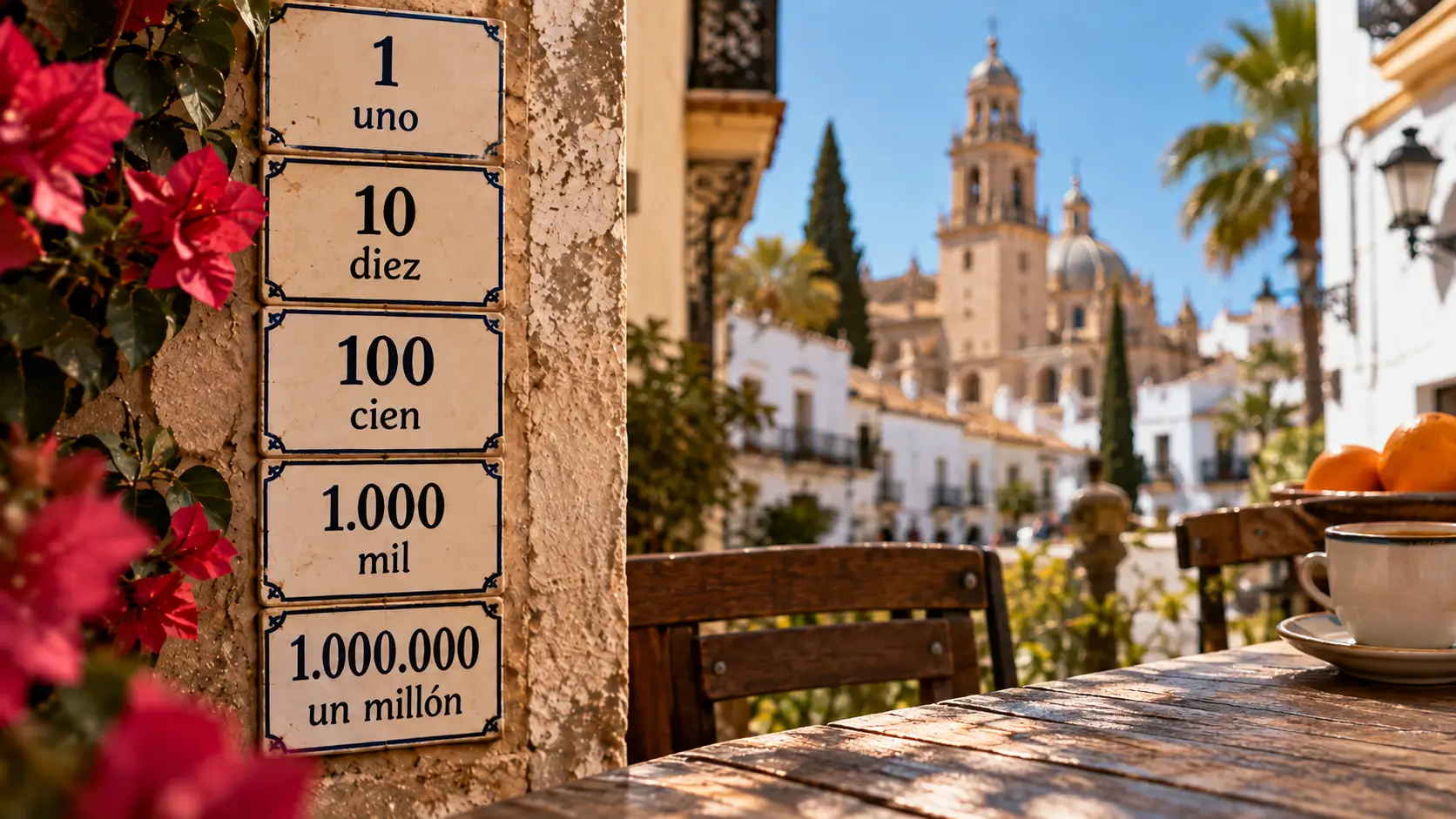
Key numbers:
- 1 = uno
- 10 = diez
- 100 = cien
- 1,000 = mil
- 1,000,000 = un millón
Remember: use ciento for numbers above 100, never say un mil, and don’t forget accent marks in numbers like dieciséis and veintidós. Mastering Spanish numbers will help you talk about prices, dates, ages, years, and time with confidence.
Learning the numbers in Spanish is one of the fastest wins for any beginner, you’ll use them for prices, dates, phone numbers, ages, and telling time from day one.
The good news: Spanish numbers follow clear, predictable patterns, and once you know 1–30 plus the tens, you can build every number up to a million.
Quick answer: The numbers 1–10 in Spanish are: uno (1), dos (2), tres (3), cuatro (4), cinco (5), seis (6), siete (7), ocho (8), nueve (9), diez (10).
Why Learn Spanish Numbers?
Learning Spanish numbers is one of the most practical skills for beginners.
Whether you’re travelling, shopping, ordering food, telling the time, giving your age, or exchanging phone numbers, you’ll use numbers in Spanish almost every day.
The good news is that Spanish numbers follow clear and predictable patterns. Once you learn the numbers from 1–30 and understand how the tens work, you can confidently build hundreds, thousands, and even millions.
Knowing Spanish numbers will help you:
- Understand prices while travelling in Spanish-speaking countries.
- Tell the time and discuss dates
- Give your age and ask others about theirs
- Understand addresses, room numbers, and phone numbers
- Talk about quantities, distances, and measurements
- Follow conversations more naturally with native speakers
Spanish numbers 1–10
| Number | Spanish | Pronunciation |
|---|---|---|
| 0 | cero | SEH-roh |
| 1 | uno | OO-noh |
| 2 | dos | dohs |
| 3 | tres | trehs |
| 4 | cuatro | KWAH-troh |
| 5 | cinco | SEEN-koh |
| 6 | seis | says |
| 7 | siete | see-EH-teh |
| 8 | ocho | OH-choh |
| 9 | nueve | noo-EH-veh |
| 10 | diez | dee-EHS |
Tip: uno changes to un before a masculine noun (un libro = one book) and una before a feminine noun (una mesa = one table).
Spanish numbers 11–20
| Number | Spanish | Pronunciation |
|---|---|---|
| 11 | once | OHN-seh |
| 12 | doce | DOH-seh |
| 13 | trece | TREH-seh |
| 14 | catorce | kah-TOHR-seh |
| 15 | quince | KEEN-seh |
| 16 | dieciséis | dee-eh-see-SAYS |
| 17 | diecisiete | dee-eh-see-see-EH-teh |
| 18 | dieciocho | dee-eh-see-OH-choh |
| 19 | diecinueve | dee-eh-see-noo-EH-veh |
| 20 | veinte | VAYN-teh |
Pattern: 16–19 are literally “ten-and-six,” etc. (diez y seis → dieciséis), written as one word.
Spanish numbers 21–100 (the tens)
The tens are the backbone. Learn these, and you can build everything in between:
| Number | Spanish | Pronunciation |
|---|---|---|
| 20 | veinte | VAYN-teh |
| 30 | treinta | TRAYN-tah |
| 40 | cuarenta | kwah-REHN-tah |
| 50 | cincuenta | seen-KWEHN-tah |
| 60 | sesenta | seh-SEHN-tah |
| 70 | setenta | seh-TEHN-tah |
| 80 | ochenta | oh-CHEHN-tah |
| 90 | noventa | noh-VEHN-tah |
| 100 | cien / ciento | see-EHN |
How to build 21–99: Use [ten] y [unit]. For example: – 31 = treinta y uno – 47 = cuarenta y siete – 88 = ochenta y ocho
The one exception is 21–29, which contract into a single word: veintiuno (21), veintidós (22), veintitrés (23)… — note the accent marks on veintidós, veintitrés, veintiséis.
Hundreds (100–900)
| Number | Spanish |
|---|---|
| 100 | cien |
| 101 | ciento uno |
| 200 | doscientos |
| 300 | trescientos |
| 400 | cuatrocientos |
| 500 | quinientos (irregular) |
| 600 | seiscientos |
| 700 | setecientos (irregular) |
| 800 | ochocientos |
| 900 | novecientos (irregular) |
Watch out: cien becomes ciento when followed by another number (ciento cincuenta = 150), and the hundreds agree in gender (doscientas casas = 200 houses).
Thousands and millions
- 1,000 = mil (never un mil)
- 2,000 = dos mil
- 100,000 = cien mil
- 1,000,000 = un millón
- 2,000,000 = dos millones
Spanish uses a period for thousands and a comma for decimals — the reverse of English (1.000,50).
Ordinal numbers (first, second, third…)
| English | Spanish |
|---|---|
| first | primero |
| second | segundo |
| third | tercero |
| fourth | cuarto |
| fifth | quinto |
Ordinals agree in gender and number (la primera vez = the first time). Beyond 10th, Spanish speakers usually switch to cardinal numbers.
Spanish Numbers Quiz
Interactive Quiz
Spanish Numbers Quiz
Test your Spanish numbers. Type each answer in Spanish, then check your score.
0 of 8 answered
Spanish Numbers for Dates
Knowing Spanish numbers is essential for talking about dates, birthdays, holidays, appointments, and travel plans.
Fortunately, Spanish dates are straightforward once you understand the basic number system.
In Spanish, dates are usually written and spoken in the format:
day + de + month + de + year
| English | Spanish |
| 5 May 2026 | 5 de mayo de 2026 |
| 12 October 2026 | 12 de octubre de 2026 |
| 25 December 2026 | 25 de diciembre de 2026 |
When speaking dates aloud, simply read the numbers as you would normally:
- 5 de mayo → cinco de mayo
- 12 de octubre → doce de octubre
- 31 de diciembre → treinta y uno de diciembre
How to Say the First Day of the Month
One important exception is the first day of the month. Instead of using uno, Spanish typically uses the ordinal number primero.
Examples:
- 1 January → primero de enero
- 1 July → primero de julio
For all other dates, use the regular cardinal numbers:
- 2 February → dos de febrero
- 15 March → quince de marzo
- 28 August → veintiocho de agosto
Common Date Questions in Spanish
Here are a few useful phrases you’ll encounter regularly:
| English | Spanish |
| What is today’s date? | ¿Qué fecha es hoy? |
| Today is 15 June. | Hoy es quince de junio. |
| When is your birthday? | ¿Cuándo es tu cumpleaños? |
| My birthday is 8 September. | Mi cumpleaños es el ocho de septiembre. |
Dates appear in everyday conversations, mastering Spanish numbers will help you discuss schedules, holidays, birthdays, and important events with confidence.
How to Say Years in Spanish
Years can seem intimidating at first, especially when they contain large numbers. The good news is that Spanish generally reads years as complete numbers rather than splitting them into pairs as English often does.
For example:
| Year | Spanish |
| 1999 | mil novecientos noventa y nueve |
| 2000 | dos mil |
| 2010 | dos mil diez |
| 2020 | dos mil veinte |
| 2025 | dos mil veinticinco |
| 2026 | dos mil veintiséis |
| 2030 | dos mil treinta |
How to Tell Time in Spanish
Telling the time is one of the most common ways you’ll use Spanish numbers in everyday life. Whether you’re arranging a meeting, checking a train schedule, or asking when a restaurant opens, knowing how to tell time in Spanish is an essential skill.
To ask for the time, use:
¿Qué hora es? (What time is it?)
Basic Time Expressions
Spanish uses the phrase son las (it is) for most times, except for one o’clock, which uses es la.
| Time | Spanish |
| 1:00 | Es la una |
| 2:00 | Son las dos |
| 3:00 | Son las tres |
| 8:00 | Son las ocho |
| 10:00 | Son las diez |
Half Past and Quarter Past
Spanish often uses special expressions for common times.
| Time | Spanish |
| 5:15 | Son las cinco y cuarto |
| 7:30 | Son las siete y media |
| 9:15 | Son las nueve y cuarto |
| 11:30 | Son las once y media |
Quarter To the Hour
For times approaching the next hour, Spanish frequently uses menos cuarto (quarter to).
| Time | Spanish |
| 8:45 | Son las nueve menos cuarto |
| 10:45 | Son las once menos cuarto |
| 12:45 | Es la una menos cuarto |
Useful Examples
Here are some examples you might hear in everyday conversations:
- La clase empieza a las nueve. (The class starts at nine.)
- Son las dos y media. (It’s half past two.)
- El tren sale a las siete y cuarto. (The train leaves at quarter past seven.)
- La reunión es a las diez menos cuarto. (The meeting is at quarter to ten.)
Because time appears in daily conversations, appointments, travel plans, and schedules, learning Spanish numbers will make it much easier to understand and communicate times confidently.
Common Spanish Examples
Here are some useful phrases you might hear in everyday conversations:
- Nací en 1998. (I was born in 1998.)
- La empresa se fundó en 2020. (The company was founded in 2020.)
- La Copa Mundial se celebrará en 2026. (The World Cup will take place in 2026.)
A Key Difference From English
In English, people often divide years into two parts:
- 1999 → “nineteen ninety-nine”
- 2026 → “twenty twenty-six”
In Spanish, this is uncommon. Instead, speakers usually read the entire number:
- 1999 → mil novecientos noventa y nueve
- 2026 → dos mil veintiséis
Learning how to say years is particularly useful when discussing birthdays, historical events, travel plans, and important dates in Spanish.
3 common mistakes with Spanish numbers
Even advanced learners occasionally make mistakes with Spanish numbers. Here are three of the most common errors to avoid:
1. Forgetting Accent Marks
Several Spanish numbers require accent marks, including dieciséis (16), veintidós (22), veintitrés (23), and veintiséis (26).
These accents are not optional. They indicate the correct syllable stress and help ensure accurate pronunciation.
❌ veintidos
✅ veintidós
❌ dieciseis
✅ dieciséis
2. Using Uno Before a Noun
When “one” appears directly before a noun, Spanish usually changes uno to un (masculine) or una (feminine).
❌ uno libro
✅ un libro (one book)
❌ uno casa
✅ una casa (one house)
This rule also applies to larger numbers ending in one:
✅ veintiún libros (21 books)
✅ treinta y una casas (31 houses)
3. Saying Un Mil Instead of Mil
Unlike English, Spanish does not use un before mil when referring to exactly 1,000.
❌ un mil
✅ mil
Examples:
✅ mil personas (1,000 people)
✅ mil euros (€1,000)
✅ dos mil personas (2,000 people)
Remember: 1,000 is simply mil.
Numbers in Spanish FAQs
How Do You Say Numbers in Spanish From 1 to 10?
The numbers from 1 to 10 in Spanish are: uno, dos, tres, cuatro, cinco, seis, siete, ocho, nueve, diez. These are the foundation of Spanish counting and are among the first words most learners study.
How Do You Count From 1 to 20 in Spanish?
To count from 1 to 20 in Spanish, use: uno, dos, tres, cuatro, cinco, seis, siete, ocho, nueve, diez, once, doce, trece, catorce, quince, dieciséis, diecisiete, dieciocho, diecinueve, veinte. Learning these numbers makes it much easier to understand larger Spanish numbers.
What Are the Spanish Numbers From 1 to 100?
Spanish numbers from 1 to 100 follow predictable patterns. After learning the numbers from 1 to 30 and the tens such as treinta (30), cuarenta (40), and cincuenta (50), you can form most numbers by combining them with y (and), such as treinta y cinco (35) or setenta y dos (72).
What Is 100 in Spanish?
100 in Spanish is cien. However, when another number follows, Spanish uses ciento instead. For example, 100 = cien, but 101 = ciento uno and 150 = ciento cincuenta.
What Is the Difference Between Cien and Ciento?
Use cien when referring to exactly 100. Use ciento when 100 is followed by another number.
Examples:
- cien = 100
- ciento uno = 101
- ciento cincuenta = 150
This is one of the most common grammar rules learners encounter when studying Spanish numbers.
How Do You Say 1,000 in Spanish?
The Spanish word for 1,000 is mil. Unlike English, Spanish does not use un before mil.
✅ mil
❌ un mil
For larger numbers, simply add another number before mil, such as dos mil (2,000) or cinco mil (5,000).
Why Do Some Spanish Numbers Have Accent Marks?
Certain Spanish numbers require accent marks to indicate the correct pronunciation and stress.
Common examples include dieciséis (16), veintidós (22), veintitrés (23), and veintiséis (26). These accents are an essential part of the spelling and should not be omitted.
How Do You Say Years in Spanish?
Years are usually read as full numbers in Spanish. For example:
- 1999 = mil novecientos noventa y nueve
- 2025 = dos mil veinticinco
- 2026 = dos mil veintiséis
Unlike English, Spanish does not typically split years into two pairs of numbers.
How Do You Use Numbers When Telling Time in Spanish?
Spanish uses numbers extensively when telling the time. For example:
- Son las dos. (It’s two o’clock.)
- Son las cinco y media. (It’s half past five.)
- Son las ocho y cuarto. (It’s quarter past eight.)
Learning Spanish numbers is essential for discussing schedules, appointments, and daily routines.
What Is One Million in Spanish?
One million in Spanish is un millón. The plural form is millones.
Examples:
- un millón = 1,000,000
- dos millones = 2,000,000
- cinco millones = 5,000,000
Remember that millón requires un, while mil does not.