|
Getting your Trinity Audio player ready...
|
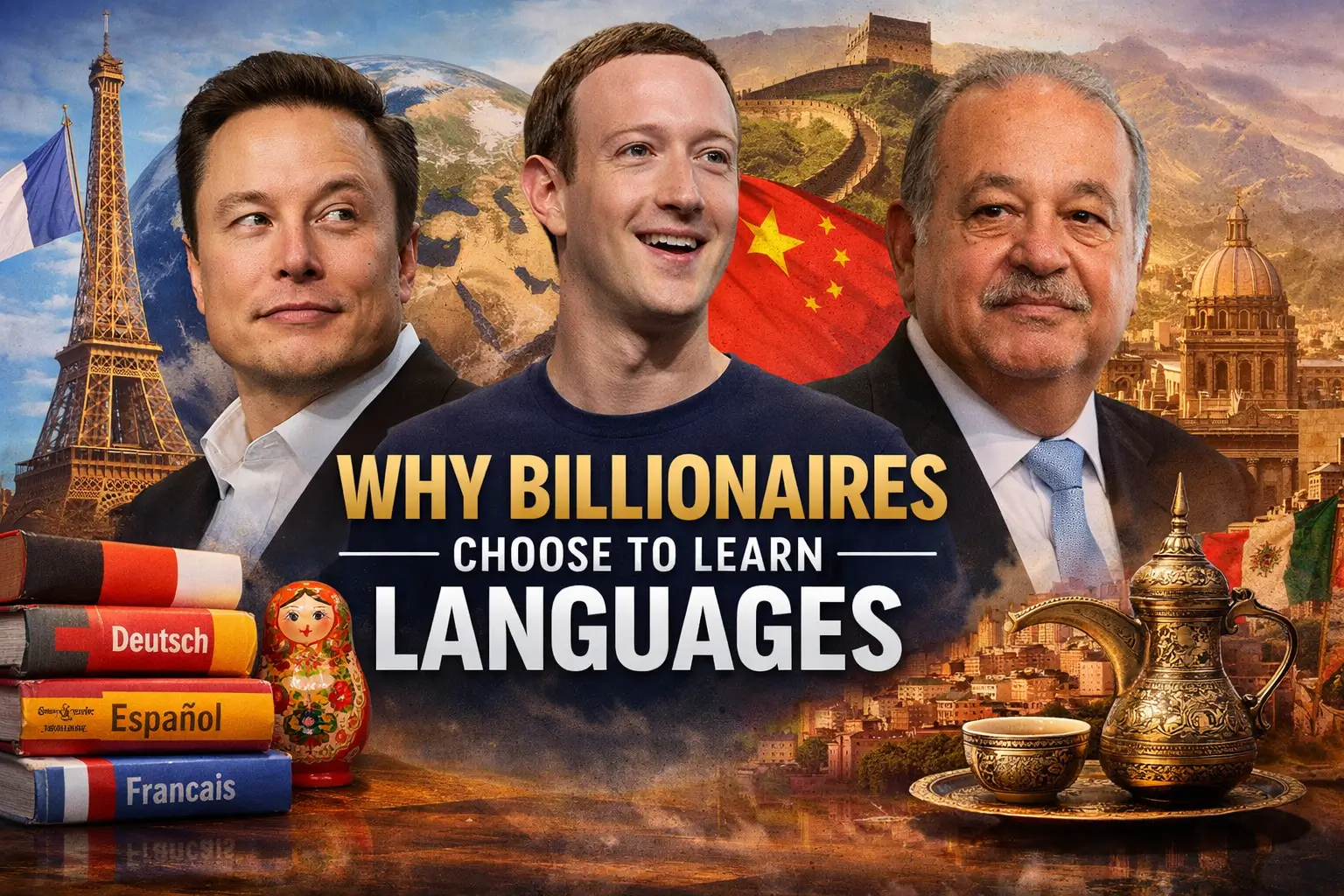
TL;DR: Billionaires learn languages to gain an edge, not to “be multilingual.” English opens doors. Other languages build trust, unlock deals, and give control. Mandarin, German, French, Spanish, and Arabic map directly to power, markets, and money.
Billionaires don’t learn languages for fun. They learn them for leverage.
At the top of global business, English opens doors, but it doesn’t secure trust, influence, or control. The right language does.
- Mandarin for supply chains
- German for engineering credibility,
- French for diplomacy and elite networks.
These choices aren’t cultural hobbies; they’re strategic tools.
This isn’t about being multilingual. It’s about learning the languages that move money, power, and decisions. Faster than everyone else.
The Global Landscape of Billionaires
Before looking at the languages billionaires learn, it helps to understand where billionaire wealth is actually concentrated.
Billionaires aren’t spread across the globe. They cluster around specific economies, industries, and power centres.
Those clusters influence which languages matter most at the top.
Statistics on the number of billionaires worldwide
Globally, there are around 2,700–2,800 billionaires. Controlling trillions of pounds in combined wealth.
While the exact number fluctuates year to year with markets, one pattern remains consistent: billionaire wealth is growing faster than the global economy itself.
This global reach makes linguistic ability less of a “nice to have” and more of a strategic asset, especially outside English-dominant contexts.
Regions with the highest concentration of billionaires
A small number of regions dominate billionaire wealth:
- North America leads in total billionaire count. Driven by the United States’ tech, finance, and investment sectors.
- East Asia, particularly China. It has seen explosive growth in billionaire numbers over the past two decades. Tied to manufacturing, technology, and infrastructure.
- Europe remains a major hub, with strong concentrations. In Germany, France, the UK, and Switzerland. Often linked to industry, luxury goods, finance, and legacy wealth.
- The Middle East and parts of South Asia host fewer billionaires. Many control enormous influence through energy, real estate, and sovereign-linked investments.
Common Languages Among Billionaires
Billionaires don’t spread their linguistic bets.
Certain languages show up again and again. They align with capital flows, political influence, and access to entire regions.
These languages act less like communication tools and more like keys. Opening markets, relationships, and credibility that outsiders struggle to reach.
English: The lingua franca of business
English is the default operating system of global wealth. It dominates finance, tech, aviation, academia, and international law. Making it unavoidable for anyone operating at scale.
What matters is how English functions as a bridge language. Enabling deals between non-native speakers, structuring global contracts, and coordinating multinational teams.
Mandarin Chinese: The language of emerging markets
Mandarin represents access to scale: industrial, demographic, and economic.
China’s role in manufacturing, logistics, technology, and infrastructure makes Mandarin valuable. Valuable for anyone dealing with supply chains or long-term growth markets.
Billionaires who engage with China often learn Mandarin, but not to reach full fluency. But to signal seriousness. Even limited skill can shift negotiations, build trust, and reduce dependence on intermediaries.
Spanish: A gateway to Latin America
Spanish opens doors across an entire continent.
Latin America’s mix of natural resources, emerging consumer markets, and fast-growing tech ecosystems. It makes Spanish a practical power language rather than a cultural luxury.
For billionaires, Spanish offers efficiency. One language provides access to many countries, political systems, and investment environments.
French: The language of diplomacy and luxury
French occupies a unique space between politics, culture, and elite networks.
It remains a working language of diplomacy, international institutions, and high-level negotiations. Particularly across Europe and Africa.
For billionaires operating in these spaces, French isn’t just functional. It’s reputational. Speaking it signals belonging in circles where status is communicated subtly, not explicitly.
The Role of English in Billionaire Success
English isn’t just a common language among billionaires. It’s the infrastructure that makes global wealth possible.
While it rarely sets billionaires apart from one another. It underpins every international deal, network, and institution they rely on.
Importance of English in international business and networking
English isn’t just widely spoken. It’s embedded in how global power operates.
At the highest levels of business, it acts as the default layer. Through which money, ideas, and influence move.
- Access to global rooms. Boardrooms, investor summits, Davos-style forums, and closed-door negotiations run in English. Even when no one in the room is a native speaker.
- Speed and efficiency. English removes the friction of translators, delays, and misinterpretation. Allowing deals and decisions to move faster.
- Network effects: Elite networks compound in English. Introductions lead to introductions, often informally and off-record.
- Information advantage: Financial analysis, academic research, policy briefings, and technical documentation. They appear in English first, sometimes only.
- Cultural fluency: English enables participation in shared business norms, humour, negotiation styles, and risk language that rarely translate.
Case studies of billionaires who attribute their success to English skill
For many billionaires from non-English-speaking backgrounds, English wasn’t a finishing touch. It was a turning point.
- Raising international capital: English-enabled founders to pitch to global investors. Rather than relying on regional funding alone.
- Crossing borders: Operating in New York, London, or Silicon Valley. It became workable without intermediaries or cultural translators.
- Scaling beyond home markets: English unlocked partnerships, acquisitions, and customer bases. Ones that weren’t accessible domestically.
- Talent and ideas: English opened doors to global teams, cutting-edge thinking, and fast-moving innovation ecosystems.
- Mindset shift: Exposure to English-language media and education. They ften reshaped how founders thought about growth, leadership, and risk itself.
The Rise of Mandarin Chinese
Mandarin Chinese has moved from being a regional language to a global power language. In the space of a few decades.
As China’s economic gravity has grown, so has the strategic value of speaking its language. Especially for those operating at the highest levels of business and investment.
Economic growth of China and its impact on global markets
China sits at the centre of global manufacturing, supply chains, and infrastructure.
Even companies that never “operate in China” often depend on Chinese production, logistics, or capital.
For billionaires, Mandarin offers clarity and leverage. It reduces reliance on intermediaries and sharpens negotiation insight. It signals long-term commitment in a market where trust is built slowly.
Language here isn’t cosmetic. It’s strategic.
Notable billionaires who speak Mandarin and their motivations
For billionaires, Mandarin isn’t about linguistic perfection. It’s about access. Speaking even limited Mandarin signals seriousness, builds trust, and reduces distance in a market. Where relationships, hierarchy, and long-term intent matter as much as balance sheets.
- Mark Zuckerberg: Learned Mandarin to engage Chinese audiences and leaders. Signalling long-term interest and cultural respect rather than transactional intent.
- Ray Dalio: Uses Mandarin as part of his deep engagement. With China’s economic philosophy, policymakers, and long-term market cycles.
- Jensen Huang: Fluent in Mandarin, enabling direct relationships. Across Asian tech and manufacturing ecosystems critical to Nvidia’s supply chain.
- Jack Ma: Leveraged Mandarin to navigate regulators, entrepreneurs, and global partners while scaling Alibaba.
- Pony Ma: Uses Mandarin to operate across China’s complex regulatory, regional, and corporate power structures at scale.
Spanish and Its Global Influence
Spanish is one of the few languages that delivers continental reach.
It connects markets across North, Central, and South America. It spans Europe and shapes global culture, media, and consumer behaviour.
For billionaires, that makes Spanish less a “foreign language” and more a multiplier. One language, many markets.
The significance of Spanish in the Americas and beyond
Spanish gives direct access to over 20 countries, fast-growing populations, and economies. Those rich in natural resources, manufacturing, fintech, and consumer growth.
In much of Latin America, business is relational rather than transactional, meaning language plays a central role in trust, credibility, and deal-making.
Unlike Mandarin or Arabic, Spanish offers broad mutual intelligibility across regions.
Examples of billionaires leveraging Spanish for business expansion
Spanish has been a practical growth tool for billionaires. Operating across Latin America, Spain, and Spanish-speaking communities in the US.
- Carlos Slim: Used Spanish to build and control telecommunications, infrastructure, and financial interests. Across many Latin American countries.
- Amancio Ortega: Leveraged Spanish to anchor Inditex’s operations and leadership culture. While expanding Zara globally.
- Ricardo Salinas Pliego: Expanded retail, media, and financial services across Mexico and beyond. Using Spanish to navigate regulation, public influence, and mass-market communication.
- Germán Larrea: Operates across mining and transport sectors in Latin America. Where Spanish enables direct negotiation.
- David Martínez: Uses Spanish to invest in Latin American finance, telecoms, and restructuring deals. Where local insight and trust are decisive.
The Appeal of French
French occupies a rare position where language, culture, and power overlap.
It’s spoken in boardrooms, diplomatic halls, luxury houses, and across fast-growing markets in Europe and Africa.
Cultural and economic ties to French-speaking countries
French remains a working language of diplomacy, international institutions, and cross-border negotiation.
It also anchors some of the world’s most influential cultural and economic ecosystems. Luxury goods, fashion, wine, aviation, energy, and infrastructure.
Crucially, French extends far beyond France. It provides access to parts of Africa, Canada, Switzerland, Belgium, and the Caribbean.
Billionaires who have invested in French-speaking regions
Across these cases, French acts as more than a shared language.
- Bernard Arnault: Built the world’s largest luxury group by leveraging France’s cultural capital. Using French as the language of heritage, brand authority, and elite networks.
- François Pinault: Invested in French and European luxury, art, and retail. Operating within elite Francophone business and cultural circles.
- Vincent Bolloré: Expanded across Francophone Africa. Where French enables direct engagement with governments, media, and infrastructure projects.
- Nassef Sawiris: Invests in France and French-speaking Europe. Using French to navigate elite financial, sporting, and political environments.
Other Notable Languages
Beyond the usual global heavyweights, a handful of languages carry outsized influence in specific high-value sectors and regions.
For billionaires, these languages aren’t about reach. They’re about depth: operating where precision, regulation, and power are intertwined.
German: The language of engineering and finance
German is synonymous with technical precision, industrial scale, and financial discipline.
It dominates sectors where margins are built on engineering excellence rather than hype. Manufacturing, automotive, industrial machinery, chemicals, and high-end finance.
For billionaires operating in Europe’s industrial core, German offers credibility.
Russian: Opportunities in Eastern Europe and beyond
Russian functions as a regional power language across parts of Eastern Europe, Central Asia, and the post-Soviet sphere.
Historically, it has been critical in energy, natural resources, defence, and infrastructure. Sectors where personal relationships and insider knowledge matter.
For billionaires, Russian has often provided access to opaque markets, influential networks, and high-risk, high-reward opportunities.
Arabic: Growing influence in global markets
Arabic is central to global capital flows.
Gulf states control vast sovereign wealth funds and play major roles. In energy, infrastructure, real estate, sport, and technology investment.
Billionaires engaging with the Middle East and North Africa. Arabic offers more than communication. It conveys respect.
Why Billionaires Choose to Learn Languages
At the billionaire level, language learning is rarely accidental. Time is scarce, incentives are clear, and effort is allocated where it compounds.
When billionaires choose to learn a language, it’s because it delivers returns that go well beyond conversation.
Personal growth and cognitive benefits
Language learning sharpens the mind in ways few other skills do.
It improves pattern recognition, memory, and cognitive flexibility. All traits are tied to high-level decision-making.
For people operating in complex, high-stakes environments, this mental agility matters.
Enhancing business opportunities and networking
Language unlocks informal access: side conversations, private dinners, jokes, cultural references.
These moments are where real relationships form and where opportunities often surface before they’re visible to the wider market.
At the top, networks don’t just matter. They compound.
Languages Billionaires Learn FAQs
Why do billionaires learn foreign languages instead of relying on translators?
Because translators filter power.
At the highest levels of business, nuance, timing, trust, and subtext matter as much as literal meaning. Speaking the language directly removes intermediaries, speeds up decisions, and builds personal credibility. It also allows billionaires to read tone, hesitation, humour, and hierarchy — signals that rarely survive translation.
Language becomes a strategic advantage, not a communication tool.
Is English enough for global business success?
English is necessary, but rarely sufficient.
It provides access to global markets, investors, and institutions, but it does not secure trust, influence, or cultural legitimacy. In markets like China, Germany, France, Latin America, and the Middle East, operating in the local language dramatically improves credibility, relationship-building, and deal flow.
English opens doors. Other languages decide who lets you in fully.
Which languages offer the highest strategic return for business leaders?
The highest-leverage languages depend on economic power, industrial dominance, and geopolitical influence:
- Mandarin: manufacturing, logistics, infrastructure, long-term growth
- German: engineering, industry, high-precision manufacturing, finance
- French: diplomacy, elite networks, luxury, Africa
- Spanish: Latin America, natural resources, fintech, fast-growing consumer markets
- Arabic: energy, sovereign wealth, infrastructure, global investment flows
These languages unlock ecosystems, not just conversations.
Do billionaires aim for fluency when learning languages?
Rarely.
Most target functional fluency: enough to negotiate, build rapport, signal seriousness, and operate independently. The goal is influence, not perfection. Even limited proficiency can dramatically shift negotiation dynamics and trust levels.
For billionaires, language learning is about leverage per hour invested.
What can entrepreneurs and professionals learn from billionaire language strategies?
That language choice should follow power, not passion.
Instead of learning languages based purely on interest, professionals can think strategically: Which language gives access to capital, supply chains, decision-makers, or fast-growing markets?
Learning the right language early compounds opportunity, network access, and career trajectory. Long before most competitors realise its value.