
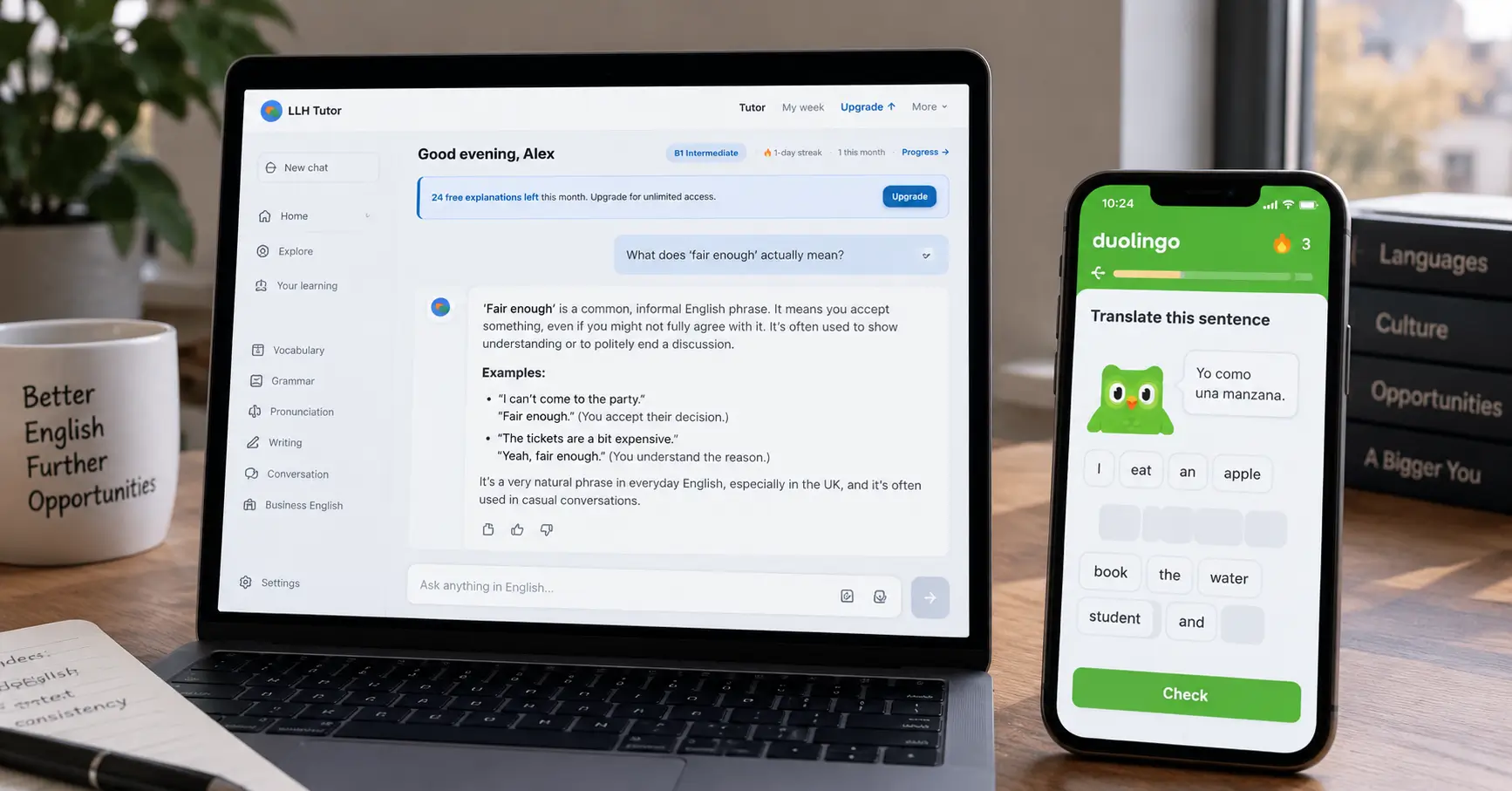
TL;DR: Wondering about the differences between LLH Tutor vs Duolingo? Duolingo is great for building a daily language habit, especially for beginners. It is fun, simple, and easy to use. But for learners who want to improve real English, natural conversations, better writing, interviews, work, travel, and everyday communication, LLH Tutor offers a more personalised and practical experience. That is where LLH Tutor stands out.
Duolingo is fun. It is addictive. It is brilliant at getting people started.
But if your goal is to speak real English, the kind people use in conversations, work messages, interviews, travel, slang, jokes, awkward pauses, and everyday life, then streaks and multiple-choice exercises may not be enough.
English learners have more options than ever. The real question is not just which app is more popular? It is: which one actually helps you understand English as it is really used?
That is where LLH Tutor and Duolingo start to feel very different.
The importance of learning English
English can change what is possible.
It can help you get better jobs, study abroad, travel with more confidence, understand global content, and speak to people from all over the world.
But learning English is not just about memorising words. It is about building a skill you can actually use, in conversations, interviews, emails, meetings, and everyday life.
The better your English becomes, the more doors you can open.
LLH Tutor and Duolingo as popular language learning platforms
LLH Tutor and Duolingo are both popular tools for learning languages, but they work in different ways.
Duolingo is built around short, fun lessons. It uses streaks, quizzes, rewards, and simple exercises to help learners practise a little every day.
LLH Tutor is more focused on real English. It helps learners understand natural phrases, improve their writing, practise conversations, and learn how English is actually used in daily life.
So, while Duolingo is great for building a habit, LLH Tutor is designed to help learners use English with more confidence.
Get explanations like this for your English questions
Personalised to your native language and level. Free to start, no card needed.
Real English Learning
Real English is about learning the language people actually use, not just the English found in textbooks or simple app exercises.
What is “real english?”
“Real English” means natural English used in everyday situations.
It is the English people use when they speak to friends, write messages, attend interviews, travel, work, study, ask questions, make jokes, explain problems, or have normal conversations.
It includes correct grammar, but it also includes tone, context, confidence, and knowing what sounds natural.
Key components of real English: conversational skills, cultural context, and practical usage
Real English has three main parts.
First, learners need conversational skills. This means being able to ask and answer questions, explain ideas, react naturally, and keep a conversation going.
Second, they need cultural context. English changes depending on the country, situation, and person you are speaking to. What sounds friendly in one context may sound too formal, too direct, or unnatural in another.
Third, they need practical usage. Learners need English they can use in real life, for emails, meetings, travel, customer service, interviews, study, friendships, and everyday problems.
The role of technology in shaping language learning
Technology has changed how people learn English.
Instead of only using textbooks or fixed lessons, learners can now practise with apps, online tutors, AI tools, videos, podcasts, and interactive exercises.
This makes learning more flexible and personal. Learners can ask questions, get instant feedback, practise real scenarios, and focus on the areas where they need the most help.
For real English, this matters because learners do not just need more content. They need support that helps them understand how English works in real situations.
What is LLH Tutor?
LLH Tutor is an English learning platform designed to help learners improve their real, everyday English.
Instead of only focusing on memorising words or completing fixed lessons, LLH Tutor helps users understand how English is actually used in conversations, writing, work, travel, study, and daily life.
LLH Tutor and its unique features
LLH Tutor is built around personalised English support.
Learners can ask questions, practise phrases, improve sentences, understand grammar, prepare for real situations, and get clear explanations that match their level.
Its main strength is that it focuses on natural English. This includes tone, word choice, cultural context, common mistakes, pronunciation support, useful expressions, and practical examples.
Rather than giving the same lesson to every learner, LLH Tutor helps people learn based on what they actually need.
Target audience and learning approach
LLH Tutor is mainly for people who want to improve their English for real-life use.
This could include students, professionals, travellers, job seekers, immigrants, or anyone who wants to speak, write, and understand English more confidently.
The learning approach is flexible and practical. Learners can focus on the areas that matter most to them, whether that is speaking more naturally, writing better emails, preparing for interviews, understanding native speakers, or fixing grammar mistakes.
Types of courses and resources offered
LLH Tutor offers support for different areas of English learning, including grammar, vocabulary, speaking practice, writing improvement, pronunciation, everyday phrases, and real-world communication.
It can also help learners with practical situations such as job interviews, workplace conversations, travel English, academic English, messages, emails, and natural conversation practice.
The goal is simple: to help learners move beyond basic lessons and start using English with more confidence in the real world.
What is Duolingo?
Duolingo is one of the most well-known language learning apps in the world. It helps people practise languages through short, interactive lessons that feel more like a game than a traditional class.
Description of Duolingo and its gamified learning approach
Duolingo is built around gamified learning.
Instead of long lessons, users complete quick exercises, earn points, keep streaks, unlock levels, and receive rewards for practising regularly. This makes the app feel fun, simple, and easy to return to each day.
Its lessons usually focus on vocabulary, grammar, listening, reading, translation, and sentence-building exercises.
Target audience and learning methodology
Duolingo is designed for a wide range of learners, especially beginners and casual learners who want to build a daily language habit.
Its method is based on repetition, pattern recognition, and short practice sessions. Learners gradually move through different units, repeating words and sentence structures until they become more familiar.
This makes Duolingo useful for getting started, building confidence, and practising little and often.
Types of courses and resources available
Duolingo offers courses across many languages, including English, Spanish, French, German, Italian, Portuguese, Japanese, Korean, and more.
Depending on the course, learners may find exercises for reading, listening, speaking, grammar, vocabulary, stories, and pronunciation practice.
The main goal is to make language learning accessible and consistent, especially for people who want a simple way to practise every day.
Comparison of Learning Methods
LLH Tutor and Duolingo both support language learning, but they use very different methods. One is built around personalised support, while the other focuses on short, self-paced app practice.
LLH Tutor’s personalised tutoring vs. Duolingo’s self-paced learning
LLH Tutor is designed to adapt to the learner. Users can ask specific questions, practise real situations, improve their mistakes, and get explanations based on their level and goals.
This makes the learning experience more personal. Instead of following the same path as everyone else, learners can focus on what they actually need, such as speaking more naturally, writing better emails, preparing for interviews, or understanding difficult grammar.
Duolingo is more self-paced. Learners move through lessons in order, complete exercises, and practise at their own speed. This is useful for building a daily habit, especially for beginners who want a simple structure to follow.
Interaction and engagement: one-to-one sessions vs. app-based exercises
LLH Tutor offers a more interactive learning experience because learners can receive direct support. They can ask follow-up questions, practise natural phrases, and get help with the exact problems they are facing.
Duolingo keeps learners engaged through app-based exercises. Streaks, rewards, levels, and quick lessons make it easy to practise regularly without much pressure.
The difference is that Duolingo is mainly about completing exercises, while LLH Tutor is more about understanding, improving, and applying English in real situations.
Effectiveness of each method in teaching real English
For real English, LLH Tutor has a clear advantage because it can focus on natural language, context, tone, and practical communication.
Learners can explore why one phrase sounds better than another, how to sound more polite or confident, and how English changes depending on the situation.
On the other hand, Duolingo can help learners build vocabulary, recognise grammar patterns, and stay consistent. However, it may not always explain the deeper context behind how English is used in everyday conversations, workplaces, interviews, or social situations.
So, Duolingo is useful for habit-building and basic practice, while LLH Tutor is better suited for learners who want to use English naturally and confidently in the real world.
Get explanations like this for your English questions
Personalised to your native language and level. Free to start, no card needed.
Content Quality and Relevance
The quality of a language learning platform depends on more than how many lessons it offers. The real question is whether the content helps learners use English confidently outside the app.
Analysis of LLH Tutor’s curriculum and real-world applicability
LLH Tutor is designed around practical English, not just lesson completion.
Its content focuses on real situations learners are likely to face, such as conversations, job interviews, workplace communication, travel, emails, messages, grammar questions, pronunciation support, and natural phrasing.
This makes the learning more relevant because users can practise English they actually need. Instead of only learning set phrases, they can understand why something sounds natural, formal, casual, polite, awkward, or incorrect.
For learners who want to improve real English, this kind of support is especially useful because it connects language learning to everyday life.
Duolingo’s content and its alignment with real English usage
Duolingo’s content is clear, structured, and easy to follow. Its short lessons are useful for building vocabulary, recognising sentence patterns, and practising regularly.
This makes it a strong option for beginners or learners who want a simple way to stay consistent.
However, Duolingo can sometimes feel less connected to real communication. Because the lessons are usually fixed and exercise-based, learners may not always get the deeper explanation behind tone, context, cultural meaning, or natural word choice.
It can help learners understand the basics, but it may not fully prepare them for the unpredictability of real English conversations.
User feedback and success stories from both platforms
Duolingo is often praised for being fun, easy to use, and motivating. Many learners like its streaks, rewards, and bite-sized lessons because they make language learning feel less overwhelming.
LLH Tutor is more likely to appeal to learners who want clearer explanations, personalised help, and English they can apply immediately.
For example, a learner preparing for an interview, writing a professional email, or trying to understand native speakers may benefit from more targeted support.
Both platforms can support progress, but in different ways.
Accessibility and User Experience
A good language learning platform needs to be easy to use, flexible, and accessible. Learners are more likely to stay consistent when the experience fits naturally into their daily routine.
LLH Tutor’s accessibility: online vs. in-person sessions
LLH Tutor is designed to be used online, which makes it accessible for learners who want support without needing to attend in-person classes.
This means users can practise English from home, during study breaks, after work, or while travelling. It removes many of the barriers that come with traditional tutoring, such as location, travel time, and fixed classroom schedules.
The support is digital, learners can also focus on the exact areas they need help with, whether that is grammar, writing, speaking, pronunciation, interviews, emails, or everyday conversation.
Duolingo’s app features and user interface
Duolingo is known for its simple and colourful app experience.
The platform uses short lessons, progress bars, streaks, reminders, rewards, and levels to keep learners engaged. Its design makes it easy to open the app, complete a quick lesson, and feel like progress has been made.
This makes Duolingo especially useful for learners who want a low-pressure way to practise every day.
Comparison of ease of use and learning flexibility
Duolingo is very easy to use because everything is already structured. Learners simply follow the course path and complete exercises at their own pace.
LLH Tutor offers more flexibility because learners can focus on what they personally need. Instead of following only one fixed route, they can ask questions, practise specific situations, and get support that matches their goals.
So, Duolingo may be easier for quick daily practice, while LLH Tutor may be more useful for learners who want personalised help and practical English they can use in real life.
Cost and Value for Money
Price matters, but value matters more. The best option is not always the cheapest one — it is the one that helps learners make real progress.
Pricing structures of LLH Tutor and Duolingo
LLH Tutor is currently free for two months during beta, with unlimited access included. After that, the first 100 members can continue for just £4.99 per month.
Duolingo has a free plan, but its paid options cost more. Super Duolingo is commonly around £10.99 per month or £89.99 per year in the UK, while Duolingo Max has been reported at around £19.99 per month or £119.99 per year.
For learners who want personalised English support at a lower price, LLH Tutor offers stronger value.
Value assessment: what learners get for their investment
Duolingo offers good value for learners who want to build a daily habit, practise vocabulary, and make steady progress through short lessons.
LLH Tutor offers value in a different way. Learners get support that can be applied directly to real life, such as improving sentences, preparing for interviews, understanding natural phrases, writing better emails, or practising everyday conversations.
For learners who only want light practice, Duolingo may be enough. For learners who want clearer explanations and more practical English, LLH Tutor may offer stronger value.
Free vs. paid options and their implications for learning
Free language learning tools are useful because they remove barriers. They help more people get started without needing to pay upfront.
However, free tools can sometimes be limited. Learners may get less personal feedback, fewer explanations, or a more general learning path.
Paid options can be worthwhile when they help learners save time, fix mistakes faster, and practise the kind of English they actually need.
Get explanations like this for your English questions
Personalised to your native language and level. Free to start, no card needed.
Future Trends in Language Learning
Language learning in 2026 is becoming more personal, more flexible, and more focused on real communication.
Predictions for language learning technologies in 2026
The biggest shift is away from fixed lessons and towards personalised learning.
Learners no longer want to simply tap through exercises. They want tools that understand their level, correct their mistakes, explain things clearly, and help them practise real situations.
AI, voice practice, instant feedback, and personalised study paths are likely to become much more important in language learning.
How LLH Tutor and Duolingo are adapting to future needs
Duolingo is adapting by adding more AI-powered features, conversation practice, and personalised review tools. This helps make the app more interactive than a simple quiz-based platform.
LLH Tutor is built around this future from the start. Its focus is not just on completing lessons, but on helping learners understand real English, ask better questions, improve their weak areas, and practise the language they actually need.
That makes LLH Tutor especially useful for learners who want support that feels more human, practical, and personalised.
The evolving role of AI and personalised learning in English education
AI is changing English learning because it gives learners support whenever they need it.
Instead of waiting for a class or guessing why something is wrong, learners can get instant explanations, examples, corrections, and practice.
This is where personalised learning becomes powerful. A beginner, a job seeker, a traveller, and a professional do not all need the same English.
The future of English learning will belong to platforms that adapt to the learner, and this is where LLH Tutor has a clear advantage.
Get explanations like this for your English questions
Personalised to your native language and level. Free to start, no card needed.
LLH Tutor vs Duolingo FAQs
Is LLH Tutor better than Duolingo for learning English?
LLH Tutor is better for learners who want personalised English support, natural explanations, and real-life practice. Duolingo is useful for building a daily habit, but LLH Tutor is more focused on helping learners use English confidently in real situations.
Is Duolingo good for real English?
Duolingo can help learners practise vocabulary, grammar, and basic sentence patterns. However, it may not always explain natural phrasing, tone, cultural context, or how English is used in everyday conversations.
Who should use LLH Tutor?
LLH Tutor is best for English learners who want help with speaking, writing, grammar, pronunciation, interviews, emails, work, travel, and everyday communication. It is especially useful for learners who want practical English rather than fixed app lessons.
How much does LLH Tutor cost?
LLH Tutor is currently free for two months during its beta period, with unlimited access included. After that, the first 100 members can continue for £4.99 per month.
Can I use LLH Tutor and Duolingo together?
Yes. Duolingo can help with daily practice and habit-building, while LLH Tutor can help learners understand real English more deeply. Using both can work well, but LLH Tutor is stronger for personalised support and real-world English improvement.