
How can you reconstruct a word from a language that nobody has spoken for thousands of years?
No recordings. No speakers. Sometimes, not even a written text.
Yet linguists can do exactly that.
By comparing languages that exist today, they can spot patterns in sounds, words and grammar that reveal clues about their ancient ancestors. Working backwards through these changes, they can reconstruct parts of languages that disappeared long ago and trace how modern languages evolved.
This is historical linguistics. The study of how languages change over time, how they are related, and what their histories can reveal about the people who spoke them.
What is Historical Linguistics?
Historical linguistics is the study of how languages change over time, and how those changes reveal relationships between languages.
Languages are never truly static. Sounds shift, words change meaning, grammar evolves and new words enter the language while others disappear.
By studying these changes, linguists can trace how languages developed, identify which languages share a common ancestor, and reconstruct parts of languages that may have disappeared thousands of years ago.
It is, in many ways, linguistic detective work: taking the clues left behind in modern languages and using them to piece together their past.
How Languages Change: Sound, Meaning, and Grammar Shifts
Languages are constantly changing.
The English spoken today would sound very different to someone from a thousand years ago, and the changes don’t happen in just one part of a language.
Sounds shift, words take on new meanings and grammar evolves.
Sound changes
Phonological change happens when the way words are pronounced changes over time. Sometimes an individual sound changes; sometimes entire patterns of pronunciation shift.
A famous example is the Great Vowel Shift, which transformed the pronunciation of many English vowels between roughly the 15th and 18th centuries.
The result is one reason modern English spelling can seem so disconnected from pronunciation: words such as name, house and time are pronounced very differently from how they would have been centuries ago.
Meaning changes
Semantic change happens when the meaning of a word shifts over time. A word can become broader, narrower, more positive, more negative, or simply develop a completely different sense.
Take “awful”. Today, it usually means something extremely bad or unpleasant. Originally, however, it meant something closer to “inspiring awe” or “worthy of respect”. The word hasn’t simply disappeared, its meaning has travelled somewhere new.
Another example is “meat”. In older English, meat could refer to food in general. Over time, its meaning narrowed to refer specifically to animal flesh.
Grammar changes
Syntactic change happens when the way words are arranged and sentences are constructed changes.
English once had a much more complex grammatical system than it does today. Old English used word endings to show things such as grammatical case, allowing word order to be more flexible. Modern English relies much more heavily on word order to show who is doing what.
The shift from Old English to modern English wasn’t a single event. It was a gradual process shaped by centuries of everyday use, contact with other languages and natural changes in how people spoke.
Together, these changes show that languages are not fixed systems. They are constantly being reshaped by the people who use them.
The Comparative Method: Reconstructing Lost Languages
How can linguists reconstruct a language that nobody has spoken for thousands of years?
The answer is the comparative method. Rather than trying to guess what an ancient language sounded like, linguists compare related languages and look for consistent patterns between them.
If several languages have words that resemble each other in both meaning and sound, that can be evidence that they inherited those words from a common ancestor. The more consistent the pattern across different words and languages, the stronger the evidence becomes.
This is how linguists have reconstructed Proto-Indo-European (PIE). A prehistoric language believed to be the ancestor of languages across much of Europe and parts of Asia, including English, Spanish, German, Greek, Russian and Hindi.
PIE was never directly recorded. Instead, linguists work backwards from its descendants.
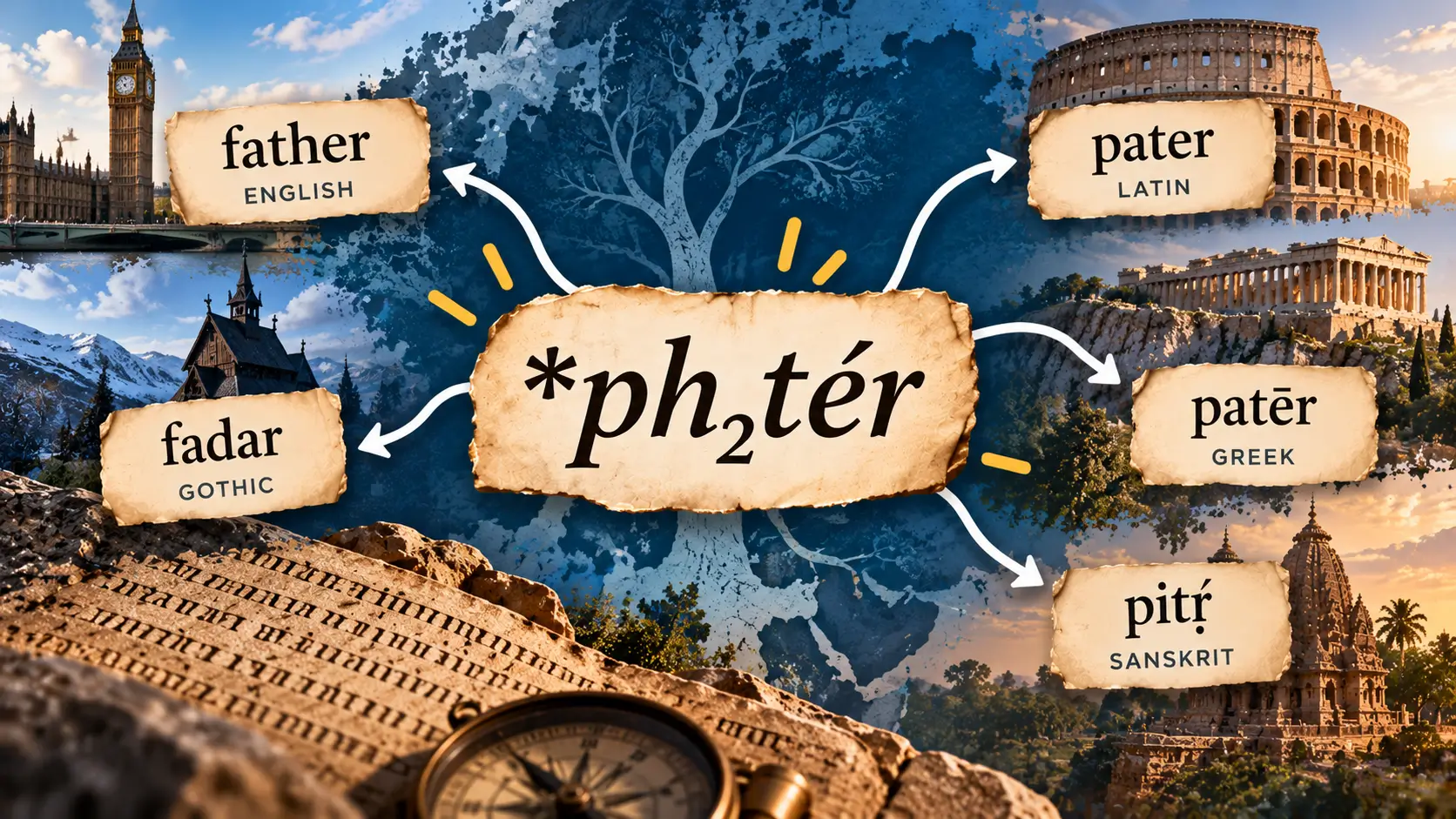
Reconstructing a Proto-Indo-European word
Take the word “father”.
Several Indo-European languages preserve remarkably similar forms:
- English: father
- Latin: pater
- Ancient Greek: patēr
- Sanskrit: pitṛ́
- Gothic: fadar
At first glance, these words aren’t identical. But the similarities become much more interesting when linguists compare them with other related words and identify recurring sound correspondences.
For example, English f regularly corresponds to sounds such as p in other Indo-European languages. This isn’t a coincidence limited to one word. It forms part of a much larger pattern of sound changes.
By comparing these patterns across many languages, linguists can work backwards towards an earlier form. For “father”, the commonly reconstructed Proto-Indo-European form is *ph₂tḗr.
The asterisk is important. It means the form is reconstructed, rather than directly recorded in an ancient text.
The process therefore looks something like this:
Proto-Indo-European *ph₂tḗr → Latin pater → English father
This doesn’t mean English directly evolved from Latin. Instead, English and Latin inherited the word from their shared ancestor and then changed independently over thousands of years.
That is the key idea behind the comparative method: linguists don’t reconstruct the past from one similarity. They piece it together from patterns repeated across many related languages.
And the same approach can be used to reconstruct much more than individual words.
By comparing vocabulary, sounds and grammatical structures, linguists can gradually build a picture of languages that disappeared long before written records existed.
Language Families: Mapping the World’s Languages
Languages may seem endlessly diverse, but many of them can be traced back to a common ancestor. These relationships are grouped into language families, collections of languages that developed from the same earlier language.
One of the largest is the Indo-European family, which includes English, Spanish, French, German, Russian, Greek, Hindi and many others.
Others include Sino-Tibetan, which includes languages such as Mandarin and Tibetan, and Afro-Asiatic, which includes Arabic, Hebrew and Amharic.
Historical linguists uncover these relationships by comparing languages and looking for systematic similarities in vocabulary, sounds and grammar. If the evidence shows that several languages share a common ancestor, linguists can reconstruct parts of that ancestor and map how its descendants split and changed over time.
The result is a language family tree. At the top sits a reconstructed ancestral language, with branches representing the different paths its descendants took as they developed.
For example, the Indo-European family can be simplified like this:
Proto-Indo-European → Germanic → West Germanic → English
while other branches eventually produced languages such as Latin, Greek, Russian and Hindi.
These trees aren’t perfect maps of linguistic history. Languages have always borrowed words and influenced one another, so their histories can look more like a network than a neat set of branches. But they provide a powerful way to visualise how languages are related and how today’s languages emerged from the ones that came before them.
Etymology: What Word Histories Reveal
Ever wondered why we say “goodbye”, “salary” or “quarantine”? The history of a word can reveal far more than where it came from. It can show how languages borrow from one another, how meanings shift and how societies influence the vocabulary we use every day.
Etymology is the study of the history and origins of words. It is closely connected to historical linguistics because tracing a word through time often means following the sound, spelling and meaning changes it has undergone across different languages.
Take “salary”. It comes from Latin salarium, a word associated with payments made to Roman soldiers. It is traditionally connected with sal, meaning “salt”, although the exact historical relationship between salt and soldiers’ pay is more complicated than the popular story suggests.
Or consider “quarantine”. The word ultimately comes from the Italian quaranta, meaning “forty”. During periods of plague, ships arriving in some Mediterranean ports could be required to remain isolated for forty days before passengers and goods were allowed ashore.
Even “goodbye” has a history that is easy to miss. It developed from the phrase “God be with ye”, which was gradually shortened and reshaped through everyday speech.
These examples show why etymology is more than simply finding the oldest definition of a word. A word’s history can take us through different languages, centuries of sound and meaning changes, and sometimes major moments in human history.
In that sense, every word carries a small piece of the past with it.
Why Historical Linguistics Matters Today
Historical linguistics might seem focused on languages that disappeared centuries ago, but its findings can tell us a surprising amount about the world we live in today.
Tracing migration and cultural history
Language can preserve clues about where people travelled, settled and interacted. Shared vocabulary can reveal periods of contact between different communities, while loanwords can provide evidence of trade, migration and cultural exchange.
Mapping how languages spread and changed shows how researchers can build a more detailed picture of human history, particularly where written records are limited or missing.
Protecting endangered languages
Historical linguistics is also valuable for documenting languages that are at risk of disappearing.
Recording vocabulary, grammar and pronunciation creates a record that can be studied by future generations, while comparing an endangered language with related languages can help researchers understand its history and development.
When a language disappears without being documented, an important part of humanity’s linguistic and cultural history can disappear with it.
Supporting archaeology and anthropology
Language can provide another line of evidence for researchers studying the past. Linguistic relationships can sometimes be compared with archaeological evidence, migration patterns and genetic research to investigate how populations moved and interacted.
Language cannot tell us everything about ancient societies, and linguistic evidence needs to be treated carefully. But when combined with evidence from archaeology and anthropology, it can help researchers test ideas about the movements, contacts and cultures of people in the past.
Ultimately, historical linguistics matters because languages are more than systems of communication. They are records of human interaction, carrying traces of migration, contact and cultural change across generations.
Historical Linguistics vs. Other Linguistic Fields
Historical linguistics is one part of a much larger field. Linguists often specialise in different areas, each asking different questions about how language works.
Historical linguistics focuses on change over time. It asks questions such as: How did a language develop? Where did it come from? Which languages are related? And how did their sounds, words and grammar change?
Linguistic typology, by comparison, looks at how languages are structured and how they differ from one another. Rather than primarily asking how a feature developed, typologists might compare how different languages form questions, express tense or organise sentences.
Computational linguistics takes a different approach, using computers and computational methods to analyse and model human language. It underpins technologies such as machine translation, speech recognition and many modern language AI systems.
These fields often overlap. Historical linguists can use computational tools to analyse large collections of historical texts, while typological data can help researchers understand whether a particular linguistic change is unusual or part of a broader pattern.
Together, these subfields offer different perspectives on the same thing: how human language works, changes and varies.