
|
Getting your Trinity Audio player ready...
|
Spanish numbers are easier to learn than they first seem. Once you know the numbers 1–15 and the main tens, most numbers follow a simple pattern. However, the tricky parts are the small grammar rules, such as when to use uno, un, or una, and how numbers like 16–19 are formed.
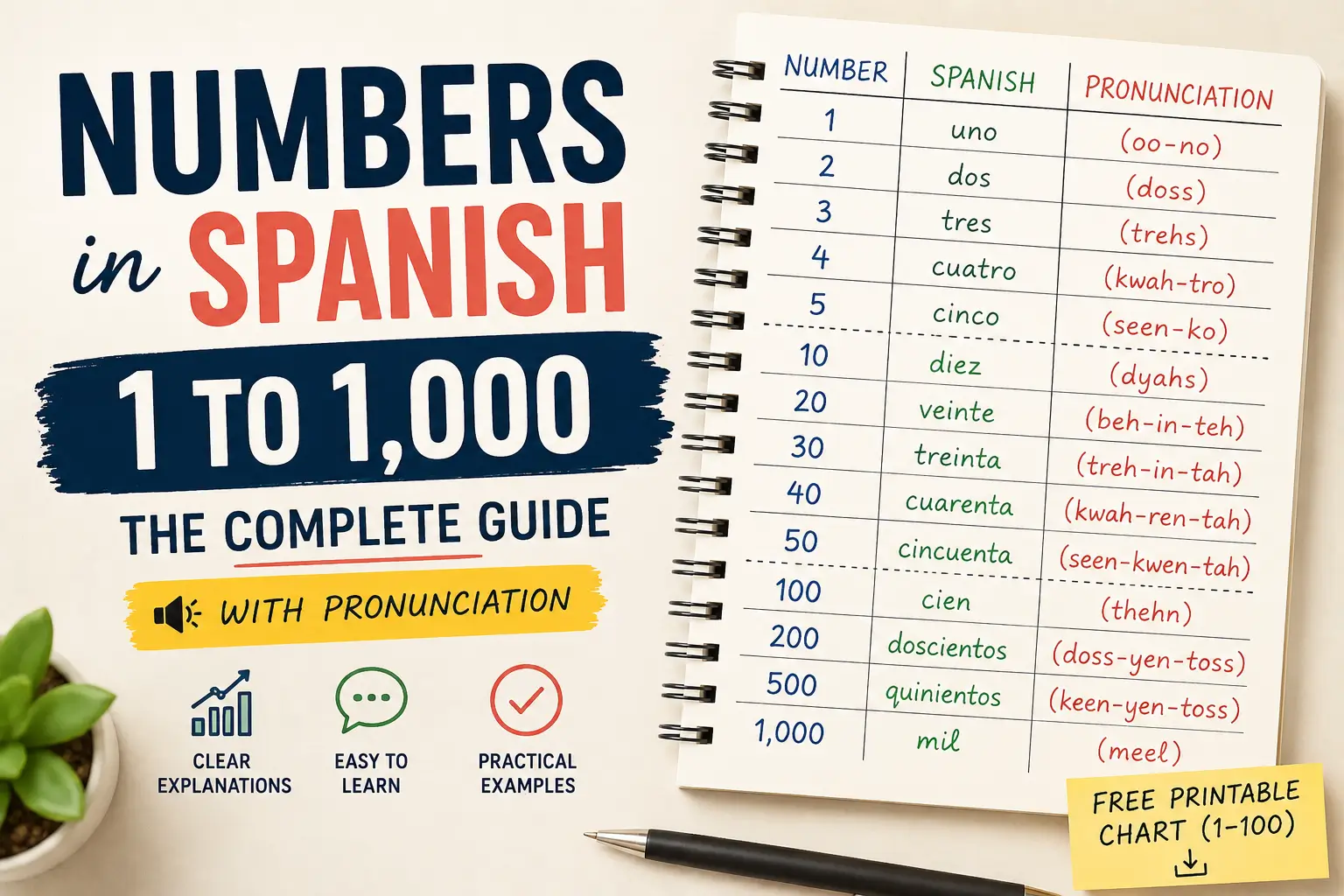
In this guide, you’ll learn Spanish numbers from 1 to 1,000, with pronunciation tips, grammar explanations, and real examples for everyday situations. For more practical vocabulary, check out our Spanish greetings guide.
Spanish Numbers 1–15 (The Core Group to Memorise)
The first 15 numbers are the most important to memorise because they form the foundation for almost every other number in Spanish. Unlike larger numbers, many of these don’t follow a predictable pattern, so learning them by heart will make counting much easier.
| Number | Spanish | Pronunciation |
| 1 | uno / una | OO-noh / OO-nah |
| 2 | dos | dohs |
| 3 | tres | trehs |
| 4 | cuatro | KWAH-troh |
| 5 | cinco | THEEN-koh (Spain) / SEEN-koh (Latin America) |
| 6 | seis | sayss |
| 7 | siete | see-EH-teh |
| 8 | ocho | OH-choh |
| 9 | nueve | NWAY-veh |
| 10 | diez | dee-ETH (Spain) / dee-ESS (Latin America) |
| 11 | once | ON-seh |
| 12 | doce | DOH-theh (Spain) / DOH-seh (Latin America) |
| 13 | trece | TRAY-theh (Spain) / TRAY-seh (Latin America) |
| 14 | catorce | kah-TOR-theh (Spain) / kah-TOR-seh (Latin America) |
| 15 | quince | KEEN-theh (Spain) / KEEN-seh (Latin America) |
Tip: In Spain, z and soft c (before e or i) are pronounced with a “th” sound, while in most of Latin America they’re pronounced as an “s” sound. Overall, both pronunciations are correct.
Why 11–15 are unique: they’re not formed from a pattern, and must be memorised
Numbers 11–15 in Spanish are unique because they do not follow the same clear pattern as later numbers.
Instead of being built from diez plus another number, each one has its own word: once, doce, trece, catorce, and quince. Because of this, it’s best to memorise them as a small group before moving on to numbers like 16, 17, and 18, where the pattern becomes easier to spot.
Spanish Numbers 16–29 (The Merged Forms)
Spanish numbers from 16 to 29 are called merged forms because they were originally written as separate words, but are now written as one word.
For example, dieciséis comes from diez y seis, meaning “ten and six”. Similarly, veinte becomes veinti- before joining with another number to form 21–29.
| Number | Spanish | Pronunciation |
| 16 | dieciséis | dyeh-see-SAYS |
| 17 | diecisiete | dyeh-see-SYEH-teh |
| 18 | dieciocho | dyeh-see-OH-choh |
| 19 | diecinueve | dyeh-see-NWEH-veh |
| 20 | veinte | BAYN-teh |
| 21 | veintiuno / veintiuna | bayn-tee-OO-noh / bayn-tee-OO-nah |
| 22 | veintidós | bayn-tee-DOHS |
| 23 | veintitrés | bayn-tee-TREHS |
| 24 | veinticuatro | bayn-tee-KWAH-troh |
| 25 | veinticinco | bayn-tee-SEEN-koh |
| 26 | veintiséis | bayn-tee-SAYS |
| 27 | veintisiete | bayn-tee-SYEH-teh |
| 28 | veintiocho | bayn-tee-OH-choh |
| 29 | veintinueve | bayn-tee-NWEH-veh |
Accent marks in 22–29: veintidós, veintitrés, veintiséis (why they have accents)
Some numbers in the 20s have accent marks because the stress falls on the final syllable
In Spanish, words that end in a vowel, n, or s are usually stressed on the second-to-last syllable. As a result, when the stress moves to the last syllable, Spanish uses an accent mark to show it.
For this reason, 22, 23, and 26 are written as veintidós, veintitrés, and veintiséis. In short, the accent tells you to emphasise the final sound.
Spanish Numbers 30–99
Spanish numbers from 30 to 99 follow a much simpler pattern. First, learn the tens: treinta, cuarenta, cincuenta, sesenta, setenta, ochenta, and noventa. Then, to make numbers in between, use y (“and”): treinta y uno = thirty-one, cuarenta y dos = forty-two.
The key difference is that 21–29 are written as one word (veintiuno, veintidós), while 31–99 are written as three words using y.
| Number | Spanish | Pronunciation |
| 30 | treinta | TRAYN-tah |
| 31 | treinta y uno / una | TRAYN-tah ee OO-noh / OO-nah |
| 32 | treinta y dos | TRAYN-tah ee dohs |
| 33 | treinta y tres | TRAYN-tah ee trehs |
| 34 | treinta y cuatro | TRAYN-tah ee KWAH-troh |
| 35 | treinta y cinco | TRAYN-tah ee SEEN-koh |
| 36 | treinta y seis | TRAYN-tah ee sayss |
| 37 | treinta y siete | TRAYN-tah ee SYEH-teh |
| 38 | treinta y ocho | TRAYN-tah ee OH-choh |
| 39 | treinta y nueve | TRAYN-tah ee NWEH-veh |
| 40 | cuarenta | kwah-REN-tah |
| 41 | cuarenta y uno / una | kwah-REN-tah ee OO-noh / OO-nah |
| 42 | cuarenta y dos | kwah-REN-tah ee dohs |
| 43 | cuarenta y tres | kwah-REN-tah ee trehs |
| 44 | cuarenta y cuatro | kwah-REN-tah ee KWAH-troh |
| 45 | cuarenta y cinco | kwah-REN-tah ee SEEN-koh |
| 46 | cuarenta y seis | kwah-REN-tah ee sayss |
| 47 | cuarenta y siete | kwah-REN-tah ee SYEH-teh |
| 48 | cuarenta y ocho | kwah-REN-tah ee OH-choh |
| 49 | cuarenta y nueve | kwah-REN-tah ee NWEH-veh |
| 50 | cincuenta | seen-KWEN-tah |
| 51 | cincuenta y uno / una | seen-KWEN-tah ee OO-noh / OO-nah |
| 52 | cincuenta y dos | seen-KWEN-tah ee dohs |
| 53 | cincuenta y tres | seen-KWEN-tah ee trehs |
| 54 | cincuenta y cuatro | seen-KWEN-tah ee KWAH-troh |
| 55 | cincuenta y cinco | seen-KWEN-tah ee SEEN-koh |
| 56 | cincuenta y seis | seen-KWEN-tah ee sayss |
| 57 | cincuenta y siete | seen-KWEN-tah ee SYEH-teh |
| 58 | cincuenta y ocho | seen-KWEN-tah ee OH-choh |
| 59 | cincuenta y nueve | seen-KWEN-tah ee NWEH-veh |
| 60 | sesenta | seh-SEN-tah |
| 61 | sesenta y uno / una | seh-SEN-tah ee OO-noh / OO-nah |
| 62 | sesenta y dos | seh-SEN-tah ee dohs |
| 63 | sesenta y tres | seh-SEN-tah ee trehs |
| 64 | sesenta y cuatro | seh-SEN-tah ee KWAH-troh |
| 65 | sesenta y cinco | seh-SEN-tah ee SEEN-koh |
| 66 | sesenta y seis | seh-SEN-tah ee sayss |
| 67 | sesenta y siete | seh-SEN-tah ee SYEH-teh |
| 68 | sesenta y ocho | seh-SEN-tah ee OH-choh |
| 69 | sesenta y nueve | seh-SEN-tah ee NWEH-veh |
| 70 | setenta | seh-TEN-tah |
| 71 | setenta y uno / una | seh-TEN-tah ee OO-noh / OO-nah |
| 72 | setenta y dos | seh-TEN-tah ee dohs |
| 73 | setenta y tres | seh-TEN-tah ee trehs |
| 74 | setenta y cuatro | seh-TEN-tah ee KWAH-troh |
| 75 | setenta y cinco | seh-TEN-tah ee SEEN-koh |
| 76 | setenta y seis | seh-TEN-tah ee sayss |
| 77 | setenta y siete | seh-TEN-tah ee SYEH-teh |
| 78 | setenta y ocho | seh-TEN-tah ee OH-choh |
| 79 | setenta y nueve | seh-TEN-tah ee NWEH-veh |
| 80 | ochenta | oh-CHEN-tah |
| 81 | ochenta y uno / una | oh-CHEN-tah ee OO-noh / OO-nah |
| 82 | ochenta y dos | oh-CHEN-tah ee dohs |
| 83 | ochenta y tres | oh-CHEN-tah ee trehs |
| 84 | ochenta y cuatro | oh-CHEN-tah ee KWAH-troh |
| 85 | ochenta y cinco | oh-CHEN-tah ee SEEN-koh |
| 86 | ochenta y seis | oh-CHEN-tah ee sayss |
| 87 | ochenta y siete | oh-CHEN-tah ee SYEH-teh |
| 88 | ochenta y ocho | oh-CHEN-tah ee OH-choh |
| 89 | ochenta y nueve | oh-CHEN-tah ee NWEH-veh |
| 90 | noventa | noh-VEN-tah |
| 91 | noventa y uno / una | noh-VEN-tah ee OO-noh / OO-nah |
| 92 | noventa y dos | noh-VEN-tah ee dohs |
| 93 | noventa y tres | noh-VEN-tah ee trehs |
| 94 | noventa y cuatro | noh-VEN-tah ee KWAH-troh |
| 95 | noventa y cinco | noh-VEN-tah ee SEEN-koh |
| 96 | noventa y seis | noh-VEN-tah ee sayss |
| 97 | noventa y siete | noh-VEN-tah ee SYEH-teh |
| 98 | noventa y ocho | noh-VEN-tah ee OH-choh |
| 99 | noventa y nueve | noh-VEN-tah ee NWEH-veh |
Spanish Numbers 100–1,000
Spanish numbers from 100 to 1,000 are mostly built around the word ciento, which means “hundred”. The main exception is 100 itself: when the number is exactly 100, you use cien. But when more numbers follow, cien changes to ciento.
For example:
- 100 = cien
- 101 = ciento uno
- 125 = ciento veinticinco
- 199 = ciento noventa y nueve
After that, you need to learn the main hundreds. Some are predictable, like doscientos and trescientos, but others are irregular, such as quinientos, setecientos, and novecientos.
| Number | Spanish | Pronunciation |
| 100 | cien | SYEN |
| 101 | ciento uno / una | SYEN-toh OO-noh / OO-nah |
| 200 | doscientos | dohs-SYEN-tohs |
| 300 | trescientos | trehs-SYEN-tohs |
| 400 | cuatrocientos | kwah-troh-SYEN-tohs |
| 500 | quinientos | kee-NYEN-tohs |
| 600 | seiscientos | sayss-SYEN-tohs |
| 700 | setecientos | seh-teh-SYEN-tohs |
| 800 | ochocientos | oh-choh-SYEN-tohs |
| 900 | novecientos | noh-veh-SYEN-tohs |
| 1,000 | mil | meel |
Next, to form numbers between the hundreds, simply add the remaining number afterwards:
| Number | Spanish |
| 234 | doscientos treinta y cuatro |
| 507 | quinientos siete |
| 618 | seiscientos dieciocho |
| 775 | setecientos setenta y cinco |
| 999 | novecientos noventa y nueve |
One important grammar note: hundreds can change gender when they describe a feminine noun. For example, 200 books is doscientos libros, but 200 houses is doscientas casas.
The three irregular hundreds, quinientos, setecientos, novecientos, must memorise
Three Spanish hundreds are irregular and need to be memorised: quinientos, setecientos, and novecientos. In other words, these mean 500, 700, and 900.
They do not follow the simple pattern you might expect, so it’s worth learning them as a small group before practising larger numbers.
Gender agreement for hundreds, doscientas mujeres (feminine form)
Hundreds in Spanish must agree with the gender of the noun they describe. In fact, this means numbers like doscientos, trescientos, cuatrocientos, and so on can change to a feminine form when used with feminine nouns.
For example, “200 men” is doscientos hombres, but “200 women” is doscientas mujeres. The same rule applies to other hundreds: trescientos libros but trescientas casas, cuatrocientos estudiantes but cuatrocientas personas.
Pronunciation Guide for Spanish Numbers
Spanish number pronunciation is usually consistent, but a few sounds are worth learning early. First, pay attention to the Spanish r.
For instance, in words like trece, the r is a quick tapped sound, similar to a very short “d” in English. Likewise, in words like cuatro, the r is also light and quick, not a heavy English r.
The letters b and v sound almost the same in Spanish, so words like veinte and nueve should not be pronounced with a strong English “v” sound.
Instead, the sound sits somewhere between English b and v, depending on the speaker and position in the word.
Another important difference is z and c before e or i. In Spain, these are often pronounced like “th”, so cinco can sound like “theen-ko”.
In most of Latin America, they are pronounced like “s”, so cinco sounds like “seen-ko”. Overall, both pronunciations are correct.
Grammar Rules for Spanish Numbers
– Uno vs un vs una — uno before a pause/end of sentence, un before masculine nouns, una before feminine nouns (veintiún hombres, veintiuna mujeres)
– Gender agreement for hundreds — doscientos libros vs doscientas páginas
– Using numbers with nouns — no article needed (tengo cinco libros)
– Approximate numbers — unos veinte (about twenty)
Spanish Numbers in Practice
Spanish numbers are mostly straightforward, but a few grammar rules are important when you use them in real sentences.
Uno vs un vs una
The number 1 can be uno, un, or una, depending on where it appears. Specifically, use uno when counting or when the number appears on its own, especially before a pause or at the end of a sentence.
For example:
- Uno, dos, tres = One, two, three
- Tengo uno = I have one
First, use un before a masculine noun:
- un libro = one book
- un hombre = one man
- veintiún hombres = twenty-one men
Similarly, use una before a feminine noun:
- una casa = one house
- una mujer = one woman
- veintiuna mujeres = twenty-one women
Gender agreement for hundreds
Hundreds also change form when they describe feminine nouns. Masculine nouns use forms like doscientos, trescientos, and cuatrocientos, while feminine nouns change -cientos to -cientas instead.
For example:
- doscientos libros = two hundred books
- doscientas páginas = two hundred pages
- trescientos alumnos = three hundred students
- trescientas personas = three hundred people
Using numbers with nouns
In Spanish, you usually do not need an article between a number and a noun. In other words, the number goes directly before the noun.
For example:
- Tengo cinco libros = I have five books
- Hay diez estudiantes = There are ten students
- Compré tres entradas = I bought three tickets
Approximate numbers
To talk about approximate numbers, use unos or unas before the number. In other words, this works like “about” or “around” in English.
For example:
- unos veinte estudiantes = about twenty students
- unas treinta personas = around thirty people
- unos cien euros = about one hundred euros
Similarly, use unos with masculine nouns and unas with feminine nouns.
Ordinal Numbers in Spanish (1st–10th)
Ordinal numbers are used to show order, such as first, second, third, and fourth. Notably, in Spanish, the most common ordinal numbers to learn first are 1st to 10th.
| English | Spanish |
| 1st | primero |
| 2nd | segundo |
| 3rd | tercero |
| 4th | cuarto |
| 5th | quinto |
| 6th | sexto |
| 7th | séptimo |
| 8th | octavo |
| 9th | noveno |
| 10th | décimo |
A key rule is that primero and tercero shorten before masculine singular nouns. For example, el primero día is incorrect. Instead, you say el primer día, meaning “the first day”. Likewise, the same happens with tercero: el tercer piso means “the third floor”.
Ordinal numbers are useful for dates, floors, rankings, and order in a sequence:
- el primero de enero = the first of January
- el segundo piso = the second floor
- el tercer lugar = third place
- la quinta vez = the fifth time
In everyday Spanish, ordinal numbers are most common from 1st to 10th. For larger numbers, Spanish speakers often use regular numbers instead.
Large Numbers in Spanish
Once you know mil, Spanish large numbers become much easier to build. The word mil means 1,000. Notably, it does not need uno before it.
| Number | Spanish |
| 1,000 | mil |
| 2,000 | dos mil |
| 10,000 | diez mil |
| 100,000 | cien mil |
| 1,000,000 | un millón |
| 2,000,000 | dos millones |
| 1,000,000,000 | mil millones |
| 1,000,000,000,000 | un billón |
One important rule is that “one million” is un millón, not uno millón. For example, 1,500,000 is un millón quinientos mil.
Be careful with the word billón. In English, “billion” usually means 1,000,000,000. By contrast, in standard Spanish, this is mil millones.
The Spanish un billón usually means 1,000,000,000,000, which is “one trillion” in English. Because of this, it’s best to use mil millones when talking about an English-style billion.
The billion false friend
One of the most important number differences in Spanish is the word billón. It looks like the English word “billion”, but it usually means something different.
A billion in English normally means 1,000,000,000. In Spanish, however, this is mil millones, literally “one thousand millions”. In contrast, the Spanish word un billón usually means 1,000,000,000,000, which is “one trillion” in English.
This is especially important in financial, business, and news contexts. If you see un billón in Spanish, do not automatically translate it as “one billion”. Check the context carefully, because it may mean “one trillion”.
Free Printable Chart: Spanish Numbers 1–100
To make learning easier, we’ve created a free printable Spanish numbers chart covering 1 to 100. You can use it as a quick reference while studying, practising pronunciation, or testing yourself without scrolling through the full guide.
The chart includes the number, the Spanish word, and a simple pronunciation guide, so it’s useful for beginners who want a clear, easy-to-read overview. Download it, print it, or save it to your phone so you can practise Spanish numbers whenever you need them.
Spanish Numbers FAQ
How do you say 1 in Spanish?
The number 1 in Spanish can be uno, un, or una, depending on the context. First, use uno when counting on its own: uno, dos, tres. Use un before a masculine noun, such as un libro, and una before a feminine noun, such as una casa.
What are the numbers 1 to 10 in Spanish?
The numbers 1 to 10 in Spanish are: uno, dos, tres, cuatro, cinco, seis, siete, ocho, nueve, and diez. These are the first numbers you should memorise because they appear in many larger Spanish numbers.
How do you count to 100 in Spanish?
To count to 100 in Spanish, start by learning 1–15, then the merged forms from 16–29, such as dieciséis and veintidós. From 30 onwards, Spanish uses a clear pattern with y, meaning “and”: treinta y uno, cuarenta y dos, cincuenta y tres. Finally, the number 100 is cien.
What is the number 1,000 in Spanish?
The number 1,000 in Spanish is mil. Unlike English, Spanish does not usually say “one thousand” as uno mil. You simply say mil.
How do you say billion in Spanish?
This depends on what you mean by “billion”. In everyday English, a billion usually means 1,000,000,000. In contrast, in Spanish, this is normally mil millones, literally “one thousand millions”. The word un billón traditionally means 1,000,000,000,000, one trillion in English, so it can cause confusion if translated directly.