
|
Getting your Trinity Audio player ready...
|
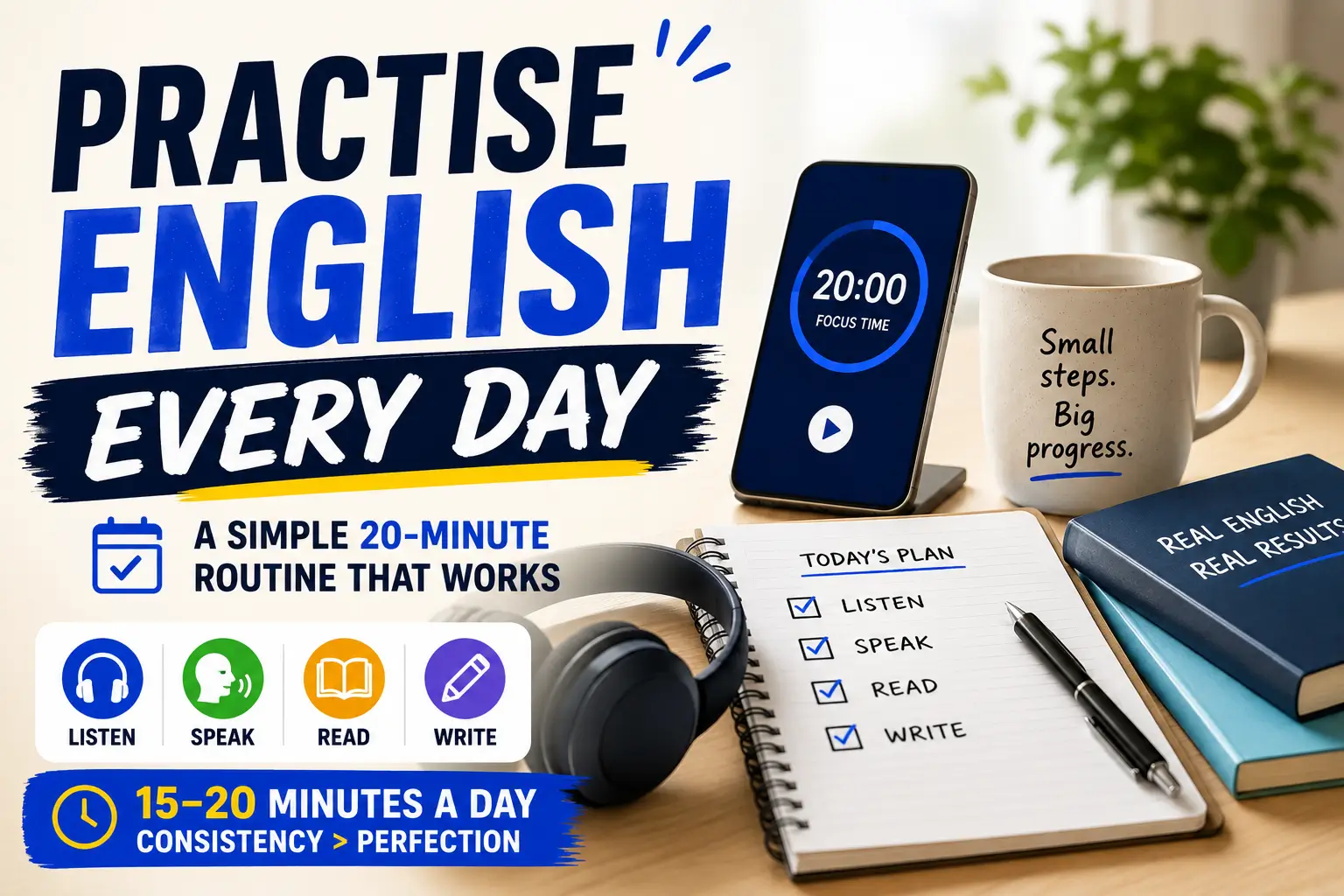
TL;DR: You do not need to spend hours studying English every day. You need a simple routine you can repeat. Aim for 15–20 minutes a day: review vocabulary, listen to real English, practise speaking, then read or write something short. Small daily practice beats one long weekly session because it keeps English active in your brain.
Most English learners who are searching for ways to practise English every day do not struggle because they are lazy, unmotivated, or “bad at languages”. They struggle because their practice is too random.
One week, they study for two hours. The next week, they do nothing. Then they download another app, start another notebook, watch another YouTube video, and wonder why their speaking still feels slow, awkward, or unnatural.
The truth is simple: improving your English does not require a perfect study plan. It requires a realistic daily habit.
Why Daily Practice Beats Occasional Long Sessions
When you are learning English, consistency matters more than intensity.
A two-hour study session might feel productive in the moment, but if you only do it once a week, your brain has too much time to forget what you learned. Daily practice works better because it gives your memory repeated exposure.
This is known as the spacing effect: you remember information more effectively when you review it several times over a period of time, rather than trying to learn everything in one big session.
When you speak, you have to choose the right words, build the sentence, pronounce the sounds, listen to the response, and keep the conversation moving. That takes cognitive memory and physical repetition. In other words, English is partly mental and partly motor skill, a bit like playing an instrument or training in a sport. You improve by activating the skill regularly.
This is why 15–20 minutes a day can be more powerful than two hours once a week.
Daily practice also makes English easier to turn into a habit. A useful idea from habit science is the “2-minute rule”: make the habit so small that it feels easy to start. You do not need to promise yourself a perfect one-hour study session every day. You just need to begin.
- listen to English for two minutes
- say five sentences out loud
- review three useful phrases
- write one short answer to a simple question
Once you start, it is much easier to continue. And even on busy days, doing a little keeps the habit alive.
The goal is not to study English perfectly. The goal is to touch English every day.
Get answers like this for your language questions
Your personal AI language tutor — adapts to your native language, your level, and the words that actually trip you up.
The 4 Skills You Need to Practise Every Day
A strong English routine should include four core skills: listening, speaking, reading, and writing.
You do not need to practise all four every single day. That can quickly become overwhelming. But across the week, you should rotate between them so your English improves in a balanced way.
Listening
Listening is the foundation of natural English comprehension. The more you listen to real English, the more your brain gets used to pronunciation, rhythm, speed, accents, and common phrases.
This is what helps English feel less like a subject and more like a real language you can understand in daily life.
Speaking
Speaking is the skill many learners need most, but it is also the one most apps neglect. You can know hundreds of words and still freeze in conversation if you rarely speak out loud. Speaking practice helps you turn passive knowledge into active ability.
It trains you to think faster, build sentences more naturally, and become more confident using English in real situations.
Reading
Reading helps you absorb vocabulary and grammar patterns without memorising endless rules.
When you read regularly, you start to notice how English sentences are built, which words appear together, and how native or fluent speakers express ideas. Even short articles, simple stories, subtitles, or social media posts can help.
Writing
Writing forces precision. When you write, you have more time to think about word choice, sentence structure, grammar, and clarity.
It also helps you notice gaps in your English. You quickly discover which words you do not know, which grammar points feel weak, and which ideas are difficult to express.
The key is not to turn every day into a full language lesson. The key is to keep your English active.
A Sample 20-Minute Daily English Routine
First 5 minutes: vocabulary review
Start by reviewing words and phrases you have already learned. You can use a spaced repetition app, flashcards, a notebook, or a simple list on your phone.
The goal is not to learn 50 new words every day. The goal is to keep useful vocabulary active in your memory. Focus on words you can actually use in real conversations, such as common verbs, everyday phrases, linking words, and expressions connected to your life, work, studies, or interests.
Next 5 minutes: listening practice
Listen to a short piece of English. This could be a podcast clip, a YouTube video, a short news segment, or part of an English lesson.
Choose something that is slightly challenging but not impossible. You should understand enough to follow the main idea, even if you miss some words. The aim is to train your ear to recognise natural pronunciation, rhythm, speed, and sentence patterns.
Next 5 minutes: speaking practice
This is the part many learners skip, but it is one of the most important.
Spend five minutes speaking out loud. You could practise with an AI conversation partner, repeat after a native speaker using shadowing, answer a simple question, or talk to yourself about your day.
- what you did today
- what you are planning to do tomorrow
- what you thought about the video you watched
- one opinion about a topic you are interested in
Do not worry about speaking perfectly. The goal is to build fluency, confidence, and speed. Mistakes are part of the process.
Final 5 minutes: reading or writing
Finish with either reading or writing.
You might read a short article, a social media post, a few paragraphs from a book, or subtitles from a video. Alternatively, you could write a short journal entry, a message, a few sentences about your day, or a quick answer to a question.
Writing is especially useful because it forces you to organise your thoughts clearly. Reading is useful because it exposes you to natural grammar and vocabulary in context.
This routine is simple, but that is the point. Twenty minutes may not feel like much, but repeated every day, it gives your brain regular contact with English. Over time, that regular contact becomes progress.
How to adapt this routine if you only have 10 minutes
If you only have 10 minutes, do not skip English completely. Just make the routine smaller.
- 3 minutes: review useful vocabulary or phrases
- 3 minutes: listen to a short English clip
- 3 minutes: speak out loud using the words you reviewed
- 1 minute: write one sentence about what you practised
The most important part is speaking. If you are short on time, prioritise active practice over passive learning. Listening to English is useful, but using English yourself is what helps you become more fluent.
A 10-minute routine will not replace deeper study, but it is much better than doing nothing. The aim is to stay connected to English every day, even when life gets busy.
10 Habits to Build Into Your Day Without Extra Study Time
The best English routine is not always the one that adds more work to your day. Sometimes, the easiest way to improve is to make small parts of your normal life happen in English.
These habits do not require a separate study session. They simply turn everyday moments into useful English practice.
1. Change your phone language to English
Your phone is something you use every day, so changing the language to English gives you regular exposure without extra effort.
You will start seeing common words for settings, notifications, apps, dates, times, and actions. At first, it might feel uncomfortable, but that is exactly why it works. You are forcing your brain to process English in a real-life context.
2. Think in English during commutes (describe what you see)
When you are walking, driving, or sitting on public transport, describe what you can see in English.
- “There is a woman waiting at the bus stop.”
- “The weather is cloudy today.”
- “I am going to work.”
- “That shop looks busy.”
This is simple, but powerful. It helps you build the habit of forming English sentences without needing a textbook.
3. Watch one YouTube video in English with English subtitles (not your native language)
Watching videos in English is useful, but subtitles matter.
Try using English subtitles instead of subtitles in your native language. This helps you connect the sound of English with the written words. You can hear pronunciation, notice sentence patterns, and pick up natural phrases at the same time.
Choose videos you would watch anyway: travel, football, business, cooking, fitness, gaming, fashion, or anything else you enjoy.
4. Listen to an English podcast while cooking, exercising, or commuting
You do not need to sit at a desk to practise listening.
Play an English podcast while you cook, clean, exercise, walk, or travel. Even if you do not understand every word, you are training your ear to recognise rhythm, pronunciation, speed, and common expressions.
For beginners, choose slower podcasts or learner-friendly content. For intermediate learners, try real podcasts made for native speakers.
5. Set an English alarm label or reminder with a phrase to use that day
Instead of setting a normal alarm, add a short English phrase to it.
- “Drink water.”
- “Practise speaking for five minutes.”
- “Review today’s phrase.”
- “What did you learn today?”
This is a small trick, but it keeps English visible during the day. It also gives you a practical phrase you can actually use.
6. Write your to-do list in English
If you already write a daily to-do list, write it in English.
- “Send email”
- “Buy food”
- “Call the doctor”
- “Finish report”
- “Clean the room”
This helps you connect English with your real life, not just classroom examples.
7. Use an AI conversation partner for 5 minutes before bed
Speaking is one of the hardest skills to practise alone, which is why an AI conversation partner can be useful.
Before bed, spend five minutes having a simple conversation in English. You could talk about your day, practise a work situation, ask for corrections, or role-play a real-life conversation.
The key is to make it short and easy. Five minutes is enough to build confidence if you do it consistently.
8. When you learn a new word, use it in a sentence immediately
When you learn a new word, do not just write it down. Use it.
Using a word immediately helps move it from short-term memory into something you can actually recall later.
9. Shadow English speakers: replay a sentence and repeat it aloud
Shadowing is a technique where you listen to a sentence and then repeat it out loud, trying to match the pronunciation, rhythm, and speed as closely as you can. Do not worry about sounding perfect. Focus on rhythm and confidence first.
10. Keep a one-sentence English journal
At the end of the day, write one sentence in English.
- “Today I worked from home.”
- “I felt tired, but I finished my tasks.”
- “I watched a video about learning English.”
- “Tomorrow I want to practise speaking.”
One sentence may seem small, but it creates a daily writing habit. Over time, you will become faster, more accurate, and more comfortable expressing your own life in English.
The aim is not to make English feel like another job. The aim is to make English part of your normal day.
The Best Resources for Daily English Practice
The best English resources are not always the most advanced ones. They are the ones you can use consistently.
A good daily practice routine should include tools for vocabulary, listening, speaking, pronunciation, and grammar. You do not need dozens of apps or resources. The goal is not to collect apps. The goal is to use the right tool for the right skill.
Apps for Daily English Practice
Apps can be useful, but only when you know what you are using them for.
Podcasts for Listening Practice
Podcasts are one of the easiest ways to make English part of your daily routine. You can listen while walking, cooking, cleaning, exercising, or commuting.
Good options include BBC Learning English, 6 Minute English, ESLPod, and All Ears English. These are useful because they expose you to spoken English in short, manageable formats.
If you are a beginner, start with learner-friendly podcasts where the speech is slower and the topics are clearly explained. If you are intermediate or advanced, try podcasts with more natural speed, casual expressions, and real conversation.
You do not need to understand every word. Focus on the main idea first. Then, replay short sections and listen for useful phrases, pronunciation, and sentence patterns.
YouTube Channels for Real Conversational English
YouTube is excellent for daily English practice because you can hear and see English being used in context.
Look for channels that include real conversations, interviews, street interviews, pronunciation lessons, everyday vocabulary, or English explained through situations. These are often more useful than videos that only teach isolated words or grammar rules.
When watching YouTube, use English subtitles where possible. You can also pause the video, repeat useful sentences out loud, and write down phrases you want to use later.
The best videos are not always “English lessons”. Sometimes, normal videos about your interests are better because they keep you engaged. If you enjoy football, business, travel, food, fitness, gaming, or films, watch that content in English.
AI Conversation Tools
AI conversation tools let you practise speaking and writing in English at any time, without needing a language partner or tutor.
Good prompts to try:
- “Correct my English after each answer.”
- “Ask me questions about my day.”
- “Help me practise ordering food in English.”
- “Give me more natural ways to say this.”
- “Speak with me at B1 level.”
Get answers like this for your language questions
Your personal AI language tutor — adapts to your native language, your level, and the words that actually trip you up.
What to Do When You Miss a Day (The Never Miss Twice Rule)
At some point, you will miss a day.
You might be busy, tired, travelling, stressed, or simply forget. That does not mean your English routine has failed. It means you are human.
The real problem is not missing one day. The problem is letting one missed day turn into two, then three, then a full week. That is when the habit starts to disappear.
A useful rule is: never miss twice.
If you miss Monday, restart on Tuesday. If you forget your full 20-minute routine, do two minutes instead. When you cannot practise all four skills, just review one phrase, listen to one short clip, or say one sentence out loud.
The “two days is the limit” rule keeps your habit alive. It gives you flexibility without letting the routine collapse completely.
The most important thing is to restart without guilt. You do not need to “make up” for the missed day with a huge study session. You do not need to punish yourself or start again from zero.
Just do two minutes.
How to Track Your Progress Without Obsessing Over Metrics
Tracking your English progress can be useful, but only if you track the right things.
The problem with many language apps is that they make progress look like XP, streaks, badges, levels, and leaderboards. These can be motivating, but they do not always show whether your English is actually improving.
Instead, track the things that connect directly to real language use.
- how many English conversations you complete each week
- how many new words or phrases you use in real sentences
- how many hours of English listening you do each month
- how often you speak out loud
- how many short journal entries or messages you write in English
These are better signs of progress because they show that you are using English, not just completing tasks.
Then, once a month, ask yourself two honest questions:
Can I understand more English than I could last month?
Can I say more of what I want to say?
If the answer to either question is yes, your routine is working. Keep going.
FAQ
How Many Minutes a Day Should I Practise English?
Aim for at least 15–20 minutes of focused practice every day. This is enough to maintain progress and build habits. If you can do more, great. But consistency matters more than length. Fifteen minutes every day is more effective than two hours once a week.
What Is the Fastest Way to Improve English?
The fastest way to improve is to practise speaking daily, listen to real English regularly, and review vocabulary using spaced repetition. Speaking is the skill most learners neglect, and it is also the one that improves fastest with regular practice. Using an AI conversation partner for a few minutes a day can accelerate your progress significantly.
How Do I Practise English Speaking at Home?
You can practise speaking at home by talking to yourself out loud, using an AI conversation partner, repeating sentences from videos or podcasts using shadowing, recording yourself and listening back, or describing your daily activities in English. You do not need a native speaker or a classroom.
Is 30 Minutes of English a Day Enough?
Yes, 30 minutes of English a day is enough to make real progress, especially if the practice is focused and varied.
A good 30-minute session could include vocabulary review, listening, speaking, and either reading or writing. The important thing is not just the amount of time, but how you use it.
Thirty minutes of active English practice is far more valuable than two hours of passive scrolling, random videos, or unfocused app exercises. If you practise consistently and include speaking, listening, and real-life vocabulary, 30 minutes a day can be very effective.