
|
Getting your Trinity Audio player ready...
|
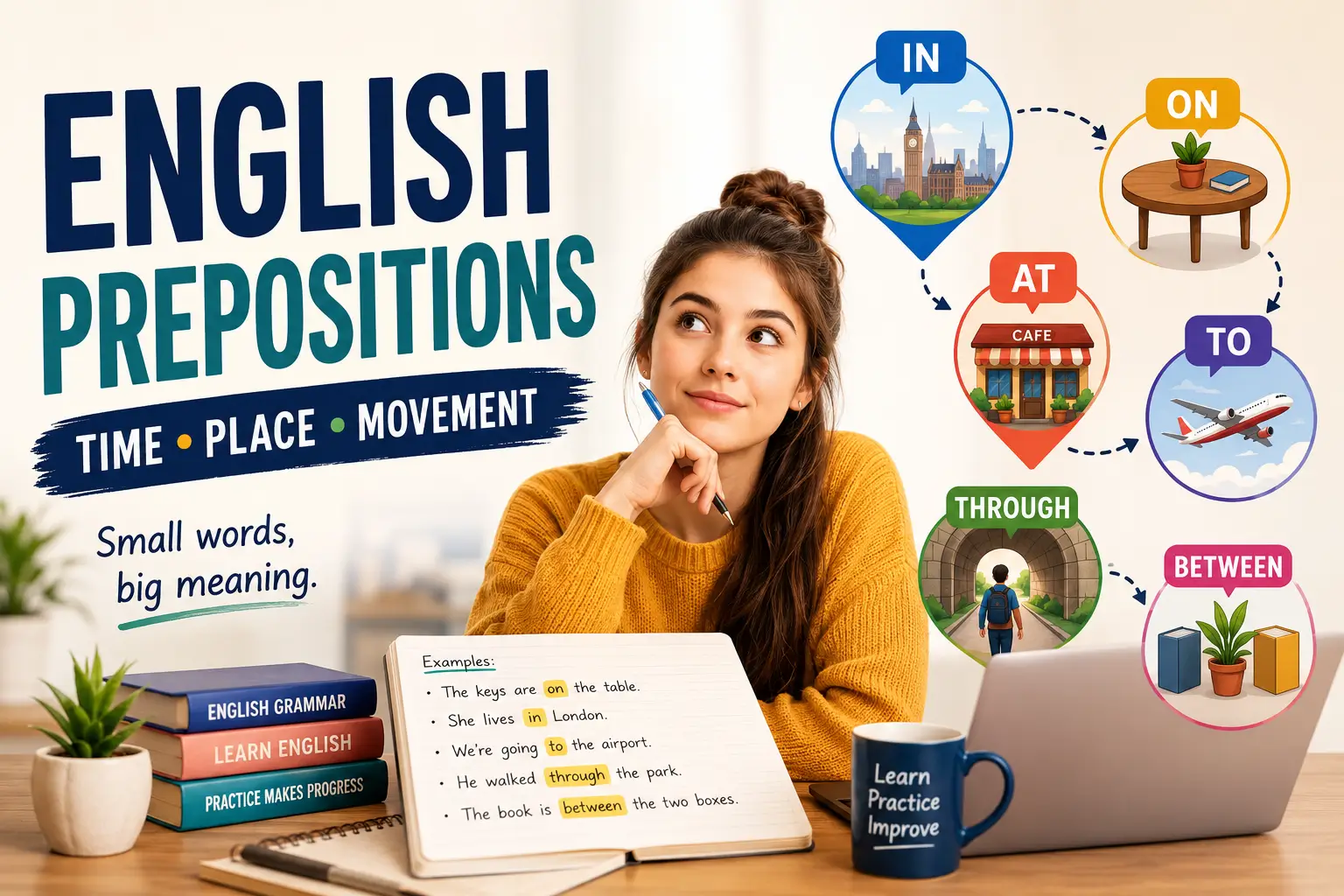
TL;DR: Prepositions are small but essential words that help explain time, place, and movement in English. Words like in, on, at, to, and through are used constantly in everyday conversations, writing, travel, work, and directions.
English prepositions can feel small, but they cause some of the biggest problems for learners.
Should you say in Monday or on Monday? Are you at the station or in the station? And why do native speakers say go to, walk into, and drive through so naturally?
The truth is that prepositions are everywhere in English. They help explain time, location, direction, and movement, and even tiny mistakes can make sentences sound confusing or unnatural.
The good news is that once you understand the patterns behind them, prepositions become far easier to use in real conversations.
Get explanations like this for your English questions
Personalised to your native language and level. Free to start — no card needed.
Prepositions are an essential part of English because they show relationships between people, places, time, and movement. They help explain when something happens, where something is, and how someone or something moves.
Small words like in, on, at, to, and through may seem simple, but they can completely change the meaning of a sentence. For example, “at the office,” “in the office,” and “going to the office” all describe different situations.
Prepositions are also used constantly in everyday English and appear in many common phrases such as interested in, good at, and depend on.
Get answers like this for your language questions
Your personal AI language tutor — adapts to your native language, your level, and the words that actually trip you up.
Understanding Prepositions
Prepositions are some of the most common words in English, yet they are also one of the biggest challenges for learners.
These small words help connect ideas and give important information about time, place, direction, and movement. Without them, sentences can sound incomplete or confusing.
What are prepositions?
Prepositions are words that show the relationship between different parts of a sentence. They often explain time, place, direction, movement, or position.
Common English prepositions include words like in, on, at, to, from, under, and through.
For example:
- The keys are on the table.
- We arrived at the airport early.
- She walked through the park.
Even though prepositions are usually small words, they play a very important role in communication.
Role of prepositions in sentence structure
Prepositions help connect nouns, pronouns, and phrases to the rest of a sentence. They provide extra detail and make sentences clearer and more specific.
Without prepositions, sentences can sound unnatural or incomplete. Compare:
- I’m going London. ❌
- I’m going to London. ✅
They also help describe:
- Time: at 5pm, on Monday, in July
- Place: in the room, on the wall, at school
- Movement: into the house, across the street, towards the station
Common misconceptions about prepositions
One common misconception is that prepositions always translate directly from another language. In reality, English prepositions often follow their own patterns and expressions.
Another misconception is that prepositions are easy because they are short words. In fact, they are one of the most difficult parts of English for many learners because small changes can completely change meaning.
Prepositions of Time
Prepositions of time help us explain when something happens.
They are extremely common in everyday English and are used when talking about schedules, routines, events, deadlines, and dates.
Learning the difference between words like at, in, and on is essential for speaking and writing naturally.
Definition and purpose
Prepositions of time show a relationship between an action and a specific time. They help answer questions such as:
- When did it happen?
- What time is the meeting?
- Which day are you travelling?
Without time prepositions, sentences can sound unclear or incomplete.
Key examples (e.g., at, in, on)
The most common prepositions of time in English are at, in, and on.
At
Use at for precise times and specific moments.
Examples:
- at 7pm
- at midnight
- at lunchtime
- at the weekend (common in British English)
On
Use on for days and dates.
Examples:
- on Monday
- on my birthday
- on 12th June
- on Christmas Day
In
Use in for longer periods of time.
Examples:
- in July
- in 2026
- in the morning
- in winter
Usage rules and common phrases
Here are some common patterns to remember:
- At = exact time
The lesson starts at 6pm. - On = days and dates
We’re travelling on Friday. - In = months, years, seasons, and longer periods
She moved here in 2024.
Some common fixed phrases include:
- in the afternoon
- at night
- on time
- in time
- at the moment
English has many fixed expressions, some phrases must simply be memorised through regular exposure and practice.
Tips for mastering time prepositions
One of the easiest ways to remember time prepositions is to think about size:
- At → small, exact point in time
- On → specific day or date
- In → larger periods of time
It also helps to learn prepositions as part of full phrases instead of single words. For example, learn at night or on Monday together rather than memorising isolated rules.
Prepositions of Place
Prepositions of place help describe where someone or something is located.
They are used constantly in everyday English to talk about positions, locations, and relationships between objects, people, and places. These prepositions are important for giving directions, describing places, and communicating clearly.
Definition and purpose
Prepositions of place show the position of a person, object, or place in relation to something else. They help answer questions such as:
- Where is the phone?
- Where are you sitting?
- Where does she work?
Without prepositions of place, descriptions would be vague and confusing.
Key examples (e.g., at, in, on, under, between)
Some of the most common prepositions of place in English include at, in, on, under, and between.
At
Use at for a specific point or location.
Examples:
- at the bus stop
- at school
- at the entrance
In
Use in when something is inside an enclosed space.
Examples:
- in the room
- in the car
- in London
On
Use on when something is touching a surface.
Examples:
- on the table
- on the wall
- on the floor
Under
Use under when something is below another object.
Examples:
- under the bed
- under the bridge
Between
Use between when something is in the middle of two people, objects, or places.
Examples:
- between the chairs
- between the bank and the café
Usage rules and common phrases
Here are some useful patterns to remember:
- At = exact point or location
She’s waiting at the station. - In = inside an area or space
The keys are in my bag. - On = touching a surface
Your phone is on the desk.
Some common place expressions include:
- at home
- in bed
- on the bus
- at work
- in the city centre
English also contains many fixed expressions, so learners should practise seeing prepositions in real sentences rather than memorising isolated rules.
Visual aids and context for better understanding
Prepositions of place are often easier to learn visually. Imagine the position of an object:
- The cat is under the table.
- The picture is on the wall.
- The shoes are in the cupboard.
Creating simple mental images can make prepositions easier to remember.
Diagrams, labelled pictures, and real-life examples are also helpful because they connect the preposition to a physical position or movement.
Get explanations like this for your English questions
Personalised to your native language and level. Free to start — no card needed.
Get explanations like this for your English questions
Personalised to your native language and level. Free to start, no card needed.
Prepositions of Movement
Prepositions of movement describe how someone or something moves from one place to another.
They are commonly used when talking about travel, direction, transport, and physical actions. These prepositions help make sentences more detailed and easier to understand.
Definition and purpose
Prepositions of movement show direction or motion. They help answer questions such as:
- Where is someone going?
- How did they move?
- Which direction did something travel?
Without movement prepositions, it would be difficult to describe actions clearly.
Key examples (e.g., to, from, through, across)
Some of the most common prepositions of movement in English include to, from, through, and across.
To
Use to when moving towards a destination.
Examples:
- She walked to the station.
- We’re travelling to Spain next week.
From
Use from to show the starting point of movement.
Examples:
- He came from the office.
- This train runs from London to Manchester.
Through
Use through when moving inside or within something.
Examples:
- They walked through the tunnel.
- The river flows through the city.
Across
Use across when moving from one side to another.
Examples:
- She ran across the road.
- We walked across the bridge.
Usage rules and common phrases
Here are some common movement patterns to remember:
- To = towards a destination
I’m going to the supermarket. - From = starting point
She travelled from Peru to the UK. - Through = movement inside something
The dog ran through the garden. - Across = movement from one side to another
He swam across the river.
Other common movement prepositions include:
- into
- out of
- towards
- along
- past
- around
Many of these are used in everyday phrases and directions, so practising them in context is very important.
Illustrative scenarios to clarify movement prepositions
Movement prepositions become much easier to understand when you imagine real situations.
For example:
- The girl walked into the shop.
→ She moved from outside to inside. - The cyclist rode along the road.
→ He followed the direction of the road. - The man jumped over the fence.
→ He moved above and across the fence. - The tourists walked through the museum.
→ They moved inside the museum space.
Visualising movement can help learners understand the difference between similar prepositions and use them more naturally in conversations and writing.
Differences Between Similar Prepositions
Many English prepositions look similar, but they are used in different situations.
These small differences are important because using the wrong preposition can change the meaning of a sentence or make it sound unnatural.
Learning common comparisons helps learners feel more confident and accurate when speaking and writing in English.
Comparing time prepositions (e.g., in vs. on)
Both in and on are used for time, but they refer to different types of periods.
In
Use in for longer periods of time, such as months, years, seasons, and parts of the day.
Examples:
- in January
- in 2026
- in the morning
- in summer
On
Use on for specific days and dates.
Examples:
- on Monday
- on my birthday
- on 15th August
- on Christmas Day
Compare:
- I started learning English in 2024.
- My lesson is on Friday.
Comparing place prepositions (e.g., at vs. in)
Both at and in describe location, but they focus on different levels of detail.
At
Use at for a specific point or exact location.
Examples:
- at the bus stop
- at the door
- at school
In
Use in when something is inside an enclosed area or space.
Examples:
- in the kitchen
- in the building
- in London
Compare:
- She is waiting at the station.
→ Focus on the location point. - She is in the station.
→ Focus on being inside the building.
Comparing movement prepositions (e.g., to vs. towards)
Both to and towards describe movement, but they are not exactly the same.
To
Use to when the destination is clear and reached.
Examples:
- We walked to the café.
- He drove to the airport.
Towards
Use towards when describing movement in a direction, but not necessarily arriving there.
Examples:
- She walked towards the park.
- The dog ran towards me.
Compare:
- He walked to the shop.
→ He arrived at the shop. - He walked towards the shop.
→ He moved in that direction, but may not have arrived.
These small differences helps learners use English more naturally and avoid common mistakes in everyday communication.
Common Errors with Prepositions
Prepositions are one of the most difficult parts of English for many learners because the rules are not always logical or consistent.
Small mistakes with prepositions are very common, even for advanced learners, especially when translating directly from another language.
Understanding the most frequent errors can help learners recognise patterns and improve their accuracy over time.
Frequent mistakes learners make
One common mistake is using the wrong preposition with time expressions.
Incorrect:
- I will see you in Monday. ❌
Correct:
- I will see you on Monday. ✅
Learners also often confuse at, in, and on when talking about place.
Incorrect:
- She is in the bus stop. ❌
Correct:
- She is at the bus stop. ✅
Another frequent issue is translating expressions directly from a native language. English uses many fixed preposition combinations that may not match other languages.
Incorrect:
- He depends of his parents. ❌
Correct:
- He depends on his parents. ✅
How to avoid these errors
One of the best ways to avoid preposition mistakes is to learn them in full phrases instead of as individual words. For example, memorising what you are interested in or good at is more effective than studying the preposition alone.
It also helps to:
- Read and listen to natural English regularly
- Pay attention to repeated patterns
- Practise using prepositions in sentences
- Avoid translating directly from your native language
Many prepositions are part of fixed expressions, and regular exposure and repetition are extremely important.
Examples of incorrect vs. correct usage
Here are some common examples learners struggle with:
| Incorrect ❌ | Correct ✅ |
| She arrived to London. | She arrived in London. |
| I’m good in maths. | I’m good at maths. |
| He was born at 1998. | He was born in 1998. |
| The picture is in the wall. | The picture is on the wall. |
| We discussed about the problem. | We discussed the problem. |
Get explanations like this for your English questions
Personalised to your native language and level. Free to start, no card needed.
English Prepositions Practical Exercises
Learning prepositions is much easier through regular practice. While grammar explanations are helpful, the real improvement happens when learners actively use prepositions in speaking, writing, listening, and reading.
Practising with real examples helps learners recognise patterns and use prepositions more naturally in everyday English.
Interactive activities to practise prepositions
There are many simple and effective ways to practise English prepositions.
Sentence Completion Exercises
Fill in the missing preposition using words such as in, on, at, to, or through.
Examples:
- The meeting starts ___ 9am.
- She walked ___ the tunnel.
- The keys are ___ the table.
Picture Description Activities
Look at a picture and describe where objects are located.
Example:
- The cat is under the chair.
- The books are on the shelf.
This helps learners connect prepositions with real visual situations.
Speaking Practice
Try describing daily routines, travel plans, or locations using prepositions naturally.
Examples:
- I wake up at 7am.
- I work in London.
- I walk to the station every morning.
Error Correction Exercises
Correct incorrect sentences to identify common mistakes.
Example:
- I arrived to school early. ❌
- I arrived at school early. ✅
Suggested resources for further learning
There are many excellent resources available for practising English prepositions:
- English grammar websites and quizzes
- YouTube pronunciation and grammar channels
- Language learning apps
- Flashcards and worksheets
- Reading articles, books, and subtitles in English
- Conversation practice with native speakers or tutors
Using multiple types of practice can improve both understanding and long-term memory.
The importance of practice in language acquisition
Prepositions are best learned through repetition and exposure. Because English uses many fixed expressions and patterns, learners need to see and hear prepositions regularly before they become natural.
Making mistakes during practice is completely normal and is an important part of language learning. Over time, repeated exposure helps learners develop instinctive understanding rather than relying only on grammar rules.
The more learners read, listen, speak, and write in English, the more confident and accurate they become when using prepositions in real conversations.
Get explanations like this for your English questions
Personalised to your native language and level. Free to start — no card needed.
Prepositions are used constantly in real-life English communication. They help speakers give clear information about time, place, direction, relationships, and movement.
Without prepositions, conversations would sound unnatural, and many sentences would lose their meaning.
How prepositions enhance communication
Prepositions make communication more precise by adding important details to sentences.
For example:
- The meeting is at 3pm.
- Your bag is under the chair.
- We’re travelling to Manchester tomorrow.
In each sentence, the preposition provides essential information about time, location, or movement. Using the correct preposition helps avoid confusion and makes speech sound more natural.
Prepositions also help connect ideas smoothly in both spoken and written English.
Examples from everyday conversations
Prepositions appear in almost every daily interaction.
Examples include:
- I’m at work right now.
- She lives in London.
- The café is across the street.
- We’ll meet on Friday.
- He walked through the park.
They are especially important when:
- Giving directions
- Talking about schedules
- Describing locations
- Explaining routines
- Discussing travel and movement
Prepositions are so common that learners hear and use them repeatedly in everyday life.
Importance in writing and professional contexts
Using prepositions correctly is also important in professional and academic communication. Mistakes with prepositions can sometimes make writing unclear or less natural.
For example:
- Please send the report by Monday.
- The meeting will take place in Conference Room A.
- We are working on a new project.
Correct preposition use improves clarity, professionalism, and fluency in emails, presentations, reports, and workplace conversations.
In professional environments, accurate communication is important, and strong understanding of prepositions can help learners sound more confident and polished in English.
English Prepositions FAQs
What are the most common prepositions in English?
Some of the most common English prepositions include in, on, at, to, from, with, under, between, and through. These words are used to describe time, place, movement, direction, and relationships between ideas or objects.
Why are prepositions difficult for English learners?
Prepositions can be difficult because they often do not translate directly from other languages. English also contains many fixed expressions and exceptions, meaning learners usually need practice and exposure rather than memorising simple rules alone.
What is the difference between “in”, “on”, and “at”?
These prepositions are commonly used for both time and place. Generally, in is used for larger areas or longer periods, on is used for surfaces and specific days, and at is used for exact points or precise times.
How can I improve my use of English prepositions?
The best way to improve is through regular practice. Reading, listening to native speakers, completing exercises, and learning prepositions in full phrases can help them feel more natural over time.
Are prepositions important in professional English?
Yes. Correct preposition use improves clarity and professionalism in emails, meetings, presentations, and workplace conversations. Using the wrong preposition can sometimes make communication confusing or unnatural.