
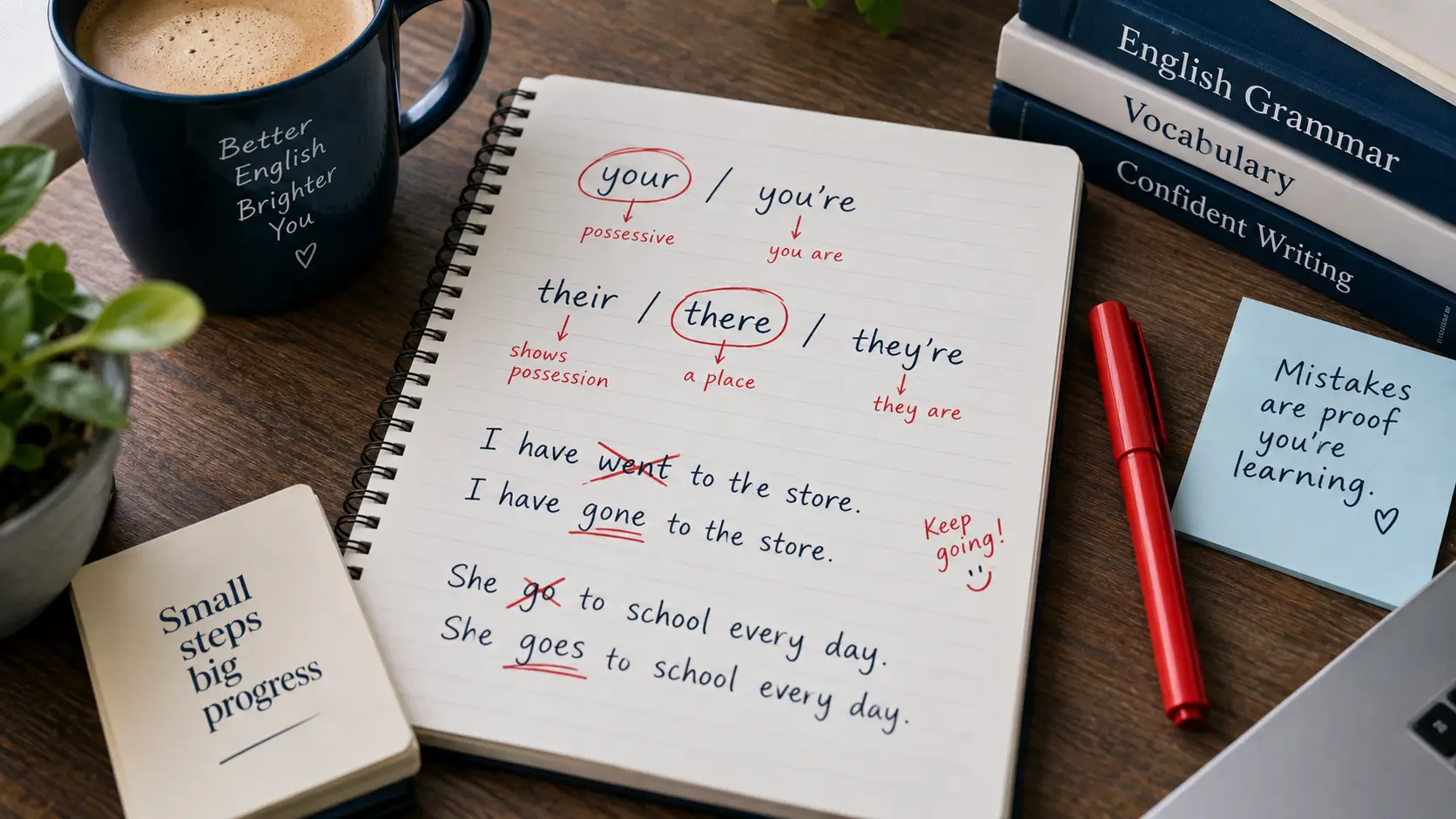
TL;DR: Common English mistakes are common, but they’re also predictable and fixable. From homophones and verb tenses to sentence structure and pronouns, most errors come down to clarity, consistency, and attention to detail.
English is everywhere, but even confident speakers get tripped up by it.
From mixing up “your” and “you’re” to misusing tenses or prepositions, common English mistakes can quietly undermine your clarity and confidence.
The good news? Most of these errors are predictable and fixable.
What are the most common English mistakes?
Even advanced learners make the same small mistakes in English.
They’re common, easy to overlook, and often repeated. Spotting them early is the fastest way to improve your accuracy and sound more natural.
- Confusing “your” vs “you’re”
- Mixing up “their”, “there”, and “they’re”
- Incorrect verb tenses (e.g. I have went instead of I have gone)
- Misusing prepositions (e.g. depend of instead of depend on)
- Overusing or missing articles (a, an, the)
- Basic subject–verb agreement errors (she go instead of she goes)
- Literal translations from your native language
- Using the wrong word order in sentences
Get answers like this for your language questions
Your personal AI language tutor — adapts to your native language, your level, and the words that actually trip you up.
Misuse of Homophones
Homophones are one of the most common and frustrating sources of English mistakes.
They sound identical but have completely different meanings and spellings. Because they sound right, they often slip past unnoticed, especially in writing.
Definition and examples
Homophones are words that are pronounced the same but differ in meaning and spelling. The confusion usually happens because learners rely on sound rather than context.
Some of the most common examples include:
- Their (possession): Their house is beautiful.
- There (place or position): The book is over there.
- They’re (they are): They’re going to the cinema.
Other frequent troublemakers:
- Your / You’re (your car vs you’re late)
- To / Too / Two (go to bed, too much, two days)
- Its / It’s (its colour vs it’s raining)
Tips for remembering the differences
The key to mastering homophones is linking each word to its function, not just its sound.
Once you understand what the word does in a sentence, choosing the right one becomes much easier.
- Break contractions apart: you’re = you are, they’re = they are
- Look for possession: words like their and your usually show ownership
- Use context clues: ask yourself, Is this about place, possession, or action?
- Create memory triggers:
- There has here inside it → relates to place
- Their has heir → think ownership
- Slow down when writing. These common English mistakes often happen when you rush
Practice exercises
The best way to fix homophone mistakes is repetition. Train your brain to spot them automatically.
Try these quick exercises:
- Fill in the blanks:
- ___ going to finish ___ work later. (they’re / their)
- Put the bag over ___. (there)
- Error correction:
- Your going to love this place. → What’s wrong?
- Create your own sentences: Write one sentence for each word in a confusing pair (e.g. your vs you’re).
- Proofreading practice: Take a short paragraph and check only for homophone errors—nothing else.
Do this consistently, and these mistakes will go from automatic errors to automatic corrections.
Subject-Verb Agreement Errors
Subject–verb agreement sounds simple, until it isn’t. Even strong English speakers slip up when sentences get longer or more complex.
The rule is straightforward, but the exceptions and tricky structures are where mistakes creep in. Nail this, and your English instantly sounds more polished and natural.
Explanation of subject-verb agreement
At its core, subject–verb agreement means the verb must match the subject in number.
- Singular subject → singular verb: She runs every day.
- Plural subject → plural verb: They run every day.
The confusion often comes when extra words get in the way:
- The list of items is on the table. (Not are, the subject is a list, not items)
The key is to always identify the true subject of the sentence, not the word closest to the verb.
Common pitfalls (e.g., collective nouns)
This is where most learners go wrong, when sentences aren’t clean and simple.
- Collective nouns (team, family, group):
- The team is winning. (treated as one unit)
- Phrases between subject and verb:
- The bouquet of flowers smells lovely.
- Indefinite pronouns (everyone, someone, each):
- Everyone wants to succeed.
- Compound subjects:
- Tom and Jerry are friends.
- Either/or & neither/nor:
- Neither the teacher nor the students are ready. (verb agrees with the closest subject)
These structures make it easy to lose track of what the verb should match.
Strategies for ensuring agreement
The best way to avoid mistakes is to slow down and simplify the sentence in your head.
- Find the real subject first
Ignore extra phrases and focus on who or what is doing the action - Mentally remove distractions
- The box of chocolates is… → a removal of chocolates
- Watch out for tricky pronouns
Words like everyone and each are always singular - Check compound subjects carefully
If there are two subjects joined by and, the verb is usually plural - Read your sentence out loud
If it sounds off, it probably is - Keep it simple when unsure
Shorter sentences reduce the risk of errors
Mastering subject–verb agreement isn’t about memorising rules. It’s about training yourself to spot the subject clearly, every time.
Incorrect Tense Usage
Tense mistakes are one of the fastest ways to confuse your reader or listener.
Even if your vocabulary is strong, switching tenses incorrectly can make your meaning unclear or awkward.
The goal isn’t perfection. It’s consistency and choosing the right tense for the situation.
What are verb tenses?
Verb tenses show when an action happens: past, present, or future. English uses different forms to add more detail, such as whether something is completed, ongoing, or connected to the present.
- Present simple: I work every day.
- Past simple: I worked yesterday.
- Present perfect: I have worked there before.
Each tense carries a specific meaning, so choosing the wrong one can subtly change what you’re trying to say.
Common mistakes (e.g., past vs. present perfect)
Many learners struggle with tenses that seem similar but aren’t interchangeable.
- Past simple vs. present perfect:
- ❌ I have seen him yesterday
- ✅ I saw him yesterday
- ✅ I have seen him before (no specific time)
- Switching tenses mid-sentence:
- ❌ She was walking to the shop and buys milk
- ✅ She was walking to the shop and bought milk
- Overusing present tense when talking about past events
- Forgetting continuous forms (I am working) when describing ongoing actions
These mistakes often come from translating directly from your native language.
Tips for mastering tense consistency
Getting tenses right is less about memorising rules and more about recognising patterns and timelines.
- Think about time first
Ask yourself: When did this happen? Is it finished or ongoing? - Stick to one timeline
Avoid jumping between past and present unless there’s a clear reason - Learn key signal words
- Yesterday, last year → past simple
- Already, ever, never → present perfect
- Practise with real examples
Write short stories or daily updates using one tense at a time - Read and listen actively
Notice how native speakers naturally switch tenses based on context - Review your writing
Do a quick “tense check” after finishing anything
Mastering tense usage isn’t about knowing every rule. It’s about building an instinct for time and consistency in your sentences.
Get explanations like this for your English questions
Personalised to your native language and level. Free to start, no card needed.
Misplaced Modifiers
Misplaced modifiers are subtle, but they can completely distort your meaning.
One small positioning error can turn a clear sentence into something confusing, awkward, or even unintentionally funny.
Fixing them is all about clarity: making sure your description clearly connects to the right word.
Definition and examples
A modifier is a word or phrase that describes something else in a sentence. When it’s placed in the wrong position, it ends up describing the wrong thing.
- ❌ Walking down the street, the trees were beautiful.
(It sounds like the trees are walking) - ✅ Walking down the street, I saw beautiful trees.
- ❌ She almost drove her kids to school every day.
(Did she almost do it, or actually do it?) - ✅ She drove her kids to school almost every day.
The rule is simple: a modifier should be placed as close as possible to the word it describes.
How misplaced modifiers can change meaning
When modifiers are misplaced, they can create confusion or completely change the message.
- ❌ He only eats vegetables on weekends.
- (Does he eat nothing but vegetables, or just on weekends?)
- ❌ I saw a man with a telescope.
- (Who has the telescope – you or the man?)
These errors force the reader to guess your meaning, and that’s exactly what you want to avoid. Clear writing leaves no room for doubt.
Techniques for proper placement
Fixing misplaced modifiers is about tightening your sentence structure and checking for clarity.
- Place modifiers next to what they describe: Keep descriptive words close to their target
- Start sentences carefully: If you begin with a phrase (Walking down the street…), make sure the subject follows immediately
- Watch words like “only”, “just”, “almost”: These can easily shift meaning depending on placement
- Read your sentence literally: Ask yourself: What is this modifier actually describing?
- Rewrite if needed: If a sentence feels confusing, simplify it
- Read it out loud: Awkward phrasing is often easier to hear than see
Modifiers aren’t about complex grammar. It’s about making your meaning crystal clear, every time.
Overusing Passive Voice
Passive voice isn’t wrong, but overusing it can make your English feel weak, vague, or overly formal.
Strong communication usually comes from clear, direct sentences, and that’s where the active voice shines. Learning when to use each is key to sounding natural and confident.
What are passive vs. active voice?
The difference comes down to who is doing the action.
- Active voice: the subject performs the action
- The teacher explained the lesson.
- Passive voice: the subject receives the action
- The lesson was explained by the teacher.
Passive voice often uses forms of “to be” + a past participle (was done, is made, has been written). It’s not incorrect, but it can feel less direct and more wordy.
When to use passive voice appropriately
Passive voice is useful when the focus isn’t on the person doing the action.
- When the doer is unknown
- My phone was stolen.
- When the action matters more than the subject
- The law was passed in 2020.
- In formal or academic writing
- The experiment was conducted under controlled conditions.
Used strategically, passive voice can sound neutral and objective.
Tips for converting passive to active voice
If your writing feels dull or unclear, switching to the active voice is often the quickest fix.
- Find the real subject
Ask: Who is actually doing the action? - Make the subject lead the sentence
- The report was written by Alex → Alex wrote the report
- Reduce unnecessary words
Active sentences are usually shorter and clearer - Watch for “was/were + past participle”
This is a common sign of passive voice - Use active voice by default
Only switch to passive when there’s a clear reason - Read for clarity and impact
Active voice tends to sound more confident and engaging
This balance helps your English feel sharper, more natural, and far more effective.
Confusing Adjectives and Adverbs
This is one of those small common English mistakes that instantly stand out.
Mixing up adjectives and adverbs can make your English sound unnatural, even if everything else is correct. The fix is simple once you understand what each one does in a sentence.
Differences between adjectives and adverbs
Adjectives and adverbs both describe things, but they describe different parts of a sentence.
- Adjectives describe nouns (people, places, things)
- She is a quick learner.
- Adverbs describe verbs, adjectives, or other adverbs
- She learns quickly.
Most adverbs are formed by adding -ly to an adjective (quick → quickly), but not always; this is where confusion begins.
Common mistakes (e.g., good vs. well)
Certain pairs are commonly mixed up, especially in everyday conversation.
- Good (adjective) vs. well (adverb)
- ❌ I did good on the test
- ✅ I did well on the test
- ❌ She sings beautiful
- ✅ She sings beautifully
- ❌ He runs very quick
- ✅ He runs very quickly
A quick rule: if you’re describing how something happens, you usually need an adverb.
Practice tips for correct usage
Improving this comes down to awareness and repetition.
- Ask what you’re describing: Is it a noun (use an adjective) or a verb (use an adverb)?
- Look for action verbs: Words like run, speak, write often need adverbs
- Watch common exceptions: Some words don’t follow the -ly rule (fast, hard, late)
- Practise sentence swaps
- He is a fast runner → adjective
- He runs fast → adverb
- Read and listen actively: Notice how native speakers naturally use these forms
- Check your writing: Do a quick scan just for adjective/adverb mistakes
Get this right, and your English will instantly sound more natural, precise, and fluent.
Get explanations like this for your English questions
Personalised to your native language and level. Free to start, no card needed.
Run-On Sentences and Comma Splices
Long sentences aren’t the problem; uncontrolled ones are.
Run-ons and comma splices happen when ideas are joined incorrectly, making your writing feel rushed, confusing, or unpolished. Fixing them is one of the fastest ways to improve clarity and flow.
Definition and examples
A run-on sentence occurs when two or more independent clauses are joined without proper punctuation or connectors.
- ❌ I love learning languages I practise every day.
- ✅ I love learning languages. I practise every day.
A comma splice is a specific type of run-on sentence where clauses are incorrectly joined with just a comma.
- ❌ I love learning languages, I practise every day.
- ✅ I love learning languages, and I practise every day.
The issue isn’t length, it’s structure. Each complete idea needs the right separation or connection.
How to identify and correct them
Spotting these errors is about recognising when a sentence contains more than one complete thought.
- Look for sentences that feel too long or rushed
- Check if both parts could stand alone as full sentences
- Watch for commas joining full sentences without a linking word
To fix them, you have a few options:
- Split into two sentences
- Add a conjunction (and, but, so, because)
- Use a semicolon for closely related ideas
Techniques for effective sentence structure
Strong writing is about balance, knowing when to connect ideas and when to separate them.
- Use conjunctions intentionally: Link ideas clearly with words like and, but, so
- Master the semicolon: Use it to connect related sentences without overusing commas
- Vary sentence length: Mix short and long sentences for better flow
- Avoid overloading sentences: If it feels like too much, it probably is
- Read your writing out loud: If you run out of breath, your sentence is likely too long
- Keep one main idea per sentence (when possible)
Clean sentence structure makes your writing easier to read, more professional, and far more effective.
Inconsistent Pronoun Usage
Pronouns seem simple, but when they’re unclear or inconsistent, they can quickly confuse your reader.
If it’s not obvious who or what a pronoun refers to, your message loses clarity. Getting this right makes your writing smoother, more precise, and easier to follow.
Explanation of pronouns and antecedents
A pronoun (he, she, it, they, etc.) replaces a noun, while the antecedent is the noun it refers to.
- Sarah lost her keys. (her refers to Sarah)
- The students finished their work. (their refers to students)
For clarity, pronouns must clearly match their antecedents in both number (singular/plural) and meaning.
Common errors (e.g., gender and number agreement)
Most common English mistakes happen when the connection between pronoun and antecedent is unclear or mismatched.
- Number disagreement
- ❌ Everyone should bring their book.
- ✅ Everyone should bring his or her book. (formal)
- ✅ Everyone should bring their book. (modern usage, acceptable)
- Unclear reference
- ❌ When John met Tom, he was late. (Who was late?)
- Gender confusion
- ❌ The doctor said she will call later. (unclear if gender wasn’t specified earlier)
- Switching pronouns mid-sentence
- ❌ If a student wants to succeed, you must work hard.
These issues force the reader to stop and figure out your meaning. Something strong writing avoids.
Strategies for maintaining consistency
Clear pronoun use is all about precision and consistency.
- Make the antecedent obvious: Avoid sentences where the pronoun could refer to more than one thing
- Match number carefully: Singular subjects → singular pronouns; plural → plural
- Stay consistent with perspective: Don’t switch between he/she, they, and you without reason
- Repeat the noun if needed: Clarity is more important than avoiding repetition
- Be mindful of modern usage: Singular they is widely accepted and often the clearest option
- Proofread specifically for pronouns: Do a quick check: What does each pronoun refer to?
Get this right, and your writing becomes clearer, more professional, and far easier to understand.
Common English Mistakes FAQs
What are the most common English mistakes learners make?
The most common mistakes include confusing homophones (like your/you’re), incorrect verb tenses, subject–verb agreement errors, and poor sentence structure, such as run-ons or comma splices.
Why do English learners keep making the same mistakes?
Most mistakes come from direct translation from a native language, misunderstanding grammar rules, or relying on how words sound rather than how they function in context.
How can I quickly improve my English accuracy?
Focus on the basics: practise common error patterns, proofread your writing, read regularly, and pay attention to how native speakers use grammar in real contexts.
Is it okay to make mistakes when learning English?
Yes. Mistakes are a natural part of learning. The key is recognising patterns in your errors and actively working to correct them over time.
What’s the fastest way to stop repeating the same mistakes?
Target your weak areas directly. Instead of general practice, focus on specific problems (like tenses or articles), and use exercises and real-world examples to reinforce correct usage.