
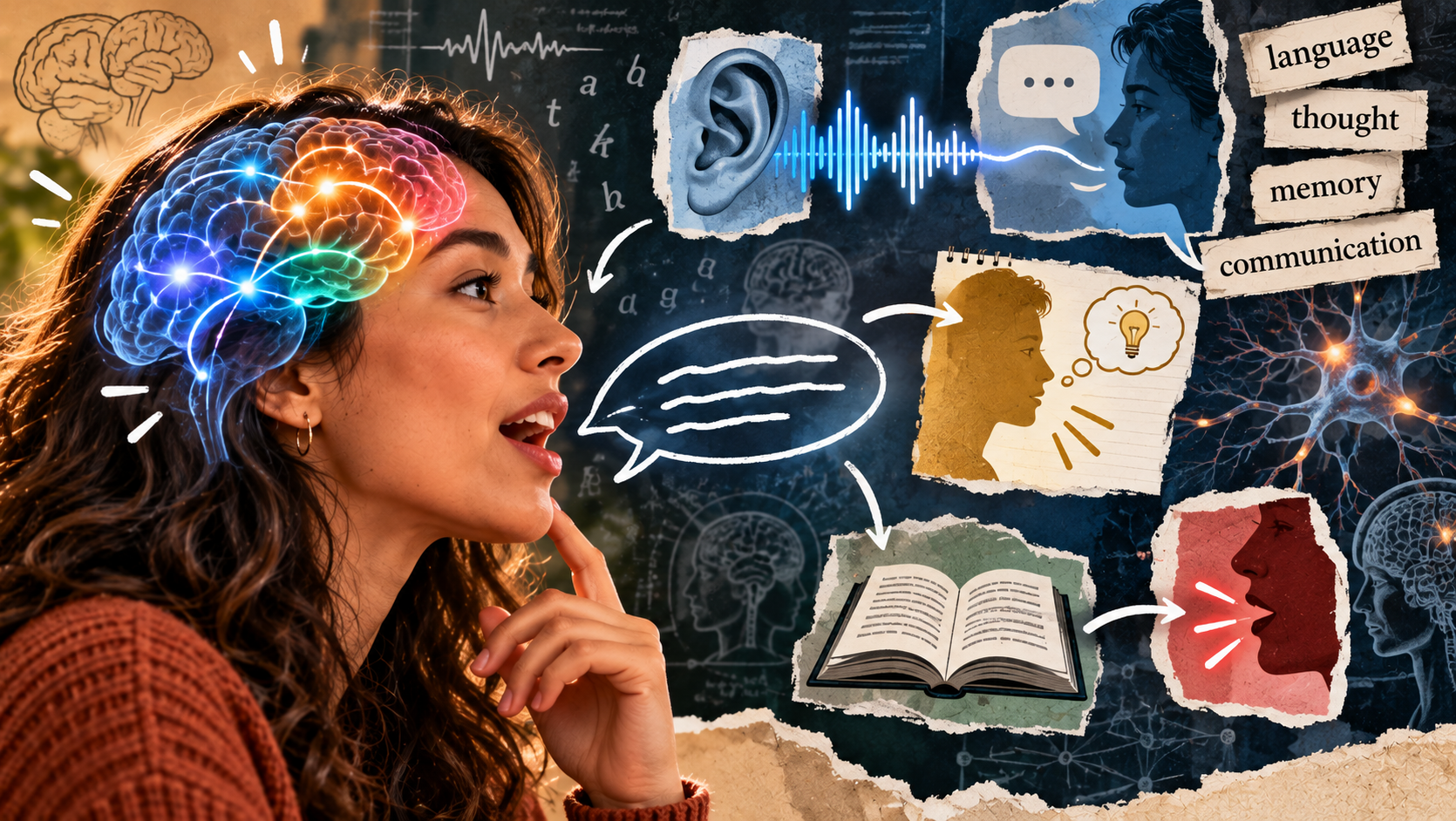
TL;DR: Psycholinguistics explains how the brain learns, understands, and produces language. It combines psychology and linguistics to reveal how we process words, structure meaning, and communicate in real time.
Language feels effortless, but your brain is doing serious work behind the scenes. Every word you read, hear, or say is processed, decoded, and predicted in milliseconds.
Psycholinguistics explores how that happens. It looks at how we understand language, produce it, and store it in memory. All in real time.
What is psycholinguistics?
Psycholinguistics is the study of how the brain processes language how we understand it, produce it, learn it, and store it in memory.
It sits between psychology and linguistics, focusing on what happens in the mind when you read a sentence, listen to someone speak, or try to find the right word.
It looks at everything from how children acquire language to why we make slips of the tongue or struggle to recall words.
The Intersection of Psychology and Linguistics
Psycholinguistics exists because language isn’t just a system of rules. It’s a mental process.
To truly understand how we communicate, you need to look at both what language is and how the brain handles it.
That’s where psychology and linguistics come together, combining structure with cognition to explain how language actually works in real life.
Explanation of both fields
Linguistics studies language itself. Its structure, rules, and patterns. It looks at things like grammar, sounds, meaning, and sentence formation to understand how language is built.
Psychology, on the other hand, focuses on the mind and behaviour. It explores how we think, learn, remember, and process information.
When you bring them together, you get a powerful perspective: not just what language looks like, but how the brain creates and understands it in real time.
How they influence each other
These two fields constantly shape one another. Linguistics provides the framework, grammar, vocabulary, and structure, while psychology explains how we actually use and process those elements.
For example, linguistic theories about sentence structure help psychologists study how quickly we can understand complex sentences.
At the same time, psychological research into memory and cognition helps linguists understand why some language patterns are easier to learn than others.
Historical context and development of psycholinguistics
Psycholinguistics didn’t emerge overnight. Early linguistics focused heavily on structure, while early psychology explored behaviour without fully addressing language.
The shift came in the mid-20th century, when researchers began asking deeper questions: How do children learn language so quickly? How does the brain process sentences in real time?
Influential thinkers like Noam Chomsky challenged existing ideas and sparked what became known as the cognitive revolution. This movement pushed researchers to study language as a mental process, not just a set of rules.
Key Concepts in Psycholinguistics
To understand how the mind processes language, you need to break it down into its core functions.
Psycholinguistics focuses on how we learn language, understand it, produce it, and store it.
Each of these processes happens rapidly and often unconsciously but together, they power everything from simple conversations to complex thought.
Language acquisition
Language acquisition is how we learn a language from scratch. For children, this happens naturally. They absorb sounds, patterns, and meanings just by being exposed to language.
- Children don’t just memorise words. They internalise grammar rules, often without being explicitly taught.
- For adults, the process is different. Learning a new language often requires more conscious effort, but the same core mechanisms, pattern recognition, repetition, and exposure, still apply.
Language comprehension
Language comprehension is how we understand spoken and written language.
It might feel instant, but your brain is doing multiple things at once, processing sounds or text, identifying words, analysing grammar, and interpreting meaning.
Psycholinguistics studies how the brain uses context, prediction, and experience to make sense of language quickly and accurately.
Language production
Language production is the process of turning thoughts into words. Before you speak or write, your brain selects the right vocabulary, organises it into a grammatical structure, and prepares it for delivery.
This process happens incredibly fast, but it’s not perfect: which is why we sometimes hesitate, mix up words, or experience “tip-of-the-tongue” moments.
Psycholinguistics examines how the brain plans and executes speech, and what happens when things go wrong.
The role of memory in language processing
Memory is the backbone of language. Without it, you couldn’t recognise words, remember meanings, or build sentences.
Different types of memory are involved. Short-term memory helps you hold onto words while processing a sentence, while long-term memory stores vocabulary, grammar rules, and past experiences with language.
Psycholinguistics looks at how these memory systems work together, allowing you to understand complex sentences, recall words instantly, and communicate effectively in real time.
Theories of Language Acquisition
How do humans learn language so quickly and so effectively?
Psycholinguistics offers several theories to explain this, each with a different take on whether language is innate, learned, or shaped through interaction.
Together, these perspectives help explain one of the most fascinating abilities of the human mind.
Nativist theories (e.g., Chomsky’s Universal Grammar)
Nativist theories argue that we’re born with an innate ability to learn language.
The most influential figure here is Noam Chomsky, who proposed the idea of Universal Grammar, a built-in set of rules that all human languages share.
According to this view, children don’t start from zero. Instead, their brains are pre-wired to recognise linguistic patterns and structures.
This explains why children can learn complex grammar so quickly, even with limited input.
Learning theories (e.g., Skinner’s behaviourism)
Learning theories take a very different approach. Psychologist B. F. Skinner argued that language is learned through interaction with the environment.
This theory is based on behaviourism, where learning happens through imitation, reinforcement, and repetition. Children copy what they hear, and correct language use is reinforced through praise or successful communication.
For example, a child says a word correctly, receives a positive response, and is more likely to use it again. Over time, these patterns build into full language use.
Interactionist approaches
Interactionist theories sit between the two extremes. They argue that language development is driven by both innate abilities and social interaction.
Children may have natural learning capabilities, but they still need meaningful communication with others to develop language fully.
Conversations with parents, caregivers, and peers provide the context, feedback, and practice needed to refine language skills.
This approach highlights the importance of environment, not just as input, but as active engagement. Language grows through use, not just exposure.
The Process of Language Comprehension
As you read or listen, your brain moves from sounds to structure to meaning, all in real time.
Psycholinguistics breaks this down into key stages that work together seamlessly to turn language into understanding.
Phonological processing
This is the first step, processing sounds. When you hear speech, your brain identifies individual sounds (phonemes) and maps them onto known words.
Even in noisy environments or with different accents, your brain is constantly predicting and filling in gaps. That’s why you can still understand someone even if you don’t catch every sound perfectly.
In short, phonological processing turns raw sound into recognisable language.
Syntactic parsing
Once words are identified, your brain organises them into a structure. This is known as syntactic parsing – figuring out how words fit together based on grammar.
For example, your brain quickly determines who is doing what in a sentence, even if the structure is complex.
When sentences are ambiguous or poorly structured, this process slows down, which is why some sentences feel harder to understand.
Syntactic parsing gives language its shape.
Semantic understanding
After structure comes meaning. Semantic processing is where your brain interprets what the words and sentences actually mean.
This involves linking words to concepts stored in memory and combining them to form a coherent idea. It’s also where misunderstandings can happen, especially with words that have multiple meanings.
Semantic understanding gives language its content.
Pragmatic interpretation
Finally, your brain considers context. Pragmatics is about going beyond the literal meaning to understand what the speaker really means.
Tone, situation, cultural norms, and prior knowledge all play a role. For example, the phrase “Nice one” could be genuine praise or sarcasm depending on context.
Pragmatic interpretation gives language its intent, helping you read between the lines and fully understand communication.
Language Production Mechanisms
Speaking might feel automatic, but it’s one of the most complex things your brain does. In a split second, you turn thoughts into structured, meaningful speech.
Psycholinguistics breaks this process down into stages, showing how the brain plans, organises, and delivers language and why it sometimes slips.
The stages of speech production
Before you say a single word, your brain has already done a lot of work. Speech production typically happens in three main stages:
- Conceptualisation: You decide what you want to say. This is where ideas are formed, before any words are chosen.
- Formulation: Your brain selects the right words and arranges them into a grammatically correct structure.
- Articulation: The physical act of speaking, where your vocal cords, tongue, and mouth produce sound.
These stages happen incredibly fast and often overlap, which is why conversation feels fluid and natural.
The role of the brain in language output
One of the most important areas is Broca’s area, which is responsible for speech planning and grammatical structuring.
When this area is disrupted, it can lead to difficulty forming sentences, even if the person knows what they want to say.
Other regions support memory, sound processing, and motor control, all coordinating to produce clear, coherent speech.
Psycholinguistics studies how these systems interact, turning abstract thoughts into spoken language in real time.
Common errors in language production
Language production is so fast that mistakes are inevitable. These errors actually reveal a lot about how the system works.
Common examples include:
- Slips of the tongue: mixing up sounds or words (e.g. “leading list” instead of “reading list”)
- Word substitutions: saying a related word by mistake
- Tip-of-the-tongue moments: knowing a word but being unable to retrieve it
These errors show that language is built in stages.
When something goes wrong, it often reflects a breakdown at a specific point, whether it’s word selection, structure, or articulation.
The Role of Neurolinguistics
If psycholinguistics explains how we process language, neurolinguistics shows where it happens in the brain.
It connects language to biology, revealing the neural systems that power speaking, understanding, and learning.
Brain regions involved in language processing
Language isn’t handled by a single “language centre”. It’s the result of multiple brain regions working together.
Key areas include:
- Broca’s area: involved in speech production and grammatical structuring
- Wernicke’s area: responsible for language comprehension and meaning
- The motor cortex: controls the physical movements needed for speech
- The auditory cortex: processes sounds and spoken language
These regions form a network, constantly communicating to turn sounds into meaning and thoughts into speech.
When everything works smoothly, language feels effortless but it’s actually a highly coordinated neural process.
The impact of brain injuries on language
When parts of this network are damaged, language abilities can be affected—sometimes dramatically.
This is known as aphasia, a condition that impacts speaking, understanding, reading, or writing.
For example:
- Damage to Broca’s area can make speech slow and difficult to produce
- Damage to Wernicke’s area can result in fluent but nonsensical speech
Neuroimaging techniques used in psycholinguistics
Modern technology allows researchers to observe the brain in action. Neuroimaging techniques have transformed our understanding of language processing.
Common methods include:
- fMRI (functional Magnetic Resonance Imaging): shows which brain areas are active during language tasks
- EEG (Electroencephalography): tracks electrical activity in the brain, capturing rapid responses to language
- PET scans (Positron Emission Tomography): measure metabolic activity linked to language processing
These tools reveal how quickly and efficiently the brain handles language, often in fractions of a second.
Psycholinguistics in Bilingualism and Multilingualism
Using more than one language doesn’t just expand communication. It reshapes how the mind works.
Psycholinguistics looks at how bilingual and multilingual individuals manage multiple language systems, often switching between them effortlessly.
Cognitive benefits of bilingualism
Bilingualism is often linked to enhanced cognitive abilities. Managing two or more languages strengthens skills like attention, problem-solving, and mental flexibility.
Bilingual individuals constantly select the right language and suppress the other; they develop stronger executive control.
The brain’s ability to focus, switch tasks, and ignore distractions. Some research also suggests benefits for memory and even long-term brain health.
In short, using multiple languages trains the brain to be more efficient and adaptable.
Language processing in bilingual individuals
For bilinguals, languages don’t sit in completely separate compartments. They’re both active at the same time. Even when speaking one language, the other is running in the background.
This means the brain is constantly selecting, filtering, and managing linguistic input. It decides which language to use based on context, environment, and intention, often in milliseconds.
Psycholinguistics studies how this dual activation works, showing that bilingual language processing is dynamic, fast, and highly controlled.
Code-switching and its implications
Code-switching is the act of switching between languages within a conversation or even within a single sentence. Far from being random, it’s a skilled and strategic behaviour.
People code-switch for many reasons: to express identity, match their audience, fill vocabulary gaps, or convey subtle meaning. It reflects both linguistic ability and social awareness.
Applications of Psycholinguistics
Psycholinguistics isn’t just theoretical. It has a real-world impact across education, healthcare, and technology.
By understanding how the mind processes language, we can design better teaching methods, support recovery from language disorders, and even build smarter machines that understand human communication.
Language education and teaching methods
Psycholinguistics helps shape how languages are taught. Instead of relying purely on memorisation, modern methods focus on how the brain naturally learns, through exposure, interaction, and meaningful use.
For example, techniques like spaced repetition, immersion, and contextual learning align with how memory and comprehension actually work.
Teachers can also use insights into processing difficulty to introduce grammar and vocabulary in a more effective order.
Speech therapy and rehabilitation
In healthcare, psycholinguistics plays a key role in diagnosing and treating language disorders.
Speech therapists use knowledge of language processing to identify where breakdowns occur, whether in understanding, word retrieval, or speech production.
This is especially important for individuals with conditions like aphasia, often caused by brain injury or stroke.
Artificial intelligence and natural language processing
Psycholinguistics also influences how machines understand language.
Fields like Natural Language Processing (NLP) aim to replicate human language abilities in systems such as chatbots, translation tools, and voice assistants.
Companies like OpenAI apply insights from human language processing to improve how AI interprets meaning, context, and intent.
Psycholinguistics FAQs
What is psycholinguistics in simple terms?
Psycholinguistics is the study of how the brain understands, produces, and learns language in real time.
How does the brain process language?
The brain processes language in stages, recognising sounds, organising grammar, interpreting meaning, and using context to understand intent.
What are the main theories of language acquisition?
The main theories include nativist (innate ability), behaviourist (learning through imitation), and interactionist (a mix of both with social input).
Why is psycholinguistics important for language learning?
It helps improve teaching methods by aligning them with how the brain naturally learns, making language learning faster and more effective.
What is the role of psycholinguistics in real life?
It’s used in education, speech therapy, and AI to improve communication, treat language disorders, and build smarter language technologies.