
|
Getting your Trinity Audio player ready...
|
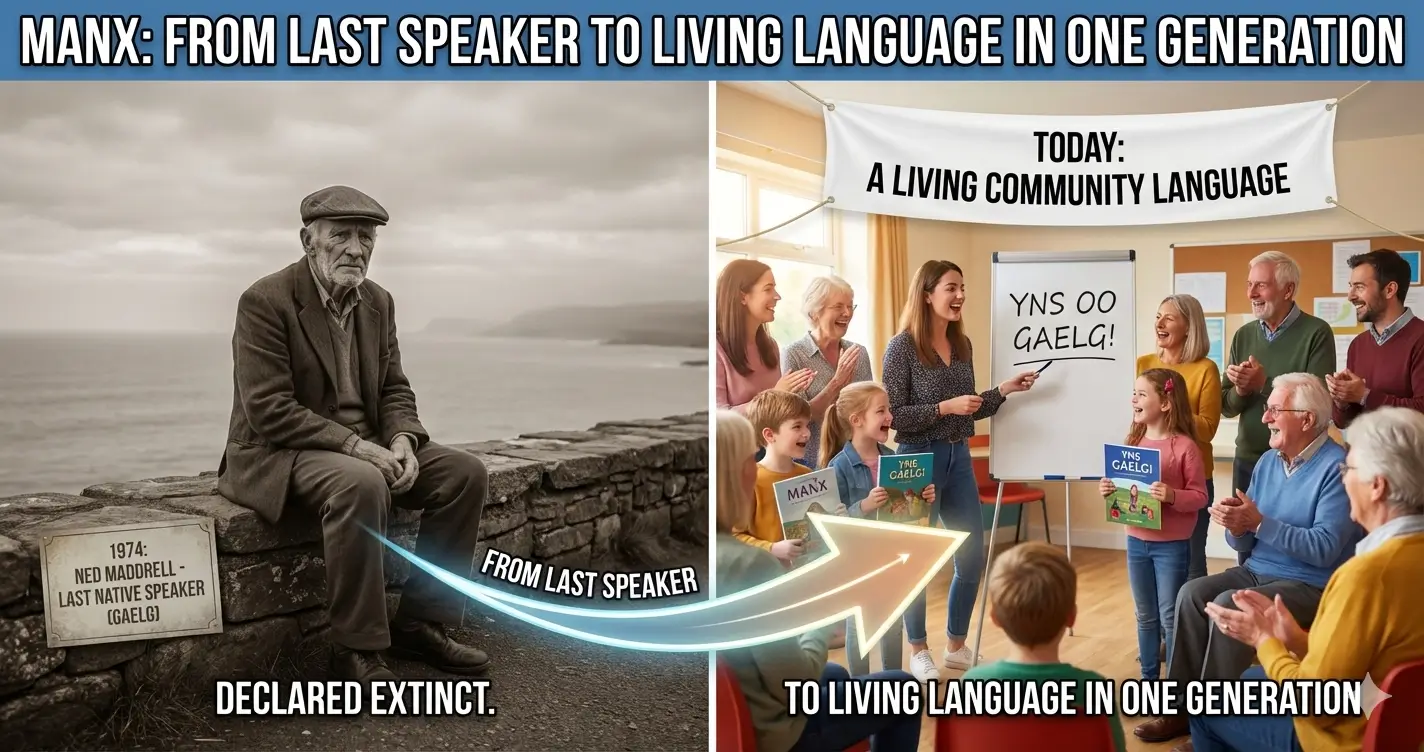
In 1974, the Manx language was declared dead.
When Ned Maddrell, the last known native speaker, died, the language was officially labelled extinct. No children were growing up with it. No streets echoed with it. According to linguists, it had no future.
They were wrong.
Within a single generation, Manx returned to daily life. Children are now educated through it, families speak it at home, musicians write new songs in it, and the language once again belongs to the Isle of Man.
The Manx language and its historical significance
Manx (Gaelg) is far more than a regional language. It is a historical record of the Isle of Man itself. Its people, laws, beliefs, and place between larger powers.
For centuries, Manx was the everyday language of the island. It shaped how people farmed, fished, worshipped, governed, and understood the world around them.
To lose Manx would not simply have meant losing words, but losing a uniquely Manx way of seeing history.
The concept of language revival and its importance
Language revival is the deliberate effort to bring a language back into active use after it has fallen out of everyday life.
Sometimes this means strengthening a language that is endangered; sometimes it means rebuilding a language that no longer has native speakers.
Crucially, revival is not about freezing a language in the past. It is about restoring its ability to function in the present and to have a future.
The Historical Context of Manx
The Manx language did not emerge in isolation
It developed on the Isle of Man, a small but strategically important island positioned between Ireland, Scotland, England, and the wider Norse world. This location shaped Manx history, culture, and language more than geography alone ever could.
Manx is best understood as a product of contact: between Celtic peoples, Viking settlers, and later English political power. Its story reflects centuries of exchange, adaptation, and survival at the edge of larger forces.
Origins and development of the Manx language
Manx belongs to the Goidelic branch of the Celtic languages, closely related to Irish and Scottish Gaelic.
It likely developed from Old Irish, brought to the island by settlers from Ireland around the early medieval period.
Over time, Manx evolved independently. While it remained clearly Celtic in structure, it absorbed influences unique to the Isle of Man. Norse rule between the 9th and 13th centuries left a lasting imprint, particularly in place-names and maritime vocabulary.
Decline of Manx speakers and the impact of English dominance
Manx did not decline because people stopped understanding it. It declined because English became the language of power.
Key factors included:
- English-only education
- Economic pressure to use English
- Social stigma around speaking Manx
By the 19th century, many families stopped passing Manx to their children. By the mid-20th century, fluent speakers were mostly elderly. When the last native speaker died in 1974, Manx was wrongly declared extinct.
The Last Native Speaker
The story of Manx reached its lowest point in the 20th century with the loss of its last native speakers.
This moment is often described as the “death” of the language. In reality, it marked the line between decline and revival.
At the centre of this turning point was one man: Ned Maddrell.
Profile of the last native speaker, Ned Maddrell
Ned Maddrell (1877–1974) was a fisherman from the village of Cregneash on the Isle of Man. Manx was his first language. The language he grew up speaking at home and in daily life.
By the time linguists took a serious interest in Manx, Maddrell was already elderly. Crucially, however, his speech was recorded.
These audio recordings captured natural Manx pronunciation, rhythm, and vocabulary, preserving elements of the language that written texts alone could not.
Circumstances surrounding the end of native fluency in the 20th century
The end of native Manx fluency was not sudden. It was the result of long-term pressure throughout the 19th and early 20th centuries.
Key factors included:
- English replacing Manx in schools
- Economic incentives to speak English
- Parents choosing not to pass Manx on to their children
- Growing stigma around Manx as “old-fashioned”
As a result, Manx was no longer learned naturally by children. Instead, it survived only among older speakers like Maddrell.
By the time of his death in 1974, there were no remaining native speakers.
The Revival Movement Begins
When Manx was declared extinct in 1974, the language was already quietly being rescued.
Its revival did not begin with government policy or large institutions, but with individuals who refused to accept that Manx belonged only to the past.
The early revival was fragile, practical, and deeply community-led.
Key figures and organisations involved in the revival of Manx
One of the most important organisations in the revival was Yn Çheshaght Ghailckagh (The Manx Language Society), founded in 1899. Long before the last native speakers died.
Its members collected vocabulary, published materials, and kept interest in Manx alive during its weakest period.
Individual learners and activists also played a crucial role. They learned Manx as adults, spoke it publicly, and treated it as a usable language rather than a museum piece. Their willingness to use imperfect Manx helped shift attitudes from preservation to revival.
Initial efforts to document and teach the language
Before Manx could be revived, it had to be recorded.
Early efforts focused on:
- Recording elderly native speakers
- Collecting traditional songs, stories, and prayers
- Producing dictionaries and grammar guides
- Standardising spelling for teaching purposes
Teaching began informally. Small classes, evening groups, and self-taught learners formed the first new generation of speakers.
There was no immersion system at first, just commitment and persistence.
Educational Initiatives
Education was the turning point in the revival of Manx.
Once the language entered classrooms, not just as a subject, but as a living means of communication. It gained something it had lacked for generations: continuity.
On the Isle of Man, education transformed Manx from a heritage interest into a language with a future.
Manx in schools and community programmes
Manx first reappeared in schools as an optional subject. Children were introduced to basic vocabulary, songs, and cultural material, helping normalise the language again.
Alongside this, community-based programmes played a vital role:
- Evening classes for adults
- Informal conversation groups
- Cultural events using Manx in real contexts
These programmes created a growing network of learners and speakers, ensuring the language was heard beyond classrooms.
Role of immersion schools and language courses
The most significant step came with immersion education. Manx-medium schooling allowed children to learn through the language, not just about it.
In immersion settings:
- Manx became the main language of instruction
- Children developed natural fluency
- English was added later, not replaced
This approach proved that Manx could function fully as a modern language of education.
Cultural Reawakening
The revival of Manx did not happen in classrooms alone.
It gathered momentum when the language re-entered culture, when people began to hear it sung, see it celebrated, and feel it as part of who they were again.
On the Isle of Man, language and identity reawakened together.
Resurgence of Manx culture and identity
As Manx returned to public life, it became a marker of pride rather than something to hide. Speaking Manx shifted from being seen as outdated to being distinctly Manx.
This cultural shift showed up in everyday ways:
- Increased use of Manx names and place-names
- Greater visibility of the language in public spaces
- A growing sense of ownership over Manx heritage
Language revival helped reconnect people with history, but without freezing it in the past. Manx identity became something lived, not just remembered.
Influence of music, arts, and festivals in promoting the language
Music and the arts played a powerful role in normalising Manx again. Songs, poetry, and performances made the language emotional, memorable, and social.
Festivals and cultural events helped by:
- Putting Manx on stage and in public celebration
- Encouraging participation rather than observation
- Creating shared experiences where the language felt natural
Technological Contributions
Technology gave the Manx revival reach. Where earlier efforts depended on classrooms and local groups, digital tools allowed Manx to be learned, heard, and used far beyond the Isle of Man.
For a small language community, this shift was crucial. Technology removed geographic limits and made Manx accessible to anyone with an internet connection.
Use of digital platforms and social media in language learning
Social media and digital platforms helped normalise Manx in everyday, modern contexts.
Short posts, videos, and audio clips showed the language being used casually rather than ceremonially. These platforms:
- Exposed learners to real, contemporary Manx
- Encouraged informal practice and interaction
- Connected speakers and learners across generations
Development of apps, websites, and online resources for Manx
Dedicated digital resources expanded access to structured learning.
Websites and online courses provided grammar guides, dictionaries, audio recordings, and exercises that learners could use independently.
Language-learning apps and digital tools supported:
- Self-paced study for beginners
- Pronunciation practice using recorded speech
- Ongoing exposure outside formal education
Community Engagement and Support
The revival of Manx succeeded because it was not left to institutions alone. It was carried by people, families, neighbours, teachers, and learners, who chose to use the language in real life.
On the Isle of Man, community support turned Manx from a taught subject into a shared social practice.
Role of local communities in fostering a supportive environment
Local communities created the conditions Manx needed to survive and grow. Instead of treating the language as fragile or ceremonial, speakers treated it as normal.
Community support showed up through:
- Conversation groups and informal meet-ups
- Use of Manx at events, shops, and cultural spaces
- Encouragement for learners, regardless of fluency level
Current Status and Future Prospects
Manx is no longer a revived experiment. It is a functioning community language again – small, but real.
On the Isle of Man, the question has shifted from Can Manx survive? to How can it grow sustainably?
Statistics on Manx speakers today
Today, Manx has:
- Several thousand people with some knowledge of the language
- Hundreds of confident speakers, including young people
- Children being educated through Manx, not just taught it
Crucially, Manx now has speakers who learned it as children, not only as adults. That marks a fundamental break from the 20th century, when fluency existed only among the elderly.
Manx is used in:
- Schools and early-years education
- Media, music, and cultural events
- Public signage and official contexts
- Homes and family life
It is no longer symbolic. It is functional.
Challenges and opportunities for the continued growth of the language
Despite its success, Manx remains vulnerable.
Key challenges include:
- A small speaker base, making continuity fragile
- Limited opportunities to use Manx in wider professional life
- Dependence on education systems and volunteer effort
- The dominance of English in digital and economic spaces
Without regular use beyond school, there is always a risk that fluency becomes passive rather than active.
Manx Language FAQs
Is Manx really a “revived” language, or is it still endangered?
Manx is best described as revived but vulnerable. It is actively spoken, taught in schools, and used in daily life, but it still has a relatively small speaker base. Its future depends on continued use beyond education and sustained community support.
How did Manx survive after the death of its last native speaker?
Manx survived because it had already been recorded, documented, and learned by committed speakers before native fluency ended. Audio recordings, written materials, and early learners meant the language was never completely lost, even after the death of Ned Maddrell.
Can children really grow up fluent in Manx today?
Yes. Children educated through Manx immersion schools learn the language naturally and fluently, much like any other first language. Many now grow up bilingual in Manx and English, especially on the Isle of Man.
What makes the Manx revival different from other language revivals?
Manx is notable because it returned to everyday use after native speakers were believed to be gone. Its revival was driven primarily by community action rather than large-scale state intervention, proving that language survival is a matter of choice, not numbers alone.
What challenges does Manx face going forward?
The main challenges include a small speaker population, limited use in professional settings, and the dominance of English in digital and economic life. The biggest long-term risk is that Manx could become a school-only language unless it continues to be used socially and at home.