
|
Getting your Trinity Audio player ready...
|
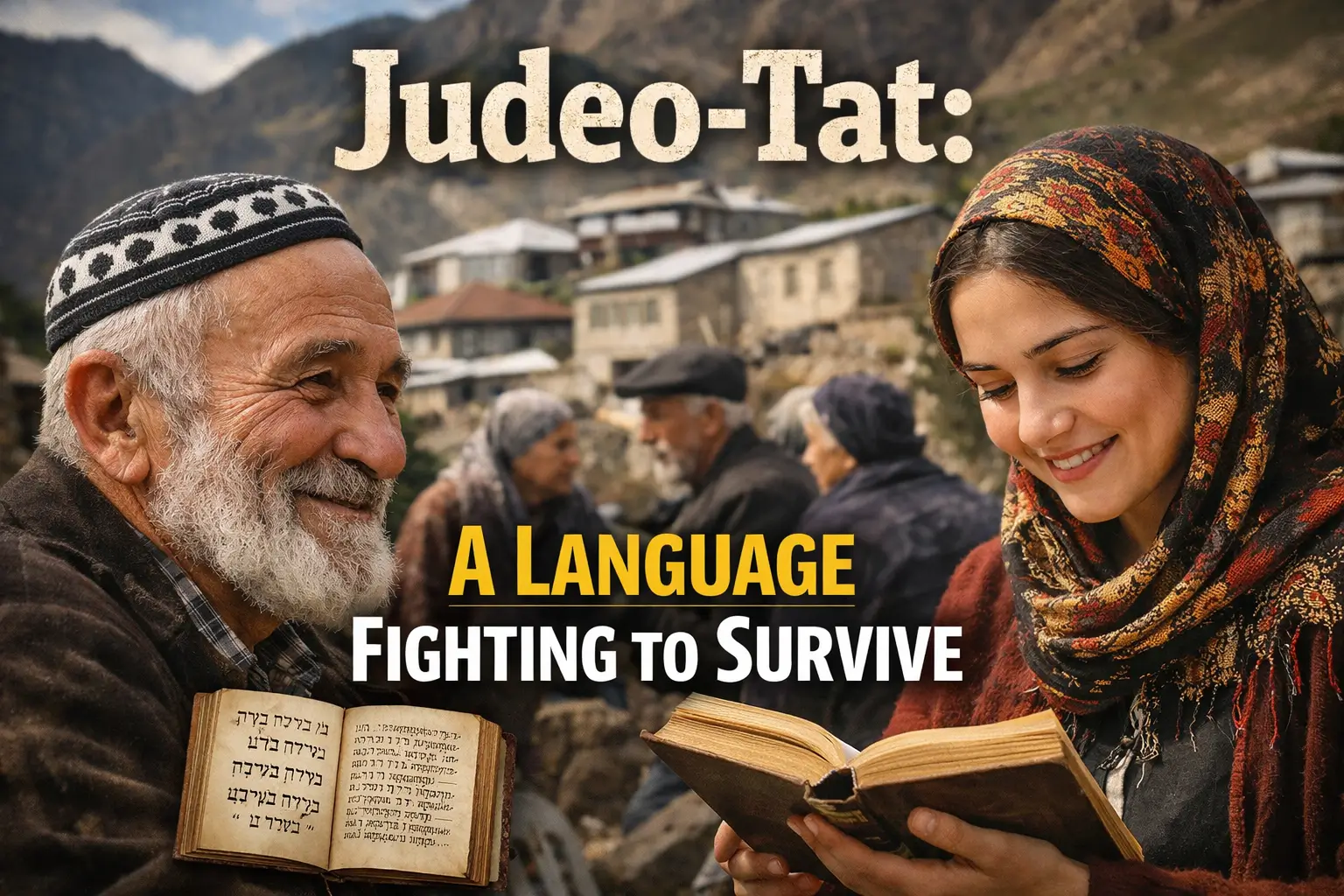
Judeo-Tat rarely makes headlines, yet it carries centuries of history, migration, and faith in every sentence.
Spoken by the Mountain Jews of the eastern Caucasus, it emerged at the crossroads of Persian, Hebrew, and life between empires. It was never a language of power, but of homes, marketplaces, prayers, and shared memory.
Today, Judeo-Tat is endangered. Younger generations are shifting to Russian, Hebrew, or Azerbaijani, and what was once an everyday language risks becoming something archived rather than spoken.
What is Judeo-Tat?
Judeo-Tat is an endangered Jewish language spoken by the Mountain Jews of the eastern Caucasus. Mainly in today’s Azerbaijan and southern Russia.
It’s an Iranian language, closely related to Persian. Shaped by centuries of Jewish life in the region and marked by Hebrew and Aramaic influence.
Today, most speakers have shifted to Russian, Azerbaijani, or Hebrew.
Importance of preserving endangered languages
Preserving endangered languages isn’t about nostalgia. It’s about protecting human knowledge.
Every language carries unique ways of understanding the world: histories, oral traditions, ecological knowledge, humour, belief systems, and social values that don’t fully translate into dominant languages.
Language loss also weakens communities. For many groups, especially indigenous and minority communities, language is tied directly to identity, belonging, and intergenerational continuity.
Historical Background
Judeo-Tat did not appear overnight. It developed through centuries of movement, contact, and adaptation in one of the world’s most culturally complex regions.
Understanding its history helps explain both its richness and its vulnerability today.
Origins of Judeo-Tat
Judeo-Tat emerged as a Jewish variety of Tat, an Iranian language related to Persian, spoken in the eastern Caucasus.
As Jewish communities settled in the region, they adapted the local language to express religious life, community norms, and identity, incorporating Hebrew and Aramaic vocabulary along the way.
Historical context of Jewish communities in the Caucasus
Judeo-Tat grew within long-established Jewish communities, not on the margins but at cultural crossroads.
Known as the Mountain Jews, these communities lived for centuries across what is now Azerbaijan and southern Russia, navigating life under Persian, Ottoman, and later Russian rule.
The language became central to daily life, reinforcing community bonds while coexisting with surrounding cultures.
Evolution of the language over time
Languages change as their speakers’ worlds change. Judeo-Tat was no exception.
Over time, contact with Russian, Azerbaijani, and other regional languages reshaped its vocabulary and usage.
In the 20th century, migration, urbanisation, and political pressure accelerated its decline, pushing Judeo-Tat from everyday speech toward endangerment.
Linguistic Features
Judeo-Tat is linguistically rich, reflecting centuries of contact between cultures, religions, and empires.
Its sound system, grammar, and vocabulary all reveal how the language developed as both a regional Iranian language and a distinctly Jewish one.
Phonetics and phonology
It includes consonant and vowel sounds familiar from Persian and neighbouring Caucasus languages, alongside features shaped by long-term contact with Azerbaijani and Russian.
Pronunciation can vary by region and generation, especially as younger speakers shift towards dominant languages.
Grammar and syntax
Judeo-Tat grammar follows patterns typical of Iranian languages, but with its own local character.
It generally uses subject–object–verb word order, relies on suffixes rather than prepositions, and marks tense and aspect through verb endings.
These structures helped the language remain stable over centuries, even as vocabulary changed.
Vocabulary and influences from other languages
Judeo-Tat’s vocabulary tells the clearest story of its history.
While its core lexicon is Iranian, it also includes significant Hebrew and Aramaic terms related to religion, ritual, and community life.
Over time, Russian and Azerbaijani loanwords entered everyday speech, reflecting migration, education, and political change.
How to Learn Judeo-Tat
Learning Judeo-Tat means learning a real, usable core of the language, even if resources are limited.
Below is a practical, beginner-friendly way to start actually using it, not just reading about it.
Start with sounds and pronunciation
Before memorising words, get comfortable with how Judeo-Tat sounds.
Judeo-Tat pronunciation is closer to Persian than to Hebrew. Vowels are clear and relatively stable, and stress usually falls naturally rather than sharply.
Listening to recordings of native speakers, even short clips, is essential. Say words out loud early; this helps lock in rhythm and intonation.
Learn essential everyday phrases
Focus first on high-frequency, everyday language, not grammar tables.
Some useful starter phrases include:
- Salam – Hello
- Tu čonî? – How are you?
- Man xobəm – I am well
- Tu nomət čî? – What is your name?
- Man noməm … – My name is …
These phrases let you form real interactions and help the language feel alive rather than abstract.
Build core vocabulary
Start with themes you actually use: family, food, time, and daily actions. Judeo-Tat vocabulary is largely Iranian, so if you know Persian, many words will feel familiar.
Religious and cultural terms often come from Hebrew, especially around holidays, prayer, and community life. Learn words in short phrases, not isolation, to understand how they behave in sentences.
Understand basic sentence structure
You don’t need complex grammar to begin. Judeo-Tat typically follows subject–object–verb order.
For example:
- “I bread eat” instead of “I eat bread.”
Getting used to this pattern early will make longer sentences feel natural later.
Learn through repetition and context
Because Judeo-Tat has few modern textbooks, repetition is your best tool.
Repeat phrases daily, read short texts aloud, and listen to the same recordings multiple times.
Pair words with stories, songs, or cultural context. Memory sticks better when language is tied to meaning.
Learn with purpose
Learning Judeo-Tat isn’t about fluency speed. It’s about use and continuity.
Even learning a small set of phrases, greetings, and cultural expressions contributes to keeping the language spoken rather than forgotten.
Cultural Significance
Judeo-Tat is more than a means of communication. It is a cultural framework that carries memory, belief, and belonging across generations.
For its speakers, the language has long been inseparable from identity and community life.
Role of Judeo-Tat in Jewish identity
Language is one of the strongest markers of identity. Judeo-Tat helped define what it meant to be a Mountain Jew.
It distinguished Jewish communities from their non-Jewish neighbours. Allowing them to remain rooted in the Caucasus.
Speaking Judeo-Tat signalled shared history, faith, and lineage. A way of being Jewish shaped outside Europe, yet connected to the wider Jewish world.
Connection to traditions, folklore, and literature
Judeo-Tat has been the language of storytelling, song, and oral tradition.
Folktales, proverbs, wedding songs, and religious narratives were passed down in Judeo-Tat. Embedding cultural values and historical memory in everyday speech.
Even where written literature was limited, the language functioned as a living archive of communal knowledge.
Current Status
Today, Judeo-Tat stands at a fragile point. While it has not disappeared, its future depends on a shrinking and ageing group of speakers and on whether the language continues to be used beyond memory and heritage.
Number of speakers and demographic trends
Estimates suggest there are tens of thousands of Judeo-Tat speakers. Fluent use is concentrated among older generations.
Many younger Mountain Jews understand the language passively but do not speak it regularly. Creating a clear break in intergenerational transmission.
Geographic distribution of Judeo-Tat speakers
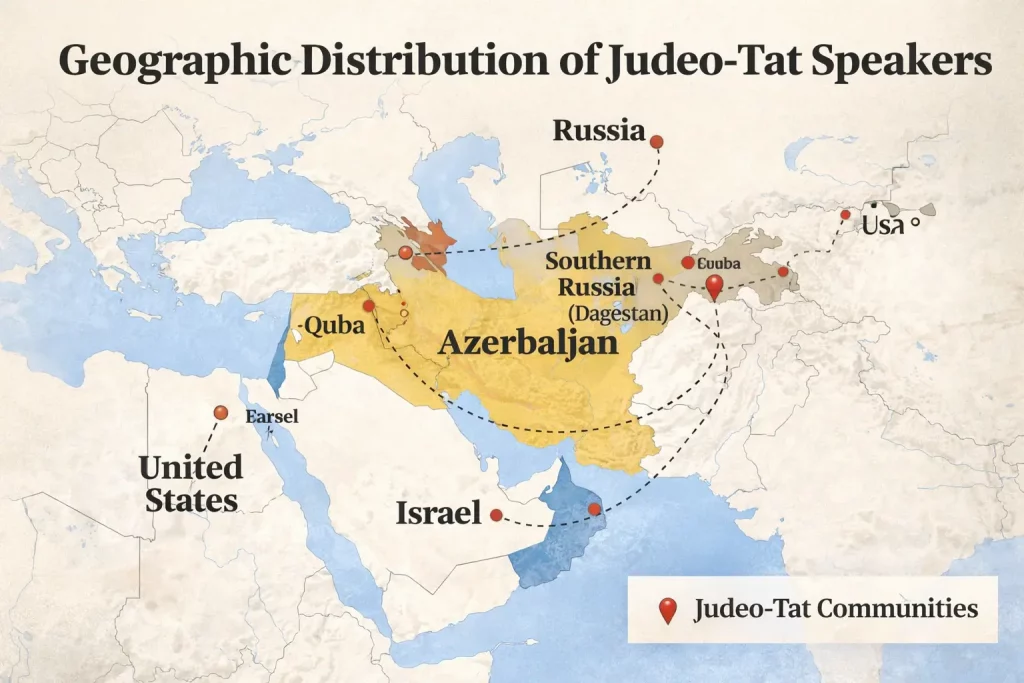
Historically centred in Azerbaijan (especially around Quba) and southern Russia (Dagestan). The speakers are now widely dispersed.
Significant communities exist in Israel, with smaller groups in Russia and elsewhere. Often as part of broader diaspora movements.
Factors contributing to language endangerment
Several forces have driven the language’s decline. Migration and urbanisation pushed speakers into dominant-language environments. Education systems favoured Russian, Hebrew, or Azerbaijani.
Over time, Judeo-Tat became confined to private or symbolic use rather than daily life. Without consistent use at home and in community spaces, the language has shifted from living speech towards endangerment.
Challenges to Preservation
Despite its cultural value, Judeo-Tat faces powerful pressures that make long-term preservation difficult.
These challenges are not unique, but together they have reduced the language’s everyday use.
Socioeconomic factors affecting language use
Economic opportunity often requires linguistic adaptation.
As Mountain Jewish communities moved to cities or migrated abroad, fluency in dominant languages became essential for education, work, and social mobility.
Judeo-Tat, associated with home and older generations, was sidelined in favour of languages seen as more practical or prestigious
Influence of dominant languages in the region
Judeo-Tat exists alongside far more dominant languages.
Russian, Azerbaijani, and Hebrew dominate public life, media, education, and administration.
Constant exposure to these languages has reduced the need for Judeo-Tat in daily communication. Especially among younger speakers who grow up multilingual but rarely use it.
Lack of institutional support for language education
Perhaps the greatest challenge is structural.
Judeo-Tat has a limited presence in schools, universities, or formal language programmes. With few textbooks, teachers, or standardised learning pathways. Transmission depends on families and community memory.
Without stronger institutional backing, preservation efforts struggle to move beyond documentation into sustained, living use.
Efforts in Revitalisation
Despite the challenges, Judeo-Tat is not disappearing.
Across communities and generations, there are growing efforts to keep the language spoken, shared, and relevant. Not just remembered.
Community initiatives to promote Judeo-Tat
Much of Judeo-Tat’s revival work begins at the community level.
Cultural associations, elders, and heritage groups play a central role by organising events, storytelling sessions, music performances, and informal language gatherings.
In many cases, the language is passed on through family interaction, community celebrations, and oral history projects rather than formal classrooms.
Role of technology and social media in language preservation
Digital tools have opened a new space for small languages like Judeo-Tat.
Audio recordings, video interviews, and social media posts allow speakers to share the language across borders. Connecting diaspora communities that would otherwise remain isolated.
Educational programmes and resources available
Formal resources remain limited, but they do exist. Linguistic documentation projects, academic publications, and archived recordings provide foundations for learning.
Some community-led initiatives and cultural organisations are beginning to adapt these materials into accessible formats. Such as beginner guides or teaching resources.
While still modest, these efforts are essential steps towards turning preservation into active use.
The Role of the Global Community
Endangered languages do not survive on local effort alone.
In a globalised world, awareness, collaboration, and support from beyond the community itself can make the difference between decline and renewal.
Importance of international awareness and support
Visibility matters.
When languages like Judeo-Tat are recognised, they are more likely to attract funding, documentation, and academic interest.
Global awareness also reframes the language as a shared part of human heritage, not just a local concern. Helping counter the idea that small languages are expendable or obsolete.
Organisations working to preserve Judeo-Tat
Preservation efforts are often driven by a mix of scholars, cultural groups, and community organisations.
Linguists document grammar, vocabulary, and oral histories. While Jewish cultural institutions and heritage initiatives support events, archives, and intergenerational transmission.
These efforts are often modest and fragmented. They provide the foundations needed for future revitalisation work.
How individuals can contribute to preservation efforts
Language preservation is not limited to experts.
Individuals can support Judeo-Tat by engaging with available materials. Sharing recordings and stories, supporting cultural initiatives, and valuing the language as a living form of expression.
Even learning a few words, amplifying community projects, or encouraging documentation helps shift the language from the margins back into use.
Judeo-Tat Language FAQs
Is Judeo-Tat still spoken today?
Yes, but it is endangered. Judeo-Tat is spoken by older generations, while many younger community members understand it but do not use it.
Where is Judeo-Tat traditionally spoken?
Judeo-Tat originated in the eastern Caucasus. Particularly in present-day Azerbaijan and southern Russia. It is now spoken within diaspora communities.
Is Judeo-Tat the same as Hebrew?
No. Judeo-Tat is an Iranian language related to Persian. It includes Hebrew and Aramaic words, especially for religious and cultural concepts. It is very different from Hebrew.
Why is Judeo-Tat considered endangered?
The language has declined due to migration, pressure from dominant languages, limited institutional support, and reduced transmission to younger generations.
Can people still learn Judeo-Tat today?
Yes, although resources are limited. Learning is possible through community initiatives, recordings, academic materials, and cultural engagement, particularly for heritage learners.