
German has a reputation for being difficult. Long compound German words, three grammatical genders, unfamiliar pronunciation, and sentences where the verb seems to disappear until the end can make the language feel intimidating at first.
But beginner German is much more manageable when you start with the words you will actually use.
Before memorising endless vocabulary lists, it helps to focus on the most common German words that appear again and again in everyday speech, reading, listening, and simple conversations.
A Note on German Noun Gender, Why It Matters From Day One
One of the first things beginners notice about German is that nouns come with gender. In English, we usually just say “the” before a noun. In German, there are three main words for “the”:
- der = masculine
- die = feminine
- das = neuter
For example:
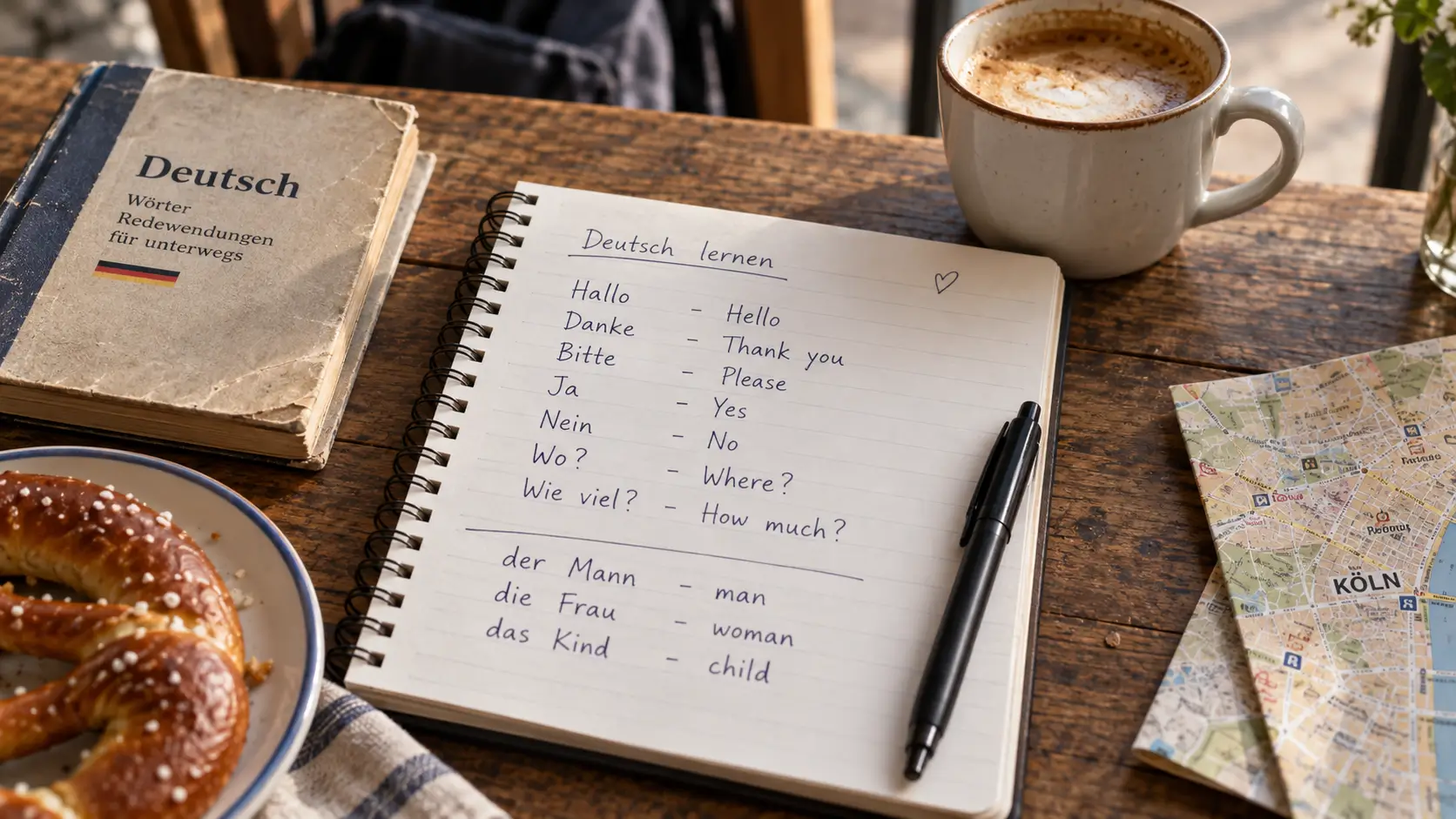
- der Mann = the man
- die Frau = the woman
- das Kind = the child
This matters because German gender is not just a small grammar detail. It affects how sentences work, including adjective endings, pronouns, and cases later on. If you learn a noun without its article, you may understand the meaning of the word, but you will make German grammar much harder for yourself later.
The best habit is to learn the article as part of the word from the beginning. Instead of memorising Frau as “woman”, memorise die Frau. Instead of learning Haus as “house”, learn das Haus. Instead of learning Tag as “day”, learn der Tag.
The 20 Most Common German Words Overall
The most common German words are not always exciting nouns like “food”, “house”, or “friend”. Many of them are small grammar words: articles, pronouns, prepositions, conjunctions, and particles.
That is actually good news. Once you recognise these words, German sentences start to feel much less mysterious. You will see them constantly in reading, hear them in everyday speech, and use them in almost every conversation.
Here are 20 of the most common German words beginners should learn first.
| German word | Pronunciation | Meaning | Usage note |
| der / die / das | dehr / dee / dass | the | The three German words for “the”. Use der for masculine nouns, die for feminine nouns, and das for neuter nouns. |
| und | oont | and | One of the easiest and most useful connector words in German. |
| in | in | in / into | Used for location and movement, depending on the sentence. |
| von | fon | from / of / by | Often used to show origin, possession, or authorship. |
| zu | tsoo | to / towards / too | Common with places, people, and infinitive verb structures. |
| den | dehn | the / him | A form of der used in certain cases, especially the accusative masculine. |
| ist | ist | is | From the verb sein, meaning “to be”. |
| nicht | nikht | not | The main word used to make a sentence negative. |
| auch | owkh | also / too | Used to add something. Ich auch means “me too”. |
| ich | ikh | I | One of the most important pronouns for basic conversation. |
| ein | ine | a / one | Used before masculine and neuter nouns. The feminine form is eine. |
| sich | zikh | oneself / himself / herself / itself | A reflexive pronoun, often used with reflexive verbs. |
| mit | mit | with | Useful for people, tools, transport, and activities. |
| auf | owf | on / onto / at | A flexible preposition used in many everyday phrases. |
| er | air | he | Masculine subject pronoun. |
| es | ess | it | Neuter subject pronoun, also used in common phrases like es gibt. |
| sie | zee | she / they / you formal | Meaning depends on context and capitalisation. Sie with a capital letter can mean formal “you”. |
| als | alss | as / than / when | Used in comparisons and some time-related expressions. |
| an | ann | at / on / to | Common in phrases involving location, contact, or direction. |
| noch | nokh | still / yet / another | Adds meaning around time, continuation, or quantity. |
Essential German Verbs (20 verbs)
Once you know a few high-frequency German verbs, you can start building real sentences very quickly. Verbs like sein meaning “to be”, haben meaning “to have”, and machen meaning “to do” or “to make” appear constantly in everyday German.
For beginners, it is useful to learn each verb in its infinitive form and in the ich form. The infinitive is the basic dictionary form of the verb, while the ich form helps you start making simple sentences about yourself.
| Infinitive | English | Ich-form present | Example sentence |
| sein | to be | ich bin | Ich bin müde. = I am tired. |
| haben | to have | ich habe | Ich habe Zeit. = I have time. |
| werden | to become / will | ich werde | Ich werde Lehrer. = I am becoming a teacher. |
| können | can / to be able to | ich kann | Ich kann Deutsch sprechen. = I can speak German. |
| müssen | must / to have to | ich muss | Ich muss gehen. = I have to go. |
| gehen | to go | ich gehe | Ich gehe nach Hause. = I am going home. |
| kommen | to come | ich komme | Ich komme aus England. = I come from England. |
| sehen | to see | ich sehe | Ich sehe das Haus. = I see the house. |
| machen | to do / to make | ich mache | Ich mache Kaffee. = I am making coffee. |
| sagen | to say | ich sage | Ich sage ja. = I say yes. |
| geben | to give | ich gebe | Ich gebe dir das Buch. = I give you the book. |
| nehmen | to take | ich nehme | Ich nehme den Bus. = I take the bus. |
| wissen | to know a fact | ich weiß | Ich weiß die Antwort. = I know the answer. |
| kennen | to know a person/place | ich kenne | Ich kenne Berlin. = I know Berlin. |
| arbeiten | to work | ich arbeite | Ich arbeite heute. = I am working today. |
| essen | to eat | ich esse | Ich esse Brot. = I eat bread. |
| trinken | to drink | ich trinke | Ich trinke Wasser. = I drink water. |
| schlafen | to sleep | ich schlafe | Ich schlafe gut. = I sleep well. |
| sprechen | to speak | ich spreche | Ich spreche ein bisschen Deutsch. = I speak a little German. |
| kaufen | to buy | ich kaufe | Ich kaufe ein Ticket. = I am buying a ticket. |
Everyday German Nouns — People & Relationships (12 words)
People and relationship words are some of the most useful German nouns to learn early. They help you talk about yourself, your family, your friends, your work, and the people around you.
Remember: with German nouns, do not learn the word alone. Learn the article too. Instead of memorising Mann, learn der Mann. Instead of memorising Familie, learn die Familie.
| German noun | Gender/article | English | Example sentence |
| der Mann | masculine: der | man | Der Mann ist hier. = The man is here. |
| die Frau | feminine: die | woman / wife | Die Frau spricht Deutsch. = The woman speaks German. |
| das Kind | neuter: das | child | Das Kind spielt. = The child is playing. |
| der Freund / die Freundin | masculine: der / feminine: die | friend / boyfriend / girlfriend | Das ist mein Freund. = That is my friend/boyfriend. |
| die Familie | feminine: die | family | Meine Familie ist groß. = My family is big. |
| die Mutter | feminine: die | mother | Meine Mutter kommt heute. = My mother is coming today. |
| der Vater | masculine: der | father | Mein Vater arbeitet viel. = My father works a lot. |
| der Bruder | masculine: der | brother | Mein Bruder wohnt in Berlin. = My brother lives in Berlin. |
| die Schwester | feminine: die | sister | Meine Schwester lernt Deutsch. = My sister is learning German. |
| der Mensch | masculine: der | person / human being | Jeder Mensch ist anders. = Every person is different. |
| der Chef | masculine: der | boss / manager | Der Chef ist im Büro. = The boss is in the office. |
| der Kollege | masculine: der | colleague | Mein Kollege ist freundlich. = My colleague is friendly. |
A useful beginner note: Freund and Freundin can mean either “friend” or “boyfriend/girlfriend”, depending on context.
To make “just a friend” clearer, German speakers may say ein Freund von mir or eine Freundin von mir, meaning “a friend of mine”.
Everyday German Nouns: Places & Things (15 words)
These German nouns are useful for talking about everyday life: where you live, where you go, what you need, and what you use.
As before, learn each noun with its article from the start. That means learning das Haus, not just Haus, and die Stadt, not just Stadt.
| German noun | Gender/article | English | Example sentence |
| das Haus | neuter: das | house | Das Haus ist gross. = The house is big. |
| die Wohnung | feminine: die | flat / apartment | Die Wohnung ist klein. = The flat is small. |
| die Stadt | feminine: die | city / town | Die Stadt ist schön. = The city is beautiful. |
| das Auto | neuter: das | car | Das Auto ist neu. = The car is new. |
| die Arbeit | feminine: die | work / job | Die Arbeit beginnt um neun. = Work starts at nine. |
| das Wasser | neuter: das | water | Das Wasser ist kalt. = The water is cold. |
| das Essen | neuter: das | food / meal | Das Essen ist gut. = The food is good. |
| das Geld | neuter: das | money | Das Geld ist auf dem Tisch. = The money is on the table. |
| die Zeit | feminine: die | time | Die Zeit vergeht schnell. = Time passes quickly. |
| das Buch | neuter: das | book | Das Buch ist interessant. = The book is interesting. |
| der Bahnhof | masculine: der | train station | Der Bahnhof ist dort. = The train station is there. |
| das Hotel | neuter: das | hotel | Das Hotel ist teuer. = The hotel is expensive. |
| der Supermarkt | masculine: der | supermarket | Der Supermarkt ist offen. = The supermarket is open. |
| die Schule | feminine: die | school | Die Schule ist gross. = The school is big. |
| das Restaurant | neuter: das | restaurant | Das Restaurant ist voll. = The restaurant is full. |
Useful German Adjectives (15 words)
Adjectives help you describe people, places, objects, feelings, and situations. With just a few common German adjectives, you can make simple sentences much more useful.
For example, instead of only saying Das Haus meaning “the house”, you can say Das Haus ist groß meaning “the house is big”.
| German adjective | English | Example sentence |
| gut | good | Das Essen ist gut. = The food is good. |
| schlecht | bad | Das Wetter ist schlecht. = The weather is bad. |
| groß | big / large | Das Haus ist groß. = The house is big. |
| klein | small | Die Wohnung ist klein. = The flat is small. |
| neu | new | Das Auto ist neu. = The car is new. |
| alt | old | Das Buch ist alt. = The book is old. |
| schnell | fast / quick | Der Zug ist schnell. = The train is fast. |
| langsam | slow | Der Bus ist langsam. = The bus is slow. |
| billig | cheap | Das Ticket ist billig. = The ticket is cheap. |
| teuer | expensive | Das Hotel ist teuer. = The hotel is expensive. |
| einfach | easy / simple | Deutsch ist nicht immer einfach. = German is not always easy. |
| schwierig | difficult | Die Frage ist schwierig. = The question is difficult. |
| schön | beautiful / nice | Die Stadt ist schön. = The city is beautiful. |
| kalt | cold | Das Wasser ist kalt. = The water is cold. |
| warm | warm | Der Kaffee ist warm. = The coffee is warm. |
Brief note on adjective endings, they change based on case and gender
One beginner note: German adjectives can change their endings when they come before a noun. For example, gut can become guter, gute, or gutes, depending on the noun’s gender, case, and article.
For now, do not worry about memorising every adjective ending at once. Start by learning the basic adjective form and using simple sentences like Das Essen ist gut or Die Stadt ist schön. Once those feel natural, adjective endings will be much easier to understand.
German Question Words (8 words)
Question words are essential because they help you ask for information, not just give simple answers. Once you know these German question words, you can start asking about people, places, time, reasons, choices, and prices.
| German question word | English | Example sentence |
| Was? | What? | Was ist das? = What is that? |
| Wer? | Who? | Wer bist du? = Who are you? |
| Wo? | Where? | Wo ist der Bahnhof? = Where is the train station? |
| Wann? | When? | Wann kommst du? = When are you coming? |
| Warum? | Why? | Warum lernst du Deutsch? = Why are you learning German? |
| Wie? | How? | Wie geht es dir? = How are you? |
| Welche / welcher / welches? | Which? | Welches Buch liest du? = Which book are you reading? |
| Wie viel? / Wie viele? | How much? / How many? | Wie viel kostet das? = How much does that cost? |
A quick beginner note: welche, welcher, and welches all mean “which”, but the ending changes depending on the noun. You will also see wie viel for uncountable things or prices, and wie viele for countable things, like people, books, or days.
Numbers, Time & Days (10 words/phrases)
Numbers, Time & Days
Numbers and time words are essential in German because they appear in everyday situations: buying things, making plans, booking travel, asking for the date, or arranging to meet someone.
Start with numbers one to ten, then learn a few basic time words and the days of the week.
German Numbers 1–10
| Number | German | Example |
| 1 | eins | Ich habe eins. = I have one. |
| 2 | zwei | Ich habe zwei Bücher. = I have two books. |
| 3 | drei | Drei Tage. = Three days. |
| 4 | vier | Vier Personen. = Four people. |
| 5 | fünf | Fünf Euro. = Five euros. |
| 6 | sechs | Sechs Minuten. = Six minutes. |
| 7 | sieben | Sieben Tage. = Seven days. |
| 8 | acht | Acht Uhr. = Eight o’clock. |
| 9 | neun | Neun Uhr. = Nine o’clock. |
| 10 | zehn | Zehn Euro. = Ten euros. |
Useful German Time Words
| German word | English | Example sentence |
| heute | today | Heute arbeite ich. = Today I am working. |
| morgen | tomorrow | Morgen komme ich. = I am coming tomorrow. |
| gestern | yesterday | Gestern war ich zu Hause. = Yesterday I was at home. |
| jetzt | now | Ich gehe jetzt. = I am going now. |
Days of the Week in German
| German day | English | Example sentence |
| Montag | Monday | Am Montag arbeite ich. = I work on Monday. |
| Dienstag | Tuesday | Am Dienstag lerne ich Deutsch. = I study German on Tuesday. |
| Mittwoch | Wednesday | Am Mittwoch gehe ich einkaufen. = I go shopping on Wednesday. |
| Donnerstag | Thursday | Am Donnerstag komme ich. = I am coming on Thursday. |
| Freitag | Friday | Am Freitag habe ich Zeit. = I have time on Friday. |
| Samstag | Saturday | Am Samstag schlafe ich lange. = I sleep late on Saturday. |
| Sonntag | Sunday | Am Sonntag esse ich mit meiner Familie. = I eat with my family on Sunday. |
A quick note: when saying “on Monday”, “on Tuesday”, or “on Sunday” in German, use am before the day: am Montag, am Dienstag, am Sonntag.
Connector Words & Sentence Glue (10 words)
Connector words are the small words that help you build real sentences. Instead of saying short, separate phrases, you can connect ideas, explain reasons, add detail, and sound more natural.
These words are especially useful once you know a few basic nouns, verbs, and adjectives.
| German word | English | Example sentence | Usage note |
| und | and | Ich trinke Kaffee und esse Brot. = I drink coffee and eat bread. | Used to connect words, phrases, or full ideas. |
| oder | or | Möchtest du Wasser oder Kaffee? = Would you like water or coffee? | Used when giving a choice. |
| aber | but | Das Buch ist gut, aber teuer. = The book is good, but expensive. | Adds contrast between two ideas. |
| weil / denn | because | Ich lerne Deutsch, weil ich in Deutschland arbeiten möchte. = I am learning German because I want to work in Germany. | Both mean “because”. Weil sends the verb to the end of the clause, while denn keeps normal word order. |
| wenn | when / if | Wenn ich Zeit habe, lerne ich Deutsch. = When/if I have time, I study German. | Can mean either “when” or “if”, depending on context. |
| auch | also / too | Ich spreche auch Englisch. = I also speak English. | Adds something extra to the sentence. |
| sehr | very | Das ist sehr gut. = That is very good. | Used before adjectives or adverbs to make them stronger. |
| noch | still / yet / another | Ich lerne noch Deutsch. = I am still learning German. | Often shows that something is continuing or not finished. |
| schon | already | Ich bin schon hier. = I am already here. | Shows that something has happened earlier than expected or is already true. |
| doch | but / yet / after all / actually | Das ist doch einfach. = That is actually easy, after all. | A tricky word with many meanings. It can soften a sentence, correct a negative idea, or add emphasis. |
Doch is one of those German words that does not always translate neatly into English. Sometimes it means “but” or “however”. Sometimes it means “actually” or “after all”. It can also be used as a one-word answer to disagree with a negative question.
For example:
- Du kommst nicht? = You’re not coming?
- Doch! = Yes, I am!
Do not worry about mastering doch immediately. At beginner level, it is enough to recognise that it often adds contrast, correction, or emphasis.
How Word Order Works in German (Quick Guide)
German word order can feel strange at first, especially when you see verbs moving around the sentence. The good news is that you do not need to master every rule immediately. At beginner level, you only need to recognise a few common patterns.
In a simple main clause, the conjugated verb usually comes in the second position.
Ich lerne Deutsch. = I am learning German.
Here, lerne is the verb, and it comes second.
This does not always mean the verb is the second word. It means the verb is the second idea or sentence element. For example:
Heute lerne ich Deutsch. = Today, I am learning German.
Here, Heute comes first, so the verb lerne still comes second, before ich.
Modal verbs, such as können meaning “can” and müssen meaning “must”, change the pattern slightly. The modal verb takes the second position, and the main verb goes to the end in its infinitive form.
Ich kann Deutsch sprechen. = I can speak German.
Here, kann is second, and sprechen goes to the end.
You will also see the verb move to the end in subordinate clauses, especially after words like weil meaning “because”, dass meaning “that”, and wenn meaning “when” or “if”.
Ich lerne Deutsch, weil ich in Deutschland arbeiten möchte. = I am learning German because I want to work in Germany.
Here, möchte moves to the end of the weil clause.
For now, do not treat this as a full grammar lesson. Just remember these three beginner patterns:
| Pattern | German example | English meaning |
| Main clause: verb in second position | Ich lerne Deutsch. | I am learning German. |
| Modal verb: second verb goes to the end | Ich kann Deutsch sprechen. | I can speak German. |
| Subordinate clause: verb goes to the end | Ich lerne Deutsch, weil ich in Deutschland arbeiten möchte. | I am learning German because I want to work in Germany. |
Once you start noticing these patterns, German sentences become much easier to follow. Instead of panicking when a verb appears at the end, you can recognise what is happening and understand the structure more clearly.
German Words FAQ
What are the most common German words?
The most common German words are usually small function words, such as und meaning “and”, die, der, and das meaning “the”, in meaning “in”, and forms of sein meaning “to be”.
These words appear constantly, so beginners should learn them early alongside nouns, verbs, and everyday phrases. Resources like DW Learn German can complement your vocabulary study with free audio and structured lessons.
How many German words do I need to have basic conversations?
Around 500 to 1,000 common German words is a strong beginner target for basic conversations. This broadly matches the A1 to A2 vocabulary range set out by the Goethe-Institut.
That should help you manage introductions, simple questions, travel situations, shopping, food, family, time, and everyday needs.
Do I need to know the gender for every German noun?
Yes. Learn German nouns with their article from the start: der Mann, die Frau, das Kind.
Gender affects articles, adjective endings, pronouns, and cases, so ignoring it early makes grammar harder later.
What is the most common verb in German?
The most common German verb is sein, meaning “to be”.
You will see it in everyday forms like ich bin meaning “I am”, du bist meaning “you are”, and es ist meaning “it is”.