
French sounds beautiful, but it does not always sound how it looks. Silent letters, accents, liaison and noun gender can make even simple french words feel tricky at first.
This guide gives you 100 of the most common French words for beginners, with meanings, pronunciation notes, example sentences and the gender of every noun. Use it to build a strong foundation, avoid bad habits, and start recognising real French in everyday conversations.
A Note on French Noun Gender and Pronunciation
Before you start learning French words, there are two things to pay attention to: gender and sound. French spelling does not always tell you exactly how a word is pronounced, so it is worth learning the word and the pronunciation together.
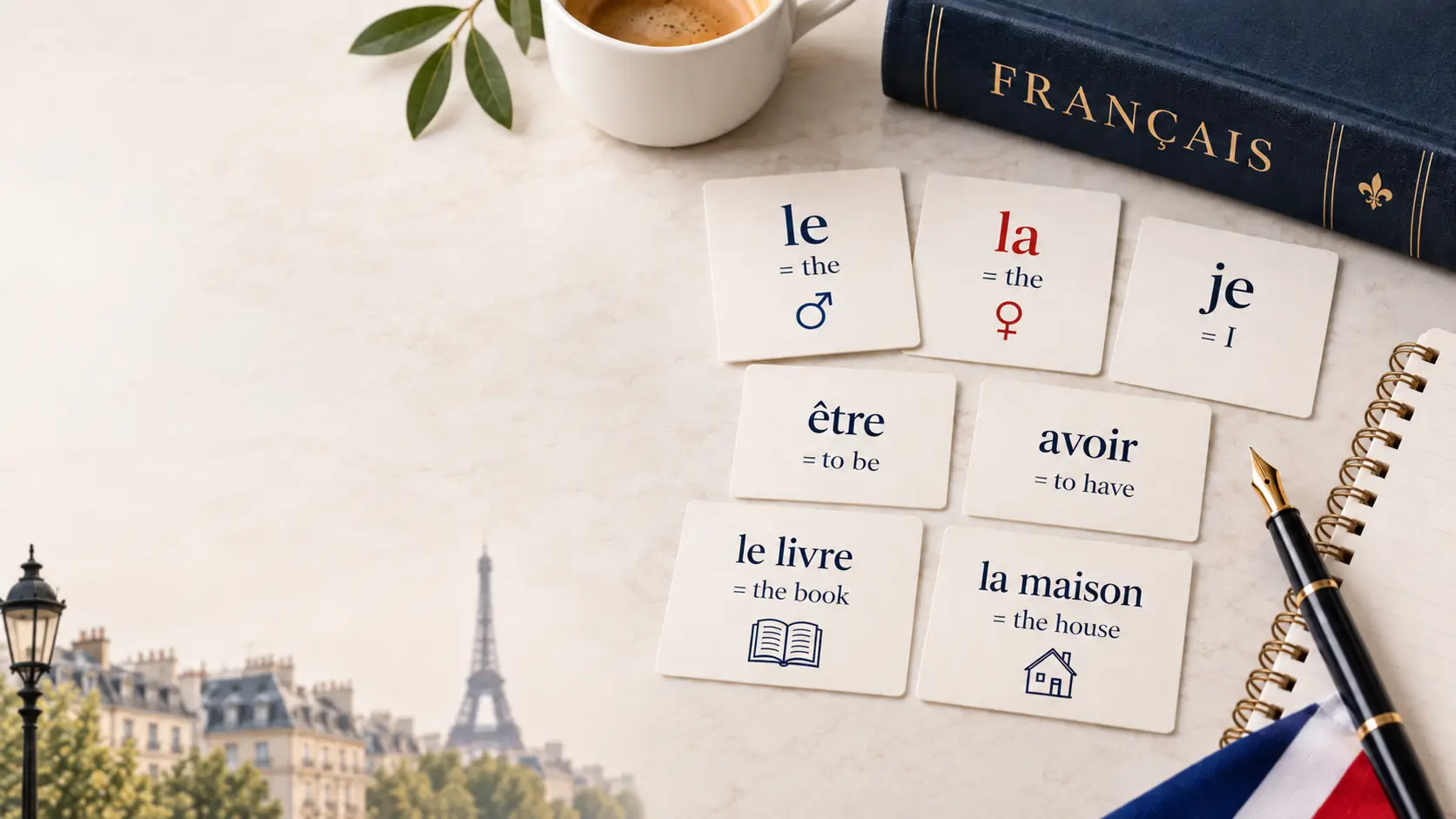
Every French noun is either masculine or feminine. Masculine nouns usually use le, while feminine nouns use la. For example, le livre means “the book”, while la maison means “the house”. When a noun begins with a vowel, le or la becomes l’, as in l’école.
French also has many silent final letters. In words like chaud, nuit and vous, the final consonant is usually not pronounced. This is one reason French can look very different from how it sounds.
Another important feature is liaison. This happens when a normally silent final consonant is pronounced because the next word begins with a vowel. For example, les enfants is pronounced more like lay-zan-fan, because the s in les links to enfants.
Finally, French has several nasal vowel sounds, especially in words with un, on, en/an and in. These sounds come through the nose and can take time to master, but recognising them early will make French pronunciation much easier.
The 20 Most Frequent French Words
These are some of the most common French words you will see again and again. Many are small “grammar words” rather than exciting vocabulary, but they are essential because they hold sentences together.
| French word | Meaning | Pronunciation note | Example sentence |
| le | the | Like “luh” | Le café est chaud. = The coffee is hot. |
| la | the | “lah” | La maison est grande. = The house is big. |
| les | the | “lay” | Les enfants jouent. = The children are playing. |
| de | of / from | Like “duh” | Je viens de Paris. = I come from Paris. |
| un | a / one | Nasal sound | J’ai un livre. = I have a book. |
| une | a / one | Like “oon” | C’est une table. = It is a table. |
| et | and | “ay” | Toi et moi. = You and me. |
| en | in / some / of it | Nasal sound | J’habite en France. = I live in France. |
| que | that / what | Like “kuh” | Je pense que oui. = I think so. |
| qui | who / which | “kee” | Qui est là ? = Who is there? |
| je | I | Soft “zhuh” sound | Je parle français. = I speak French. |
| il | he / it | “eel” | Il est ici. = He is here. |
| à | to / at / in | “ah” | Je vais à Paris. = I am going to Paris. |
| pas | not | Final s is silent | Je ne sais pas. = I do not know. |
| dans | in / inside | Nasal sound, silent s | Il est dans la maison. = He is in the house. |
| être | to be | Like “ehtr” | Je veux être prêt. = I want to be ready. |
| avoir | to have | “ah-vwahr” | Je veux avoir le temps. = I want to have time. |
| faire | to do / make | “fehr” | Je vais faire du café. = I am going to make coffee. |
| aller | to go | “ah-lay” | Je vais aller au marché. = I am going to go to the market. |
| dire | to say / tell | “deer” | Je veux dire merci. = I want to say thank you. |
Learn these words early because they appear everywhere. Even before you know hundreds of nouns and adjectives, words like le, de, je, être, avoir and aller will help you understand the basic structure of French sentences.
Essential French Verbs (20 verbs)
Verbs are some of the most useful French words to learn early because they let you build real sentences quickly. If you want to go deeper, our French Grammar for Beginners guide covers verb conjugation in full.
With just a few verbs, you can say what you are, what you have, where you are going, what you want, what you know and what you like.
French verbs change depending on the subject, so in this table you will see both the infinitive form and the je form. The infinitive is the basic dictionary form, while the je form shows how to use the verb when talking about yourself.
| Infinitive | Je form | Pronunciation | Example |
| être = to be | je suis | zhuh swee | Je suis étudiant. = I am a student. |
| avoir = to have | j’ai | zhay | J’ai un livre. = I have a book. |
| aller = to go | je vais | zhuh vay | Je vais à Paris. = I am going to Paris. |
| faire = to do / make | je fais | zhuh fay | Je fais du café. = I am making coffee. |
| dire = to say / tell | je dis | zhuh dee | Je dis merci. = I say thank you. |
| pouvoir = can / to be able to | je peux | zhuh puh | Je peux aider. = I can help. |
| vouloir = to want | je veux | zhuh vuh | Je veux apprendre. = I want to learn. |
| savoir = to know | je sais | zhuh say | Je sais la réponse. = I know the answer. |
| venir = to come | je viens | zhuh vee-an | Je viens de Londres. = I come from London. |
| voir = to see | je vois | zhuh vwah | Je vois la maison. = I see the house. |
| prendre = to take | je prends | zhuh prahn | Je prends le train. = I take the train. |
| partir = to leave | je pars | zhuh par | Je pars demain. = I am leaving tomorrow. |
| mettre = to put | je mets | zhuh may | Je mets le livre ici. = I put the book here. |
| manger = to eat | je mange | zhuh mahnzh | Je mange une pomme. = I eat an apple. |
| boire = to drink | je bois | zhuh bwah | Je bois de l’eau. = I drink water. |
| travailler = to work | je travaille | zhuh tra-vy | Je travaille aujourd’hui. = I work today. |
| parler = to speak | je parle | zhuh parl | Je parle français. = I speak French. |
| acheter = to buy | j’achète | zhah-shet | J’achète du pain. = I buy bread. |
| chercher = to look for | je cherche | zhuh shersh | Je cherche mon sac. = I am looking for my bag. |
| aimer = to like / love | j’aime | zhem | J’aime la musique. = I like music. |
Essential French Nouns: People & Relationships (12 words)
People and relationship words are some of the most useful French nouns to learn early. Notice that every noun has a gender, even when the English translation does not. Learn the article with the word: le for masculine, la for feminine, and l’ before a vowel. If you are ever unsure of a noun’s gender, the WordReference French dictionary always lists it.
| French noun | Meaning | Pronunciation | Example |
| l’homme | the man | lom | L’homme parle français. = The man speaks French. |
| la femme | the woman / wife | lah fam | La femme est ici. = The woman is here. |
| l’enfant | the child | lon-fon | L’enfant joue. = The child is playing. |
| l’ami / l’amie | the friend | lah-mee | C’est mon ami. = He is my friend. |
| la famille | the family | lah fa-mee | Ma famille habite à Paris. = My family lives in Paris. |
| la mère | the mother | lah mehr | Ma mère travaille. = My mother works. |
| le père | the father | luh pehr | Mon père est gentil. = My father is kind. |
| le frère | the brother | luh frehr | J’ai un frère. = I have a brother. |
| la sœur | the sister | lah suhr | Ma sœur est étudiante. = My sister is a student. |
| la personne | the person | lah pair-son | Cette personne est gentille. = This person is kind. |
| le monsieur | the gentleman / man | luh muh-syuh | Le monsieur attend ici. = The gentleman is waiting here. |
| Madame | Mrs / Madam | mah-dam | Bonjour, Madame. = Hello, Madam. |
A useful note: Madame is normally used without la when speaking to someone directly, as in Bonjour, Madame. For “the lady”, French usually says la dame, not la madame. For a full list of polite expressions, see our guide on French greetings.
Essential French Nouns: Places & Objects (15 words)
These French nouns help you talk about everyday places, travel, food, money and basic objects. Pay attention to the article before each word: le is masculine, la is feminine, and l’ is used before a vowel.
| French noun | Meaning | Pronunciation | Example |
| la maison | the house | lah may-zon | La maison est grande. = The house is big. |
| la ville | the city / town | lah veel | J’habite dans la ville. = I live in the city. |
| le travail | work / job | luh tra-vy | Je vais au travail. = I am going to work. |
| la voiture | the car | lah vwah-tur | La voiture est rouge. = The car is red. |
| le restaurant | the restaurant | luh res-toh-ron | Le restaurant est ouvert. = The restaurant is open. |
| l’eau | the water | loh | Je bois de l’eau. = I drink water. |
| la nourriture | the food | lah noo-ree-tur | La nourriture est bonne. = The food is good. |
| l’argent | the money | lar-zhon | J’ai de l’argent. = I have money. |
| le temps | time / weather | luh ton | Le temps est mauvais. = The weather is bad. |
| le livre | the book | luh leevr | Je lis un livre. = I am reading a book. |
| l’aéroport | the airport | lah-ay-ro-por | Je vais à l’aéroport. = I am going to the airport. |
| l’hôtel | the hotel | loh-tel | L’hôtel est près de la gare. = The hotel is near the train station. |
| la rue | the street | lah roo | La rue est calme. = The street is quiet. |
| la gare | the train station | lah gar | La gare est loin. = The train station is far away. |
| le magasin | the shop | luh ma-ga-zan | Le magasin est fermé. = The shop is closed. |
A useful beginner tip: le temps can mean both time and weather, depending on the sentence. For example, Je n’ai pas le temps means “I do not have time”, while Le temps est mauvais means “The weather is bad”.
French Adjectives (15 words)
French adjectives help you describe people, places, objects and situations. Many adjectives change depending on whether the noun is masculine or feminine, so it is useful to learn both forms together.
| French adjective | Meaning | Pronunciation | Example |
| grand / grande | big / tall | grahn / grahnd | La maison est grande. = The house is big. |
| petit / petite | small / little | puh-tee / puh-teet | Le livre est petit. = The book is small. |
| bon / bonne | good | bohn / bun | La nourriture est bonne. = The food is good. |
| mauvais / mauvaise | bad | moh-vay / moh-vez | Le temps est mauvais. = The weather is bad. |
| nouveau / nouvelle | new | noo-vo / noo-vel | C’est un nouveau restaurant. = It is a new restaurant. |
| vieux / vieille | old | vyuh / vyay | La voiture est vieille. = The car is old. |
| beau / belle | beautiful | bo / bel | C’est une belle ville. = It is a beautiful city. |
| rapide | fast | ra-peed | Le train est rapide. = The train is fast. |
| lent / lente | slow | lon / lont | Le service est lent. = The service is slow. |
| cher / chère | expensive | sher | L’hôtel est cher. = The hotel is expensive. |
| pas cher / pas chère | cheap / not expensive | pah sher | Ce café n’est pas cher. = This coffee is cheap. |
| facile | easy | fa-seel | C’est facile. = It is easy. |
| difficile | difficult | dee-fee-seel | Le français est difficile. = French is difficult. |
| chaud / chaude | hot | sho / shod | Le café est chaud. = The coffee is hot. |
| froid / froide | cold | frwah / frwahd | L’eau est froide. = The water is cold. |
A quick rule: many French adjectives add -e in the feminine form, but pronunciation does not always change. In words like grand/grande, petit/petite, chaud/chaude and froid/froide, the final consonant is often silent in the masculine form but pronounced in the feminine form.
French adjective agreement: must match noun in gender and number
In French, adjectives usually change to match the noun they describe. This is called adjective agreement.
French adjectives must match the noun in:
- Gender: masculine or feminine
- Number: singular or plural
For many adjectives, you add -e for the feminine form and -s for the plural form.
French Question Words & Time Words (12 words)
Question words help you ask for basic information, while time words help you talk about when something happens. These are small words, but they appear constantly in real French conversations. If you want to improve how natural you sound when asking questions, visit our article on sounding natural in French.
| French word | Meaning | Pronunciation | Example |
| Qu’est-ce que ? / Que ? | what? | kes-kuh / kuh | Qu’est-ce que c’est ? = What is it? |
| Qui ? | who? | kee | Qui est là ? = Who is there? |
| Où ? | where? | oo | Où est la gare ? = Where is the train station? |
| Quand ? | when? | kon | Quand pars-tu ? = When are you leaving? |
| Pourquoi ? | why? | poor-kwah | Pourquoi tu apprends le français ? = Why are you learning French? |
| Comment ? | how? | ko-mon | Comment ça va ? = How are you? |
| Combien ? | how much / how many? | kom-byen | Combien ça coûte ? = How much does it cost? |
| Aujourd’hui | today | oh-zhoor-dwee | Je travaille aujourd’hui. = I am working today. |
| Demain | tomorrow | duh-man | Je pars demain. = I am leaving tomorrow. |
| Hier | yesterday | yair | J’ai travaillé hier. = I worked yesterday. |
| Maintenant | now | man-tuh-non | Je suis prêt maintenant. = I am ready now. |
| Bientôt | soon | byen-toh | À bientôt ! = See you soon! |
A quick note: Qu’est-ce que ? is very common in everyday French and is usually easier for beginners than using que on its own. For example, Qu’est-ce que tu veux ? means “What do you want?”
Essential French Connectors (10 words)
Connectors are small words that make your French sound more natural. They help you join ideas, explain reasons, compare things and build longer sentences. For more on how to use them fluently, see our guide on sounding natural in French.
| French word | Meaning | Pronunciation | Example |
| et | and | ay | Toi et moi. = You and me. |
| ou | or | oo | Thé ou café ? = Tea or coffee? |
| mais | but | meh | Je veux venir, mais je travaille. = I want to come, but I am working. |
| parce que | because | pars-kuh | J’apprends le français parce que j’aime la langue. = I am learning French because I like the language. |
| si | if | see | Si tu veux, je peux aider. = If you want, I can help. |
| aussi | also / too | oh-see | Moi aussi. = Me too. |
| très | very | treh | C’est très bon. = It is very good. |
| plus | more | ploo / ploos | Je veux plus de temps. = I want more time. |
| moins | less | mwan | C’est moins cher. = It is less expensive. |
| avec | with | ah-vek | Je suis avec ma famille. = I am with my family. |
A quick pronunciation note: plus changes sound depending on how it is used. When it means “more”, it is often pronounced ploos before a vowel or on its own, but ploo before a consonant.
Numbers 1–10 in French
Numbers are some of the first French words beginners should learn. You will use them for prices, ages, dates, phone numbers, addresses and everyday conversations.
| Number | French | Pronunciation |
| 1 | un / une | uh / oon |
| 2 | deux | duh |
| 3 | trois | trwah |
| 4 | quatre | katr |
| 5 | cinq | sank |
| 6 | six | sees |
| 7 | sept | set |
| 8 | huit | weet |
| 9 | neuf | nuhf |
| 10 | dix | dees |
Use un with masculine nouns and une with feminine nouns. For example, un livre means “one book”, while une maison means “one house”.
For a full guide, see our dedicated article on French numbers.
Pronunciation Tips for Beginners
French pronunciation can feel difficult at first because words do not always sound how they look. Before memorising hundreds of new words, it helps to understand a few common patterns. Tools like Forvo can help you hear native speaker pronunciations for individual French words.
The French R
The French r is different from the English r. Instead of rolling from the front of the mouth, it is usually made at the back of the throat.
For example:
- restaurant
- rue
- frère
- travailler
Do not force it too much at the start. A soft throat sound is better than a strong English r.
Silent Final Consonants
In French, final consonants are often silent. This means the last letter of a word may be written, but not clearly pronounced.
For example:
| French word | Pronunciation note |
| chaud | final d is silent |
| froid | final d is silent |
| vous | final s is silent |
| temps | final ps is silent |
| petit | final t is usually silent |
There are exceptions, but this pattern is one of the biggest reasons French spelling and pronunciation can feel different.
U vs OU
French u and ou are completely different sounds.
| French word | Meaning | Pronunciation note |
| tu | you | French u sound |
| tout | all / everything | ou sounds like “oo” |
| rue | street | French u sound |
| vous | you | ou sounds like “oo” |
For English speakers, ou is usually easier because it sounds close to “oo” in “food”. French u is tighter and more forward in the mouth.
Nasal Vowels
French also has nasal vowel sounds, where the sound passes partly through the nose. These appear in common spellings like an, en, in, ain, on and un.
| Spelling | Example | Pronunciation note |
| an / en | enfant, dans | nasal “on/ahn” sound |
| in / ain | pain, matin | nasal “an” sound |
| on | bon, maison | nasal “on” sound |
| un | un, brun | nasal un sound |
You do not need perfect pronunciation immediately. Focus first on recognising the patterns: silent final letters, liaison, nasal vowels, and the difference between u and ou. These will make the most common French words much easier to remember and say correctly. Our guide to French listening practice for beginners can also help you tune your ear to these sounds.
Full Reference Table
| French word | Article (if noun) | Pronunciation | English | Example sentence |
| le | — | luh | the | Le café est chaud. = The coffee is hot. |
| la | — | lah | the | La maison est grande. = The house is big. |
| les | — | lay | the | Les enfants jouent. = The children are playing. |
| de | — | duh | of / from | Je viens de Paris. = I come from Paris. |
| un | — | uh | a / one | J’ai un livre. = I have a book. |
| une | — | oon | a / one | C’est une table. = It is a table. |
| et | — | ay | and | Toi et moi. = You and me. |
| en | — | on | in / some / of it | J’habite en France. = I live in France. |
| que | — | kuh | that / what | Je pense que oui. = I think so. |
| qui | — | kee | who / which | Qui est là ? = Who is there? |
| je | — | zhuh | I | Je parle français. = I speak French. |
| il | — | eel | he / it | Il est ici. = He is here. |
| à | — | ah | to / at / in | Je vais à Paris. = I am going to Paris. |
| pas | — | pah | not | Je ne sais pas. = I do not know. |
| dans | — | don | in / inside | Il est dans la maison. = He is in the house. |
| être | — | ehtr | to be | Je suis étudiant. = I am a student. |
| avoir | — | ah-vwahr | to have | J’ai un livre. = I have a book. |
| aller | — | ah-lay | to go | Je vais au marché. = I am going to the market. |
| faire | — | fehr | to do / make | Je fais du café. = I am making coffee. |
| dire | — | deer | to say / tell | Je dis merci. = I say thank you. |
| pouvoir | — | poo-vwahr | can / to be able to | Je peux aider. = I can help. |
| vouloir | — | voo-lwahr | to want | Je veux apprendre. = I want to learn. |
| savoir | — | sah-vwahr | to know | Je sais la réponse. = I know the answer. |
| venir | — | vuh-neer | to come | Je viens de Londres. = I come from London. |
| voir | — | vwahr | to see | Je vois la maison. = I see the house. |
| prendre | — | prondr | to take | Je prends le train. = I take the train. |
| partir | — | par-teer | to leave | Je pars demain. = I am leaving tomorrow. |
| mettre | — | metr | to put | Je mets le livre ici. = I put the book here. |
| manger | — | mon-zhay | to eat | Je mange une pomme. = I eat an apple. |
| boire | — | bwahr | to drink | Je bois de l’eau. = I drink water. |
| travailler | — | tra-vy-ay | to work | Je travaille aujourd’hui. = I work today. |
| parler | — | par-lay | to speak | Je parle français. = I speak French. |
| acheter | — | ash-tay | to buy | J’achète du pain. = I buy bread. |
| chercher | — | shair-shay | to look for | Je cherche mon sac. = I am looking for my bag. |
| aimer | — | eh-may | to like / love | J’aime la musique. = I like music. |
| homme | l’homme | lom | man | L’homme parle français. = The man speaks French. |
| femme | la femme | lah fam | woman / wife | La femme est ici. = The woman is here. |
| enfant | l’enfant | lon-fon | child | L’enfant joue. = The child is playing. |
| ami / amie | l’ami / l’amie | lah-mee | friend | C’est mon ami. = He is my friend. |
| famille | la famille | lah fa-mee | family | Ma famille habite à Paris. = My family lives in Paris. |
| mère | la mère | lah mehr | mother | Ma mère travaille. = My mother works. |
| père | le père | luh pehr | father | Mon père est gentil. = My father is kind. |
| frère | le frère | luh frehr | brother | J’ai un frère. = I have a brother. |
| sœur | la sœur | lah suhr | sister | Ma sœur est étudiante. = My sister is a student. |
| personne | la personne | lah pair-son | person | Cette personne est gentille. = This person is kind. |
| monsieur | le monsieur | luh muh-syuh | gentleman / man | Le monsieur attend ici. = The gentleman is waiting here. |
| madame | Madame | mah-dam | Madam / Mrs | Bonjour, Madame. = Hello, Madam. |
| maison | la maison | lah may-zon | house | La maison est grande. = The house is big. |
| ville | la ville | lah veel | city / town | J’habite dans la ville. = I live in the city. |
| travail | le travail | luh tra-vy | work / job | Je vais au travail. = I am going to work. |
| voiture | la voiture | lah vwah-tur | car | La voiture est rouge. = The car is red. |
| restaurant | le restaurant | luh res-toh-ron | restaurant | Le restaurant est ouvert. = The restaurant is open. |
| eau | l’eau | loh | water | Je bois de l’eau. = I drink water. |
| nourriture | la nourriture | lah noo-ree-tur | food | La nourriture est bonne. = The food is good. |
| argent | l’argent | lar-zhon | money | J’ai de l’argent. = I have money. |
| temps | le temps | luh ton | time / weather | Le temps est mauvais. = The weather is bad. |
| livre | le livre | luh leevr | book | Je lis un livre. = I am reading a book. |
| aéroport | l’aéroport | lah-ay-ro-por | airport | Je vais à l’aéroport. = I am going to the airport. |
| hôtel | l’hôtel | loh-tel | hotel | L’hôtel est près de la gare. = The hotel is near the train station. |
| rue | la rue | lah roo | street | La rue est calme. = The street is quiet. |
| gare | la gare | lah gar | train station | La gare est loin. = The train station is far away. |
| magasin | le magasin | luh ma-ga-zan | shop | Le magasin est fermé. = The shop is closed. |
| grand / grande | — | grahn / grahnd | big / tall | La maison est grande. = The house is big. |
| petit / petite | — | puh-tee / puh-teet | small / little | Le livre est petit. = The book is small. |
| bon / bonne | — | bohn / bun | good | La nourriture est bonne. = The food is good. |
| mauvais / mauvaise | — | moh-vay / moh-vez | bad | Le temps est mauvais. = The weather is bad. |
| nouveau / nouvelle | — | noo-vo / noo-vel | new | C’est un nouveau restaurant. = It is a new restaurant. |
| vieux / vieille | — | vyuh / vyay | old | La voiture est vieille. = The car is old. |
| beau / belle | — | bo / bel | beautiful | C’est une belle ville. = It is a beautiful city. |
| rapide | — | ra-peed | fast | Le train est rapide. = The train is fast. |
| lent / lente | — | lon / lont | slow | Le service est lent. = The service is slow. |
| cher / chère | — | sher | expensive | L’hôtel est cher. = The hotel is expensive. |
| pas cher / pas chère | — | pah sher | cheap / not expensive | Ce café n’est pas cher. = This coffee is cheap. |
| facile | — | fa-seel | easy | C’est facile. = It is easy. |
| difficile | — | dee-fee-seel | difficult | Le français est difficile. = French is difficult. |
| chaud / chaude | — | sho / shod | hot | Le café est chaud. = The coffee is hot. |
| froid / froide | — | frwah / frwahd | cold | L’eau est froide. = The water is cold. |
| Qu’est-ce que ? / Que ? | — | kes-kuh / kuh | what? | Qu’est-ce que c’est ? = What is it? |
| Où ? | — | oo | where? | Où est la gare ? = Where is the train station? |
| Quand ? | — | kon | when? | Quand pars-tu ? = When are you leaving? |
| Pourquoi ? | — | poor-kwah | why? | Pourquoi tu apprends le français ? = Why are you learning French? |
| Comment ? | — | ko-mon | how? | Comment ça va ? = How are you? |
| Combien ? | — | kom-byen | how much / how many? | Combien ça coûte ? = How much does it cost? |
| Aujourd’hui | — | oh-zhoor-dwee | today | Je travaille aujourd’hui. = I am working today. |
| Demain | — | duh-man | tomorrow | Je pars demain. = I am leaving tomorrow. |
| Hier | — | yair | yesterday | J’ai travaillé hier. = I worked yesterday. |
| Maintenant | — | man-tuh-non | now | Je suis prêt maintenant. = I am ready now. |
| Bientôt | — | byen-toh | soon | À bientôt ! = See you soon! |
| ou | — | oo | or | Thé ou café ? = Tea or coffee? |
| mais | — | meh | but | Je veux venir, mais je travaille. = I want to come, but I am working. |
| parce que | — | pars-kuh | because | J’apprends le français parce que j’aime la langue. = I am learning French because I like the language. |
| si | — | see | if | Si tu veux, je peux aider. = If you want, I can help. |
| aussi | — | oh-see | also / too | Moi aussi. = Me too. |
| très | — | treh | very | C’est très bon. = It is very good. |
| plus | — | ploo / ploos | more | Je veux plus de temps. = I want more time. |
| moins | — | mwan | less | C’est moins cher. = It is less expensive. |
| avec | — | ah-vek | with | Je suis avec ma famille. = I am with my family. |
| deux | — | duh | two | J’ai deux livres. = I have two books. |
| trois | — | trwah | three | J’ai trois amis. = I have three friends. |
| quatre | — | katr | four | Il y a quatre personnes. = There are four people. |
| cinq | — | sank | five | J’ai cinq euros. = I have five euros. |
| six | — | sees | six | Il y a six livres. = There are six books. |
| sept | — | set | seven | J’ai sept jours. = I have seven days. |
| huit | — | weet | eight | Il est huit heures. = It is eight o’clock. |
| neuf | — | nuhf | nine / new | J’ai neuf euros. = I have nine euros. |
| dix | — | dees | ten | J’ai dix minutes. = I have ten minutes. |
French Words FAQ
What are the most common French words?
Some of the most common French words are small function words like le, la, les, de, un, une, et, en, que and qui. These words appear constantly because they hold sentences together. Common verbs like être “to be”, avoir “to have”, faire “to do/make” and aller “to go” are also essential for beginners. To keep practising, explore our guide on the best tools and apps to learn French.
How many French words do I need for basic conversation?
For basic French conversation, aim to learn around 500 to 1,000 useful words. This gives you enough vocabulary for greetings, simple questions, travel situations, food, family, work, opinions and everyday needs. The first 100 words are only the foundation, but they help you start recognising sentence patterns quickly.
Is French noun gender important to learn from the start?
Yes. French noun gender is very important because it affects articles, adjectives and sentence structure. Instead of learning maison as “house”, learn la maison. Instead of learning livre as “book”, learn le livre. This helps you build the right habits from the beginning.
What is the most common French verb?
The most common French verb is être, which means “to be”. It appears in everyday sentences like je suis “I am”, il est “he is / it is” and c’est “it is”. It is one of the first verbs every French beginner should learn. You can explore its full conjugation in the Larousse conjugation guide.