
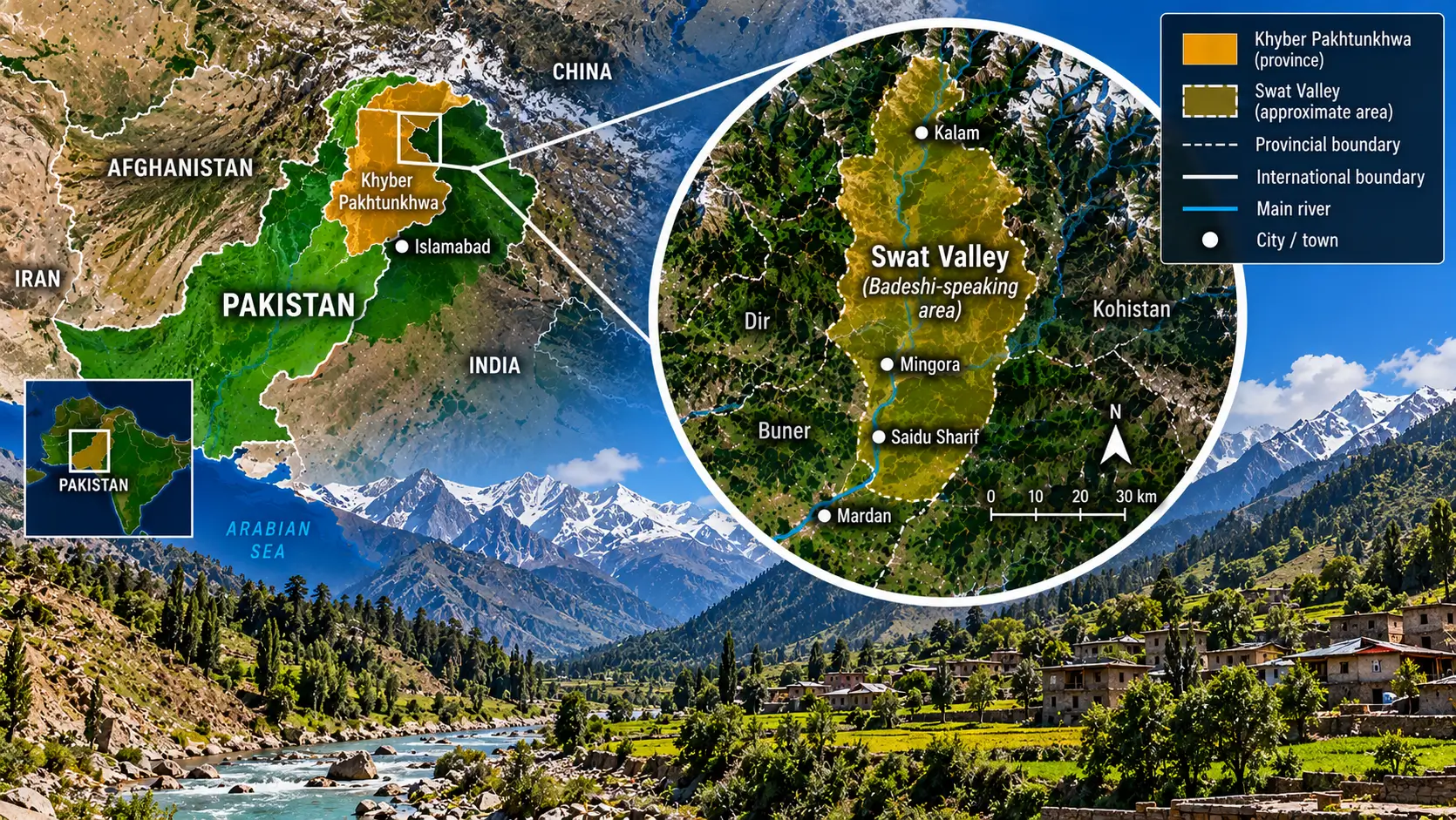
TL;DR: Badeshi is a nearly extinct language from Pakistan’s Swat Valley, now spoken by only a few elderly people. Without new speakers, it may disappear, but documentation and preservation efforts can still protect its legacy.
High in the remote valleys of northern Pakistan’s Hindu Kush mountains, a little-known language called Badeshi is fighting for survival.
Once spoken by communities in the Swat Valley, Badeshi has almost disappeared, with only a handful of elderly speakers believed to remain.
Yet rapid social change, language shift, and the dominance of larger regional languages such as Pashto and Torwali have pushed it to the brink of extinction.
Importance of language in cultural identity
Language is far more than a tool for communication. It shapes how communities understand the world, express their traditions, and pass knowledge from one generation to the next.
Through stories, songs, and everyday conversation, language carries the values, history, and identity of a people.
When a language disappears, an irreplaceable part of cultural heritage can vanish with it.
Historical Context
The story of Badeshi is closely linked to the remote valleys of northern Pakistan’s Hindu Kush mountains.
In isolated communities of the Swat Valley, small languages developed naturally over centuries as people lived, traded, and interacted within tight-knit mountain societies.
Badeshi emerged from this environment, reflecting the culture and daily life of the communities that spoke it.
Origins of the Badeshi language
Linguists classify Badeshi within the Indo-Aryan branch of the Indo-European language family. It developed locally in the Swat Valley, where small communities used it for everyday communication, storytelling, and cultural traditions.
Because these settlements were geographically isolated, Badeshi was able to evolve with its own vocabulary and speech patterns for generations.
Historical significance of the region
The Swat Valley has long been a cultural crossroads connecting South Asia, Central Asia, and the Middle East. Throughout history, traders, travellers, and empires moved through the region, leaving behind a rich cultural and linguistic mix.
The area was also an important centre of Buddhist culture and learning in ancient times, adding further historical depth to the region’s identity.
Influence of neighbouring languages and cultures
Badeshi has been influenced by nearby languages such as Pashto, Torwali, and Kohistani, which are widely spoken in the region today.
Over time, the spread of larger languages, particularly Pashto and Urdu, reduced the everyday use of Badeshi. Among younger generations, contributing to its current endangered status.
Linguistic Features
Although Badeshi is now extremely rare, the language offers valuable insight into the linguistic diversity of the Hindu Kush region.
Linguists who have documented the language note that it reflects both its Indo-Aryan roots and the influence of neighbouring mountain languages.
Unique characteristics of Badeshi
Badeshi is known for its localised vocabulary and pronunciation, which set it apart from the larger regional languages spoken around it.
Many everyday terms are closely tied to mountain life, agriculture, and local traditions, reflecting the environment in which the language developed.
It was primarily a spoken language with little written tradition. Much of Badeshi’s uniqueness survives through oral communication, storytelling, and conversation within the community.
Phonetics, grammar and vocabulary
Phonetically, Badeshi shares several sound patterns with other Indo-Aryan languages, but it also includes pronunciation features influenced by neighbouring languages in northern Pakistan.
Grammatically, it follows structures typical of the region’s languages, often using subject–object–verb word order, which is common across South Asian languages.
Its vocabulary includes a mix of native terms and borrowed words from nearby languages such as Pashto and Torwali.
Comparison with other languages in the region
In the Swat Valley, Badeshi exists alongside languages such as Pashto, Torwali, and Kohistani.
While Pashto is a dominant regional language, Badeshi belongs to a different linguistic branch and developed separately within local communities.
Compared with these larger languages, Badeshi has far fewer speakers and is poorly documented, making it much more vulnerable to extinction.
Cultural Significance
For the communities where it once flourished, Badeshi was more than a means of communication.
It was a living expression of culture, identity, and shared history. In small mountain communities, language often carries traditions, beliefs, and stories that have been passed down for generations
Role of Badeshi in local traditions and folklore
Like many community languages, Badeshi was closely linked to oral traditions.
Stories, legends, and local folklore were traditionally shared through spoken language, allowing cultural knowledge to move from elders to younger generations.
These stories often reflected the realities of mountain life, nature, and community values, helping preserve cultural identity within the region.
Connection between language and community identity
Language plays a powerful role in shaping how communities see themselves.
For Badeshi speakers, the language served as a marker of belonging, distinguishing their community from neighbouring groups.
Speaking Badeshi helped maintain social bonds and a shared sense of heritage, reinforcing cultural continuity across generations.
Examples of cultural expressions in Badeshi
Although documentation is limited, languages like Badeshi typically carry unique expressions, sayings, and storytelling traditions that reflect local culture.
These may include traditional greetings, proverbs related to nature and daily life, and phrases tied to community customs.
Even small linguistic details can reveal how people understand their environment and their place within it.
Current Status
Badeshi is considered one of the rarest languages in the world.
Once spoken within small communities in Pakistan’s Swat Valley, the language has nearly disappeared as younger generations have shifted to more widely used regional languages.
With only a few known speakers remaining, Badeshi is often cited by linguists as an example of how quickly linguistic diversity can vanish
Number of speakers and demographic trends
Estimates suggest that fewer than a handful of fluent Badeshi speakers remain, most of whom are elderly. This means the language is no longer being passed down naturally to younger generations.
Without new speakers learning the language at home or in education, Badeshi has effectively reached a critical stage of endangerment, where everyday use has almost completely disappeared.
Factors contributing to the decline of Badeshi
Several factors have contributed to the decline of Badeshi.
One of the main reasons is the growing dominance of larger languages such as Pashto, Torwali, and Urdu, which are used in schools, media, and public life.
Migration, social mobility, and the need to communicate with wider communities have also encouraged younger people to adopt these larger languages instead of continuing to speak Badeshi.
Comparison with other endangered languages
Badeshi’s situation is similar to many other critically endangered languages around the world, particularly those spoken by small communities in remote regions.
Like languages in the Amazon, the Pacific Islands, or parts of Africa, Badeshi has struggled to survive in a world where economic and social pressures favour widely spoken languages.
Challenges to Preservation
Preserving a language like Badeshi is extremely difficult once the number of speakers becomes very small.
When those conditions disappear, the language gradually fades from everyday life. In the case of Badeshi, several social and structural challenges have made preservation particularly difficult.
Socio-political factors affecting language survival
In many regions, national and regional languages dominate public life, education, and administration.
In northern Pakistan, languages such as Pashto and Urdu are widely used in schools, government institutions, and the media.
As a result, smaller community languages like Badeshi often receive little formal recognition or institutional support, making it harder for them to survive across generations.
Impact of globalisation and modernisation
Modernisation has connected remote communities to wider social and economic networks.
While this brings opportunities, it also encourages the use of widely spoken languages that allow communication across larger populations.
Younger generations may choose to prioritise languages that offer educational, professional, and social advantages, which can gradually reduce the use of smaller local languages.
Lack of educational resources and support
Another major challenge is the lack of learning materials and formal teaching for the language. Badeshi has very limited written documentation, dictionaries, or educational programmes.
Without structured resources, it becomes difficult for younger community members or language learners to study and maintain the language, increasing the risk that it may disappear completely.
Efforts for Revitalisation
Although Badeshi is critically endangered, efforts to document and preserve the language show that revitalisation is still possible.
Around the world, linguists, communities, and cultural organisations are working to protect endangered languages before they disappear completely.
Community initiatives to preserve Badeshi
Local communities are often the most important force in language preservation.
When speakers recognise the cultural value of their language, they can help record vocabulary, stories, and traditional knowledge for future generations.
In the case of Badeshi, community involvement has helped linguists identify the remaining speakers and gather basic documentation of the language.
Role of linguists and anthropologists
Researchers play a key role in documenting endangered languages like Badeshi.
Linguists often work directly with the remaining speakers to record pronunciation, vocabulary, and grammar.
These recordings and studies help create linguistic archives, dictionaries, and research papers that preserve the language in academic and cultural records, even if everyday use becomes rare.
The Future of Badeshi
The future of Badeshi is uncertain, but not entirely without hope. Like many critically endangered languages, it stands at a tipping point, either fading into extinction or becoming the focus of renewed preservation efforts.
What happens next will depend on whether the language can be recorded, valued, and passed on before it disappears completely.
Predictions for the language’s survival
With only a few elderly speakers remaining, Badeshi is at serious risk of extinction in the near future.
Without active use in daily life or structured revitalisation efforts, the language may cease to exist as a living means of communication.
However, even if it is no longer spoken widely, ongoing documentation could ensure that Badeshi survives in recorded and academic form.
Importance of intergenerational transmission
The survival of any language depends on whether it is passed from one generation to the next.
For Badeshi, this chain has largely been broken, as younger generations have shifted to more dominant languages.
Potential for revitalisation and cultural resurgence
While the challenges are significant, revitalisation is not impossible. Around the world, endangered languages have been brought back through community-driven efforts, education, and cultural pride.
If awareness of Badeshi continues to grow, there is potential for a small-scale revival, whether through documentation, cultural projects, or renewed interest from the community itself.
Badeshi Language FAQs
What is the Badeshi language?
Badeshi is a critically endangered language spoken in Pakistan’s Swat Valley, belonging to the Indo-Aryan language family. It is now one of the rarest languages in the world.
How many people still speak Badeshi?
Only a handful of elderly speakers are believed to remain, with no active transmission to younger generations.
Why is Badeshi disappearing?
The language has declined due to the dominance of larger languages like Pashto and Urdu, along with social change, migration, and lack of educational support.
Can Badeshi be saved?
While full revival is unlikely, documentation and community efforts can help preserve the language and its cultural significance.
Why is it important to preserve languages like Badeshi?
Languages like Badeshi carry unique cultural knowledge, history, and identity. Preserving them helps protect global linguistic diversity and human heritage.