
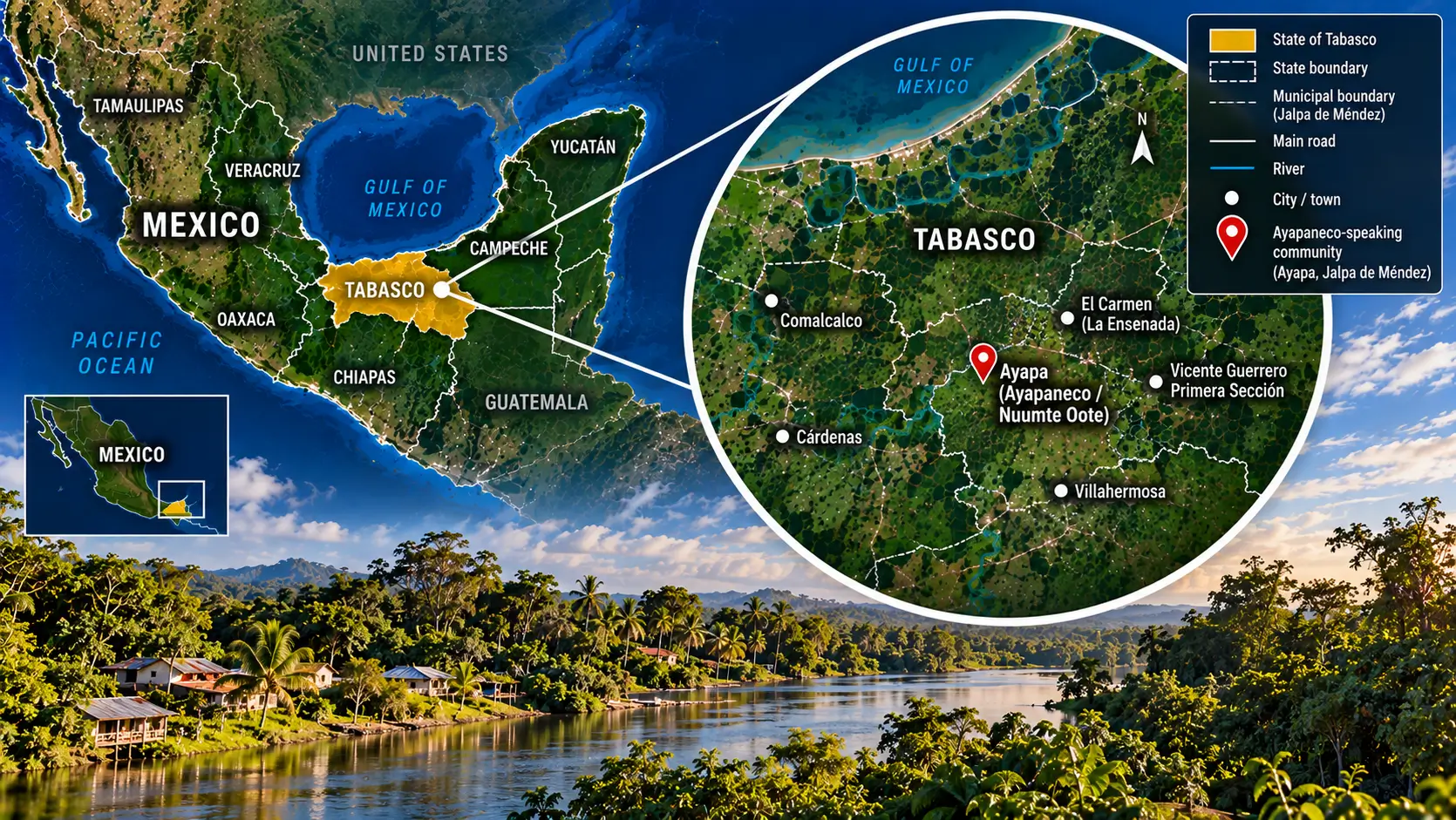
TL;DR: Ayapaneco (Nuumte Oote) is a critically endangered Indigenous language from Ayapa in Tabasco, Mexico, with only a few speakers remaining. It has declined due to the dominance of Spanish and limited learning resources, but community efforts and linguistic research are helping document and preserve the language.
Deep in the Mexican state of Tabasco, a language once spoken by an entire community now survives with only a handful of speakers.
Ayapaneco, also known as Nuumte Oote, is one of the rarest languages on Earth and stands on the brink of disappearance.
Yet its story is not just about loss. It is also about resilience, identity, and the urgent global effort to preserve the world’s linguistic diversity before it is gone forever.
What is Ayapaneco?
Deep in the Mexican state of Tabasco, a language once spoken by an entire community now survives with only a handful of speakers
Ayapaneco, also known as Nuumte Oote, is one of the rarest languages on Earth and sits on the brink of extinction.
Its story highlights how languages can disappear within a single generation.
Definition and classification
Ayapaneco is an Indigenous language spoken in the small village of Ayapa, located in the state of Tabasco in southern Mexico.
The language is traditionally known by its speakers as Nuumte Oote, which translates roughly to “the true voice” or “the true language.”
Despite this, linguists and community members have been working to document and revitalise the language so that future generations can learn it.
Geographic location and community of speakers
Ayapaneco belongs to the Mixe–Zoquean language family, a group of Indigenous languages historically spoken across parts of southern Mexico.
Languages in the Mixe–Zoquean family share certain grammatical and structural similarities, including complex verb systems and distinctive sound patterns.
Ayapaneco represents one of the smaller and least-documented branches of this family, which makes its preservation especially important for linguistic research.
Historical context and origins
The language originates from Ayapa, a rural village near the city of Comalcalco in Tabasco. Historically, Ayapaneco was used in everyday life for communication within the community, including storytelling, local traditions, and cultural practices.
Over time, however, Spanish became dominant in the region, particularly through education, media, and government administration.
The Current Status of Ayapaneco
Ayapaneco is widely recognised as one of the rarest languages in the world.
Over the past century, the number of speakers has declined dramatically as Spanish became the dominant language in education, work, and daily life in southern Mexico.
Number of speakers and demographic trends
Estimates suggest that fewer than a dozen fluent speakers of Ayapaneco remain, most of whom are elderly. In many cases, these speakers grew up using the language at home but gradually shifted to Spanish as they entered school or the workforce.
Younger members of the community generally speak Spanish as their first language, which has contributed to a break in intergenerational language transmission.
Factors contributing to its rarity
Several factors have contributed to the decline of Ayapaneco. One of the most significant has been the dominance of Spanish in schools, media, and government institutions throughout Mexico.
Migration and economic pressures have also played a role, as many younger people leave small villages like Ayapa in search of work or education in larger towns and cities where Spanish is essential.
Comparison with other endangered languages
Ayapaneco’s situation reflects a broader global trend. Thousands of languages around the world are currently considered endangered or vulnerable, particularly those spoken by small Indigenous communities.
However, Ayapaneco is especially rare because of its extremely small number of speakers. While some endangered languages still have hundreds or even thousands of speakers, Ayapaneco’s remaining speaker base is among the smallest recorded.
Cultural Significance of Ayapaneco
Ayapaneco is more than just a means of communication. It represents the cultural memory and identity of the community in Ayapa.
Like many Indigenous languages, it carries generations of knowledge, traditions, and ways of understanding the world.
Role in local traditions and identity
Historically, Ayapaneco played an important role in daily life, storytelling, and community traditions.
Elders used the language to share oral histories, teach cultural values, and pass down knowledge about local customs and the surrounding environment.
For many speakers, the language is closely tied to personal and collective identity.
Unique expressions and idioms
Like all languages, Ayapaneco contains expressions and idioms that reflect the worldview of its speakers.
These phrases often capture cultural ideas, humour, and ways of describing nature or everyday experiences that may not translate easily into Spanish or other languages.
Such linguistic features make the language valuable not only to the community but also to linguists studying how different cultures shape communication and meaning.
Connection to indigenous heritage
Ayapaneco forms part of the broader Indigenous linguistic heritage of Mexico, particularly within the Mixe–Zoquean language family.
For centuries, languages like Ayapaneco have helped sustain cultural practices, spiritual beliefs, and traditional knowledge systems.
Protecting the language helps maintain a living connection to this heritage.
Challenges Facing Ayapaneco
Like many critically endangered languages, Ayapaneco faces several challenges that threaten its survival.
Over generations, social change, economic pressures, and the dominance of Spanish have reduced opportunities for the language to be used in everyday life.
Language shift and assimilation
One of the biggest challenges for Ayapaneco has been the language shift toward Spanish.
As Spanish became the primary language used in schools, government, and business, many families gradually adopted it as their main language.
As a result, younger generations may grow up speaking only the dominant language, which breaks the chain of intergenerational transmission needed to keep a language alive.
Lack of educational resources
Another major obstacle has been the limited availability of learning materials for Ayapaneco. Unlike widely spoken languages, there are very few textbooks, dictionaries, or structured courses available.
Although linguists have worked to document the language, access to formal teaching resources remains limited.
Socio-economic factors impacting language use
Economic and social factors also influence whether a language continues to be used.
In many cases, younger residents of small villages move to larger towns or cities in search of education, employment, and opportunities.
When people leave their communities, they often adopt the dominant language used in those environments.
Efforts to Revitalise Ayapaneco
Despite its critically endangered status, several efforts have emerged to document, preserve, and revitalise Ayapaneco.
Community members, linguists, and cultural organisations have worked together to record the language and encourage new learners.
Community initiatives and grassroots movements
Local efforts have played an important role in keeping Ayapaneco alive.
In recent years, community members in Ayapa have supported language classes and cultural activities aimed at encouraging younger generations to learn the language.
These initiatives often focus on reconnecting people with their heritage through storytelling, traditional knowledge, and everyday conversation.
Role of technology and social media
Technology has also become a valuable tool for language preservation. Digital recordings, online dictionaries, and educational videos allow Ayapaneco to be documented and shared beyond its small geographic area.
Social media platforms can raise awareness about endangered languages and connect researchers, activists, and learners interested in revitalisation.
Collaboration with linguists and cultural organisations
Linguists and academic institutions have worked closely with Ayapaneco speakers to document the language’s grammar, vocabulary, and pronunciation.
These projects often involve recording native speakers and creating dictionaries or teaching materials.
Cultural organisations and universities also support preservation efforts by promoting research, funding documentation projects, and raising awareness about endangered languages.
The Role of Government and Policy
Government policy can play a crucial role in determining whether endangered languages survive or disappear.
In Mexico, Indigenous languages are officially recognised as part of the country’s cultural heritage, and efforts have been made to support their preservation.
However, smaller languages like Ayapaneco often receive less attention and fewer resources than larger Indigenous languages.
Current policies affecting indigenous languages
Mexico has taken important steps to recognise and protect Indigenous languages. The General Law of Linguistic Rights of Indigenous Peoples granted Indigenous languages national status alongside Spanish and recognised them as part of the country’s cultural identity.
Institutions such as the National Institute of Indigenous Languages (INALI) work to document, promote, and support the use of Indigenous languages across Mexico.
Importance of governmental support
Government involvement is often essential for successful language revitalisation. Funding for education programmes, research projects, and community initiatives can provide the tools needed to preserve endangered languages.
Support from national and regional authorities can also help integrate Indigenous languages into schools, cultural programmes, and public institutions.
Recommendations for policy improvements
To strengthen preservation efforts, governments could expand funding for community-led language revitalisation programmes and provide more resources for documentation and teaching materials.
Introducing bilingual education in regions where Indigenous languages originate can also help younger generations learn and use these languages alongside Spanish.
How You Can Help
Although Ayapaneco is spoken by only a small number of people, awareness and support from outside the community can still make a difference.
Learning about endangered languages, sharing their stories, and supporting preservation efforts all contribute to protecting linguistic diversity.
Even small actions can help ensure that rare languages like Ayapaneco are not forgotten.
Raising awareness about Ayapaneco
One of the simplest ways to help is by raising awareness.
Sharing information about Ayapaneco through articles, social media, or educational discussions helps highlight the challenges facing endangered languages.
Greater awareness can encourage researchers, educators, and organisations to invest more time and resources into language documentation and revitalisation projects.
Supporting local initiatives and organisations
Many language preservation efforts are led by local communities, linguists, and cultural organisations.
Supporting these initiatives, whether through donations, partnerships, or promoting their work, can help provide resources for documentation, teaching materials, and community programmes.
These grassroots efforts are often the most effective because they are closely connected to the people and culture the language represents.
Engaging in language learning and cultural exchange
Another way to support endangered languages is by engaging with Indigenous cultures and linguistic research.
While learning Ayapaneco directly may be difficult due to limited resources, exploring academic materials, language documentation projects, and cultural studies can help keep the language visible.
Ayapaneco Language FAQs
What language family does Ayapaneco belong to?
Ayapaneco belongs to the Mixe–Zoquean language family, a group of Indigenous languages spoken in parts of southern Mexico. These languages share similar grammatical structures and historical roots, linking Ayapaneco to other regional Indigenous languages.
How many people still speak Ayapaneco?
Ayapaneco is critically endangered, with fewer than a dozen fluent speakers remaining. Most speakers are elderly, which makes the preservation and documentation of the language especially urgent.
Where is Ayapaneco spoken?
Ayapaneco originates from the village of Ayapa in the state of Tabasco, Mexico. Historically, it was spoken throughout the local community, but today its use is extremely limited.
Why did Ayapaneco become endangered?
The language declined mainly due to the dominance of Spanish in education, government, and everyday life. Over time, younger generations stopped learning Ayapaneco, leading to a break in language transmission.
Are there efforts to save the Ayapaneco language?
Yes. Community initiatives, linguistic research, and documentation projects are working to record and revitalise the language. These efforts aim to preserve Ayapaneco and encourage new learners in the future.