
|
Getting your Trinity Audio player ready...
|
TL;DR: The schwa (/ə/) is the most common vowel sound in English and appears in unstressed syllables. It sounds like a soft, relaxed “uh” and is essential for natural rhythm and connected speech.
If your English sounds slightly “off”, even when your grammar is perfect, the problem might not be vocabulary, tenses, or even difficult consonants.
It might be the schwa.
The schwa (/ə/) is the most common vowel sound in English. And yet, most learners have never been formally taught how to recognise it, hear it, or produce it.
That’s why it quietly becomes the silent pronunciation killer.
The schwa sound and its significance in English pronunciation
If English pronunciation feels inconsistent, unpredictable, or strangely “mumbled,” you’re not imagining it.
The reason is often one small sound: the schwa.
The schwa (/ə/) is the most common vowel sound in English and one of the most important for natural rhythm, clarity, and fluency.
Get answers like this for your language questions
Your personal AI language tutor — adapts to your native language, your level, and the words that actually trip you up.
Why is it often overlooked or misunderstood?
The schwa is everywhere in English, yet many learners barely notice it. Here’s why.
It Doesn’t Match Spelling
The schwa can replace any vowel letter, so there’s no clear visual clue. Learners expect to pronounce vowels as they’re written, but English follows stress, not spelling.
It Sounds “Too Simple”
Because it’s just a soft “uh,” it doesn’t seem important. Learners often focus on more obvious challenges like “th” or long vowels instead.
Many Languages Don’t Reduce Vowels
In languages like Spanish or Italian, vowels are pronounced clearly. English weakens unstressed syllables, which can feel unnatural at first.
It’s Linked to Stress and Rhythm
The schwa only appears in unstressed syllables. Without understanding word and sentence stress, it’s difficult to use correctly.
The result? Learners pronounce every vowel clearly and their English sounds less natural.
What is the Schwa Sound?
Before you can improve your pronunciation, you need to understand the sound that shapes English rhythm more than any other.
The schwa may be small and subtle, but it sits at the heart of natural speech. It’s not dramatic, it’s not sharp, and it doesn’t stand out.
Definition of the schwa sound
The schwa is a weak, neutral vowel sound that appears in unstressed syllables. It is produced with the mouth in a relaxed, central position, not wide, not rounded, not tense.
It sounds like a short, soft “uh”.
Unlike strong vowel sounds, the schwa is quick and light. It doesn’t carry emphasis. Instead, it supports the rhythm of English by allowing stressed syllables to stand out clearly.
Phonetic representation and examples of the schwa in different words
In the International Phonetic Alphabet (IPA), the schwa is written as:
/ə/
What makes the schwa unusual is that it can replace any vowel letter (a, e, i, o, u) when the syllable is unstressed.
Examples:
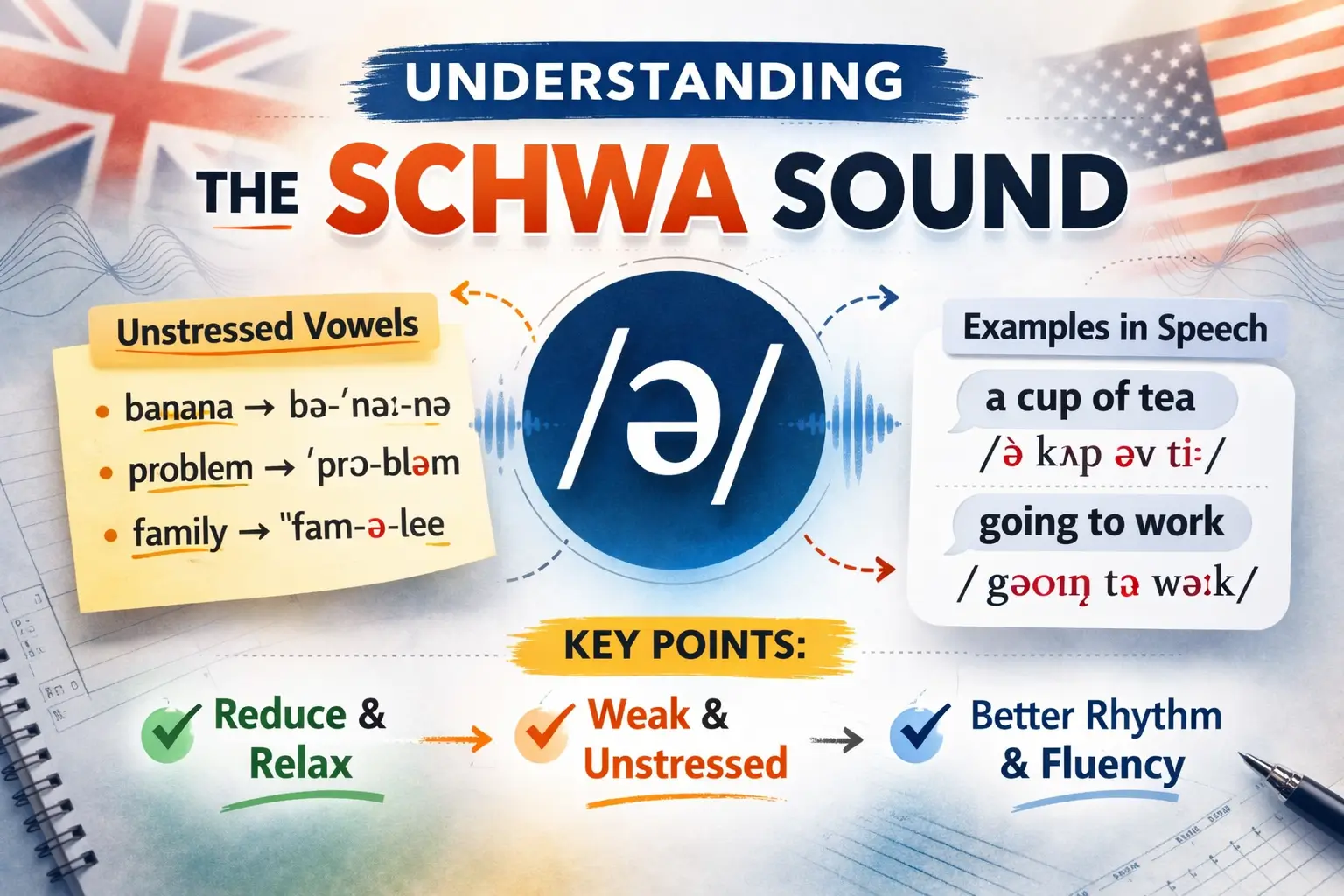
- about → /əˈbaʊt/
- teacher → /ˈtiːtʃə/
- banana → /bəˈnɑːnə/
- problem → /ˈprɒbləm/
- support → /səˈpɔːt/
Notice that spelling doesn’t tell you when schwa appears. Stress does.
If the syllable is weak, the vowel often reduces to /ə/.
The Role of the Schwa in the English Language
If English sometimes feels uneven, strong here, weak there, that’s not accidental.
English has a built-in rhythm, and the schwa is one of the main reasons it works. Without it, speech would sound stiff and mechanical. With it, English gains movement, contrast, and flow.
Importance of the schwa in reducing syllable stress
English depends on contrast between stressed and unstressed syllables.
- Stressed syllables are longer, louder, and clearer.
- Unstressed syllables are shorter and weaker and this is where the schwa appears.
Take these examples:
- banana → bə-NA-nə
- problem → PRO-bləm
- support → sə-PORT
In each case, the strong syllable stands out because the others reduce. The schwa helps “step back” so the important syllable can “step forward.”
If every vowel were pronounced clearly, there would be no contrast and no natural stress pattern.
How the schwa contributes to the rhythm and flow of spoken English
English is a stress-timed language. That means the rhythm depends more on stressed syllables than on counting syllables evenly.
The schwa makes speech smoother by:
- Shortening weak syllables
- Allowing faster transitions between words
- Creating a natural rise and fall in sound
For example:
- I want to go to the cinema.
In natural speech, several small words reduce:
- I wənt tə go tə thə cinema.
Those quick schwa sounds keep the sentence flowing instead of sounding heavy and over-pronounced.
The result? Speech that feels connected, balanced, and natural.
Get explanations like this for your English questions
Personalised to your native language and level. Free to start, no card needed.
Common Misconceptions about the Schwa
Because the schwa is subtle and often reduced in speech, it’s surrounded by confusion. Many learners misunderstand what it is, when it appears, and how important it really is.
Clearing up these misconceptions can transform the way you approach English pronunciation.
Addressing myths surrounding the schwa sound
Myth 1: The schwa is a separate vowel letter
It isn’t. The schwa is a sound, not a spelling. It can replace any vowel letter when the syllable is weak.
Myth 2: It’s lazy or incorrect pronunciation
In reality, reducing vowels is essential for natural English rhythm. Native speakers use the schwa constantly.
Myth 3: It only appears in certain words
The schwa is extremely common. It appears in thousands of everyday words and in many short function words like to, a, and the.
Myth 4: Every vowel should be pronounced clearly
In English, clarity comes from contrast. If every syllable is equally strong, speech sounds unnatural.
Clarifying its presence in unstressed syllables
The most important rule is simple:
The schwa appears in unstressed syllables.
It does not depend on spelling. It depends on stress.
For example:
- about → /əˈbaʊt/
- banana → /bəˈnɑːnə/
- problem → /ˈprɒbləm/
In each case, the stressed syllable is clear and strong. The weaker syllables reduce to /ə/.
Understanding this connection between stress and vowel reduction removes much of the mystery
Identifying the Schwa in Everyday Speech
The schwa isn’t rare or academic, it’s everywhere.
The challenge is that it’s quiet, short, and often disappears into fast speech. Once you train your ear to notice it, you’ll start hearing it constantly in everyday conversation.
Tips for recognising the schwa in conversation
The schwa rarely announces itself. It doesn’t stand out, and it isn’t pronounced with effort.
Instead, it slips quietly into unstressed syllables, especially in fast, natural speech. That’s why many learners struggle to hear it at first.
- Listen for weak syllables: If a syllable sounds quick, soft, and unstressed, it’s often a schwa.
- Find the stressed syllable first: Identify the strongest part of the word. The other syllables frequently reduce.
- Notice reduced function words: Small grammar words like to, a, the, of, for are commonly pronounced with schwa in natural speech.
- Pay attention to speed: The faster someone speaks, the more likely vowels will reduce.
Common words and phrases that contain the schwa
You’ll hear schwa in countless everyday words:
- about → /əˈbaʊt/
- teacher → /ˈtiːtʃə/
- family → /ˈfæməli/
- problem → /ˈprɒbləm/
- banana → /bəˈnɑːnə/
And in natural phrases:
- a cup of tea → ə cup əv tea
- going to → go-əng tə
- for a minute → fər ə minute
- at the moment → ət thə moment
When you begin to recognise these soft “uh” sounds in unstressed positions, English speech becomes easier to understand and much easier to produce naturally.
The Schwa Sound in Different Accents
The schwa exists across almost all varieties of English, but it doesn’t sound identical everywhere.
While the core idea remains the same regional accents shape how clearly it’s pronounced, how long it lasts, and sometimes whether it appears at all.
Understanding these differences helps you become a more flexible listener.
Variations of the schwa sound across different English dialects
In most accents, the schwa is a short, central “uh” sound. However, its realisation can vary slightly:
- In Received Pronunciation (RP) and many southern British accents, final -er often becomes a clear schwa:
- teacher → /ˈtiːtʃə/
- teacher → /ˈtiːtʃə/
- In General American, the same word may sound more like an “r-coloured” vowel:
- teacher → /ˈtiːtʃɚ/
- teacher → /ˈtiːtʃɚ/
- In faster urban accents, schwa sounds can become extremely short or even disappear entirely.
Despite these differences, the principle stays the same: unstressed syllables reduce.
How regional accents influence the pronunciation of the schwa
One major factor is whether an accent is rhotic (pronounces the “r” sound) or non-rhotic (drops it unless followed by a vowel).
- In non-rhotic accents (e.g., much of England), final “r” often becomes schwa.
- In rhotic accents (e.g., most of the US), that same vowel may blend with an “r” sound.
Regional speech patterns also influence:
- How strongly vowels are reduced
- Whether certain syllables are compressed
- The speed and rhythm of connected speech
For example, in some northern English accents, unstressed vowels may sound slightly clearer than in southern varieties.
Get explanations like this for your English questions
Personalised to your native language and level. Free to start, no card needed.
The Impact of the Schwa on Non-Native Speakers
For many learners, the schwa isn’t just another sound to practise. It’s a shift in how English works. Because it depends on stress and reduction, not spelling, it can feel unfamiliar and even counter-intuitive.
Yet mastering it often marks the difference between clear but “textbook” English and speech that sounds natural and fluent.
Challenges faced by learners of English regarding the schwa
The schwa may be small, but its impact on learners is significant. Because it shapes stress, rhythm, and connected speech.
Understanding the challenges it creates is the first step toward improving both pronunciation and listening skills.
1. Pronouncing every vowel clearly
Speakers of languages with consistent vowel pronunciation (such as Spanish or Italian) often articulate each vowel fully. In English, this can make speech sound overly careful or unnatural.
2. Relying too heavily on spelling
Because schwa can replace any vowel letter, learners who depend on spelling cues struggle to predict when reduction happens.
3. Difficulty hearing weak syllables
The schwa is short and subtle. In fast speech, it can seem to disappear, making listening comprehension harder.
4. Misplaced stress
Without accurate stress patterns, learners may emphasise the wrong syllables. Preventing natural reduction from happening.
Strategies for mastering the schwa sound in pronunciation practice
Once you recognise why the schwa causes problems, the next step is practical.
With focused strategies and the right type of practice, this subtle sound becomes far less intimidating.
Start with stress, not the vowel.
Always identify the stressed syllable first. The unstressed syllables often reduce automatically.
Practise contrast
Say the word once with clear vowels, then again with reduction.
Example: banana → ba-NA-na → bə-NA-nə.
Use sentence practice.
Focus on natural phrases:
- a cup of tea
- going to work
- at the moment
Listen to how small words weaken.
Shadow native speech.
Repeat short clips from podcasts or interviews, copying rhythm and reduction rather than individual sounds.
Relax your mouth.
The schwa is neutral and effortless. Tension prevents proper reduction.
Resources to Practise the Schwa Sound
Understanding the schwa is one thing.
Training your ear and mouth to use it naturally is another.
Because the schwa depends on stress and rhythm, practice should focus on reduction, flow, and connected speech. Not just repeating isolated sounds.
Resources for further practice, including audio examples
To continue improving, use materials that emphasise listening and stress patterns:
- BBC Learning English: Clear pronunciation videos and audio examples.
- Rachel’s English (YouTube): Detailed explanations of vowel reduction and connected speech.
- Cambridge Online Dictionary: IPA transcriptions and audio in both British and American accents.
- Podcast shadowing practice (choose slow or intermediate-level content first).
When practising, remember: the schwa is about relaxation and rhythm. If you’re forcing the sound, you’re probably overthinking it.
Schwa Sound FAQs
What is the schwa sound in English?
The schwa (/ə/) is a weak, neutral vowel sound that appears in unstressed syllables. It sounds like a short, relaxed “uh” and is the most common vowel sound in spoken English.
Why is the schwa important for pronunciation?
The schwa is essential for natural rhythm and stress patterns. English is stress-timed, meaning strong syllables stand out while weaker ones reduce, often to schwa. Without it, speech can sound robotic or overly formal.
Does the schwa have its own letter?
No. The schwa is a sound, not a letter. It can replace any vowel letter (a, e, i, o, u) when the syllable is unstressed. Its appearance depends on stress, not spelling.
How can I tell when to use the schwa?
First, identify the stressed syllable in a word. Any unstressed syllables often reduce to schwa. For example, in banana (bə-NA-nə), the first and last syllables weaken.
Why is the schwa difficult for non-native speakers?
Many languages pronounce every vowel clearly, while English reduces unstressed vowels. This difference makes the schwa hard to hear and produce at first, especially in fast, natural speech.
Does the schwa sound the same in all English accents?
The core sound is similar across accents, but pronunciation can vary slightly. In British English, final “-er” often becomes a clear schwa (teacher → /ˈtiːtʃə/), while in American English it may be “r-coloured” (teacher → /ˈtiːtʃɚ/).