|
Getting your Trinity Audio player ready...
|
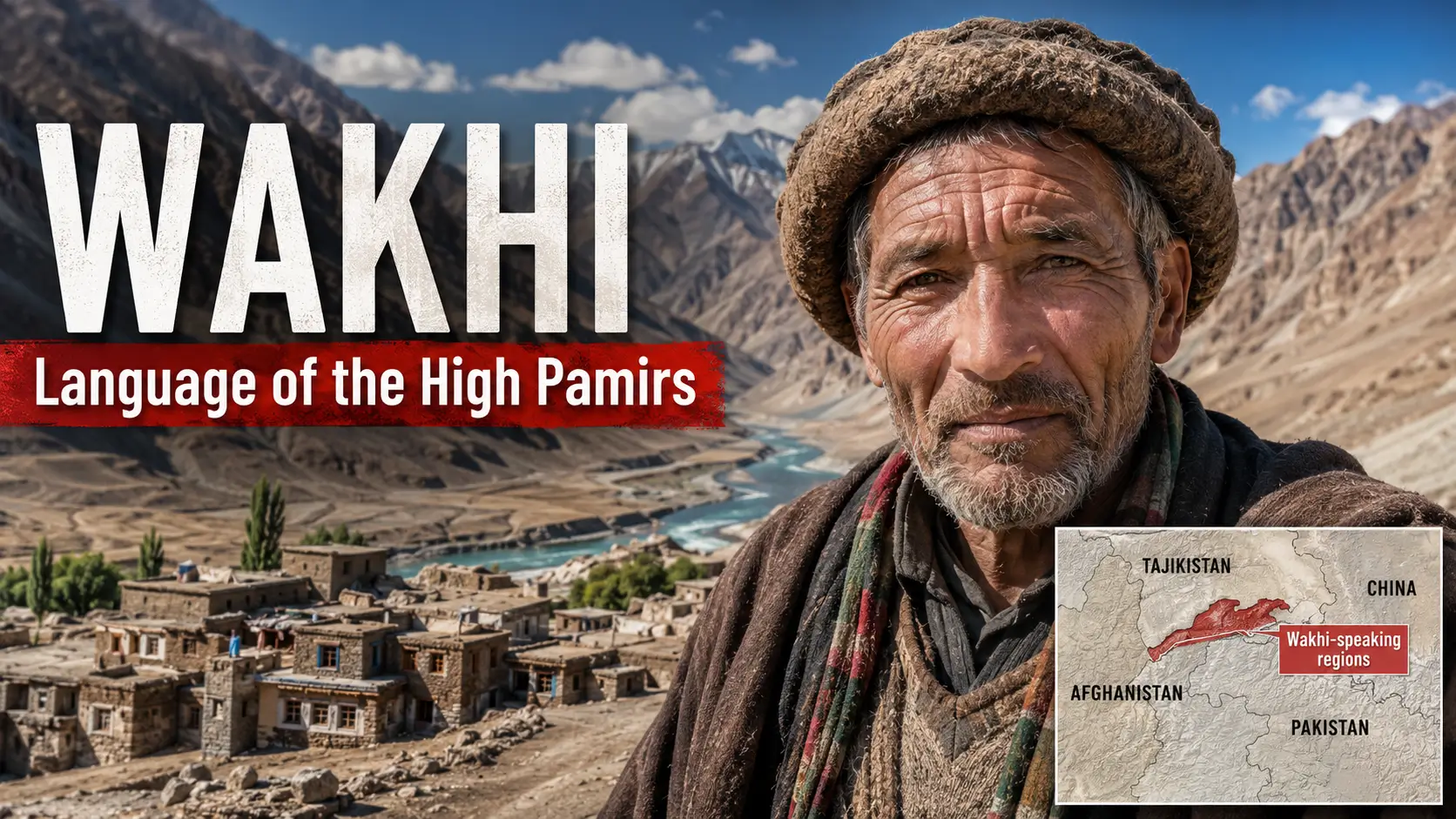
TL;DR: Wakhi is an Eastern Iranian language spoken in the High Pamirs across Afghanistan, Pakistan, Tajikistan and China. Shaped by mountain isolation and oral tradition, it remains a strong marker of cultural identity.
High in the towering Pamir Mountains, where Afghanistan, Pakistan, Tajikistan and China converge, Wakhi is still spoken against the odds.
This Eastern Iranian language belongs to communities scattered across some of the world’s most remote valleys.
Rarely heard beyond the High Pamirs, Wakhi carries a rich heritage of poetry, tradition and identity.
More than a means of communication, it is a living link to centuries of history. Surviving borders, migration and linguistic pressure.
What is the Wakhi language?
Wakhi is an Eastern Iranian language. Spoken in the high mountain regions of Afghanistan, Pakistan, Tajikistan and China. It belongs to the Pamir branch of the Iranian language family within Indo-European.
Spoken by roughly 50,000–75,000 people, Wakhi is used in everyday life. Storytelling and local traditions.
Though small in number, its speakers maintain a strong cultural identity across the High Pamirs. Preserving the language despite modern borders and outside influence.
Wakhi Language at a Glance
| Category | Information |
| Language Family | Indo-European |
| Branch | Eastern Iranian |
| Subgroup | Pamir languages |
| Estimated Speakers | 50,000–75,000 |
| Main Regions | Afghanistan, Pakistan, Tajikistan, China |
| Traditional Transmission | Oral (storytelling, songs, family use) |
| Word Order | Subject–Object–Verb (SOV) |
| Writing Systems | Perso-Arabic, Cyrillic, Latin (varies by country) |
Importance of the High Pamirs as a cultural and geographical region
The High Pamirs are known as the “Roof of the World”. A vast mountain region where major Asian ranges meet. They connect Central and South Asia, forming a natural crossroads.
Part of Silk Road routes, the Pamirs carried trade, ideas and cultures across centuries.
Today, despite modern borders, the region remains a shared cultural space where mountain communities preserve distinct languages and traditions.
The Origins of Wakhi
To understand Wakhi, you have to look beyond the language itself and into the mountains that shaped it.
The High Pamirs are not just a backdrop. They are part of the story.
Wakhi emerged from centuries of movement, isolation, trade and survival in one of the world’s most dramatic landscapes.
Historical background of the Wakhi people
The Wakhi people have lived in the Pamir region for centuries. Particularly in the Wakhan Corridor and surrounding valleys. Positioned along historic Silk Road routes, their communities were never completely isolated.
Yet the mountains also protected them. Geography created small, tight-knit settlements where traditions, oral poetry and shared identity could be preserved.
Over time, modern borders divided Wakhi speakers across Afghanistan, Pakistan, Tajikistan and China. Cultural ties remained stronger than political lines.
Linguistic roots and connections to other Iranian languages
Wakhi belongs to the Eastern Iranian branch of the Indo-European language family. This links it to languages such as Persian, Pashto and Kurdish. Though Wakhi developed along its own path.
It is part of the Pamir group of languages, sometimes referred to as “Pamir languages”. Which include Shughni and other regional tongues.
These languages share ancient features that trace back to early Iranian speech forms spoken thousands of years ago.
The evolution of Wakhi over time
Like all living languages, Wakhi has adapted. Contact with Dari, Tajik, Urdu and Mandarin has introduced loanwords and influenced pronunciation in different regions.
Wakhi was passed down orally through storytelling, songs and family life. Only more recently have standardised writing systems developed. These differ depending on the country.
Despite outside pressure and migration, the Wakhi have survived. Not because it was protected for centuries, but because communities chose to keep using it.

Geographic Distribution
Wakhi is spoken across one of the most dramatic and elevated regions on Earth, the High Pamirs.
This mountainous area stretches across northeastern Afghanistan, northern Pakistan, eastern Tajikistan and western China. Forming a natural crossroads between Central and South Asia.
High Pamirs and neighbouring regions
The High Pamirs sit where major mountain systems meet. Including the Hindu Kush, Karakoram and Tian Shan ranges.
Deep valleys, high plateaus and glacier-fed rivers define the landscape. Connected by Silk Road routes, the region has long been a place of movement, yet also isolation.
Communities in which Wakhi is spoken
Wakhi-speaking communities are found in the Wakhan Corridor of Afghanistan. The Gojal and upper Hunza valleys of Pakistan, the Gorno-Badakhshan region of Tajikistan, and the Taxkorgan area of Xinjiang in China.
Though separated by borders, these communities share cultural traditions, kinship ties and linguistic heritage.
The impact of mountainous geography on language maintenance and isolation
The mountains have both protected and divided Wakhi.
Remote valleys limited outside influence for centuries, helping preserve the language. At the same time, physical barriers created regional variation and dialect differences.
In the Pamirs, geography is not just scenery. It shapes how language survives, changes and connects people across distance.
Linguistic Features of Wakhi
A small community may speak Wakhi, but it is rich and complex.
As part of the Eastern Iranian branch, it preserves older structural features. While also reflecting centuries of contact with neighbouring languages.
Phonetics and phonology
Wakhi has a sound system typical of many Iranian languages, with a mix of clear vowels and strong consonants. It includes long and short vowels, and certain consonant clusters that can feel unfamiliar to English speakers.
Because Wakhi has been influenced by Dari, Tajik, Urdu and other regional languages. Pronunciation can vary depending on where it is spoken.
Mountain isolation helped preserve older sounds, while cross-border contact introduced subtle shifts.
Grammar and syntactic structure
Wakhi generally follows a Subject–Object–Verb (SOV) word order. Meaning the verb usually appears at the end of the sentence. This structure is common in Iranian and many Central Asian languages.
It uses postpositions (rather than prepositions), and verbs carry important information about tense, aspect and agreement.
Like other Iranian languages, Wakhi shows case marking and inflectional patterns that signal grammatical relationships within a sentence.
Distinctive vocabulary and idiomatic expressions
Wakhi vocabulary reflects mountain life.
Words for landscape, livestock, kinship and seasonal movement are especially detailed. Many expressions are tied to pastoral traditions and communal living.
Over time, loanwords from neighbouring languages have entered everyday speech. Particularly for modern concepts such as education, administration and technology.
Cultural Significance
Wakhi is more than a language of daily conversation. It is a thread that binds community, memory and belonging across the High Pamirs.
Remote valleys where families have lived for generations. Language carries history in a deeply personal way.
The role of Wakhi in shaping cultural and communal identity
For Wakhi speakers, the language is a marker of who they are.
It signals shared ancestry, shared geography and shared experience. Even when communities are separated by national borders. Speaking Wakhi reinforces a sense of unity.
In small mountain settlements, language strengthens kinship ties and social cohesion. It is spoken at home, during gatherings and in moments that matter most. Weddings, celebrations and community discussions.
Traditional stories, songs, and oral literature
Much of Wakhi’s cultural richness lives in oral tradition. Folktales, epic narratives, proverbs and songs have long been passed down from elders to younger generations.
Storytelling is not simply entertainment; it is education. Through stories, children learn values, history and practical knowledge about life in the mountains.
The influence of cultural practices on language use
Daily life in the High Pamirs shapes how Wakhi is spoken. Seasonal farming, pastoral traditions and communal labour influence vocabulary and expression.
Ceremonies and religious practices also affect language use, blending older linguistic forms with regional influences.
Even modern changes, migration, schooling and cross-border contact, are reshaping how younger generations use Wakhi.
Challenges Facing the Wakhi Language
Like many minority languages, Wakhi faces a delicate balancing act. Adapting to the modern world while trying to hold onto its roots
The mountains once protected it. Today, connection to the outside world brings both opportunity and pressure.
Pressures from globalisation and modernisation
Education systems, media and administration in Afghanistan, Pakistan, Tajikistan and China operate in dominant national languages. Such as Dari, Tajik, Urdu and Mandarin. This often means Wakhi is limited to home and community use.
Access to smartphones, social media and migration for work further increases exposure to global languages. While this opens doors, it can reduce the everyday use of Wakhi. Especially among younger speakers.
Shifts in language use and speaker numbers
In some areas, younger generations are more fluent in national or international languages than in Wakhi.
Urban migration can weaken intergenerational transmission. Particularly when families relocate away from traditional villages.
Although Wakhi is still spoken across the High Pamirs, speaker numbers remain small. Variation between regions can make standardisation difficult.
Ongoing efforts to document and preserve the Wakhi
Community groups and researchers have begun documenting Wakhi through dictionaries. Recorded oral histories and educational materials.
In some regions, literacy initiatives and cultural centres promote written forms of the language.
Digital tools are also playing a role, helping connect dispersed communities and share resources across borders.
Community Efforts for Preservation
Across the High Pamirs, the preservation of Wakhi is not driven by policy or institutions. It is powered by community will.
Families, elders and young activists are taking practical steps to ensure the language remains part of everyday life.
Grassroots movements and local organisations
In several regions, local cultural groups and language committees are working to document Wakhi vocabulary, record oral histories and produce learning materials.
Community-led classes and informal teaching sessions help children build confidence in reading and writing the language.
These efforts are often small in scale but meaningful. Rooted in the belief that preservation begins at home.
Cultural festivals and events celebrating Wakhi heritage
Festivals, music gatherings and traditional celebrations provide powerful spaces for language use.
Songs, poetry recitations and storytelling performed in Wakhi reinforce pride and visibility.
Such events do more than entertain. They publicly affirm that Wakhi is not just a private language of the past, but a living part of contemporary cultural identity.
Collaboration between Wakhi communities, linguists, and researchers
Partnerships with linguists and academic institutions have supported the creation of dictionaries, grammar descriptions and written standards.
Recording projects capture elders’ voices before knowledge is lost, preserving pronunciation, idioms and oral narratives.
When community knowledge and academic research work together, preservation becomes more sustainable. Blending lived experience with long-term documentation.
The Future of the Wakhi Language
The future of Wakhi is not predetermined. Like many minority languages, its survival depends less on numbers alone and more on daily use, pride and continuity.
The mountains gave Wakhi strength for centuries. Now, its future rests in human choice.
Prospects for the language’s long-term survival
Wakhi is still actively spoken across several regions, which gives it a solid foundation. It is not a dormant language. It lives in homes, conversations and community life.
Long-term survival depends on whether it continues to be used by younger generations.
If children grow up speaking Wakhi alongside national languages, the language remains stable. If it becomes confined to older speakers, the risk of decline increases.
Community involvement and intergenerational transmission
Language survival begins in the family. When parents and grandparents tell stories, share songs and speak Wakhi at home, they pass on more than vocabulary, they pass on identity.
Intergenerational transmission is the strongest safeguard.
Schools, organisations and researchers can support preservation, but everyday conversation is what keeps a language alive.
Opportunities for revitalisation and renewed visibility
Wakhi’s future does not depend on preservation, it depends on renewal. Revitalisation is about making Wakhi visible, valued and used in modern life.
Key opportunities include:
- Digital media and social platforms: Sharing Wakhi stories, songs and short videos online can connect speakers. Across Afghanistan, Pakistan, Tajikistan and China.
- Online dictionaries and learning resources: Accessible digital tools help younger generations read, write and study Wakhi more.
- Cross-border collaboration: Joint cultural and linguistic projects can strengthen unity between dispersed Wakhi communities.
- Youth-led initiatives: School clubs, creative writing projects and music groups can make the language feel relevant and contemporary.
- Cultural festivals and public events: Celebrating Wakhi through performance and storytelling increases pride and public recognition.
- Written materials and publications: Books, children’s stories and community newsletters reinforce literacy and visibility.
Wakhi Language FAQs
What language family does Wakhi belong to?
Wakhi belongs to the Indo-European language family. More specifically, it is part of the Eastern Iranian branch and the Pamir group of languages.
Where is Wakhi spoken today?
Wakhi is spoken in the High Pamirs across northeastern Afghanistan, northern Pakistan, eastern Tajikistan and western China (Xinjiang).
How many people speak Wakhi?
It is estimated that between 50,000 and 75,000 people speak Wakhi, mainly in small mountain communities.
Is Wakhi an endangered language?
Wakhi is considered vulnerable. It is still actively spoken, but pressures from dominant national languages and migration pose long-term risks.
Why is Wakhi culturally important?
Wakhi carries centuries of oral tradition, poetry and mountain heritage. It remains a powerful marker of identity and unity for communities across the High Pamirs.