
|
Getting your Trinity Audio player ready...
|
TL;DR: Yugambeh’s future depends on making it a normal, visible part of daily life. By integrating it into schools, supporting community-led programmes, and empowering younger generations to use it in modern spaces, the language can move from revitalisation to long-term growth and sustainability.
Before the Gold Coast had skyscrapers and surf culture, it had Yugambeh.
Spoken for thousands of years across the Gold Coast hinterland and the surrounding regions of south-east Queensland. Yugambeh is a living Aboriginal Australian language tied to Country, story, and identity.
Today, revitalisation efforts are led by the community. It is ensuring the language is heard, taught, and celebrated once again. Proof that it is not just history, but a living heritage.
Yugambeh and its cultural and linguistic significance
Yugambeh is a living Aboriginal language of south-east Queensland. Connected to the Gold Coast hinterland and the identity of its people.
It forms part of the wider Pama–Nyungan family and reflects thousands of years of knowledge shaped by Country. Its vocabulary encodes ecological insight, kinship systems, and place-based understanding of land and waterways.
Its continued teaching and revitalisation are not just about preserving words. Strengthening cultural continuity, community pride, and connection to Country.
Importance of preserving Indigenous languages in Australia
Indigenous languages are among Australia’s oldest living knowledge systems.
Preserving them is not only about safeguarding words, but protecting culture, identity, and thousands of years of connection to Country.
- Cultural identity: Language strengthens community belonging and passes down traditions, law, and values.
- Connection to Country: Indigenous languages encode detailed ecological and geographical knowledge.
- Historical continuity: Preservation helps repair the disruption caused by colonisation and language suppression.
- Educational benefits: Bilingual and language revival programmes support cultural pride and improved learning outcomes.
- Linguistic diversity: Protecting Indigenous languages enriches Australia’s cultural and intellectual landscape.
Historical Context
Yugambeh requires looking beyond the present moment and into the deep history of south-east Queensland.
For thousands of years, the language evolved alongside the landscapes of the Gold Coast hinterlands. Shaped by rivers, forests, coastal plains, and the communities that lived there.
Origins and historical development of the Yugambeh language
Yugambeh developed over millennia as part of the wider Pama–Nyungan language family. Adapting to the specific environments and social structures of the region.
Its vocabulary reflects intimate knowledge of local ecosystems, seasonal cycles, kinship systems, and spiritual traditions.
As generations passed, the language was transmitted through storytelling, ceremony, and daily life. Ensuring both linguistic stability and subtle evolution across time.
The role of Yugambeh speakers in the Gold Coast Hinterland
Yugambeh speakers were custodians of Country long before modern borders existed.
Through language, they mapped waterways, named sacred sites, preserved Dreaming narratives, and maintained complex systems of law and kinship.
Communication was not limited to conversation. It extended into song, ceremony, and intergroup relationships, reinforcing social cohesion and shared identity across the region.
Impact of colonisation on the language and culture
The arrival of British settlers in the nineteenth century brought displacement, violence, and policies that suppressed Indigenous languages.
As communities were removed from their lands and children were separated from their families. Intergenerational transmission of Yugambeh declined.
Today’s revitalisation efforts are grounded in this history. Acknowledging past injustices while rebuilding linguistic and cultural strength for future generations.
Linguistic Features of Yugambeh
Yugambeh reflects the depth and complexity found across Aboriginal Australian languages.
Its sound system, grammar, and vocabulary are tied to land, kinship, and social relationships.
Like many Indigenous languages, it developed through a strong oral tradition. In which precision of meaning and cultural context are central to communication.
The language’s structure (phonetics, grammar, and vocabulary)
Yugambeh is part of the Pama–Nyungan language family. It shares structural traits common to many Aboriginal Australian languages. While maintaining its own regional characteristics.
Phonetics and Sound System
Yugambeh has a small vowel inventory, three core vowels:
- /a/
- /i/
- /u/
These vowels may vary in quality depending on surrounding consonants.
Like many Australian languages, Yugambeh distinguishes between places of articulation. Rather than voicing (there is generally no strong contrast between “b” and “p” like in English). Instead, it contrasts sounds such as:
- Bilabial (made with the lips)
- Dental (tongue against the teeth)
- Alveolar (tongue just behind the teeth)
- Retroflex (tongue curled back)
- Palatal
- Velar
It also includes nasal, lateral, and rhotic sounds across several of these positions.
This multi-place articulation system is a defining feature of many Australian languages and gives Yugambeh its distinctive rhythm and texture.
Distinctive characteristics that set Yugambeh apart
While Yugambeh shares features with neighbouring languages, it has its own lexical items, pronunciation patterns, and regional variations.
Its kinship terminology is particularly detailed, encoding social responsibilities and relationships beyond simple “family” labels.
The language also preserves unique place names across the Gold Coast hinterland. Many of which remain in use today.
Examples of common words and phrases
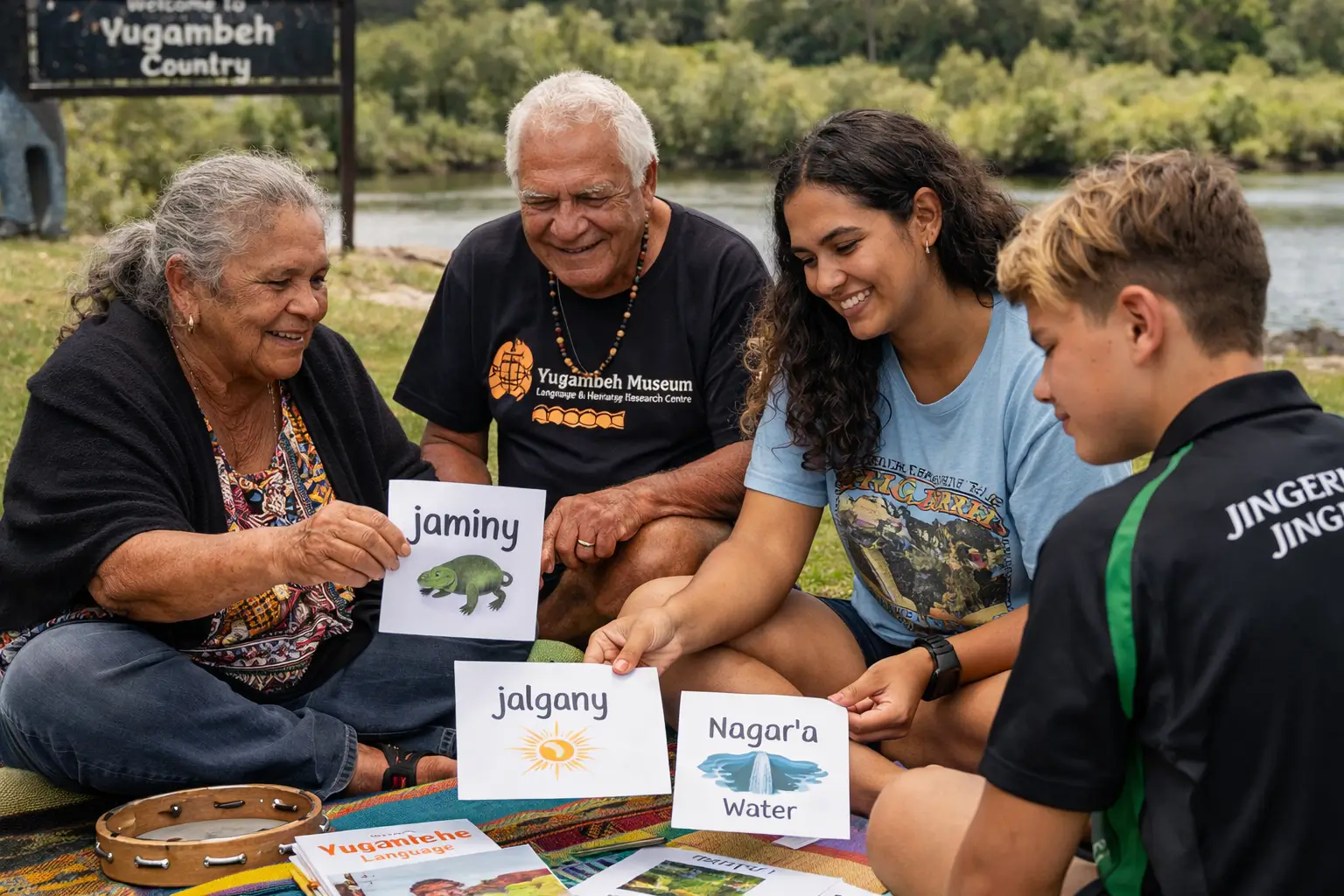
Examples often taught in revitalisation programmes include:
- Jingeri: a greeting meaning “hello” or “greetings”
- Yugambeh: the name of the language and people
- Mibunn: “good”
These words prove how language functions not only as communication, but as cultural affirmation, each term carrying identity, respect, and connection to Country.
Cultural Significance
Yugambeh is not a means of communication. It is a foundation of identity, belonging, and continuity.
For the Yugambeh people of south-east Queensland, language connects individuals to ancestors, land, law, and shared memory.
Each word carries cultural meaning shaped by generations of lived experience on Country.
The connection between language and cultural identity
Language affirms who people are and where they come from. In Yugambeh, identity is embedded in kinship terms, place names, and expressions tied to land and ancestry.
Speaking the language reinforces connection to Country and strengthens intergenerational bonds.
It also restores pride and self-determination after periods of suppression. Making language revitalisation a powerful cultural act.
Traditional stories, songs, and cultural practices associated with Yugambeh
Yugambeh has long been transmitted through oral tradition, storytelling, song, and ceremony.
Dreaming narratives explain the origins of landscapes, waterways, and cultural law. Songs encode ecological knowledge and social responsibility, while ceremonial speech maintains continuity of tradition.
These practices ensure that language is not learned in isolation, but as part of a living cultural system.
Dreaming Stories (Creation Narratives)
- Jellurgal (Burleigh Headland) Story: Explains the spiritual significance of Jellurgal and its role as a ceremonial and meeting place. The headland is associated with ancestral beings and long-standing cultural gatherings.
- The Story of the Kombumerri and the Coast: Narratives describing the creation of coastal landscapes, sand dunes, and waterways. Linking ancestral activity to present-day geography.
- Wagawn (The Crow): A moral and teaching story involving the crow, common in many south-east Queensland traditions. Used to send lessons about behaviour and responsibility.
- The Creation of the Logan and Albert Rivers: Stories explaining how ancestral beings shaped river systems that remain central to Yugambeh Country.
The role of language in maintaining community cohesion and heritage
Language fosters unity within a community. Shared vocabulary and narrative traditions reinforce collective memory and responsibility.
Teaching Yugambeh in schools, cultural centres, and community programmes strengthens cultural resilience and ensures that heritage is not only preserved, but lived.
In this way, the language remains central to maintaining both social cohesion and cultural continuity.
Revitalisation Efforts
Like many Aboriginal Australian languages, Yugambeh experienced decline due to colonisation and government policies. These disrupted intergenerational transmission.
Today, it is the focus of strong community-led revitalisation.
Current initiatives aimed at reviving and promoting Yugambeh
Revival work includes:
- Language documentation projects: Recording elders, preserving vocabulary, grammar, and pronunciation for future generations.
- Dictionary and resource development: Compiling word lists and teaching materials to standardise and support learning.
- Public language visibility: Incorporating Yugambeh into signage, place acknowledgements, and community events across the Gold Coast region.
- Cultural tourism and heritage programmes: Sharing language through guided experiences that connect visitors to the country.
The role of local organisations and community members
Revitalisation is led by the community. The Yugambeh Museum, Language and Heritage Research Centre plays a central role in research, archiving, and education.
Elders and knowledge holders guide pronunciation, storytelling, and cultural protocols, ensuring authenticity and respect.
Community members contribute by teaching language classes. Integrating Yugambeh into Welcome to Country ceremonies and encouraging its use among younger generations.
Educational programmes and available learning resources
Educational efforts include:
- School-based language programmes in south-east Queensland.
- Community workshops and short courses are open to both Indigenous and non-Indigenous learners.
- Online resources and printed materials, including vocabulary lists and pronunciation guides.
- Cultural immersion experiences that combine language learning with on-Country education.
The Role of Technology
Technology has become a powerful ally in the preservation and revitalisation of Indigenous languages such as Yugambeh.
Language transmission was once disrupted by distance and historical suppression. Digital tools now help reconnect communities and archive knowledge. Making learning more accessible to younger generations.
How technology supports language learning and preservation
Digital recording tools allow elders’ voices and pronunciation. Oral histories to be preserved in high quality for future learners.
Databases and digital archives store vocabulary, grammar notes, and cultural materials. In structured formats that can be updated and shared widely.
Technology also enables flexible learning through audio files, interactive exercises, and multimedia content. This supports pronunciation and comprehension beyond traditional classroom settings.
Online resources, apps, and social media initiatives
Websites and digital archives host word lists, pronunciation guides, and educational materials developed by community organisations. Social media platforms are used to share:
- Word-of-the-day posts
- Short pronunciation videos
- Cultural facts and place names
- Event announcements and workshops
The impact of digital storytelling on cultural transmission
Digital storytelling, through video, podcasts, and online exhibitions. Allows Dreaming stories, historical narratives, and cultural knowledge to reach broader audiences. While remaining community-led.
By combining language with visual imagery, music, and narration, digital media strengthens emotional connection and engagement.
Importantly, it supports intergenerational learning: elders can share knowledge. Younger community members can document, edit, and distribute it.
Community Involvement
Language revitalisation only succeeds when it is community-led. For Yugambeh, the strength of revival efforts lies in active participation. From Elders, educators, cultural leaders, and younger generations.
Language is not taught. It is lived, spoken at gatherings, embedded in ceremony, and shared within families. Community engagement ensures that revitalisation reflects cultural authority. Not outside interpretation.
Importance of community engagement in language revitalisation
Community involvement guarantees authenticity and continuity. Elders provide guidance on pronunciation, meaning, and cultural protocol.
Families reinforce language at home. Local leaders advocate for visibility in schools, councils, and public events.
When community drives the process:
- Cultural knowledge remains protected and respected.
- Intergenerational transmission is strengthened.
- Language learning reflects lived experience, not just academic study.
- Pride and identity are rebuilt.
Profiles of key community members and their contributions
Several individuals and organisations have played important roles in sustaining the Yugambeh language and culture:
- Uncle Ted Williams: A respected Yugambeh Elder. He contributed to language documentation and cultural education.
- Aunty Patricia O’Connor: Cultural educator and language advocate. She was involved in sharing Yugambeh knowledge through schools and community programmes.
- Yugambeh Museum, Language and Heritage Research Centre (Beenleigh): A central institution. Dedicated to research, archiving, and teaching the language.
Events and workshops promoting Yugambeh language and culture
Community-led initiatives include:
- Language workshops and short courses for local learners.
- School programmes integrating Yugambeh into classroom education.
- NAIDOC Week celebrations featuring language, storytelling, and performance.
- Welcome to Country ceremonies using Yugambeh language.
- Cultural festivals and museum exhibitions highlighting regional history and heritage.
Challenges Faced
Revitalising Yugambeh is a powerful cultural movement, but it is not without obstacles.
Like many Aboriginal Australian languages, it faces structural, social, and generational challenges shaped by history and modern life.
Understanding these barriers is essential to building sustainable solutions.
Obstacles in the revitalisation of Yugambeh
One of the most significant challenges is intergenerational disruption.
Colonisation, forced removals, and assimilation policies. It weakened the natural transmission of language within families.
As a result, fluent speakers became fewer, and much knowledge had to be reconstructed from archival records and community memory.
Other obstacles include:
- Limited funding for long-term language programmes
- Shortage of trained language teachers
- Balancing documentation with cultural protocol
- Ensuring consistent spelling and standardisation across resources
Impact of globalisation and urbanisation on Indigenous languages
Modern urban life can reduce everyday opportunities to use traditional languages.
English dominates education, employment, and the media. Making it difficult for minority languages to compete in daily communication.
Globalisation also shifts cultural priorities. Particularly among younger generations exposed to international media and digital culture.
Without strong community reinforcement, language use can decline in favour of dominant global languages.
Strategies for overcoming these challenges
Despite these pressures, revitalisation can succeed through structured, community-led strategies:
- Strengthening school-based and community language programmes
- Training new generations of language teachers
- Increasing visibility in public signage and official events
- Using digital tools and social media to reach younger audiences
- Supporting Elders as central knowledge holders
The Future of Yugambeh
The future of Yugambeh depends not only on preservation, but on normalisation. A thriving language is one that is heard in classrooms, ceremonies, public spaces, and homes.
The long-term vision is for Yugambeh to move beyond revival status. It become an everyday presence across its traditional lands in south-east Queensland.
A vision for the future of the language and its speakers
A sustainable future for Yugambeh means increasing the number of confident speakers. Across generations.
This includes developing fluent second-language speakers. Supporting Elders as knowledge custodians, and embedding language use into cultural governance and community life.
It also involves strengthening institutional recognition. The language remains visible and respected across the Gold Coast hinterland.
Potential integration into local education systems
One of the most impactful pathways forward is structured inclusion within education. This may include:
- Primary and secondary school language programmes
- Teacher training initiatives focused on Indigenous language instruction
- Curriculum resources aligned with Queensland education standards
- Partnerships between schools and community language centres
When Yugambeh is taught in schools, it shifts from optional heritage study to recognised cultural knowledge.
Yugambeh FAQs
What is the Yugambeh language?
Yugambeh is an Aboriginal Australian language traditionally spoken in south-east Queensland, particularly across the Gold Coast hinterland and surrounding regions. It belongs to the Pama–Nyungan language family and is deeply connected to Country, kinship, and cultural law.
Is Yugambeh still spoken today?
Yes. While the number of fluent speakers declined due to colonisation and language suppression, revitalisation efforts have strengthened its presence through schools, community programmes, and cultural ceremonies.
What makes Yugambeh linguistically unique?
Yugambeh features a three-vowel system, multiple consonant articulation points (including dental and retroflex sounds), and ergative case marking. Its grammar relies heavily on suffixes rather than strict word order, and its vocabulary encodes detailed ecological and kinship knowledge.
How is Yugambeh being preserved?
Preservation efforts include language documentation, school-based teaching, community workshops, digital resources, and public visibility through signage and Welcome to Country ceremonies. The Yugambeh Museum and community Elders play central roles in this work.
Why is preserving Yugambeh important?
Preserving Yugambeh protects cultural identity, oral history, and ecological knowledge tied to the land. It strengthens community cohesion, supports reconciliation, and ensures that one of Australia’s oldest living knowledge systems continues into the future.