
|
Getting your Trinity Audio player ready...
|
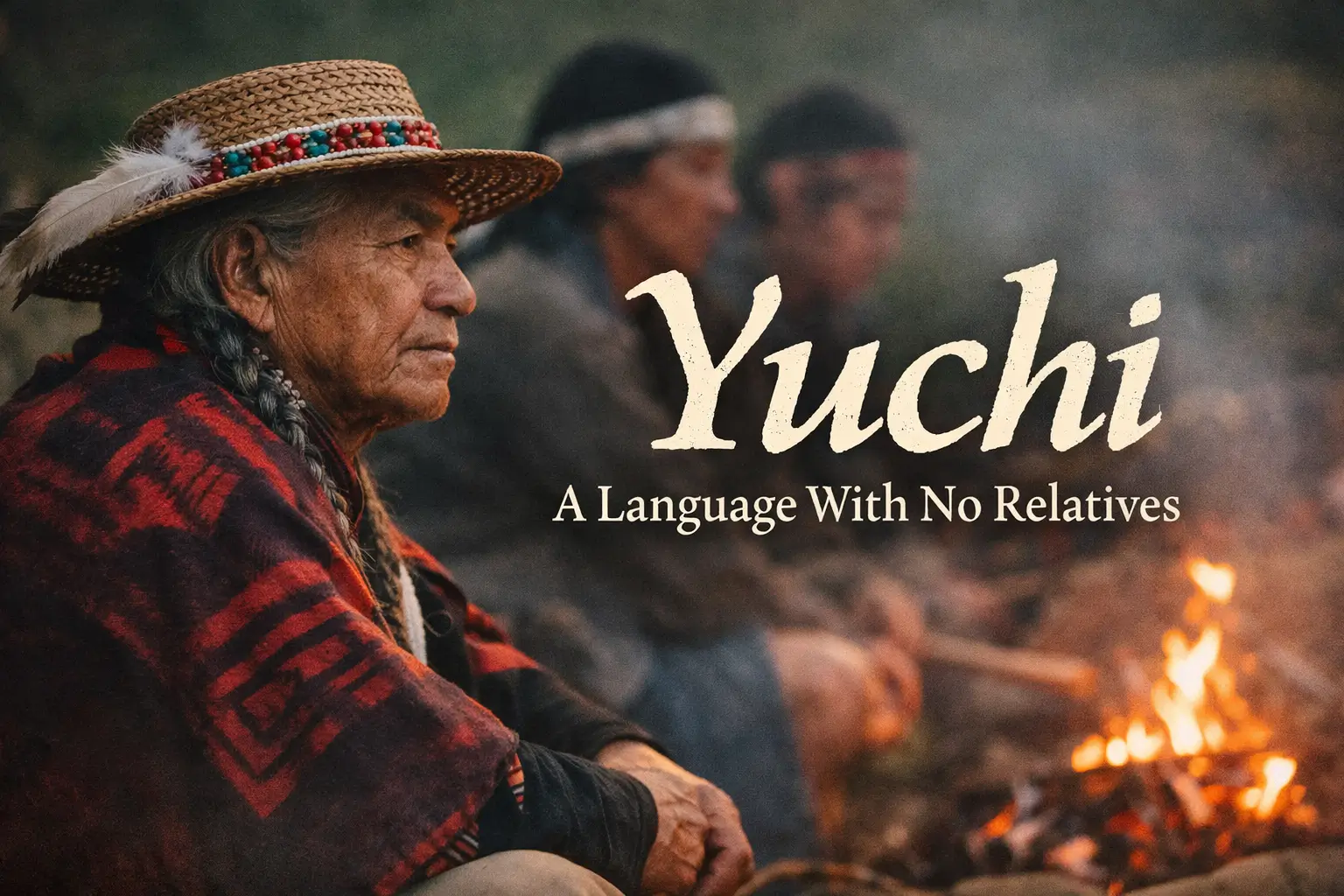
Most languages belong to families. The Yuchi language, however, doesn’t.
Spoken by a small Native American community in the United States. Yuchi is a true language isolate. A language with no proven relatives anywhere on Earth. It stands alone, with sounds and structures unlike those of any neighbouring tongue.
That’s what makes Yuchi so remarkable. Its survival matters far beyond the community that speaks it.
What is the Yuchi language?
The Yuchi language is a Native American language spoken by the Yuchi (Euchee) people, mainly in Oklahoma. What sets it apart is its status as a language isolate.
While most Indigenous languages belong to wider linguistic groups, Yuchi stands on its own. Its sounds, grammar, and structure cannot be linked to any other language. Making it one of the most distinctive languages in the world.
Yuchi is critically endangered. It is preserving it, which means safeguarding a unique way of understanding language. One that exists nowhere else.
Historical Background of the Yuchi Language
The history of the Yuchi language is a story of resilience under pressure.
Shaped by deep pre-colonial roots, forced displacement, and centuries of cultural disruption, Yuchi has survived where many languages did not.
Its past reveals not only where the language comes from. Why its preservation today carries such profound significance.
Origins and early speakers
Yuchi is one of North America’s oldest linguistic mysteries. The language was spoken by the Yuchi people long before European contact. Its deeper origins remain unknown.
Linguists cannot trace it back to a wider language family. Making Yuchi a rare surviving fragment of a much older linguistic landscape.
For early Yuchi communities, the language was more than communication. It carried identity, ceremony, and social structure. Every generation inherited not words. A distinct worldview encoded into the language itself.
Historical context and geographical distribution
Historically, Yuchi was spoken across parts of what are now Tennessee, Georgia, Alabama, and South Carolina. These communities were often situated near major river systems. This shaped trade, travel, and cultural exchange.
Forced removals in the 19th century. Particularly during the Trail of Tears era, relocated Yuchi speakers to present-day Oklahoma. This displacement fractured communities. It is reduced the number of fluent speakers, accelerating language decline.
Influence of colonisation and modernisation
Colonisation had a devastating impact on Yuchi.
English-language schooling, cultural suppression, and assimilation policies discouraged or outright punished Indigenous language use.
Over time, younger generations were pushed towards English for survival, work, and education.
Linguistic Features of Yuchi
Yuchi doesn’t just stand alone historically. It sounds and behaves differently, too.
Its linguistic features set it apart from neighbouring languages. Reinforcing its status as a true isolate. Making it especially valuable to linguists.
Phonetics and phonology
Yuchi is known for its complex sound system. Particularly its use of tone.
Unlike English, pitch in Yuchi can change the meaning of a word, adding a layer of precision and subtlety.
It also features sounds that are uncommon or unfamiliar to English speakers. Contributing to its distinct rhythm and acoustic identity.
Grammar and syntax
Grammatically, Yuchi is highly structured and expressive.
It uses detailed verb forms to convey information about action, timing, and relationships between speakers.
Meaning is often packed into a single word through affixes. Rather than spread across separate words as in English.
| Grammatical feature | How it works in Yuchi | Why it matters |
| Verb-centred structure | Verbs carry most of the meaning in a sentence, including subject, object, tense, and aspect | One verb can replace an entire English sentence |
| Affixation | Prefixes and suffixes attach to verb roots to add meaning | Reduces the need for separate pronouns or auxiliary verbs |
| Aspect over tense | Emphasis is placed on how an action happens (ongoing, completed, habitual) rather than strict past/present/future | Gives more nuance about the nature of actions |
| Pronominal marking | Subjects and objects are marked directly on the verb | Pronouns are often unnecessary as standalone words |
| Flexible word order | Sentence order can vary because grammatical roles are already marked | Focus is placed on meaning and emphasis, not rigid structure |
| Relational markers | Verbs encode relationships between speakers and participants | Reflects social awareness built into the language |
| Economy of expression | Multiple grammatical ideas are packed into single words | Makes Yuchi highly efficient but complex to learn |
Vocabulary and unique expressions
Yuchi vocabulary reflects a way of organising the world that developed from neighbouring languages. The language evolved in isolation, many of its words and expressions.
Rather than focusing on abstract categories, Yuchi leans towards relationships, actions, and lived context. Words often carry social or situational information alongside their basic meaning. Especially in areas tied to community life.
The Yuchi People and Their Culture
Language and culture are inseparable for the Yuchi. To understand the language, you have to understand the people who speak it.
Their history, traditions, and the role Yuchi plays in preserving identity across generations.
What is the Yuchi tribe?
The Yuchi are a Native American people with deep roots in the southeastern United States. Now based in Oklahoma.
Although they are recognised as part of the Muscogee (Creek) Nation. The Yuchi maintain a distinct cultural identity, reflected most in their language.
Despite displacement and assimilation pressures, Yuchi communities have preserved their traditions through family networks, ceremonies, and oral history.
Cultural practices and traditions
Yuchi cultural life centres on community, ceremony, and continuity.
Traditional practices include stomp dances, seasonal ceremonies, storytelling, and shared rituals that reinforce social bonds and collective memory.
Much of this knowledge is transmitted orally. Elders played a key role in teaching values, customs, and history.
The role of language in cultural identity
For the Yuchi, language is more than a tool. It is a marker of belonging. Speaking Yuchi signals connection to family, heritage, and shared responsibility.
Many cultural concepts, songs, and ceremonial meanings exist only in Yuchi. Losing depth or clarity when translated into English.
This is why language revitalisation is also cultural revitalisation.
The Status of Yuchi Today
Yuchi has survived centuries of disruption. Today, it stands at a critical crossroads.
Its future depends on how successfully knowledge can be passed from elders to new generations.
Current number of speakers
Yuchi is considered critically endangered. Only a small number of fluent speakers remain, most of them elders. In 2016, the language was around 16 speakers.
While some community members understand parts of the language, full fluency is now rare. Placing Yuchi among the most threatened languages in North America.
Efforts to revitalise the language
Revitalisation efforts are community-led and deeply intentional.
These include language classes, immersion sessions, recordings of elder speakers, and educational materials designed for younger learners.
The focus is not just on memorising words, but on using Yuchi in real social and cultural contexts.
Challenges faced by the Yuchi language community
The challenges are significant. With few fluent speakers, limited funding, and the dominance of English in education and media, maintaining momentum is difficult.
Intergenerational transmission, the natural passing of language from parent to child. It has been severely disrupted.
Yuchi’s Unique Linguistic Classification
Yuchi isn’t just endangered. It’s unclassifiable in the usual way. Its place outside all known language families is what makes it so significant to linguists.
Explanation of language families
Most languages belong to families. Groups that descend from a common ancestral language. English, for example, sits within the Indo-European family alongside German, French, and Hindi.
These relationships are identified through shared vocabulary, sound patterns, and grammatical structures.
Why Yuchi has no known relatives
Yuchi breaks this pattern. Despite extensive study, linguists have found no convincing evidence linking it to any other language.
Similarities with neighbouring languages are limited to borrowed words through contact. Mot shared ancestry.
This makes Yuchi a language isolate. A language that cannot be placed on any existing family tree. It may represent the last surviving member of an ancient linguistic lineage that disappeared long ago.
Comparisons with other Indigenous languages
Unlike languages within large families, Yuchi does not share predictable sound correspondences or grammatical frameworks with nearby tongues.
Where many Indigenous languages show clear structural cousins, Yuchi’s systems stand apart.
The Importance of Language Preservation
Preserving a language isn’t about nostalgia. It’s about protecting knowledge, identity, and ways of thinking that cannot be replaced once lost.
The role of language in cultural heritage
Language carries history in everyday use. Stories, ceremonies, humour, and social rules are embedded in how things are said, not just what is said.
When a language disappears, so do unique perspectives on family, nature, time, and community. Many of which were never written down.
Benefits of preserving endangered languages
Preserving endangered languages is not just about saving words. It’s about protecting knowledge systems, identities, and ways of understanding the world that cannot be recreated once lost. The impact reaches far beyond the communities themselves.
- Strengthens cultural identity and a sense of belonging
- Supports community wellbeing and intergenerational connection
- Helps younger generations reconnect with their heritage
- Expands understanding of human cognition and communication
- Preserves global linguistic and cultural diversity
- Protects ecological and environmental knowledge
- Safeguards traditional practices and local wisdom
Community initiatives and educational programmes
Successful preservation is community-led.
Language classes, immersion sessions, recordings of elders, and school-based programmes help rebuild intergenerational transmission.
Digital tools now support this work, making lessons, audio, and archives accessible beyond physical boundaries.
Case Studies of Language Revitalisation
Learning from other endangered languages shows that decline is not inevitable.
Around the world, communities have reversed language loss by combining cultural commitment with practical action.
Lessons learned that can be applied to Yuchi
These revitalisation efforts reveal patterns that make the difference between survival and disappearance.
- Community-led initiatives are more effective than top-down programmes
- Intergenerational transmission is the strongest predictor of success
- Regular, everyday use matters more than perfect fluency
- Elders are essential as teachers, cultural guides, and linguistic anchors
- Language learning must be tied to identity, not education
- Long-term commitment outweighs short-term funding bursts
Potential strategies for Yuchi revitalisation
For Yuchi, revitalisation depends on rebuilding natural use while adapting to modern realities.
- Creating safe spaces for speaking without fear of mistakes
- Expanding immersion-based learning for children and families
- Recording fluent speakers to preserve pronunciation and grammar
- Integrating Yuchi into cultural events and ceremonies
- Using digital tools to support learning and documentation
- Encouraging daily use in simple, practical contexts
The Future of the Yuchi Language
The future of Yuchi is not fixed. While the language faces serious challenges, its survival depends on choices being made now. Communities, educators, and especially younger speakers.
Predictions for the language’s survival
Yuchi’s future will be shaped by whether transmission can move beyond documentation into daily use.
Languages with small speaker bases can survive when learning becomes consistent, social, and meaningful rather than symbolic.
The impact of technology and social media
Technology has transformed what language preservation looks like. Audio archives, video lessons, messaging apps, and social platforms. They allow Yuchi to be heard beyond classrooms and ceremonies.
Social media, in particular, helps normalise use. Turning the language into something spoken and shared. It is visible rather than archived and distant.
Yuchi Language FAQs
Is Yuchi a dead language?
No. Yuchi is critically endangered. It is still spoken by a small number of fluent speakers. Active revitalisation efforts are underway to keep it alive.
Why is Yuchi considered a language isolate?
Yuchi is classified as a language isolate. Linguists have found no reliable evidence linking it to any other language family.
Where is the Yuchi language spoken today?
Today, Yuchi is spoken within communities in Oklahoma. Where the Yuchi people were relocated during the 19th century.
Can Yuchi still be learned by new speakers?
Yes. While fluent speakers are few, language classes, recordings, and community programmes make it possible for new learners to study Yuchi.
Why does preserving Yuchi matter beyond the community itself?
Preserving Yuchi protects unique linguistic structures and cultural knowledge. It includes ways of understanding the world that exist nowhere else.