
|
Getting your Trinity Audio player ready...
|
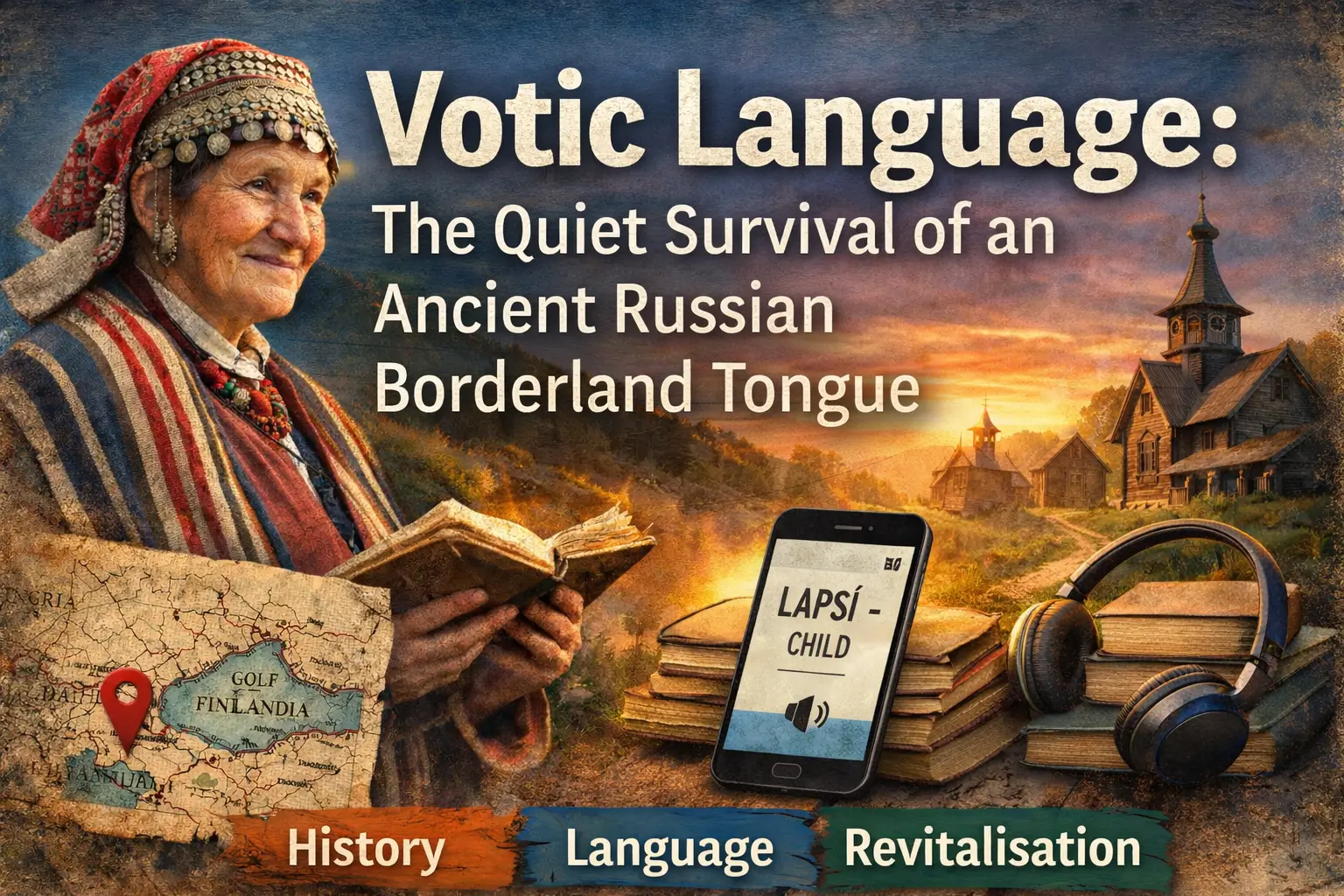
Along the forests and wetlands near Russia’s western edge, a language has been holding on. This is the Votic language, one of Europe’s most endangered tongues.
Votic is one of Europe’s most endangered languages. Ancient, Finno-Ugric, and once spoken across large parts of what is now north-west Russia. Only a handful of speakers remain.
For decades, Votic was written off as already lost. Children stopped learning it. Villages emptied. Records were sparse. Silence seemed inevitable.
And yet, the language never disappeared.
Through songs, fragments of speech, and the efforts of speakers, researchers, and local communities, Votic has survived into the present. Fragile, but alive.
This is the story of a language that refused to vanish, even when almost everything around it changed.
What is the Votic language?
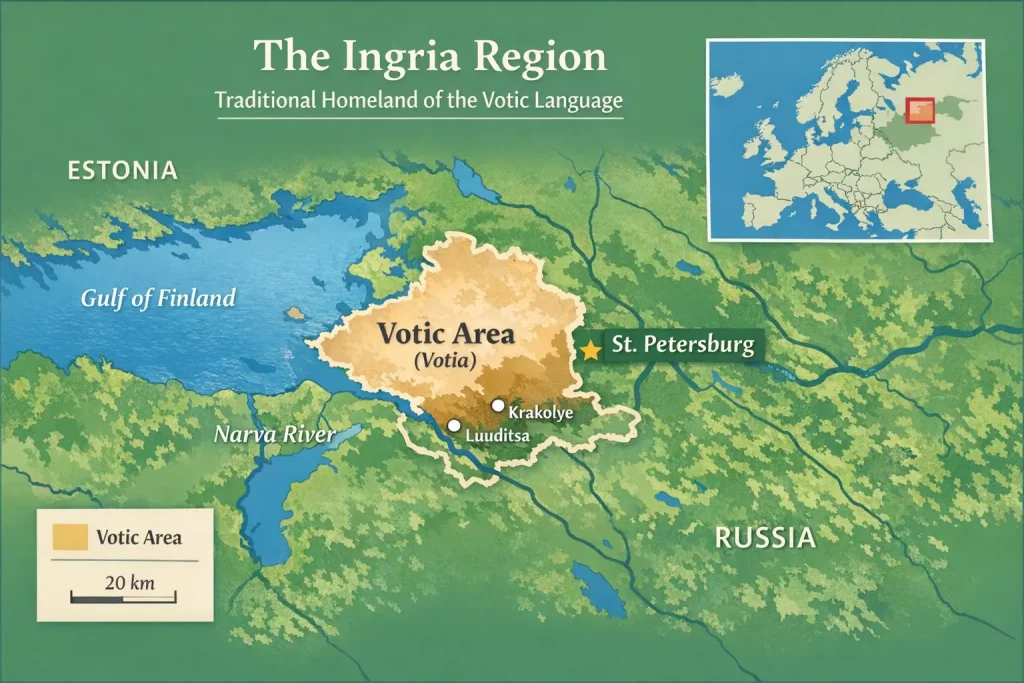
Votic is a critically endangered Finno-Ugric language. Spoken in the Ingria region of north-west Russia, close to the Estonian border.
Related to Finnish and Estonian, Votic preserves older linguistic features that have disappeared from many other Finnic languages. Making it especially important to linguists.
It was spoken in small rural communities. The spread of Russian, displacement, and assimilation in the 20th century caused its rapid decline.
Today, Votic survives through a handful of speakers, historical recordings, and cultural preservation efforts. Existing as a heritage language rather than one used in daily life.
Importance of studying endangered languages
Studying endangered languages matters because each one holds knowledge the world cannot replace.
They preserve unique ways of thinking, history, and environmental understanding that exist nowhere else. For linguists, they reveal how language evolves and how humans have communicated across centuries.
For communities, these languages are tied to identity, memory, and belonging. When a language disappears, so does an irreplaceable part of human culture.
Historical Background
Votic is one of the oldest surviving members of the Finnic language family. With roots that stretch back over a thousand years.
Its history is tied to the borderlands of north-western Russia. A region shaped by migration, trade, and shifting political control.
Votic’s past helps explain both its richness and its vulnerability today.
Origins of the Votic language
Votic developed from early Finnic languages spoken around the Gulf of Finland. Sharing deep ancestry with Finnish and Estonian.
Over time, it evolved its own distinct sound system, vocabulary, and grammatical structures.
Because it remained largely rural and locally spoken, Votic preserved many archaic features that have disappeared from related languages. Making it especially valuable for linguistic study.
Historical context of the Votic-speaking community
Historically, Votic was spoken by small farming and fishing communities in Ingria. Often organised around villages rather than cities.
These communities lived at the crossroads of empires and trade routes. Yet remained distinct.
Throughout the 19th and 20th centuries, war, displacement, and state-led assimilation disrupted everyday language transmission. Accelerating the decline of Votic in daily life.
Influence of neighbouring languages and cultures
Living in a border region meant constant contact with other cultures.
Russian, Estonian, Finnish, Swedish, and German influences all left traces on Votic vocabulary and usage. While borrowing enriched the language, the prolonged dominance of Russian pushed the Votic out of public life.
This layered linguistic influence reflects centuries of coexistence, pressure, and adaptation in one of Europe’s most complex cultural regions.
Linguistic Features
Votic may be little known, but linguistically it is rich.
As a Finnic language, it shares broad similarities with Finnish and Estonian. Yet it also preserves older structures and develops distinctive traits of its own.
Phonetics and phonology of Votic
Votic has a sound system typical of Finnic languages. Including vowel harmony and a clear distinction between short and long sounds.
Length can change meaning, making pronunciation especially important. Compared to its relatives, Votic retains older consonant patterns and subtle sound contrasts that have disappeared elsewhere.
Stress generally falls on the first syllable, giving the language a steady, rhythmic quality.
Grammar and syntax
Votic grammar is inflected. Relying on case endings rather than word order to show meaning.
Nouns take grammatical cases to express relationships such as location, movement, and possession. Verbs change according to tense, mood, and person.
Sentence structure is flexible, allowing speakers to shift emphasis without losing clarity, a feature common in many Uralic languages
Unique vocabulary and expressions
Much of Votic vocabulary reflects traditional rural life. With rich terminology for farming, fishing, forests, and seasonal change.
Some words and expressions have no direct equivalents in larger languages. Capturing local ways of thinking and living.
While borrowing from Russian and other neighbours occurred over time, Votic retains a core vocabulary that reflects its deep cultural and historical roots.
Basic Votic Vocabulary
People & Everyday Life
- mī – I
- sī – you (singular)
- tämā – this
- inimīni – person / human
- lapsi – child
- naizī – woman
- mees – man
Nature & Place
- maa – land / earth
- vesi – water
- Mētsä – forest
- järvī – lake
- päivä – day
- öö – night
Common Verbs
- olla – to be
- tullā – to come
- mennä – to go
- elää – to live
- sööä – to eat
- nähä – to see
Useful Expressions
- Terve! – Hello
- Kuidas sī olet? – How are you?
- Hüvä – good
- Ei – no
- Jah – yes
The Votic Community
The Votic people are one of Europe’s smallest recognised ethnic groups. Their story is not defined by numbers, but by continuity.
A community that has endured centuries of political pressure, displacement, and cultural change while maintaining a distinct identity rooted in language, land, and tradition.
Demographics of Votic speakers
Today, the number of fluent Votic speakers is small, often estimated at fewer than a dozen, with most speakers being elderly. The community is in a few villages in the historical Ingria region of north-west Russia.
While ethnic identification may extend beyond fluent speakers, intergenerational transmission of the language ceased in the 20th century, placing Votic among the most critically endangered languages in the world.
Cultural practices and traditions
Traditional Votic culture was tied to rural life. Farming, fishing, and seasonal cycles shaped daily routines, rituals, and oral traditions.
Folk songs, laments, and storytelling played an important role in passing down knowledge and values.
Many customs overlapped with neighbouring Finnic cultures. Yet retained distinctive local elements that reflected Votic history and environment.
Role of the Votic language in community identity
For the Votic community, the language has long been more than a tool for communication. It represents ancestry, belonging, and cultural survival.
Even as everyday use declined, Votic remained a symbol of identity. Spoken in songs, remembered in phrases, and preserved in family memory.
Today, learning or supporting Votic is often an act of cultural reclamation. Reaffirming identity in the face of near-erasure.
Current Status of the Votic Language
Votic is classified as critically endangered. Sitting at the very edge of language survival. While it no longer functions as a community language, it has not vanished.
Its current status reflects both the depth of its decline. The importance of ongoing documentation and preservation.
Number of speakers today
Today, the number of fluent Votic speakers is extremely small. Often estimated at fewer than ten.
Most are elderly, and natural intergenerational transmission has stopped.
Beyond fluent speakers, there are also descendants and learners who keep partial knowledge, remembered phrases, or passive understanding of the language.
Geographic distribution
Votic has historically been spoken in the Ingria region of north-west Russia. Particularly in a handful of villages near the Gulf of Finland.
Modern speakers are scattered, with some remaining in these traditional areas. Others living elsewhere due to displacement and migration during the 20th century.
There is no longer a single, active Votic-speaking settlement.
Factors contributing to language endangerment
Votic did not disappear because its speakers abandoned it overnight. Its decline was the result of long-term pressure. Where survival became impractical and impossible in everyday life.
- Forced assimilation policies reduced the use of Votic in public and private life. Especially through schooling and administration.
- Population displacement during wars broke up Votic-speaking communities and disrupted natural language transmission.
- Urbanisation and economic pressure pushed younger generations to adopt Russian as the language of opportunity and mobility.
- The dominance of Russian in education and public life left little space for minority languages to be maintained.
- Lack of official recognition and institutional support meant Votic received no protection, funding, or formal teaching.
Efforts for Revitalisation
Although Votic remains critically endangered, it has not been forgotten.
In recent decades, small but meaningful efforts have focused on documentation, education, and cultural visibility. Aiming to preserve what remains and, where possible, reconnect people with the language.
Community initiatives and grassroots movements
Local descendants, cultural activists, and volunteers have played a central role in keeping Votic visible.
This includes recording elder speakers, preserving songs and oral histories, and organising small cultural events.
Rather than large-scale revival, these efforts focus on cultural continuity. Ensuring the language is remembered, respected, and accessible to future generations.
Role of educational programmes
Formal education in Votic is limited, but teaching has taken place through workshops, short courses, and community-led learning projects.
Some initiatives introduce Votic as a heritage language. Helping learners engage with basic vocabulary, pronunciation, and cultural context.
These programmes prioritise awareness and preservation over fluency. Reflecting the language’s fragile status.
Support from linguistic organisations
Universities, archives, and linguistic institutes have been essential to Votic’s survival.
Researchers have documented grammar, compiled dictionaries, and created audio recordings that now serve as the foundation for all learning and revitalisation efforts.
International linguistic organisations also help raise awareness of Votic as a critically endangered language, supporting its documentation and long-term preservation.
The Impact of Technology
For a language with so few speakers, technology has become one of the most important tools for survival.
While it cannot replace living communities, it allows Votic to exist beyond geography and time. Giving the language a presence in the modern world.
Digital resources for Votic language learning
Digital archives, online dictionaries, and recorded audio have made Votic accessible in ways that were before impossible.
Linguistic recordings of native speakers now form the backbone of learning materials. Allowing pronunciation, vocabulary, and grammar to be preserved.
Social media and its role in language preservation
Social media has helped bring visibility to Votic by sharing its story with a wider audience.
Posts about endangered languages, short vocabulary features, and cultural history introduce Votic to people who may never have encountered it otherwise.
Even minimal online exposure helps shift the language from obscurity to recognition.
Comparative Analysis
Placing Votic alongside related languages helps clarify both its uniqueness and its vulnerability.
Comparison shows how closely Votic is tied to the wider Finno-Ugric family. While also highlighting the specific historical pressures that shaped its decline.
Votic in relation to other Finno-Ugric languages
Votic belongs to the Finnic branch of the Finno-Ugric language family. Alongside languages such as Finnish, Estonian, Karelian, and Ingrian.
Like its relatives, it uses rich case systems, vowel harmony, and agglutinative grammar.
Votic is more conservative than many of these languages. Retaining older grammatical and phonological features that have disappeared elsewhere.
Similarities and differences with Estonian and Finnish
Votic is most closely related to Estonian, sharing vocabulary, sound patterns, and grammatical structures. Many basic words are recognisable, though pronunciation and inflection differ.
Compared to Finnish, Votic grammar is simpler in some areas but retains archaic traits lost in modern Finnish.
Unlike both languages, Votic never underwent large-scale standardisation or state-supported development, which limited its ability to adapt to modern contexts.
Lessons learned from other endangered languages
The survival of endangered languages elsewhere offers clear lessons for Votic. While every language faces different pressures, successful preservation efforts tend to share common foundations.
- Visibility matters: Languages that appear in media, public spaces, and online are more likely to be valued and supported.
- Community engagement is essential: Revitalisation works best when speakers, descendants, and learners feel ownership of the language.
- Education creates continuity: Even small-scale teaching programmes help keep languages active across generations.
- Institutional support makes a difference: Legal recognition, funding, and academic backing improve survival chances.
- Technology extends life beyond speakers: Documentation, digital archives, and online resources preserve knowledge even when fluent use declines.
- Cultural pride sustains memory: A language can remain meaningful even without daily use, as long as it is respected and remembered.
The Future of Votic
The future of Votic is uncertain, but not without possibility.
While the language stands at the edge of extinction, its story is still being written through preservation, education, and renewed interest in endangered languages.
Challenges facing the language
Votic faces significant obstacles that limit its chances of recovery:
- Extremely small number of fluent speakers, most of whom are elderly
- Lack of intergenerational transmission, with no children raised as native speakers
- Absence of formal education systems teaching the language
- Limited official recognition and funding
- Fragmented community, due to historical displacement and migration
Opportunities for growth and revitalisation
Despite these challenges, there are realistic paths for sustaining Votic’s legacy:
- Digital documentation and archives preserving authentic speech and grammar
- Heritage learning programmes focused on basic language skills and cultural knowledge
- Growing global interest in endangered languages, increasing visibility and support
- Technology and online platforms enabling learning without geographic limits
- Cultural projects and storytelling that reconnect descendants with their linguistic heritage
Votic Language FAQs
Is the Votic language still spoken today?
Yes, but only by a very small number of people. Votic is considered critically endangered, with fewer than ten fluent speakers remaining, most of whom are elderly.
Where was the Votic language traditionally spoken?
Votic was traditionally spoken in the Ingria region of north-west Russia, near the Gulf of Finland and close to the modern Estonian border.
Is Votic related to Finnish or Estonian?
Yes. Votic belongs to the Finnic branch of the Finno-Ugric language family and is closely related to Estonian and Finnish, though it preserves older linguistic features that those languages have lost.
Why did the Votic language nearly disappear?
Votic declined due to forced assimilation, war-time displacement, urbanisation, and the dominance of Russian in education and public life, which disrupted intergenerational transmission.
Can the Votic language be revived?
Large-scale revival is unlikely due to the lack of native speakers, but documentation, digital resources, and heritage learning projects can preserve the language and keep its cultural legacy alive.