
|
Getting your Trinity Audio player ready...
|
Most learners get stuck translating everything from English first. It works at the beginning, but later it slows you down, breaks your flow, and makes your Russian sound stiff or unnatural.
Real fluency starts when Russian becomes the default, not the conversion.
This guide shows you how to move away from mental translation and into direct thinking, using practical habits, mindset shifts, and simple techniques you can apply immediately.
How to think in your target language?
Thinking in your target language isn’t about forcing yourself to stop translating. It’s about making translation unnecessary. In the beginning, your brain uses English as a bridge because it’s familiar and efficient.
Over time, though, that bridge slows you down. Real progress happens when you start linking words directly to meaning, images, and intentions, rather than running everything through your native language first.
The shift comes from small, repeated habits: thinking in short fragments, narrating everyday actions, and accepting imperfect language.
You don’t need full sentences or perfect grammar, just staying inside the language. When your target language starts to feel like the default and English becomes the afterthought, you’re no longer translating. You’re thinking.
Understanding the Concept of Language Thinking
Thinking in a language means processing ideas directly in that language, without running them through another one first.
Instead of translating thoughts from English, your brain begins to associate words with meaning, emotion, and intention on their own.
This is a cognitive shift, not a vocabulary milestone. It develops gradually through exposure, repetition, and comfort with ambiguity.
Thinking in a language
When you think in a language, your thoughts are often short, incomplete, and situational. They’re closer to instincts than sentences.
Native speakers don’t mentally narrate perfect grammar; they think in fragments, reactions, and cues shaped by context.
Training yourself to think this way reduces hesitation and helps the language feel lived-in rather than constructed.
Differences between translation and direct thought
Translation is a two-step process: meaning first exists in your native language, then gets converted.
Direct thought skips that step entirely. The result is faster comprehension, smoother speech, and fewer unnatural structures.
Translation leans on accuracy; direct thought prioritises flow and intent. While translation is useful early on, staying in it too long keeps the language at arm’s length.
| Aspect | Thinking via Translation | Thinking Directly in the Language |
| Mental process | Two-step: idea in native language → converted | One-step: idea forms directly in the language |
| Speed | Slower, with noticeable pauses | Faster and more automatic |
| Cognitive load | High – constant mental switching | Lower – ideas flow naturally |
| Speech quality | Often stiff or over-constructed | Smoother, more natural |
| Grammar focus | Accuracy first, rules in mind | Meaning and intent first |
| Word choice | Literal, sometimes unnatural | Idiomatic and context-driven |
| Listening comprehension | Delayed while translating | Immediate understanding |
| Fatigue level | Mentally tiring over time | Less exhausting in conversation |
| Best use case | Early learning stages | Intermediate to advanced fluency |
| Long-term effect | Keeps language at a distance | Builds true fluency and instinct |
Benefits of thinking in Russian
When you start thinking in Russian, the language stops feeling like something you use and starts feeling like something you inhabit. Instead of assembling sentences piece by piece, your brain reacts in Russian.
Key benefits:
- More natural word choice, with fewer literal or “English-shaped” phrases
- Better rhythm and intonation that match how Russian is actually spoken
- Faster responses, without long pauses to translate
- Stronger listening skills and quicker comprehension of real speech
- Improved grasp of tone, emphasis, and emotional nuance
- Easier recognition of common patterns and structures
- Less mental fatigue during conversations
- Greater confidence in spontaneous situations
- A deeper connection to humour, culture, and everyday expression
Immersion: Surrounding Yourself with the Language
Immersion doesn’t mean moving to Russia or spending all day studying. It means giving your brain no choice but to meet Russian regularly and naturally.
The more often Russian shows up in low-pressure, everyday contexts, the faster your mind stops translating and starts responding automatically.
Engaging with Russian media
Russian media exposes you to how the language actually sounds, flows, and reacts to emotion.
- Films and series train your ear for rhythm and informal speech,
- music helps internalise pronunciation and stress patterns,
- books build intuition for structure and vocabulary.
The goal isn’t to understand everything. It’s to recognise patterns and let meaning form without constant analysis.
Participating in language exchange programmes
Language exchanges push you out of passive learning and into real interaction.
Speaking with native or fluent speakers forces your brain to prioritise meaning over perfection.
You learn how people really respond, interrupt, joke, hesitate, and clarify. All of which accelerates your ability to think directly in Russian rather than constructing sentences in advance.
Creating a Russian-speaking environment
You can simulate immersion wherever you are. Change your phone settings, think through daily tasks in Russian, label objects, and talk to yourself using simple phrases.
These small, consistent exposures teach your brain that Russian isn’t “study time”. It’s part of daily life. Over time, Russian becomes the language your mind reaches for first.
Building Vocabulary in Context
Vocabulary sticks when it’s learned with meaning attached, not in isolation.
Words learned on their own are easy to forget and hard to use, but words learned in context come back naturally when you need them.
Context turns vocabulary into something usable rather than theoretical.
Learning words through phrases and sentences
Instead of memorising single words, learn them as part of common phrases or short sentences.
This shows you how words behave, which cases or prepositions they take, and what they sound like in real use.
You’re not just learning what a word means, but how it lives inside the language.
Using flashcards and spaced repetition systems
Flashcards work best when they test recognition and recall in context.
Short phrases, example sentences, or situational prompts are far more effective than word-for-word translations.
Spaced repetition helps move vocabulary from short-term memory into long-term recall, making access faster and more automatic over time.
To be able to use flashcards, here are some of the best sites to use:
- Anki: powerful spaced repetition, fully customisable, ideal for sentence-based and cloze cards
- Quizlet: easy to use, good for quick phrase review and recognition practice
- Memrise: strong on audio, native-speaker clips, and contextual learning
- Brainscape: confidence-based repetition with clean, focused decks
- LingQ: vocabulary learned directly from real texts and media
- ClozeMaster: excellent for learning high-frequency words through full sentences
Associating new vocabulary with images or experiences
Link new words to images, actions, or personal experiences rather than English definitions.
If you learn a word while cooking, walking, or watching something memorable, your brain stores it with a sensory hook.
This strengthens recall and encourages direct thought, meaning appears first, and the word follows.
Practising Active Listening
Active listening is one of the fastest ways to start thinking in your target language.
When you listen properly, your brain is forced to process meaning in real time rather than translating word by word.
Over time, this builds instinct, pattern recognition, and confidence, especially in fast, unscripted speech.
Importance of listening to native speakers
Native speakers expose you to natural speed, rhythm, reductions, and emotional tone that textbooks can’t replicate.
Hearing how Russian is actually spoken trains your ear to recognise familiar structures automatically.
The more you listen, the less your brain panics and the less it needs English as a crutch.
Techniques for improving listening skills
Improving listening isn’t about catching every word. It’s about training your brain to follow meaning in real time. The aim is to stay with the language, even when it’s fast or unclear, and let understanding build naturally through exposure and repetition.
- Focus on the overall message, not individual words
- Listen to the same audio multiple times with different goals
- First listen for general meaning; later listen for details
- Shadow short sections by repeating what you hear aloud
- Pause and summarise the content in simple language
- Tolerate gaps in understanding without switching to English
Utilising podcasts, audiobooks, and conversations
Podcasts and audiobooks are ideal for sustained exposure and building endurance, especially when paired with transcripts.
Conversations, even short ones, force immediate processing and response, which accelerates the shift away from translation.
Mixing passive listening with active engagement keeps your listening skills sharp and growing.
Speaking Without Fear of Mistakes
Fear is one of the biggest barriers to fluency. Many learners know what they want to say but hesitate because they’re worried about being wrong.
Letting go of perfection is essential. Mistakes aren’t signs of failure, they’re evidence that you’re actually using the language.
Embracing errors as part of the learning process
Every mistake gives your brain feedback. Native speakers expect errors from learners and usually focus on meaning, not correctness.
The more you speak imperfectly, the faster your accuracy improves. Silence, on the other hand, teaches your brain nothing.
Finding conversation partners or tutors
Regular interaction creates accountability and momentum.
Conversation partners help you practise real, everyday language, while tutors can gently guide you and correct patterns before they fossilise.
Even short, frequent sessions are far more effective than occasional long ones.
Engaging in role-playing scenarios
Role-playing removes pressure by giving you a clear context and purpose.
Practising situations like ordering food, making plans, or handling problems helps you build ready-made language that your brain can access quickly.
When similar situations appear in real life, you respond automatically. Not by translating, but by reacting.
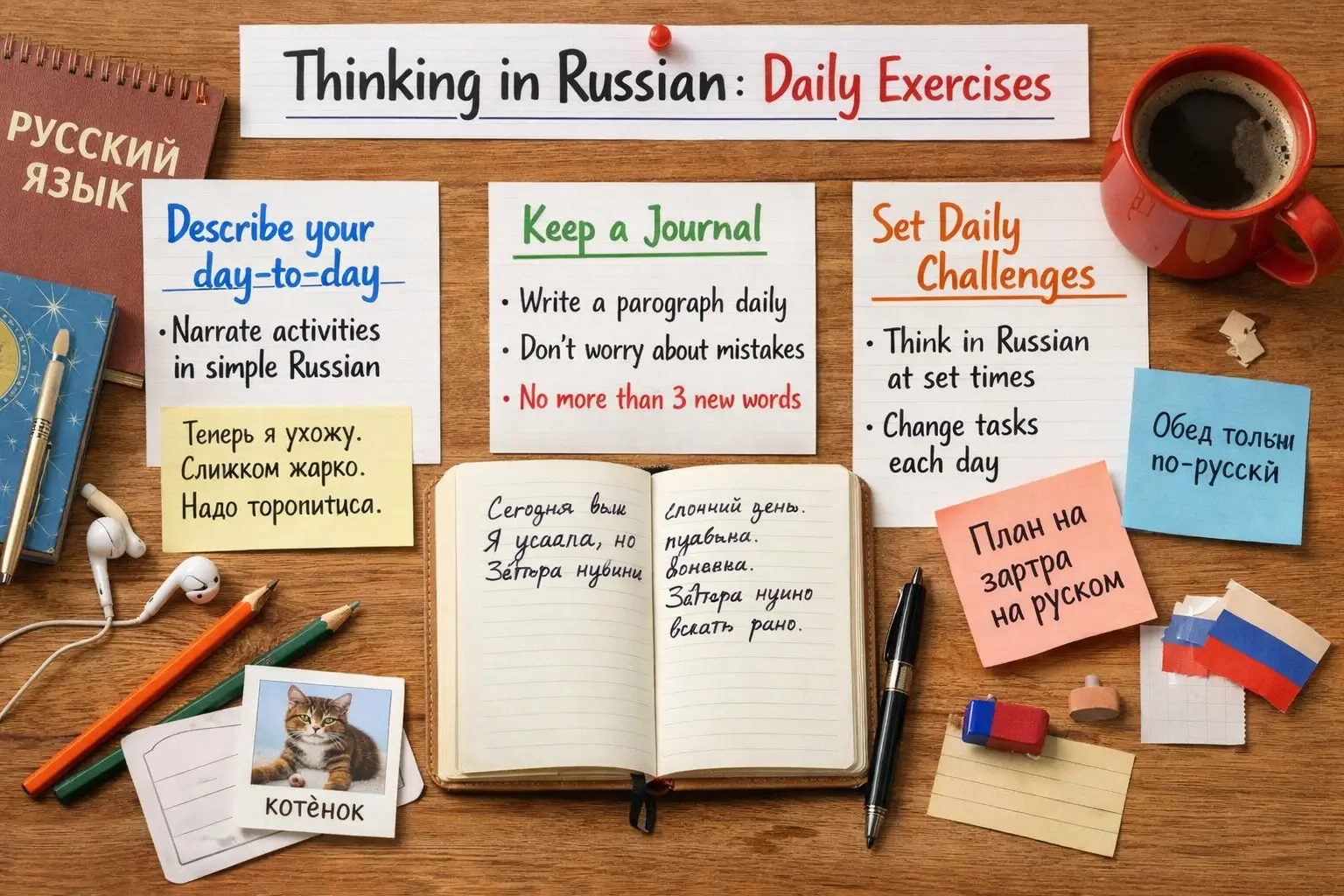
Thinking in Russian: Daily Exercises
Fluency isn’t built in long study sessions. It’s built in small, repeatable actions that train your brain to default to Russian.
These exercises are designed to be practical, slightly uncomfortable, and easy to fit into real life. Done daily, they push you out of translation mode and into instinct.
Describing your day-to-day activities in Russian
Turn everyday moments into language triggers. As you cook, walk, or work, narrate what you’re doing in short, simple phrases. Don’t aim for elegance. Aim for speed.
If you don’t know a word, work around it. This forces active recall and keeps your thinking inside Russian instead of English.
Example:
- “Now I’m leaving.”
- “Too hot.”
- “Need to hurry.”
Keeping a journal in Russian
Write briefly but consistently. One paragraph a day is enough.
Focus on what happened, how you felt, or what you plan to do. Not on perfect grammar.
If you hit a gap, simplify rather than switching languages. Over time, you’ll see patterns repeat, sentences shorten, and confidence grow.
Rule: never look up more than three words per entry.
Setting daily challenges to think in Russian
Give your brain clear, limited tasks. One day, think only in Russian during meals. Another day, plan tomorrow in Russian.
Another, react to messages or videos in Russian without translating. Constraints make the exercise sharper and more effective.
These aren’t study drills, they’re rewiring habits. When Russian becomes the language of small thoughts, it naturally becomes the language of big ones too.
Think in Russian FAQs
When should I start trying to think in Russian?
You can start very early. Even at beginner level, thinking in single words or short phrases helps build direct connections between meaning and Russian, reducing reliance on English over time.
Is it bad to translate from English when learning Russian?
Translation isn’t bad. It’s useful at the start. Problems arise when you rely on it for too long. The aim is to gradually reduce translation until ideas form directly in Russian.
Do I need a large vocabulary to think in Russian?
No. Thinking in Russian works best with a small set of high-frequency words used often. Fast access and familiarity matter more than vocabulary size.
What if my Russian is grammatically incorrect when I think or speak?
That’s completely normal. Thinking in Russian doesn’t require perfect grammar. Staying in the language, even imperfectly, is far more valuable than constant self-correction.
How long does it take to start thinking naturally in Russian?
It varies, but with daily exposure and active use, many learners notice a shift within weeks. The change is gradual and driven by consistency rather than sudden breakthroughs.