
|
Getting your Trinity Audio player ready...
|
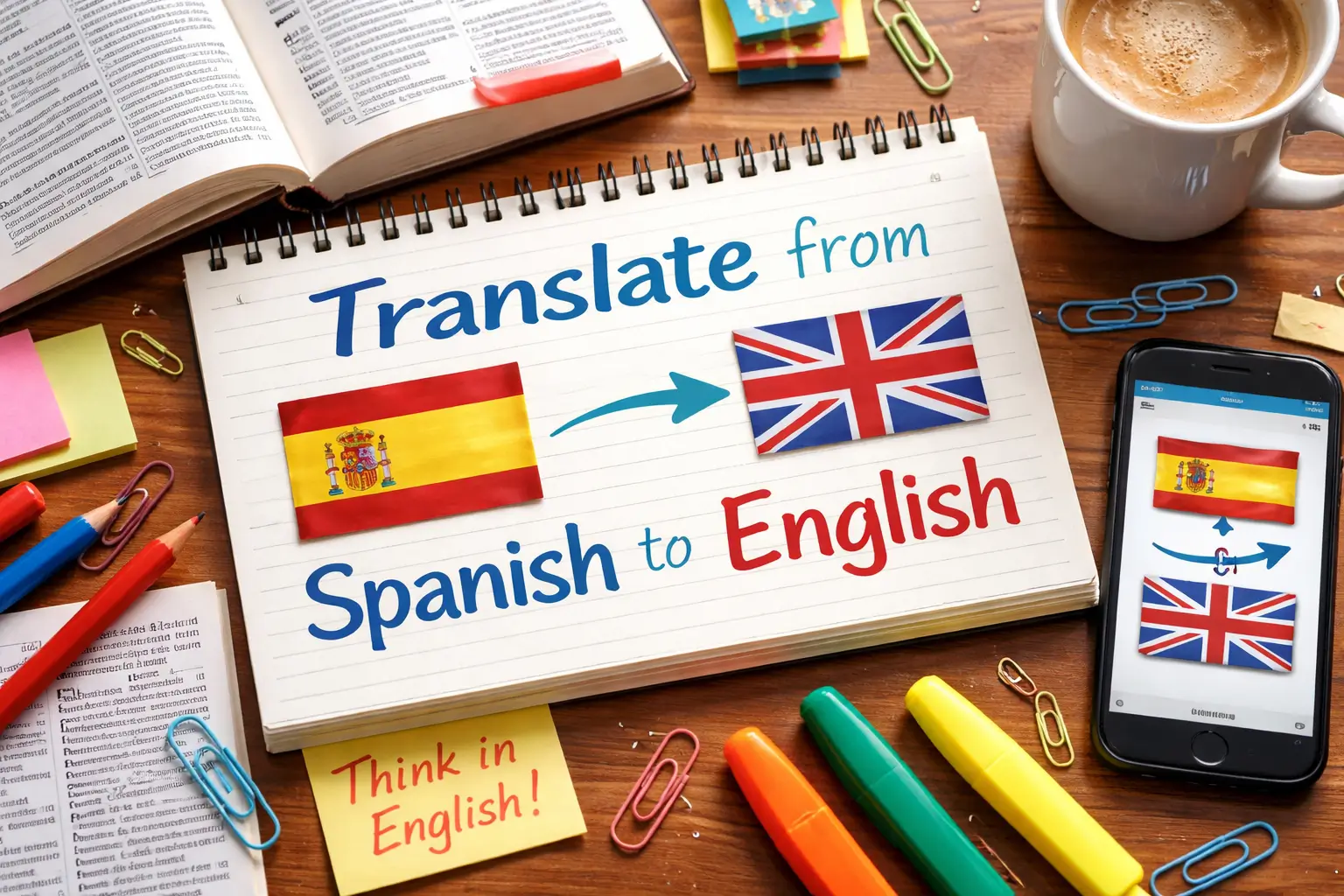
TL;DR: If you want to speak English more fluently, it’s important to stop translating from Spanish before you speak. Translating from Spanish before speaking English slows your fluency and increases hesitation. To speak more naturally, train yourself to think directly in English through daily immersion, simple speaking practice, and consistent real conversations.
If you’re a Spanish speaker learning English, you’ve probably felt this before: someone asks you a simple question… and your brain goes quiet. Not because you don’t know the answer, but because you’re building it in Spanish first.
You think it in Spanish.
You translate it into English.
You check the grammar.
You panic.
And by the time you’re ready, the moment has passed.
The problem isn’t your vocabulary. It isn’t your intelligence. And it definitely isn’t your effort. The real issue is that you’re running English through a Spanish operating system.
It begins when you stop translating.
Importance of fluency in English
Fluency in English isn’t about big words or perfect grammar. It’s about flow. Saying what you mean without freezing, translating, or overthinking.
In real life, conversations move fast. Interviews, meetings, travel, friendships. You don’t get time to build sentences in your head. Fluency lets you respond naturally, not mechanically.
And here’s the truth: people notice confidence more than perfection. Smooth communication, even with small mistakes, sounds strong. Constant hesitation doesn’t.
- Grammar builds the structure.
- Vocabulary gives you the tools.
- Fluency gives you freedom.
Common challenge of translating from Spanish
If you’re learning English as a Spanish speaker, translating in your head feels natural. It’s how you survived at the beginning. You built every sentence in Spanish first, then converted it into English.
But what helped you at A1 or A2 level quietly becomes your biggest barrier to fluency later on.
Here are the most common challenges Spanish speakers face when they rely on translation:
- Word-for-word sentence structure: Spanish order creeps into English sentences, creating phrases that sound “almost right” but slightly unnatural.
- False friends (falsos amigos): Words like actually, realise, or embarrassed get confused because they look similar to Spanish equivalents but mean something different.
- Overusing literal equivalents: Translating expressions directly (e.g., “I have 20 years” instead of “I am 20”) leads to recurring mistakes.
- Slower response time: Building the idea in Spanish first creates hesitation and breaks conversational flow.
- Mental overload: Your brain is doing double work, thinking in one language and speaking in another, which increases anxiety.
- Loss of natural rhythm: English stress and phrasing get disrupted when sentences are structured with Spanish timing in mind.
What is the Translation Habit?
At the beginning of your English journey, translating is survival. It’s how you make sense of new words. You hear “apple”, you think “manzana”. You hear “I’m tired”, you think “estoy cansado”.
But over time, this helpful strategy becomes automatic. You don’t even realise you’re doing it. Every idea passes through Spanish before it comes out in English.
That automatic dependence is what we call the translation habit.
The problem? What feels safe starts limiting your fluency.
What is the mental process of translation?
When you translate mentally, your brain follows a multi-step process:
- Form the idea in Spanish.
- Search for equivalent English words.
- Adjust grammar and word order.
- Check if it sounds correct.
- Finally, speak.
That’s five cognitive steps, for one sentence.
Meanwhile, native speakers (and advanced bilinguals) skip most of this. They connect the idea directly to English words, without passing through another language first.
Why bilingual speakers often translate
Translating isn’t a bad habit. It’s a natural stage of bilingual development.
Your brain prefers efficiency and familiarity. Spanish is your strongest neural pathway, so your mind uses it as a base. When English is still developing, your brain leans on Spanish for support.
There are a few reasons this happens:
- Comfort and security: Spanish feels stable. English feels uncertain.
- School-based learning: Many classrooms teach vocabulary through direct equivalents.
- Fear of mistakes: Translating feels safer than speaking spontaneously.
- Limited immersion: If you don’t use English daily, your brain keeps defaulting to Spanish first.
The impact of translation on fluency and confidence
The biggest cost of translation isn’t grammar mistakes. It’s hesitation.
When you translate, you pause more. You overthink more. You edit yourself mid-sentence. That interruption breaks your rhythm and rhythm is a huge part of sounding confident.
Even if your grammar is correct, constant processing creates:
- Slower responses in conversation
- Reduced natural intonation
- Increased anxiety
- Mental fatigue
- Lower speaking confidence
Ironically, many Spanish speakers know enough English to communicate smoothly but translation prevents them from accessing it quickly.
Embracing English Thinking
Fluency changes the moment you stop asking, “How do I say this in English?” and start thinking directly in English instead.
That shift isn’t about forgetting Spanish. It’s about building a second mental pathway. One where ideas connect straight to English words without translation in the middle.
Techniques to shift mindset from Spanish to English
The goal is simple: reduce the time between thought and speech.
1. Use simple English, not perfect English
Instead of translating complex Spanish ideas, simplify the thought. If you don’t know the exact word, describe it. Fluency grows from flexibility, not precision.
2. Think in short sentences
Your brain struggles when you try to build long, advanced structures. Train yourself to think in short English phrases:
- “I’m hungry.”
- “I need to call her.”
- “That was difficult.”
Short thoughts reduce mental overload.
3. Avoid direct equivalents
When learning new vocabulary, don’t memorise it as word = translation. Attach it to an image, situation, or feeling instead. This builds direct English associations.
4. Narrate your actions
Quietly describe what you’re doing throughout the day in English:
- “I’m making coffee.”
- “I forgot my keys.”
- “It’s raining again.”
This builds automaticity without pressure.
The role of immersion in English-speaking environments
Immersion forces your brain to adapt.
When English surrounds your brain, it has less opportunity to retreat to Spanish. It starts recognising patterns naturally instead of analysing them.
You don’t need to live in an English-speaking country to create immersion. You can:
- Change your phone and apps to English
- Follow English creators online
- Listen to English audio daily
- Join English-speaking communities
Practising thinking in English through daily activities
You don’t need special exercises. You need awareness.
Start with moments when your mind is already active. Walking, cooking, commuting. Use those moments to practise internal English thinking.
Try:
- Mentally planning your day in English
- Replaying conversations in English
- Imagining future scenarios in English
- Describing your environment silently
At first, it feels slow. That’s normal. You’re building a new neural pathway.
But with repetition, something changes.
You stop translating.
You start responding.
Expanding Your English Vocabulary
If fluency is flow, vocabulary is fuel.
You can’t think directly in English if you don’t have enough English words available. When vocabulary is limited, your brain automatically returns to Spanish to “fill the gaps.”
A wider vocabulary doesn’t just help you speak more. It helps you think more clearly in English.
Importance of a robust English vocabulary
Vocabulary isn’t about memorising long, academic words. It’s about knowing the right everyday words quickly.
When your vocabulary is strong:
- You respond faster in conversations
- You describe ideas more precisely
- You rely less on Spanish equivalents
- You feel more confident expressing opinions
Many learners underestimate how much vocabulary affects confidence. Often, hesitation isn’t about grammar. It’s about searching for words.
Strategies for learning new words and phrases
To build real fluency, you need active vocabulary, words you can use, not just recognise.
Here are effective strategies:
1. Learn phrases, not isolated words
Instead of memorising “decision”, learn “make a decision.” English works in chunks. Learning phrases reduces grammar mistakes and sounds more natural.
2. Connect words to context
Attach new vocabulary to situations, emotions, or images. The brain remembers stories better than lists.
3. Focus on high-frequency words
Prioritise words you’ll use daily. Common verbs, connectors, and expressions matter more than rare vocabulary.
4. Use the word immediately
Create three original sentences with every new word. Usage strengthens memory far more than repetition alone.
Utilising flashcards, apps and reading materials
Tools can accelerate your progress, if you use them intentionally.
Flashcards
Digital flashcards (especially spaced repetition systems) help move vocabulary from short-term to long-term memory. But avoid writing translations only. Include example sentences.
Apps
Language apps are great for exposure and review, but combine them with speaking practice. Vocabulary must be activated, not just recognised.
Reading materials
Reading is one of the fastest ways to expand vocabulary naturally. Articles, graded readers, novels, blogs. They expose you to words in context. Highlight useful phrases and reuse them in your own sentences.
The goal isn’t to know more words than other learners.
Listening and Mimicking
If you want to stop translating and start thinking in English, your ears matter as much as your mouth.
Fluency isn’t built only through speaking. It’s built through exposure, hearing natural rhythm, stress, phrasing, and tone again and again until they feel familiar.
Listening trains instinct. Mimicking turns that instinct into skill.
The benefits of active listening to native speakers
Passive listening (background noise) has some value.
Active listening changes your fluency.
When you actively listen, you focus on:
- How sentences are structured
- Where speakers pause
- Which words are stressed
- How connected speech flows
Over time, your brain starts recognising patterns automatically. You don’t analyse grammar. You feel what sounds natural.
Techniques for mimicking pronunciation and intonation
Mimicking is one of the fastest ways to sound more natural.
Here’s how to do it effectively:
- Shadowing: Play a short audio clip and repeat it immediately, trying to match rhythm and tone. Don’t focus on perfection. Focus on flow.
- Copy the music of the sentence: English has stress-timing. Some words are strong, others are reduced. Imitate the melody, not just the words.
- Record yourself: Compare your version to the original. Notice differences in stress, speed, and connected sounds.
- Use short segments: Practise with 5–10 second clips. Short repetition builds accuracy without overwhelming your brain.
Mimicking reduces translation because you’re training your mouth to follow patterns automatically, not construct sentences from scratch.
Recommended resources: podcasts, films and music
Choosing the right content makes a huge difference. You want clear speech, natural rhythm, and language you’ll actually use.
Here are strong, practical options:
Podcasts
- 6 Minute English: Short, clear episodes with useful vocabulary and natural British pronunciation.
- The English We Speak: Great for learning real expressions and everyday phrases.
- All Ears English: Conversational American English with a focus on natural speaking.
- Luke’s English Podcast: Longer episodes, excellent for listening stamina and exposure to natural British rhythm.
Films & Series (Use English subtitles)
- The King’s Speech: Clear articulation and powerful pronunciation focus.
- Friends: Everyday conversational American English.
- The Crown: Clear British pronunciation and formal speech patterns.
- Harry Potter and the Philosopher’s Stone: Accessible vocabulary with clear British accents.
Music (Great for Rhythm & Connected Speech)
- Ed Sheeran: Clear lyrics and natural pacing.
- Adele: Strong vowel sounds and emotional expression.
- Taylor Swift: Story-based lyrics with clear pronunciation.
- Coldplay: Slower tempo songs that are easier to follow.
Engaging in English Conversations
At some point, input isn’t enough.
You can listen to podcasts. You can read articles. You can shadow scenes from films. But fluency only solidifies when you use English with another human being.
Conversation is where translation breaks because there’s no time to translate.
It’s uncomfortable at first. That’s exactly why it works.
Finding language exchange partners or conversation groups
You don’t need to live in an English-speaking country to practise real conversations. You just need access to people.
Here are practical ways to find them:
- Tandem: Connects you with native speakers for text, audio, and video exchanges.
- HelloTalk: Great for informal conversations and quick corrections.
- Meetup: Search for English conversation groups in your area or online.
- Italki: Book structured speaking sessions with professional teachers or community tutors.
You can also:
- Join English-speaking Discord or Facebook groups
- Attend international events
- Start weekly calls with a friend learning English
Consistency matters more than intensity. One focused conversation per week is better than ten passive hours alone.
Tips for initiating and maintaining conversations in English
The hardest part is starting.
Keep it simple.
1. Use predictable opening questions
Prepare 3–5 questions you can always use:
- “How was your week?”
- “What are you working on lately?”
- “Have you watched anything interesting recently?”
Preparation reduces hesitation.
2. Focus on ideas, not grammar
Your goal is communication, not perfection. If you forget a word, explain it differently. Keep talking.
3. Use conversation fillers
Native speakers buy time naturally:
- “That’s a good question.”
- “Let me think.”
- “Well, I guess…”
These small phrases reduce silence and increase confidence.
4. Ask follow-up questions
Conversations flow when you show interest. Follow-ups keep the exchange moving and reduce pressure on you to talk constantly.
Overcoming the fear of making mistakes
Fear is the biggest barrier. Not vocabulary.
Most learners wait until they feel “ready.” The truth? Confidence doesn’t come before speaking. It comes from speaking.
Mistakes are not proof that you’re bad at English. They’re proof you’re using it.
Remember:
- Native speakers don’t expect perfection.
- Small errors rarely block understanding.
- Hesitation feels bigger to you than it sounds to others.
If you want to stop translating, you must allow imperfect English to exist.
Fluency grows in messy conversations. Confidence grows in uncomfortable moments.
Practising Without Translation
If you want to break the translation habit, you can’t just understand it. You have to train against it.
The goal isn’t perfect English.
The goal is direct English.
That means speaking before your brain has time to run everything through Spanish first. It feels uncomfortable at the beginning, but that discomfort is exactly where fluency develops.
Exercises to practise speaking without translating
These exercises are designed to reduce thinking time and build automatic responses.
The 5-Second Rule
Ask yourself a question and answer within five seconds. No overthinking. No rewriting. Just respond.
Example:
- “What did I do yesterday?”
- “What do I want to achieve this year?”
Fast answers weaken the translation reflex.
Object Description Drill
Look around the room and describe random objects in English:
- “This is a black chair. It’s comfortable. I use it every day.”
Keep it simple. The simplicity is the training.
Time-Limited Speaking
Set a timer for 60 seconds. Choose a topic and speak continuously. If you get stuck, rephrase instead of stopping.
The aim is flow, not complexity.
Think-Out-Loud Practice
Narrate your actions while cooking, walking, or working:
- “I need to send that email.”
- “I’m running late.”
- “This tastes better than I expected.”
This builds internal English thinking without pressure.
Role-playing scenarios to enhance fluency
Role-play removes hesitation because you know the situation in advance.
Try scenarios like:
- Ordering food in a restaurant
- Explaining a problem to customer service
- Introducing yourself at a networking event
- Answering common job interview questions
Create the scene in your mind and act it out aloud.
Using prompts to encourage spontaneous speaking
Spontaneity is the opposite of translation.
Use random prompts to force immediate thinking:
- “Describe your ideal weekend.”
- “What would you do if you won £1 million?”
- “What’s one habit you want to change?”
- “If you could live anywhere, where would you go?”
Answer without preparing in Spanish.
You can also:
- Use question generator apps
- Pull random topics from a list
- Ask a friend to surprise you with questions
The more you practise spontaneous speaking, the less your brain depends on Spanish structure.
Setting Realistic Goals
Fluency doesn’t happen in one big breakthrough. It’s built through small, consistent wins.
Many learners set goals that are too vague, “I want to be fluent”, or too extreme, “I’ll speak perfectly in three months.” When progress feels slow, motivation drops.
Clear, realistic goals keep you focused. They turn English from something overwhelming into something measurable.
And measurable progress builds confidence.
Importance of setting achievable language goals
Good goals are specific and practical.
Instead of:
- “Improve my English”
Try:
- “Have one 20-minute conversation per week.”
- “Learn 10 new phrases I can actually use.”
- “Think in English for 5 minutes every day.”
Achievable goals reduce pressure and increase consistency. When your brain sees progress, it stays motivated. When goals feel impossible, it shuts down.
Tracking progress and celebrating small victories
If you don’t track progress, you’ll underestimate how far you’ve come.
Keep it simple:
- Record short speaking samples once a month.
- Track conversation hours.
- Keep a list of new phrases you’ve used in real life.
- Note moments when you responded without translating.
These small wins matter.
Adjusting goals as fluency improves
As your fluency grows, your goals should evolve.
- At beginner level, the focus might be basic sentences.
- At intermediate level, it might be reducing hesitation.
- At advanced level, it might be refining pronunciation and nuance.
If something feels too easy, increase the challenge slightly.
If it feels overwhelming, simplify.
The goal isn’t speed.
It’s sustainability.
Seeking Professional Help
Sometimes, the fastest way to break the translation habit isn’t more self-study. It’s a guided correction.
You can practise alone for months and still repeat the same patterns without realising it. A good teacher doesn’t just teach grammar. They spot hesitation, notice when you’re translating, and push you to respond directly in English.
Support accelerates awareness. Awareness accelerates fluency.
Benefits of language classes or tutoring
Working with a professional gives you structure and accountability.
Key benefits include:
- Immediate feedback: You find out what sounds unnatural right away.
- Targeted correction: A tutor can identify specific Spanish-influenced patterns in your speech.
- Speaking pressure (in a good way): Regular sessions force you to respond in real time.
- Personalised strategies: You get exercises tailored to your level and goals.
Finding the right instructor or programme
Not every teacher will suit your goals.
Look for someone who:
- Encourages speaking from the start
- Focuses on communication, not just grammar
- Understands common challenges Spanish speakers face
- Corrects constructively without interrupting fluency
If possible, book a trial session. Pay attention to how comfortable you feel speaking — that matters as much as qualifications.
Platforms like italki, Preply, and Cambly make it easy to test different instructors before committing.
Stop Translating From Spanish FAQs
Why do I translate from Spanish before speaking English?
Because your brain uses Spanish as a safety system. When English isn’t fully automatic yet, your mind builds the idea in Spanish first and then converts it, which slows your response time.
Is translating always a bad thing?
No. Translation is useful at beginner levels to understand vocabulary and structure. It only becomes a problem when it continues at intermediate or advanced levels and blocks natural fluency.
How can I stop translating in my head?
Practise thinking in short, simple English sentences every day. Use time-limited speaking exercises and real conversations to force faster responses without analysing everything first.
How long does it take to think directly in English?
It depends on consistency. With daily exposure, active listening, and regular speaking practice, many learners notice improvement within a few months.
Will I ever stop translating completely?
Yes, but gradually. As your vocabulary and confidence grow, English starts to connect directly to ideas instead of Spanish, and translation becomes less frequent and eventually automatic.