
|
Getting your Trinity Audio player ready...
|
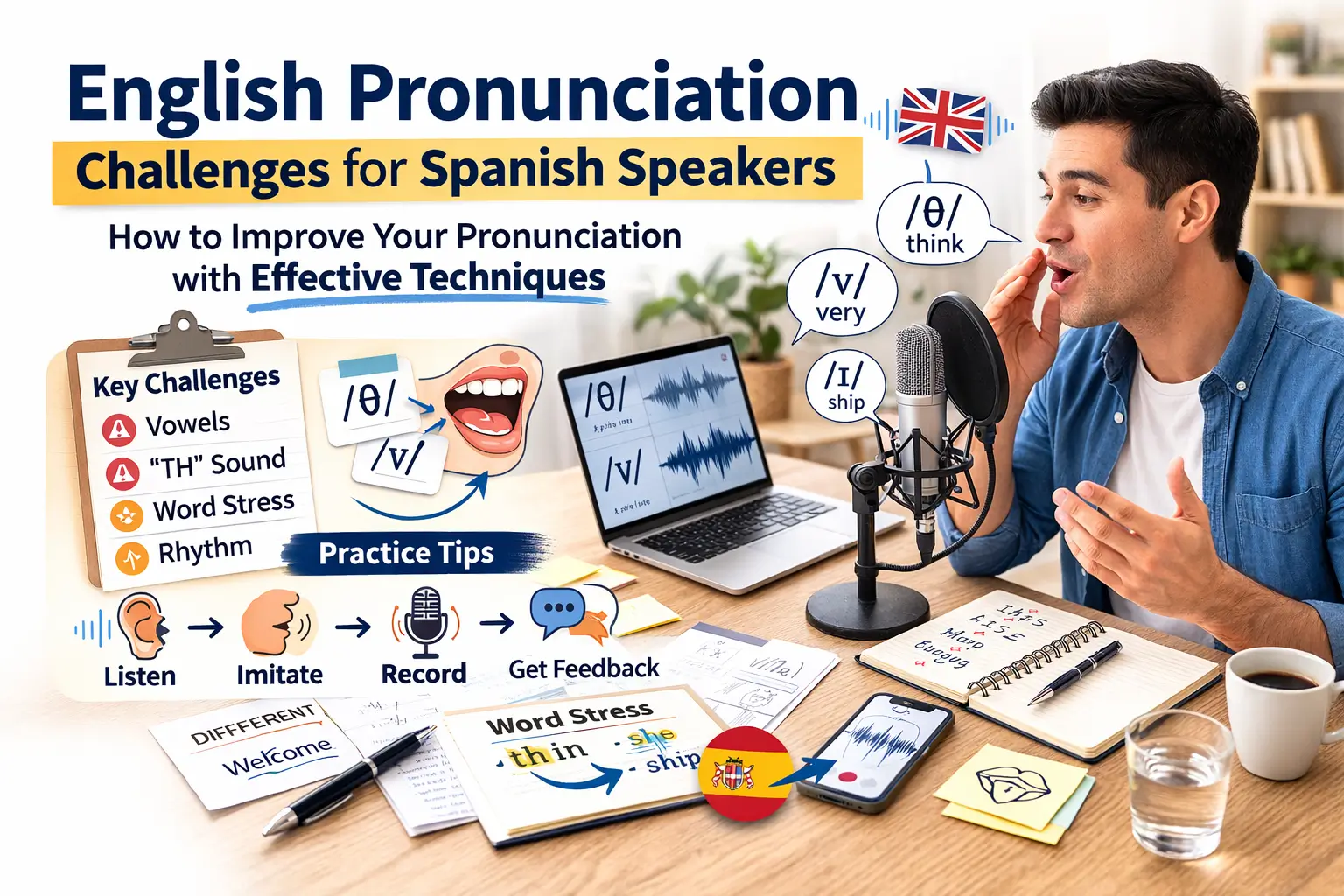
TL;DR: Spanish speakers struggle with English pronunciation because the two sound systems are very different. English has more vowels, unfamiliar sounds like “th” and “v”, complex endings, and a stress-timed rhythm.
English pronunciation can feel frustrating if Spanish is your first language. One reason Spanish Speakers Struggle is because the two languages are built differently, not because you’re “bad at accents”.
Spanish has a clean, consistent sound system. Most letters are pronounced the same way every time. English, on the other hand, is full of surprises: irregular spelling, reduced vowels, silent letters, and sounds that simply don’t exist in Spanish.
That’s why Spanish speakers often:
- Replace /ɪ/ with /i/ (“sit” → “seat”)
- Struggle with the short “ʌ” sound (“cup”)
- Pronounce every syllable clearly instead of reducing unstressed ones
- Transfer Spanish rhythm into English, creating a flatter stress pattern
The good news? These aren’t random mistakes. They’re predictable patterns caused by sound system differences.
Once you understand why the errors happen, vowel inventory differences, stress timing, and consonant gaps like /v/ and /ʃ/, you can fix them systematically.
The importance of pronunciation in language learning
Pronunciation isn’t about sounding “perfect”. It’s about being understood.
You can know thousands of words and solid grammar but if key sounds, stress, or rhythm are off, communication breaks down. Listeners may struggle, conversations slow down, and confidence drops.
That’s why pronunciation matters from the very beginning.
Here’s why it plays such a central role in language learning:
- Clarity over perfection: Clear pronunciation makes your message easy to follow, even with an accent.
- Listening improves too: When you can produce sounds accurately, you recognise them faster when others speak.
- Confidence increases: Feeling understood reduces hesitation and fear of speaking.
- Fewer misunderstandings: Small sound differences can change meaning completely (e.g. “ship” vs “sheep”).
- Natural rhythm and stress: Languages have patterns. Mastering them makes you sound smoother and more fluent.
The challenges faced by Spanish speakers when learning English pronunciation
Spanish speakers don’t struggle with English pronunciation because they lack the ability. They struggle because English and Spanish are built on very different sound systems.
Spanish is consistent and syllable-timed. English is irregular and stress-timed. That structural gap creates predictable challenges.
Here are the main ones:
- Vowel overload: Spanish has five clear vowels. English has many more, including subtle distinctions like /ɪ/ vs /iː/ (“sit” vs “seat”) and /ʌ/ (“cup”), which don’t exist in Spanish.
- Unfamiliar consonant sounds: Sounds like /v/, /ʃ/ (“sh”), /ʒ/ (as in “measure”), and the English /ɹ/ are either absent or very different in Spanish.
- The “th” sounds (/θ/ and /ð/): These are produced with the tongue between the teeth. A position that feels unnatural for many Spanish speakers.
- Word stress differences: Spanish words are more evenly stressed. English relies heavily on stressed syllables, and misplacing stress can make a word hard to recognise.
- Connected speech and reductions: English reduces vowels in unstressed syllables (the schwa /ə/). Spanish typically pronounces each syllable clearly, so English speech can feel rushed or unclear.
- Spelling vs pronunciation mismatch: Spanish spelling is largely phonetic. English spelling often gives unreliable clues about how a word sounds.
The Phonetic Differences Between Spanish and English
If you really want to improve your English pronunciation as a Spanish speaker, you have to look beyond spelling and vocabulary and focus on sound systems.
Spanish and English don’t just use different words. They organise sounds differently. They prioritise different rhythms, even move their mouths differently.
The Spanish phonetic system
Spanish has one of the most consistent phonetic systems in the world.
- It has five core vowel sounds: /a, e, i, o, u/.
- Each vowel is stable and clear.
- Words are largely pronounced as they are written.
Spanish is also syllable-timed, meaning each syllable receives roughly equal emphasis. This creates a smooth, even rhythm.
Key differences in vowel sounds
This is where many pronunciation issues begin.
English has a much larger vowel inventory. Depending on the variety, it can have 14–20 vowel sounds, including long vowels, short vowels, diphthongs, and reduced vowels.
For Spanish speakers, this creates several challenges:
- Distinguishing /ɪ/ and /iː/ (“sit” vs “seat”)
- Producing /ʌ/ (“cup”)
- Recognising the schwa /ə/ in unstressed syllables (“about”, “problem”)
- Handling diphthongs like /eɪ/ (“day”) and /aɪ/ (“time”)
In Spanish, vowels don’t change quality depending on stress. In English, they do. Unstressed vowels often weaken. Something that feels unnatural if you’re used to pronouncing every vowel clearly.
Consonant variations and their impact on pronunciation
English and Spanish share many consonants, but they don’t always use them in the same way, and some English sounds don’t exist in Spanish at all.
Common areas of difficulty include:
- The /v/ sound (often replaced with /b/)
- The English /ɹ/ (very different from the Spanish rolled or tapped “r”)
- The “th” sounds /θ/ and /ð/
- The “sh” sound /ʃ/
- Final consonant clusters (“tests”, “worlds”)
Spanish syllable structure tends to be simpler. English allows complex clusters at the beginning and end of words. This often leads to added vowels (“es-treet” for “street”) or dropped sounds.
Influence of the Native Language on English Pronunciation
When learning a new language, you don’t start from zero. You start with the sound system you already know.
Your native language shapes how you hear sounds, how you move your mouth, and how you organise rhythm. That influence is called language transfer. It plays a major role in English pronunciation for Spanish speakers.
This influence isn’t about labelling mistakes. It’s about recognising patterns.
What is language transfer and its effects?
Language transfer happens when learners apply rules from their first language to a second language.
Sometimes this helps. Shared sounds and similar structures make certain words easy to pronounce.
But when the sound systems differ, transfer creates predictable errors:
- Hearing English sounds as the “closest” Spanish equivalent
- Applying Spanish stress rules to English words
- Pronouncing English spelling as if it were Spanish
- Maintaining Spanish rhythm instead of English stress patterns
Common pronunciation errors influenced by Spanish
Spanish has a smaller vowel system and more consistent spelling, many English pronunciation patterns get simplified.
Typical examples include:
- Replacing /ɪ/ with /iː/ (“sit” → “seat”)
- Replacing /v/ with /b/ (“very” → “bery”)
- Adding a vowel before consonant clusters (“school” → “eschool”)
- Pronouncing every written vowel clearly instead of reducing unstressed syllables
- Rolling or tapping the English /ɹ/
- Confusing “b” and “v” in perception
These patterns aren’t random. They reflect how Spanish organises sound.
Examples of specific words or sounds that prove problematic
Certain words clearly reveal language transfer in action.
- “Very”: /v/ doesn’t exist distinctly in Spanish.
- “Think” / “This”: the tongue-between-the-teeth “th” sound is unfamiliar.
- “World”: multiple consonants together challenge Spanish syllable structure.
- “Cup”: the /ʌ/ vowel has no direct Spanish equivalent.
- “Beach” vs “Bitch”: subtle vowel length differences are difficult without targeted training.
- “Comfortable”: English stress and vowel reduction don’t match spelling.
These examples show how native language influence shapes pronunciation automatically.
The Role of Stress and Intonation
Pronunciation isn’t just about individual sounds. It’s about music.
English and Spanish don’t only differ in vowels and consonants. They differ in rhythm, stress, and melody. These patterns shape how natural, clear, and confident a speaker sounds.
When stress and intonation are off, communication can suffer even if every word is technically correct.
Differences in stress patterns between Spanish and English
Spanish is generally syllable-timed. Each syllable receives fairly even emphasis, creating a steady rhythm.
English is stress-timed. Some syllables are strong and longer, while others are reduced and shorter.
This leads to key differences:
- English reduces unstressed vowels to /ə/ (schwa)
- Content words (nouns, verbs, adjectives) are stressed
- Function words (to, of, a, for) are often weakened
- Word stress can change meaning (“REcord” vs “reCORD”)
Spanish speakers often pronounce every syllable clearly, without reduction. This can make English sound more “flat” or overly deliberate.
Importance of intonation in conveying meaning
Intonation refers to the rise and fall of pitch across a sentence.
In English, intonation signals:
- Questions vs statements
- Surprise, doubt, or certainty
- Politeness or directness
- Emphasis and focus
For example:
- “You’re coming.” (falling tone = statement)
- “You’re coming?” (rising tone = question or surprise)
English relies heavily on pitch movement to carry meaning beyond the words themselves.
How these differences can lead to misunderstandings
When English is spoken with Spanish stress timing:
- Important words may not stand out clearly
- Questions may sound like statements
- Emotional intent may feel unclear
- Sentences may seem abrupt or overly strong
For instance, failing to reduce small words (“I WANT TO GO TO THE STORE”) can sound overly forceful in English.
Misplaced stress can also confuse listeners:
- “I didn’t say he stole the money.”
- (Stress changes the meaning entirely depending on which word is emphasised.)
The takeaway: stress and intonation are not decoration. They are meaning.
Common Pronunciation Challenges for Spanish Speakers
English pronunciation isn’t difficult because it’s “hard”. It’s difficult because it’s different.
Spanish and English organise sounds, stress, and syllables in different ways. When Spanish speakers transfer familiar patterns into English, certain challenges appear again and again.
The good news? These patterns are predictable and trainable.
Specific sounds that are difficult (e.g. “th”, “v”, “h”)
Some English sounds simply don’t exist in standard Spanish, which makes them harder to hear and produce accurately.
Common examples include:
- “th” (/θ/ and /ð/): The tongue must come between the teeth. Many speakers replace it with /t/, /d/, or /s/ (“think” → “tink”, “this” → “dis”).
- “v” (/v/): Produced by touching the lower lip to the upper teeth. It’s often pronounced like /b/ (“very” → “bery”).
- “h” (/h/): In Spanish, “h” is silent. In English, it’s a soft breath sound. Words like “house” or “help” may lose the initial sound.
Issues with word endings and syllable stress
English allows complex consonant clusters, especially at the end of words. Spanish syllable structure is simpler.
This creates challenges such as:
- Dropping final consonants (“best” → “bes”)
- Adding extra vowels (“street” → “estreet”)
- Simplifying clusters (“world” → “worl”)
- Misplacing word stress (“comFORTable” instead of “COMfortable”)
Spanish stress is more regular and predictable, English stress patterns can feel inconsistent and confusing.
Examples of frequent mispronunciations
Certain words repeatedly reveal these patterns:
- “Think” → “Tink”
- “Very” → “Bery”
- “School” → “Eschool”
- “Comfortable” → pronounced exactly as written
- “Beach” vs “Bitch” → vowel length confusion
Many of these errors come from vowel simplification or from avoiding unfamiliar mouth positions.
Psychological Factors at Play
Pronunciation isn’t just physical. It’s psychological.
Many Spanish speakers know what the correct sound should be but hesitation, self-consciousness, or fear of sounding “wrong” gets in the way.
When anxiety enters the picture, the mouth tightens, speech speeds up or becomes rigid and accuracy drops.
Improving pronunciation isn’t only about training the tongue. It’s about managing the mindset.
Fear of making mistakes and its impact on speaking
Fear changes how we speak.
When learners worry about being judged:
- They avoid difficult sounds
- They speak more quietly
- They simplify vocabulary
- They revert to “safe” pronunciation patterns
This often reinforces the very habits they’re trying to change. For example, avoiding the “th” sound because it feels awkward prevents the brain from ever automatising it.
Mistakes are not signs of failure. They are part of muscle training. Every accurate sound you produce started as an uncomfortable one.
The role of confidence in language acquisition
Confidence directly affects clarity.
When speakers feel relaxed:
- Their mouth movements become more natural
- Stress and rhythm improve
- Intonation becomes more expressive
- Speech flows more smoothly
Confidence doesn’t come from waiting until you’re perfect. It comes from repetition and small wins.
Strategies to overcome anxiety during pronunciation practice
You can reduce pronunciation anxiety with deliberate habits:
- Practise alone first: Record yourself and listen back.
- Focus on one sound at a time: Avoid overwhelming your brain.
- Exaggerate during drills: Over-articulation builds muscle memory.
- Use slow practice: Clarity improves at lower speeds.
- Celebrate small improvements: Progress is incremental.
Most importantly, reframe pronunciation as training. Not performance.
You’re not trying to impress anyone. You’re strengthening coordination between your ear, brain, and mouth.
Effective Techniques for Improving English Pronunciation
Improving pronunciation isn’t about repeating random words and hoping they sound better. It’s about training your ear, your mouth, and your rhythm deliberately.
When practice is structured, progress becomes measurable and much faster.
Phonetic training and its benefits
Phonetic training focuses on how sounds are produced, not just what words mean.
Instead of memorising vocabulary, you:
- Learn mouth position (tongue, lips, airflow)
- Study the International Phonetic Alphabet (IPA)
- Practise minimal pairs (“ship” vs “sheep”)
- Train stress and syllable patterns
The benefit? You stop guessing.
Once you understand the mechanics behind sounds like /ɪ/, /ʌ/, or /θ/, you gain control. Pronunciation becomes technical rather than emotional.
The use of technology and apps for practice
Technology makes pronunciation training more precise and accessible than ever.
You can use:
- Speech recognition apps to check clarity
- Slow-down audio tools to analyse rhythm
- YouTube playback controls for shadowing
- Recording apps to compare your voice to models
- Interactive IPA charts
The key is active use. Don’t just listen, record, compare, adjust, repeat.
Importance of listening to and imitating native speakers
Pronunciation improves through imitation.
English rhythm, stress, and intonation are absorbed through exposure. By shadowing, you train timing and melody, not just individual sounds.
Effective imitation means:
- Choosing short clips
- Repeating them multiple times
- Matching stress and pitch, not just words
- Copying reductions and linking
The goal isn’t to erase your accent. It’s to increase clarity and natural rhythm across native speakers.
The Value of Practice and Feedback
Pronunciation doesn’t improve through awareness alone. It improves through repetition, correction, and adjustment.
You can understand every rule in English phonetics but without consistent practice and external feedback, habits rarely change.
Real progress happens when training meets accountability.
The role of consistent practice in mastering pronunciation
Pronunciation is motor skill training.
Your tongue, lips, and jaw must learn new movement patterns. That only happens through repetition.
Consistent practice:
- Builds muscle memory
- Reduces hesitation
- Strengthens sound distinction
- Improves rhythm and timing
Short, daily sessions are far more effective than occasional long ones.
Five to ten focused minutes on a single sound, stress pattern, or sentence rhythm can create noticeable improvement over time.
Seeking constructive feedback from teachers or peers
Self-practice is powerful, but feedback accelerates progress.
Often, learners cannot hear their own subtle errors. A teacher or trained partner can point out:
- Vowel length issues
- Incorrect stress placement
- Missing consonants
- Intonation patterns that sound unnatural
Constructive feedback should be specific, not vague. Instead of “your pronunciation needs work,” useful feedback sounds like:
- “Your /ɪ/ sounds like /iː/ in this word,” or “Stress the first syllable here.”
Participating in conversation groups or language exchanges
Pronunciation must eventually move from drills to real communication.
Conversation groups and language exchanges help you:
- Apply pronunciation in spontaneous speech
- Adjust rhythm in real time
- Develop confidence
- Receive natural feedback through listener reactions
Speaking with others also exposes you to different accents and speech speeds, strengthening listening skills alongside pronunciation.
Spanish Speakers Struggle with English Pronunciation FAQs
Why is English pronunciation harder for Spanish speakers?
English and Spanish have very different sound systems. English has more vowel sounds, unfamiliar consonants like “th” and “v”, complex word endings, and a stress-timed rhythm. Spanish is more phonetic and syllable-timed, which makes English feel less predictable.
Do Spanish speakers need to lose their accent to speak clearly?
No. The goal is clarity, not accent removal. Many Spanish speakers can maintain their identity while improving specific sounds, stress patterns, and rhythm for better intelligibility.
What are the most difficult English sounds for Spanish speakers?
Common challenges include the “th” sounds (/θ/ and /ð/), the /v/ sound, the English /ɹ/, short vowels like /ɪ/ and /ʌ/, and consonant clusters at the end of words.
How can Spanish speakers improve English stress and rhythm?
By practising word stress, learning vowel reduction (schwa /ə/), and using techniques like shadowing, repeating short audio clips while copying rhythm and intonation.
How long does it take to improve English pronunciation?
It depends on consistency. With focused daily practice on specific sounds and regular feedback, noticeable improvement can happen within weeks. Long-term refinement develops over months of structured training.