
|
Getting your Trinity Audio player ready...
|
You don’t need fluent Russian to travel confidently in 2026, but you do need the right Russian travel phrases.
A handful of well-chosen Russian expressions can be the difference between confusion and smooth travel, indifference and genuine help.
Outside tourist hotspots, English quickly disappears. Russians respond well to effort, especially when it’s practical and polite.
The importance of learning Russian travel phrases
Learning russian travel phrases isn’t about sounding impressive. It’s about making travel work.
A small set of practical phrases helps you navigate real situations: buying tickets, ordering food, asking for help, and dealing with problems calmly.
In countries where English isn’t widely spoken, these phrases turn potential stress into manageable moments and give you far more independence.
They also change how people respond to you. Making even a basic effort signals respect and awareness, often leading to clearer communication, more patience, and better treatment overall.
Understanding the Russian Language
Russian often has a reputation for being intimidating, but most of that fear comes from unfamiliarity rather than true difficulty.
Once you understand how the language works, and what actually matters for travel. Russian becomes far more approachable than many learners expect.
The Cyrillic alphabet
At first glance, Cyrillic looks like a wall of symbols. In reality, it’s a phonetic alphabet with clear, consistent sounds.
Most letters are read exactly the same way every time, which means once you learn them, you can read signs, menus, and place names surprisingly quickly.
The key takeaway for travellers is this: learning the Cyrillic alphabet isn’t about reading literature, it’s about recognising patterns.
Common misconceptions about the difficulty of Russian
Russian is often labelled “one of the hardest languages in the world”, but that claim needs context. Yes, the Russian grammar is complex, and none of it matters much for travel.
You don’t need cases, verb aspects, or perfect sentence structure to be understood.
Importance of pronunciation and intonation
In Russian, how you say something often matters more than how much you say. Stress placement can change meaning, and mis-stressed words may confuse listeners even if every letter is correct.
Statements fall, questions rise, and politeness is carried by calm delivery rather than exaggerated friendliness.
Focusing on clear vowels, firm consonants, and steady rhythm will make your Russian far more understandable than trying to speak quickly or “perfectly”.
Essential Greetings and Polite Expressions
In Russian, first impressions matter more than small talk
A few polite expressions used confidently can set the tone for an entire interaction whether you’re checking into a hotel, asking for help, or ordering food.
You don’t need many words, but you do need the right ones.
Basic greetings (hello, goodbye, thank you, please)
Russian greetings are clear, direct, and situational. Choosing the right word matters more than sounding friendly, and using polite forms correctly signals respect immediately.
- Здравствуйте: Hello (polite and safe with strangers, staff, and older people)
- Привет: Hi (informal; use once rapport is established)
- До свидания: Goodbye (neutral and polite)
- Пока: Bye (casual and friendly)
- Спасибо: Thank you (used often, without extra phrases)
- Пожалуйста: Please / You’re welcome (one word, two essential functions)
How to introduce yourself
Introductions in Russian are brief and functional. You’re not expected to explain yourself. Just state who you are.
- Меня зовут… — My name is… (the standard, natural introduction)
- No titles or extra details needed unless the setting is formal
- Handshakes are common in first-time or professional situations
- Calm delivery and clear pronunciation matter more than enthusiasm
Importance of politeness in Russian culture
Russian politeness is often misunderstood. It’s not about smiling constantly or using soft filler phrases. It’s about respectful distance and correct language.
Using polite forms shows awareness of social boundaries and earns trust quickly.
Navigating Transport
Transport is where a little Russian goes a long way. Tickets, platforms, and directions are rarely designed for tourists, and English support can be limited.
Knowing a few transport-specific phrases helps you move confidently and avoid common mistakes.
Key phrases for public transport (bus, train, taxi)
Russian transport language is functional and to the point. Short questions are normal, and politeness is shown through tone rather than extra words.
- Где автобус / поезд / метро?: Where is the bus / train / metro?
- Сколько стоит билет?: How much is a ticket?
- Один билет, пожалуйста: One ticket, please
- Это останавливается здесь?: Does this stop here?
- До [место], пожалуйста: To [place], please (essential for taxis)
- Можно картой?: Can I pay by card?
Asking for directions
When asking for directions, simplicity matters. Russians are generally helpful but expect clear, concise questions.
- Как пройти к…?: How do I get to…?
- Это далеко?: Is it far?
- Налево или направо?: Left or right?
- Прямо: Straight ahead
Understanding signs and announcements
Many transport signs are written only in Cyrillic, especially outside major cities. Learning key words helps you orient yourself quickly.
- Вход / Выход: Entrance / Exit
- Платформа: Platform
- Остановка: Stop
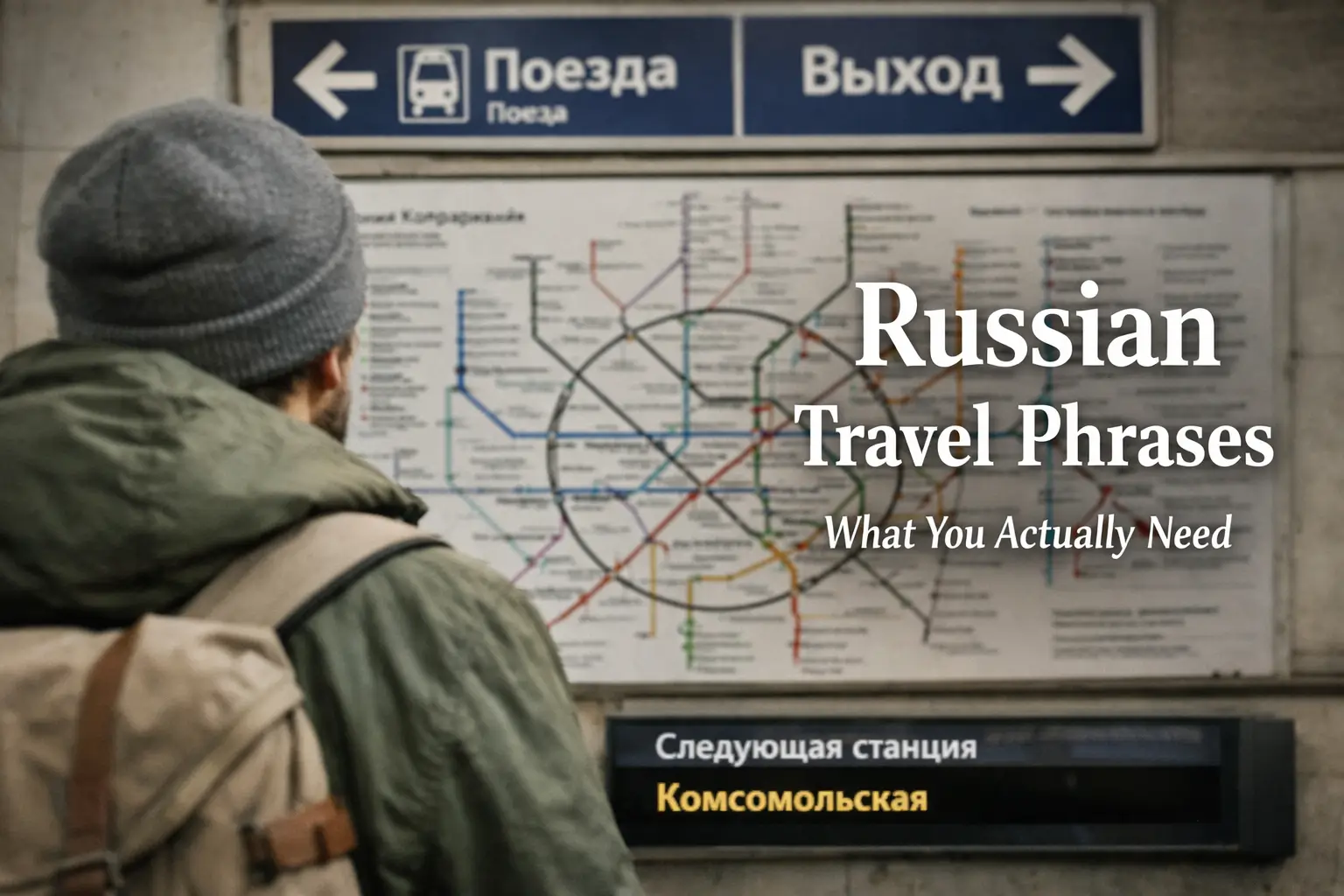
- Следующая станция: Next station
- Конечная: Final stop
Dining Out: Restaurant and Food Phrases
Eating out in Russia is usually straightforward, but menus and staff won’t always switch to English, especially outside tourist areas.
A few food-related phrases help you order confidently, avoid misunderstandings, and enjoy the experience rather than stress over it.
How to read a menu
Russian menus are typically organised by category, and once you recognise a few key words, they become much easier to navigate.
Many dish names are descriptive rather than creative, which actually works in your favour.
- Супы: Soups
- Салаты: Salads
- Горячие блюда: Main / hot dishes
- Закуски: Starters / appetisers
- Гарнир: Side dish
- Напитки: Drinks
Ordering food and drinks
Ordering in Russian is polite but direct. You don’t need long sentences — short, clear phrases are standard and sound natural.
- Можно меню, пожалуйста?: May I see the menu, please?
- Я буду…: I’ll have…
- Можно это?: Can I have this?
- Ещё один / ещё одну: Another one (drink or dish)
- Счёт, пожалуйста: The bill, please
Asking about dietary requirements
Dietary preferences are less commonly discussed in Russia than in some countries, but clear questions are usually respected. Simplicity is key.
- Без мяса: Without meat
- Я вегетарианец / вегетарианка: I’m vegetarian
- Есть ли здесь…?: Is there…?
- Я не ем…: I don’t eat…
- Есть орехи / молоко / яйца?: Does it contain nuts / milk / eggs?
Accommodation and Check-in Procedures
Hotels and hostels in Russia are generally efficient and formal. Staff may not initiate much conversation, but they are used to clear requests and straightforward questions.
Knowing a few accommodation-specific phrases helps everything run smoothly from arrival to departure.
Key phrases for booking a hotel or hostel
Even if you book online, confirming details in Russian can save time and avoid confusion at reception.
- У меня есть бронирование: I have a reservation
- На имя…: Under the name…
- На одну / две ночи: For one / two nights
- Есть свободные номера?: Do you have any rooms available?
- Сколько стоит номер за ночь?: How much is the room per night?
Checking in and out
Check-in procedures are usually formal and may involve passports or registration documents. Staying calm and prepared helps the process move quickly.
- Я хочу зарегистрироваться: I’d like to check in
- Вот мой паспорт: Here is my passport
- Во сколько выезд?: What time is check-out?
- Я выезжаю сегодня: I’m checking out today
- Можно оставить багаж?: Can I leave my luggage?
Asking for amenities and services
Requests for services are best kept short and specific. Russians generally prefer clear questions over indirect hints.
- Есть Wi-Fi?: Is there Wi-Fi?
- Пароль, пожалуйста: The password, please
- Есть завтрак?: Is breakfast included?
- Мне нужно полотенце / фен: I need a towel / hairdryer
- Можно поздний выезд?: Is late check-out possible?
Shopping and Bargaining
Shopping in Russia ranges from fixed-price supermarkets to informal street markets.
Knowing a few shopping phrases helps you avoid confusion, understand prices quickly, and handle transactions with confidence especially where English isn’t spoken.
Essential phrases for shopping
In most shops, interactions are brief and practical. Staff won’t usually engage in small talk, so clear questions work best.
- Сколько это стоит?: How much does this cost?
- Можно посмотреть?: Can I take a look?
- Я беру это: I’ll take this
- Есть другой размер / цвет?: Is there another size / colour?
- Можно картой?: Can I pay by card?
Understanding prices and currency
Russia uses the rouble (рубль). Often written as ₽ or abbreviated as руб. Prices are usually stated clearly, but large numbers can sound fast.
- Тысяча: Thousand
- Двести / пятьсот: Two hundred / five hundred
- Дорого: Expensive
- Дёшево: Cheap
Tips for bargaining in markets
Bargaining is not common in supermarkets or shopping centres, but it may happen in open-air markets or souvenir stalls. Even then, it’s subtle rather than aggressive.
- Start with Слишком дорого: Too expensive
- Try Можно дешевле?: Can it be cheaper?
- Smile, stay relaxed, and don’t push too hard
- If the price doesn’t change, simply say Спасибо and walk away
Emergency Situations
In an emergency, clarity matters more than perfect grammar.
Russians respond quickly to direct, serious language, so learning a few key phrases can make a critical difference when time and understanding matter most.
Key phrases for medical emergencies
If you need medical help, keep your language short and urgent. Simple statements are more effective than explanations.
- Помогите!: Help!
- Мне нужна помощь: I need help
- Вызовите скорую: Call an ambulance
- Мне плохо: I feel unwell
- У меня болит…: I have pain in…
- Аллергия: Allergy
- Мне нужен врач: I need a doctor
How to ask for help or report a problem
When something goes wrong, being calm but firm works best. Russians generally take problems seriously when they’re stated clearly.
- У меня проблема: I have a problem
- Меня обокрали: I’ve been robbed
- Я потерял / потеряла паспорт: I’ve lost my passport
- Это срочно: This is urgent
- Где полиция?: Where is the police?
Important numbers to know (police, ambulance)
Emergency numbers in Russia are straightforward and free to call from any phone:
- 112: General emergency number (works nationwide, multilingual support in many areas)
- 103: Ambulance
- 102: Police
- 101: Fire service
Cultural Tips for Using Phrases Effectively
Knowing the words is only half the skill. In Russia, how and when you use phrases matters just as much as what you say.
Cultural expectations help your Russian sound natural, respectful, and effective even at a basic level.
Understanding body language and gestures
Russian body language is generally restrained. Excessive smiling, animated gestures, or constant nodding can feel unnatural in everyday interactions.
Neutral facial expressions and calm movements are normal and not a sign of unfriendliness.
Significance of context in conversations
Context strongly shapes language choice in Russian. Formal and informal speech are clearly separated, and using a polite greeting with strangers is expected.
Casual language is reserved for friends, peers, or people who have already switched to it first.
Tips for practising phrases with locals
Practising Russian with locals doesn’t require confidence. It builds it.
Small, respectful attempts are usually met with patience, and how you approach the interaction matters more than how much you know.
- Start with short, practical phrases, not full sentences
- Speak slowly and clearly; rushing makes understanding harder
- Allow pauses. Silence is normal and not awkward in Russian conversations
- Accept corrections as help, not criticism
- Repeat the corrected phrase to reinforce it and show appreciation
- End interactions with a clear Спасибо to leave a positive impression
Russian Travel Phrases FAQs
Do I need to speak Russian to travel in Russia?
You don’t need fluency, but knowing basic russian travel phrases makes a big difference. Outside major tourist areas, English is limited, and simple Russian helps with transport, food, and everyday interactions.
Is Russian pronunciation more important than grammar for travellers?
Yes. Clear pronunciation and correct stress matter far more than perfect grammar. Short, well-pronounced phrases are easier to understand than long, complex sentences.
Can I get by using English in hotels and restaurants?
In international hotels and central restaurants, often yes. In smaller cities, local cafés, shops, and transport, English is much less common, so basic Russian is extremely useful.
Is it rude to make mistakes when speaking Russian?
Not at all. Most Russians appreciate the effort. Mistakes are normal, and corrections are usually meant to help, not criticise.
What are the most important Russian phrases to learn first?
Focus on greetings, polite expressions, transport phrases, ordering food, and asking for help. These cover most real travel situations and give you confidence quickly.