
|
Getting your Trinity Audio player ready...
|
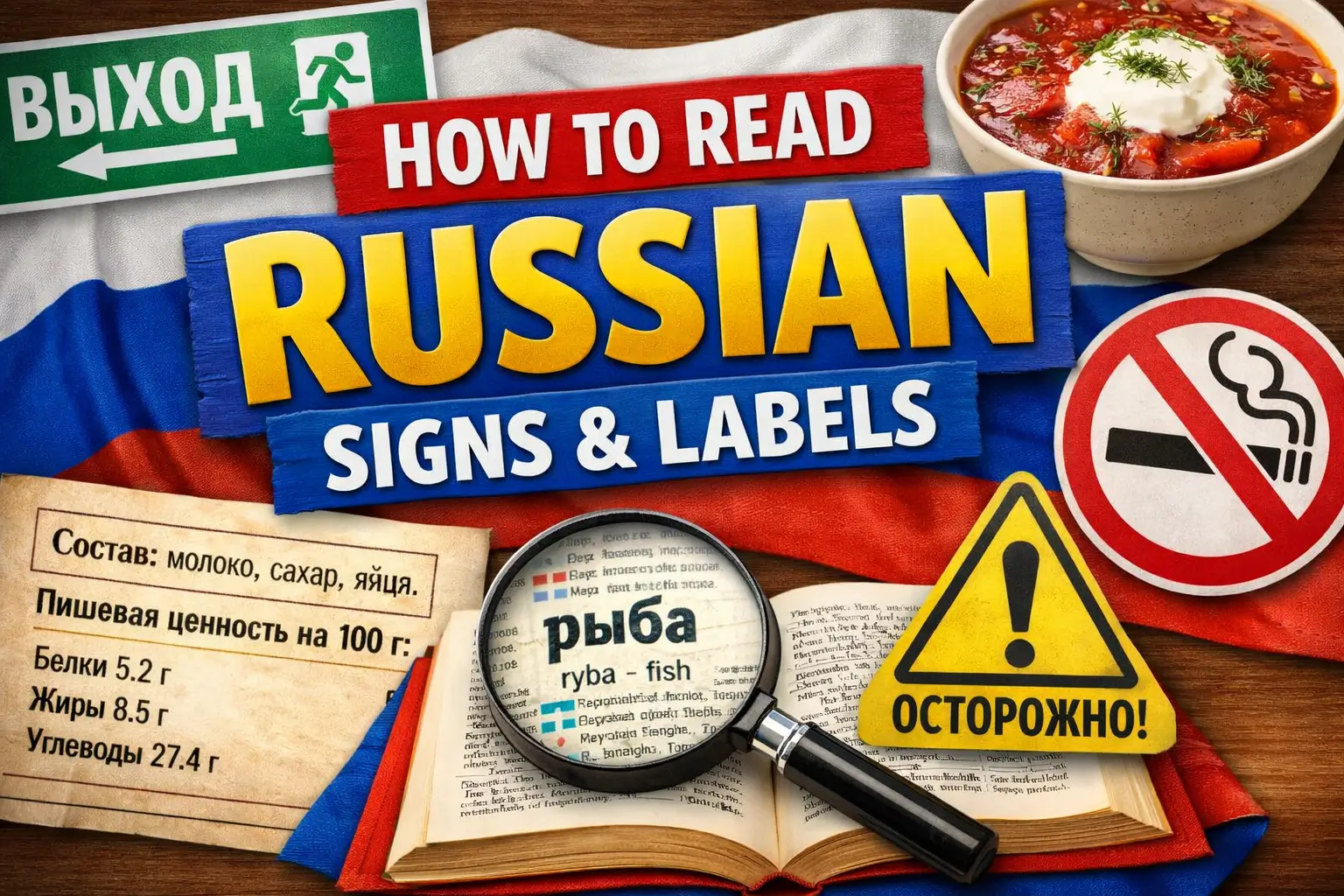
Walking through a Russian-speaking city as a beginner can feel like everything is written in code. It’s only when you start to read Russian that street signs, café menus, and shop labels begin to make sense.
Familiar places suddenly become unreadable. But here’s the good news: Russian text looks far more intimidating than it actually is.
Once you understand how the Cyrillic alphabet works and learn to spot a handful of common patterns, Russian signs start to unlock themselves. You don’t need advanced grammar or a huge vocabulary.
Understanding Russian signs, menus, and labels
Understanding Russian signs, menus, and labels is one of the most empowering skills you can develop as a beginner.
It turns Russian from something you study into something you can actually use, whether you’re ordering food, navigating public transport, or working out what’s on a supermarket shelf.
At first glance, Cyrillic can feel unfamiliar and even intimidating. But most real-world Russian text is highly predictable. The same words, symbols, and formats appear again and again.
Benefits of being able to read basic Russian
Being able to read basic Russian is one of the fastest ways to feel “capable” in the language. Even before you can speak much. Here are the biggest benefits:
- You can navigate without guessing: street signs, метро (metro) stations, exits, toilets, and directions stop being stressful.
- You avoid simple (and expensive) mistakes: reading labels helps you buy the right item and understand sizes, flavours, ingredients, and warnings.
- Menus become manageable: you’ll recognise common food words and categories, so ordering is quicker and less awkward.
- Your vocabulary grows naturally: repeated exposure to everyday words (coffee, bread, entrance, sale) sticks far better than isolated flashcards.
- You improve pronunciation and speaking: once you can decode Cyrillic, you can sound out words — and that makes practising aloud much easier.
- You can use public services more confidently: tickets, forms, notices, and basic instructions become readable instead of overwhelming.
- It makes Russian feel real: reading turns the language into something you interact with daily, which boosts motivation and momentum.
- You’re less reliant on translation apps: you’ll still use them, but you’ll need them less and you’ll trust your own judgement more.
The Cyrillic Alphabet: A Beginner’s Guide
Cyrillic looks intimidating until you realise it’s just a different set of letters.
And the moment you can read it, Russian becomes visible: signs stop being random symbols, menus start showing patterns, and labels become something you can decode rather than ignore.
What is the Cyrillic script?
Cyrillic alphabet is the writing system used for Russian (and several other languages). Think of it like an alphabet “family”. Similar to how English uses the Latin alphabet, Russian uses Cyrillic.
Some letters look like English letters and sound the same, some look familiar but sound different (those are the tricky ones), and some are completely new.
Once you learn the system, you stop “translating” letters in your head and start reading automatically.
The letters and their sounds
Here’s the simplest way to understand Cyrillic as a beginner: group the letters by familiarity.
1) Letters that look like English and sound the same
These are your free points:
- А а = a (as in father)
- Е е = ye / e (often like “ye” at the start of a word)
- К к = k
- М м = m
- О о = o (more like “oh”)
- Т т = t
2) Letters that look like English but sound different
These cause most beginner misreads. Learn these early and you’ll avoid loads of confusion:
- В в looks like B, sounds like v
- Н н looks like H, sounds like n
- Р р looks like P, sounds like r (rolled/tapped)
- С с looks like C, sounds like s
- У у looks like Y, sounds like oo
- Х х looks like X, sounds like kh (like the “ch” in loch)
3) Completely new-looking letters
These are easier than they look because you’re not tempted to “English-read” them:
- Б б = b
- Г г = g
- Д д = d
- Ж ж = zh (like the “s” in measure)
- З з = z
- И и = ee
- Л л = l
- П п = p
- Ф ф = f
- Ц ц = ts
- Ч ч = ch
- Ш ш = sh
- Щ щ = shch (a longer, softer “sh”)
- Ы ы = a deep vowel sound (no perfect English equivalent; you’ll learn it by imitation)
The two “sign” symbols you’ll see a lot
These aren’t vowels. They change how words sound:
- Ь ь = “soft sign” (makes the consonant softer)
- Ъ ъ = “hard sign” (less common; separates sounds)
Tips for memorising the alphabet
You don’t memorise Cyrillic by staring at a chart for an hour. You memorise it by making your brain use it in small, repeatable ways. Here are the methods that work quickest:
Learn the “fake friends” first
Spend extra time on В Н Р С У Х (and maybe Ё when you meet it). These are the letters that make beginners read nonsense. Fix them early and everything becomes easier.
Memorise in sound pairs, not letter names
Don’t learn “this is em, this is en.” Learn:
- М = m, Н = n
- В = v, Р = r
That’s what helps you read real words quickly.
Use mini-word practice instead of single letters
Once you learn a handful of letters, practise with tiny, high-frequency words you’ll actually see:
- мир (mir)
- дом (dom)
- кафе (kafe)
- метро (metro)
- банк (bank)
Even if you don’t know the meaning yet, sounding them out trains your decoding skill.
Label your environment (seriously)
Stick notes on things for one week using Cyrillic transliteration:
- чай (chai), кофе (kofe), вода (voda)
- Your brain will stop seeing Cyrillic as “foreign shapes” and start seeing it as normal text.
- Your brain will stop seeing Cyrillic as “foreign shapes” and start seeing it as normal text.
Read out loud for 2 minutes a day
Pick anything: a menu screenshot, a street sign photo, a product label. Read it slowly, even if you don’t understand it. This builds automatic recognition faster than silent study.
Aim for “80% fluent,” not perfect
Your goal is not to master every nuance of Russian phonetics immediately.
Your goal is to get to the point where you can look at a word and go, “I can read that.” That single skill unlocks everything else.
Common Signs You’ll Encounter
Once you can read Cyrillic, Russian signs stop feeling like “decoration” and start acting like helpful instructions. The best part is that public-space vocabulary is very repetitive.
The same words appear on doors, walls, transport hubs, shops, and forms everywhere. Learn a small core set, and you’ll suddenly be able to “read the room” in Russian, even with beginner-level vocabulary.
Essential vocabulary for navigating public spaces
These are the high-frequency signs you’ll see constantly. Focus on recognising them quickly rather than translating word-by-word.
Directions and access
- Вход (vkhod): Entrance
- Выход (vykhod): Exit
- Открыто (otkryto): Open
- Закрыто (zakryto): Closed
- Тяните (tyanite): Pull
- Толкайте (tolkayte): Push
- Не входить (ne vkhodit’): Do not enter
- Посторонним вход воспрещён (postoronnim vkhod vospreshchyon): No unauthorised entry
Toilets and facilities
- Туалет (tualet): Toilet
- WC / ВЦ (ve-tse): WC
- М (em): Men
- Ж (zhe): Women
- Мужской (muzhskoy): Men’s
- Женский (zhenskiy): Women’s
- Инвалид(ы) / Для инвалидов (dlya invalidov): Accessible / for disabled people
Warnings and basic rules
- Осторожно (ostorozhno): Caution / careful
- Опасно (opasno): Danger
- Не курить (ne kurit’): No smoking
- Курение запрещено (kureniye zapreshcheno): Smoking prohibited
- Внимание (vnimaniye): Attention
- Ведётся видеонаблюдение (vedyotsya videonablyudeniye): CCTV in operation
Visual examples of common signs and their meanings
Here are realistic sign “formats” you’ll recognise in shops, cafés, metros, and public buildings. (These are written the way you’ll actually see them.)
Door signs
- ВХОД → Entrance (usually on the main door
- ВЫХОД → Exit (often a separate door)
- ОТКРЫТО / ЗАКРЫТО → Open / Closed (classic window/door sign)
- ТЯНИТЕ / ТОЛКАЙТЕ → Pull / Push (often printed near the handle)
Toilet signs
- ТУАЛЕТ → Toilet (sometimes with an arrow)
- М / Ж → Men / Women (may be letters only)
- МУЖСКОЙ / ЖЕНСКИЙ → Men’s / Women’s (more formal)
Public transport and buildings
- ВЫХОД В ГОРОД (vykhod v gorod) → Exit to street/city
- ВХОД НЕ РАБОТАЕТ (vkhod ne rabotayet) → Entrance not working / closed
- ОСТОРОЖНО, ДВЕРИ ЗАКРЫВАЮТСЯ (ostorozhno, dveri zakryvayutsya) → Caution, doors closing (metro/train)
Shop and service signs
- КАССА (kassa) → Till / checkout
- ОЧЕРЕДЬ (ochered’) → Queue
- СКИДКИ (skidki) → Discounts
- АКЦИЯ (aktsiya) → Promotion / special offer
- БЕЗНАЛИЧНЫЙ РАСЧЁТ (beznalichnyy raschyot) → Card payment / cashless
- НАЛИЧНЫЕ (nalichnyye) → Cash
Contextual tips for understanding signs in different environments
A beginner superpower is learning how Russian signage behaves. You don’t need to know every word. You need to know what to look for.
Use “category words” to identify the situation
Certain words tell you what kind of place you’re in:
- КАССА = you’re near payment
- ВХОД / ВЫХОД = doors and flow
- ТУАЛЕТ = facilities nearby
- ОСТОРОЖНО / ВНИМАНИЕ = rules/warnings ahead
Watch for arrows and floor numbers
Russian signs often rely on layout more than explanation:
- → / ← shows direction
- этаж (etazh) = floor (e.g., 2 этаж = 2nd floor)
- лифт (lift) = lift, лестница (lestnitsa) = stairs (both common in malls/offices)
Expect “formal Russian” in institutions
In stations, airports, clinics, and government buildings, you’ll see longer, more official phrasing. Don’t panic, hunt the keyword:
- Spot вход/выход, запрещено (prohibited), документы (documents), регистрация (registration) and you’ll get the message.
In shops, assume it’s about money, rules, or offers
Most shop signage is one of three things:
- price/discount (скидки, акция)
- payment method (наличные, безналичный)
- behaviour rules (не курить, не входить)
Learn the “pattern” words that repeat everywhere
Two words unlock loads of signs:
- не = “not / don’t” (a clear warning marker)
- для = “for” (e.g., для клиентов = for customers; для персонала = staff only)
Decoding Menus: Key Phrases and Dishes
Menus are where beginner Russian starts paying off immediately.
Even if you only know a little, you can still work out what’s safe to order, what’s likely to be spicy, and what’s going to arrive covered in sour cream.
Russian menus follow predictable patterns: category headings, short descriptions, and repeated ingredient words. Learn those patterns and you’ll stop relying on guesswork every time you sit down to eat.
Common menu terms and phrases
These are the menu headings you’ll see everywhere — cafés, canteens, restaurants, even delivery apps. Aim to recognise them at a glance.
Menu sections
- Меню: menu
- Закуски: starters / snacks
- Салаты: salads
- Супы: soups
- Горячие блюда: hot dishes / mains
- Основные блюда: main courses
- Гарниры: side dishes
- Десерты: desserts
- Напитки: drinks
- Чай / Кофе: tea / coffee
Common labels you’ll see next to dishes
- Состав: ingredients
- Порция: portion
- Вес (г): weight (grams)
- Соус: sauce
- Сметана: sour cream (shows up a lot)
- Острый: spicy
- Домашний: homemade / house-style
- Фирменный: house speciality / signature
- С добавлением…: with added…
- На выбор: choice of / you can choose
High-frequency ingredient words
- Курица (chicken), говядина (beef), свинина (pork), рыба (fish)
- Грибы (mushrooms), картофель (potato), сыр (cheese)
- Лук (onion), чеснок (garlic), перец (pepper)
Popular Russian dishes to look out for
Some dish names appear so often that recognising them gives you an instant advantage. Here are the staples you’re most likely to see.
Soups (Супы)
- Борщ: beetroot soup (often served with sour cream)
- Щи: cabbage soup
- Солянка: rich, salty soup with meat/fish and pickles
- Уха: fish soup
Dumplings and comfort food (very common)
- Пельмени: meat dumplings (often with sour cream or butter)
- Вареники: dumplings with potato/cheese/cherries etc.
- Котлеты: meat patties/cutlets
- Голубцы: stuffed cabbage rolls
- Бефстроганов: beef stroganoff
- Шашлык: grilled skewered meat
Salads and sides
- Оливье: “Russian salad” (potato, egg, mayo, often ham)
- Селёдка под шубой: layered herring salad
- Гречка: buckwheat (common side)
- Пюре: mashed potato
Breakfast / café favourites
- Блины: thin pancakes (sweet or savoury)
- Сырники: fried cottage-cheese pancakes
- Пирожки: stuffed buns (baked or fried)
Tips for asking questions about menu items
You don’t need fluent Russian to ask the right questions. The goal is to keep it simple, point to the item, and use a few reliable phrases.
Easy questions that work in any restaurant
- Что это?: What is this?
- Что входит?: What’s included?
- Из чего это?: What is it made from?
- Это острое?: Is it spicy?
- Там есть мясо?: Is there meat in it?
- Там есть рыба?: Is there fish in it?
Useful “can I have it without…?” phrases
- Можно без…?: Can it be without…?
- Без мяса, пожалуйста: No meat, please.
- Без молока / без сыра: No milk / no cheese.
The phrase that instantly makes people more helpful
- Я плохо говорю по-русски: I don’t speak Russian well.
Russian Labels: Products and Ingredients
Reading Russian labels is one of the most practical beginner skills you can build.
It saves you from buying the wrong thing, helps you spot ingredients instantly, and makes supermarkets feel less like a guessing game.
Once you know a core set of label words, you’ll start recognising meaning in seconds, even if you can’t translate every line.
How to read labels on food and drink products
Most Russian food packaging follows a similar layout. If you know what each section is called, you can scan quickly instead of getting stuck.
Start with what the product is
Look for the big, bold name plus a “category” word:
- молоко (milk), йогурт (yoghurt), сыр (cheese)
- хлеб (bread), масло (butter/oil), сок (juice)
Check the ingredients line
This is usually marked as:
- Состав: Ingredients
Manufacturers often list ingredients in a long comma-separated string. Your job is not to understand everything — it’s to spot the important bits (meat, dairy, nuts, gluten, etc.).
Look for the date and storage rules
Common label cues:
- Дата изготовления: date of production
- Годен до / Срок годности: best before / shelf life
- Хранить при…: store at…
- После вскрытия: after opening
Find weight/volume and strength (for drinks)
- Масса нетто: net weight
- Объём: volume
- Крепость: strength (often for alcohol)
- Газированный: fizzy/carbonated (for water/soft drinks)
Key vocabulary for ingredients and nutritional information
These are the words you’ll see constantly. Learning them makes labels readable fast.
Core ingredient words
- Сахар: sugar
- Соль: salt
- Мука: flour
- Молоко: milk
- Сливки: cream
- Сыр: cheese
- Яйцо / яйца: egg/eggs
- Масло: butter / oil (context matters)
- Растительное масло: vegetable oil
- Подсолнечное масло: sunflower oil
- Вода: water
- Мясо: meat
- Курица: chicken
- Говядина: beef
- Свинина: pork
- Рыба: fish
- Орехи: nuts
- Мёд: honey
- Шоколад: chocolate
“Processed food” words that show up a lot
- Ароматизатор: flavouring
- Краситель: colouring
- Консервант: preservative
- Усилитель вкуса: flavour enhancer
- Загуститель: thickener
- Эмульгатор: emulsifier
- Добавки: additives
Nutrition and values
- Пищевая ценность: nutritional value
- Энергетическая ценность: energy value
- Калории / ккал: calories / kcal
- Белки: protein
- Жиры: fats
- Углеводы: carbohydrates
- Сахара: sugars
- Клетчатка: fibre
- Натрий: sodium
- На 100 г / на 100 мл: per 100g / per 100ml
Quick win: memorise белки / жиры / углеводы (protein/fat/carbs). You’ll spot nutrition tables instantly.
Tips for identifying allergens and dietary restrictions
If you have allergies or dietary limits, Russian labels can still be manageable as a beginner. As long as you know the key trigger words and how warnings are written.
The most useful “alert” phrases
- Содержит… — contains…
- Может содержать следы… — may contain traces of…
- Без… — without…
- Не содержит… — does not contain…
Common allergens to recognise
- Молоко: milk
- Лактоза: lactose
- Яйца: eggs
- Рыба: fish
- Арахис: peanuts
- Орехи: nuts
- Соя: soy
- Пшеница: wheat
- Глютен: gluten
- Сельдерей: celery
- Горчица: mustard
- Кунжут: sesame
Dietary labels you may see
- Вегетарианский: vegetarian
- Веганский: vegan
- Постный: “Lent/fasting-friendly” (often dairy/egg-free, but not always; still check)
- Без глютена: gluten-free
- Без сахара: sugar-free
- Без лактозы: lactose-free
Practical Tips for Reading on the Go
Reading Russian in real life isn’t like reading a textbook. You’re usually standing up, in a hurry, with distractions and the goal isn’t perfect translation, it’s quick understanding.
The trick is to build a “scan and decode” habit: pick out the useful words, ignore the rest, and let context do a lot of the work.
Strategies for quickly deciphering unfamiliar words
When you see a new word, don’t stop and freeze. Use a simple process that works anywhere: sound it out → look for a familiar root → match it to the situation.
Sound it out first (even silently)
If you can pronounce it, you can often recognise it:
- Russian has many international words: кафе (café), банк (bank), метро (metro), шоколад (chocolate).
Hunt for “word roots” you’ve seen before
Russian words change endings, but the core stays similar. If you recognise the middle, you’re winning.
- Example pattern: a menu might list курица (chicken) but a description could say куриный (chicken-style/related). Same root, different ending.
Ignore small words and focus on “meaning words”
On signs and labels, you can usually ignore connecting words and grab the nouns/verbs:
- не (not/don’t), вход (entrance), выход (exit), осторожно (caution), состав (ingredients).
Use “category guessing”
Ask: What kind of text is this?
- A door sign is probably about entry/rules.
- A label is about ingredients/dates/storage.
- A menu is about categories, ingredients, and portion sizes.
Look for numbers, units, and symbols
These often tell you more than the words:
- г / кг (grams/kilos), мл / л (ml/litres), %, ₽ (roubles), 24/7, arrows →.
Using translation apps and tools effectively
Translation apps are useful — but beginners often use them in the slowest, least reliable way. The goal is to use tools to confirm meaning, not to translate every word.
Best ways to use your phone without getting stuck
- Camera mode for quick scanning: great for menus and signs, but treat it like a rough guide.
- Tap-to-translate single words: faster and more accurate than translating a whole paragraph.
- Copy/paste Cyrillic text when possible: typed text usually translates better than camera text.
Tips to avoid common mistakes
- Don’t trust the first translation if it looks weird. Try translating just the key noun or verb.
- Check the context, not just the words. Apps may translate a food term literally, missing what it actually refers to.
- Use transliteration only as a bridge. It helps you read aloud, but you still want to train your Cyrillic recognition.
The importance of context in understanding signs and labels
Context is your cheat code. In real life, you almost never need a full translation. You need the message.
The environment narrows the meaning
The same word can feel confusing in isolation, but obvious in context:
- In a restaurant, a word near prices is probably a dish or category.
- In a supermarket, a bold word is usually the product name, while smaller text is ingredients.
Layout and design are part of the language
Russian signage often communicates through placement:
- Big bold text = the main instruction (ВЫХОД, ОСТОРОЖНО)
- Smaller text = details or rules
- Icons reinforce meaning (no smoking, CCTV, accessibility, etc.)
Repetition trains your brain faster than study
You’ll see the same words again and again:
- вход/выход (entrance/exit)
- состав (ingredients)
- скидки (discounts)
- острый (spicy)
After a week of exposure, you’ll recognise them instantly — no flashcards required.
Accept “partial understanding” as success
If you can understand enough to act correctly, you’re reading effectively:
- You found the toilet.
- You didn’t buy salted yoghurt by mistake.
- You ordered dumplings, not liver.
Russian Cultural Insights: What to Expect
Reading Russian isn’t just about letters and vocabulary. It’s also about understanding how information is presented.
Signs, menus, and labels reflect cultural habits: what gets stated directly, what’s implied, and what people assume you already know.
nce you learn a few common conventions, you’ll interpret Russian text faster and feel much more “in sync” with your surroundings.
Cultural nuances related to signs and menus
Russian public text tends to be direct, functional, and rule-focused. It’s not trying to sound friendly. It’s trying to be clear.
- Instructions are often written as commands. You’ll see imperative forms like “Push”, “Pull”, “Do not enter”, “Do not smoke”. It can feel blunt in English, but in Russian it’s normal and neutral.
- “No” signs are common. Words like Не… (“Don’t/No…”) appear everywhere: Не входить (do not enter), Не курить (no smoking). It’s less about strictness and more about straightforward public guidance.
- Menus often assume familiarity. Many dishes aren’t described in detail because locals already know them. You might only get a short ingredient list or a name plus weight.
- Sour cream isn’t a “special request”, it’s a default. You’ll regularly see сметана included with soups, dumplings, pancakes, and salads. If you don’t want it, you may need to ask.
- Service and seating can be more structured. In some places you’ll see signs guiding behaviour: where to queue, where to pay, whether self-service is expected.
Common phrases and expressions that may appear
Certain phrases show up so often that recognising them gives you instant understanding, even if you’re reading quickly.
Polite and practical phrases
- Пожалуйста: please / you’re welcome
- Спасибо: thank you
- Извините: excuse me / sorry
- Внимание: attention
- Осторожно: caution / be careful
Restaurant and café language
- Заказ у стойки: order at the counter
- Самообслуживание: self-service
- Бизнес-ланч: set lunch / lunch deal (usually weekdays)
- Комплексный обед: set meal (fixed menu)
- С собой:to take away
- На месте: to eat in
- Чаевые: tips (less automatic than in the UK/US; varies by place)
Shop and payment language
- Касса: checkout/till
- Оплата: payment
- Наличные: cash
- Безналичный расчёт / картой: card payment / cashless
- Сдачи нет: no change (they can’t break large notes)
The significance of certain symbols and colours
A lot of meaning is carried by visual shorthand. Russian signs use many of the same global icons you’re used to, but there are a few patterns worth knowing.
Common symbols you’ll recognise quickly
- 🚭 No smoking (often paired with Не курить)
- 📹 CCTV (often with Ведётся видеонаблюдение)
- ♿ Accessibility (often для инвалидов)
- ⛔ / 🚫 Prohibited (often with запрещено)
- Ⓜ Metro sign (very common in big cities)
Colour cues (general patterns)
- Red usually signals prohibition, warnings, or urgency: “do not”, “danger”, restricted access.
- Green often signals permission, exits, safety routes: exit signs, emergency routes.
- Yellow frequently signals caution: slippery floor, steps, closing doors.
- Blue is commonly used for information and services: directions, facilities, public information.
A few “small but useful” visual conventions
- M / Ж on toilet doors: quick shorthand for men/women (sometimes without words).
- Arrows and floor numbers matter more than full sentences in malls and stations.
- Discount signage is bold and loud by design. Words like Скидки (discounts) and Акция (promotion) are meant to grab attention fast.
Resources for Further Learning
Once you can decode Cyrillic and pick up meaning from signs and labels, the next step is consistency.
The fastest progress comes from using a small set of reliable resources in a simple routine: a bit of vocab, a bit of listening, and regular reading in the real world
Recommended apps, websites, and books for learning Russian
Apps (best for daily momentum)
- Duolingo: good for habit-building and basic sentence patterns (use it as a warm-up, not your whole plan).
- Memrise: strong for practical vocabulary and spaced repetition.
- Anki: the best long-term tool for memory if you’re willing to use flashcards
- Clozemaster: great once you know the basics; teaches vocab through sentence context.
- LingQ: ideal for reading and listening with instant word lookups (brilliant for “learn by content”).
- HelloTalk / Tandem: language exchange with native speakers (excellent for short messages and corrections).
- Forvo: pronunciation help: search a word, hear natives say it
Websites (quick lookups and real-world reading)
- Wiktionary: surprisingly useful for declensions, stress, and examples.
- Reverso Context: excellent for seeing how a word is used in real sentences.
- YouGlish (Russian): find words spoken in real clips (great for listening + pronunciation).
- RussianPod101 (site/app): structured listening practice and beginner-friendly dialogues.
Russian Books
- The New Penguin Russian Course (Nicholas J. Brown): classic beginner textbook; very clear.
- Colloquial Russian (Routledge): practical and well-paced for self-study.
- Russian Grammar in Use: strong for building accuracy without drowning in theory.
- The Big Silver Book of Russian Verbs / 501 Russian Verbs: useful once you start meeting verb patterns regularly.
- Beginner Russian readers (graded readers): ideal after Cyrillic. It helps you read smoothly with controlled vocabulary.
Online communities and forums for language practice
Practising in public (even a little) speeds everything up. These communities are useful for questions, corrections, and motivation:
- Reddit: r/russian: quick answers, grammar explanations, and learning tips.
- HelloTalk / Tandem communities: ask native speakers, post short writing, get corrections.
- Discord servers for Russian learners: great for casual chat and voice practice (search “Russian learners Discord”).
- Language Exchange subreddits / forums: find a partner for weekly practice.
- YouTube teacher communities (comments + live streams): good for low-pressure exposure and listening.
Local language classes or workshops
If you want external structure (and accountability), classes can be a huge accelerator — even once a week.
In-person options (UK-friendly approach)
- Adult education centres / evening classes (often run through local councils or colleges).
- WEA (Workers’ Educational Association): sometimes offers language courses depending on region.
- Universities / language centres: many run community-access evening courses.
- Meetup language exchanges: informal speaking practice in cafés or pubs (great alongside self-study).
Flexible alternatives if local options are limited
- Online tutors (italki / Preply): perfect for speaking confidence and practical scenarios (ordering food, shopping, travel).
- Small group classes online: cheaper than 1:1, more speaking than big classes.
Russian Practice Makes Perfect: Real-Life Scenarios
Reading Russian gets easier in a very specific way: not through long study sessions, but through repeated, low-pressure exposure in the real world.
The more you see the same words in context, entrances, exits, “ingredients”, “discounts”, “push/pull”, the faster your brain starts recognising them automatically.
Tips for practising reading in real-life situations
Start with “high-repetition” places
Choose environments where the same language appears again and again:
- Supermarkets (labels, categories, prices, ingredients)
- Cafés (menus, order signs, receipts)
- Public transport (station names, exits, announcements in text)
- Pharmacies (basic product categories, signs, instructions)
Use the 10-second rule
Give yourself 10 seconds to decode before reaching for your phone. Even if you’re wrong, your brain learns faster when it tries first.
Read what you don’t need to read
This sounds odd, but it works: practise on signs that aren’t urgent.
- Advert posters, shop names, product slogans, menu descriptions you’re not ordering.
Zero stress = better learning.
Take photos for later “calm practice”
If you’re in a rush, snap a photo and move on. Later, decode it at home with no pressure. This builds your “real-life library” of vocabulary.
Focus on patterns, not perfection
If you can recognise:
- the category (menu section, warning, ingredients)
- the key noun (toilet, exit, chicken, gluten)
- and the action (push, pull, do not enter)
…you’re reading successfully.