
|
Getting your Trinity Audio player ready...
|
Pazeh is one of the rarest and most overlooked languages in the world, yet its story reveals far more than a simple tale of linguistic decline.
Once spoken by the Pazeh people of central Taiwan. This Austronesian language vanished within a single generation. This was due to colonisation, cultural assimilation, and the dominance of Mandarin Chinese.
From its unique linguistic features to last-minute revitalisation efforts, Pazeh highlights the global crisis of language loss. It shows the urgent need to preserve endangered languages before they are gone for good.
What is the Pazeh language?
The Pazeh language is a critically endangered Austronesian language. Once spoken by the Pazeh people of central Taiwan. Part of the Formosan language group. Pazeh is especially important to linguists because it preserves ancient features. Those help trace the origins of Austronesian languages. This is across the Pacific and Southeast Asia.
Pazeh declined during the 20th century due to colonisation. Mandarin-only education and cultural assimilation. By the 1990s, only one fluent speaker remained.
Today, Pazeh survives through documentation and revival efforts. Standing as a stark example of how a language can be pushed to the edge of extinction.
Learn Basic Pazeh: A Practical Starter Guide
Learning Pazeh today is an act of cultural preservation rather than everyday communication.
While full fluency is not currently possible, documented materials allow learners to understand how the language works, how it sounds, and how meaning is constructed.
Sounds and pronunciation
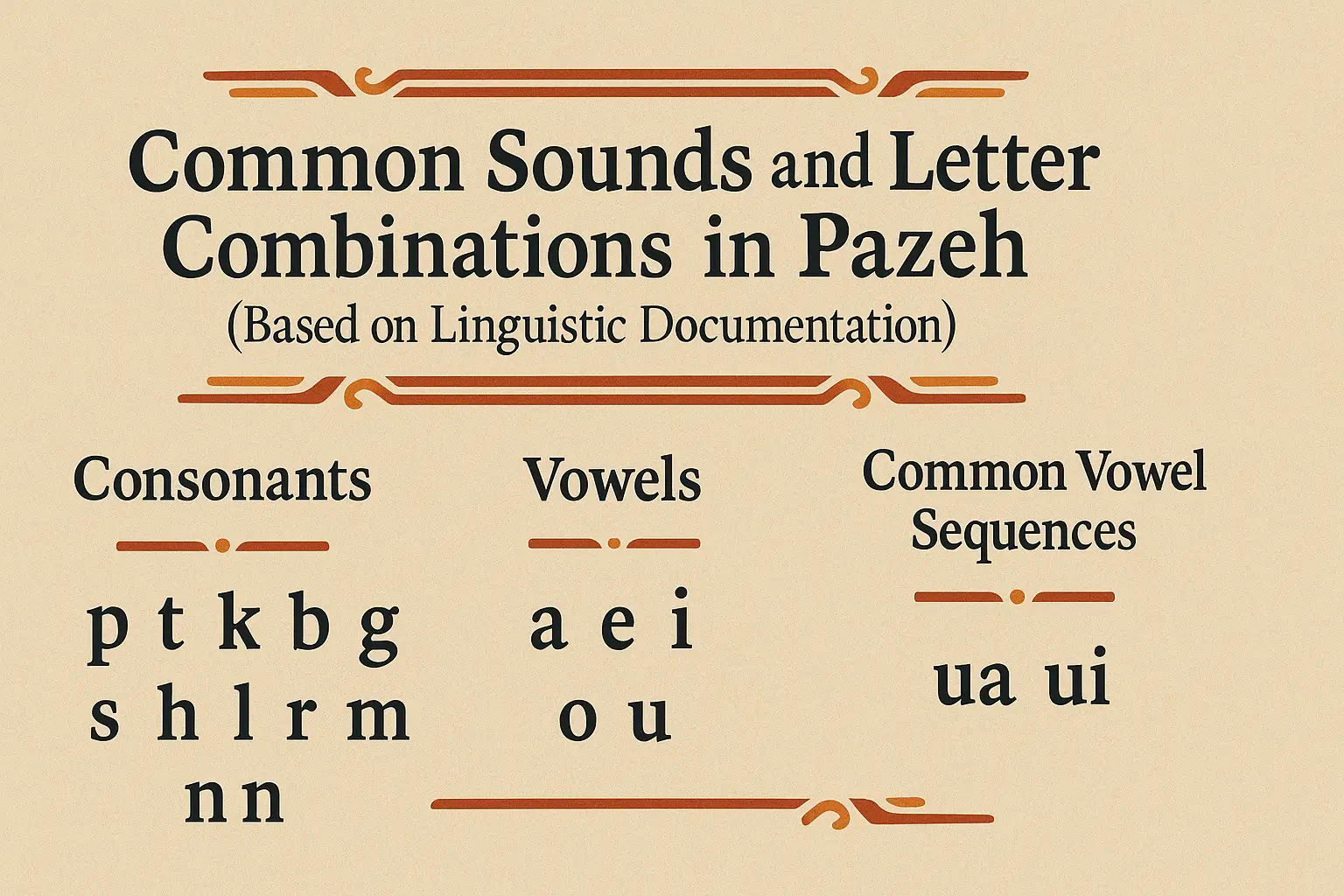
Pazeh uses a relatively small sound system compared to many global languages, which makes pronunciation approachable for beginners.
- Vowels are clear and consistent, similar to Spanish-style vowels (a, e, i, o, u).
- Consonants are pronounced distinctly, with little reduction or slurring.
- Words are spoken evenly, without strong stress patterns or tones changing meaning.
Listening to archived recordings is essential, as pronunciation cannot be fully captured through spelling alone.
Sentence structure and grammar
Pazeh follows patterns common in Austronesian languages, but with features that are linguistically conservative and historically important.
- Verb-first structure is common, with sentences often beginning with the action.
- Affixes attached to verbs convey tense, focus, and grammatical roles rather than separate helper words.
- Pazeh makes use of voice and focus systems, allowing speakers to highlight the actor, object, or location within a sentence.
This structure shows how meaning in Pazeh relies more on verb morphology than on strict word order.
Core vocabulary and meanings
Many Pazeh words reflect universal human concepts and the natural environment, which is why they are often used in linguistic reconstruction.
- mata – eye
- lima – hand / five
- ina – mother
- ama – father
- ruma – house
- walu – eight
These words closely resemble forms found across Austronesian languages, highlighting Pazeh’s importance in historical linguistics.
Simple conceptual phrases (illustrative)
While full conversational Pazeh is limited, learners can understand how meaning was expressed:
- Family references relied heavily on kinship terms rather than names
- Place and direction were often described in relation to land and settlement
- Actions were shaped by verb affixes indicating who was involved and why
These patterns reveal a language designed around relationships, place, and context.
Cultural approach to learning Pazeh
Learning Pazeh is inseparable from learning its cultural context.
Words were not isolated units but part of oral storytelling, ritual speech, and communal memory. Even basic vocabulary carries cultural weight tied to land, ancestry, and social roles.
How to Study Pazeh Responsibly
Studying Pazeh carries ethical responsibilities because the language no longer has native speakers and represents the heritage of an Indigenous community. Responsible learning helps preserve dignity, accuracy, and cultural meaning rather than reducing the language to an academic curiosity.
Approach learning as an act of cultural respect, not novelty. Pazeh is tied to lived history, displacement, and identity, and should be treated with the same care given to any endangered cultural heritage.
Here are credible, responsible websites and resources where readers can learn more about Pazeh and related Formosan languages. These focus on documentation, scholarship, and Indigenous language preservation rather than casual overviews:
- SIL International: Linguistic resources, language surveys, and typological information relevant to endangered languages
- Academia.edu: Research papers by linguists who documented Pazeh and other Formosan languages, including grammars, phonological studies, and fieldwork notes
- ResearchGate: Academic articles and datasets related to Pazeh, Austronesian linguistics, and language endangerment in Taiwan
- Endangered Languages Project: Global archive providing background, documentation links, and preservation context for critically endangered languages
- ELAR (Endangered Languages Archive): Hosted by SOAS, this archive includes high-quality recordings, annotations, and fieldwork materials for endangered languages worldwide
- PARADISEC: A digital archive preserving recordings of endangered languages, including Austronesian and Formosan materials
- Taiwan Indigenous Languages Research and Development Foundation: Official body supporting Indigenous language research, education, and revitalisation initiatives
- National Taiwan University – Linguistics Department: Academic research and publications related to Formosan languages and Austronesian studies
Importance of preserving endangered languages
Preserving endangered languages matters. Each language carries a unique way of understanding the world. Languages encode history, identity, ecological knowledge, oral traditions, and cultural values. They cannot be translated or replaced once lost.
From a linguistic perspective, endangered languages like Pazeh help researchers. It helps them understand how human language evolved and diversified. Their disappearance narrows our knowledge of
- grammar,
- sound systems,
- and meaning, limiting future study.
Historical Background of Pazeh
The history of Pazeh is tied to the wider story of Taiwan’s Indigenous peoples. Including the early development of Austronesian languages.
Once spoken across several villages in central Taiwan. Pazeh evolved over centuries as a living community language shaped by migration, trade, and local traditions.
Origins and development of the Pazeh language
Pazeh belongs to the Formosan branch of the Austronesian language family. This was regarded as the ancestral homeland of all Austronesian languages.
Its structure preserves older linguistic features that have disappeared elsewhere. Making it especially valuable for understanding early Austronesian development and divergence.
Cultural context of the Pazeh-speaking community
The Pazeh people lived in agrarian communities. With language embedded in daily life, rituals, storytelling, and social organisation.
Oral traditions played a central role in passing down history, values, and knowledge. Reinforcing language as a core part of cultural identity.
Historical events that influenced the language’s evolution
From the 17th century onwards, colonial rule led to land displacement. Later Japanese and Mandarin-dominant education systems eroded Pazeh use.
Forced assimilation, intermarriage, and urbanisation accelerated language shift. Leading to a rapid decline in speakers. This includes breaking intergenerational transmission within a short period of time.
Linguistic Features of Pazeh
Pazeh, though nearly extinct, is a rich and fascinating language. With distinct linguistic features that set it apart from other languages. Those in the Austronesian family.
These features include unique phonetic elements, a specific grammatical structure, and a vocabulary. It is connected to the culture and environment of the Pazeh-speaking community.
Phonetics and phonology: distinctive sounds and pronunciation patterns
Pazeh boasts many phonetic features characteristic of the Formosan languages. Including various vowel sounds and complex consonant clusters.
Unlike many modern languages, Pazeh uses a distinction between voiced and voiceless stops. As well as tonal elements that influence meaning.
It has a particularly distinctive set of nasal consonants and vowel combinations. They are rare in other languages of Taiwan.
Grammar and syntax: structural characteristics of the language
Pazeh’s grammar follows an Austronesian pattern, with a focus on verb-subject-object word order.
It also features extensive use of affixes that change verbs to state tense, aspect, and mood.
The language uses ergativity in its sentence structure. Meaning the subject of an intransitive verb is treated similarly to the object of a transitive verb. A structure found in several other Formosan languages.
Vocabulary: key words and expressions that define Pazeh
The vocabulary of Pazeh reflects its rooted connection to the environment. With words related to local flora, fauna, and traditions. Unique terms for natural phenomena, rituals, and familial relationships are prominent.
For example, terms related to the land and agriculture are central to Pazeh. Reflecting the community’s close connection with the environment.
Many Pazeh words also keep traces of Proto-Austronesian. Offering linguistic insight into the early history of the Austronesian-speaking peoples.
The Pazeh Community
The story of the Pazeh language cannot be separated from the people who spoke it.
The Pazeh community of central Taiwan maintained a distinct cultural identity for centuries. With language playing a central role in social life, tradition, and belonging.
Demographics of Pazeh speakers
Today, there are no native first-language speakers of Pazeh.
By the late 20th century, fluent speakers had dwindled to one individual. With others retaining partial or passive knowledge.
Most people of Pazeh descent now speak Mandarin Chinese or Taiwanese Hokkien. Reflecting decades of language shift and assimilation.
Cultural practices and traditions connected to the language
Pazeh was traditionally used in oral storytelling, rituals, agricultural practices, and communal ceremonies.
Songs, ancestral narratives, and place names carried cultural knowledge that was transmitted orally across generations. As the language declined, many of these practices survived only in fragmented or translated forms.
Role of Pazeh in shaping community identity
Even with few speakers remaining, Pazeh continues to hold symbolic power. It represents ancestral heritage, collective memory, and resistance to cultural erasure.
Revival efforts, documentation projects, and renewed interest among younger generations. They have helped reframe Pazeh not just as a lost language. As a cornerstone of cultural identity and continuity.
Current Status of Pazeh
Pazeh is considered one of the most endangered languages in Taiwan.
Often cited as an example of how a community language can disappear when transmission is disrupted.
Number of speakers and geographical distribution
Pazeh no longer has native first-language speakers.
The last fluent speaker passed away in the early 21st century. Leaving behind learners, semi-speakers, and documented materials.
Pazeh was spoken in villages across central Taiwan. Particularly in areas around present-day Taichung.
Factors contributing to its endangered status
The decline of Pazeh was driven by colonial rule, forced assimilation, and language policies. Those that prioritised Japanese and later Mandarin Chinese.
Intermarriage, urban migration, and the absence of Pazeh in formal education. This accelerated language shift. Ultimately breaking intergenerational transmission within a single lifetime.
Comparison with other endangered languages in Taiwan
Taiwan is home to several endangered Indigenous languages. Pazeh is among the most severely affected.
While some languages, such as Amis or Atayal, still have thousands of speakers. Pazeh reached functional extinction much earlier.
Its situation highlights both the fragility of minority languages and the urgent need for documentation and revitalisation. This is across Taiwan’s Indigenous linguistic landscape.
| Language | Approx. Number of Speakers | Current Status | Level of Vitality |
| Pazeh | 0 native speakers | Functionally extinct | Critical |
| Amis | 200,000+ | Actively spoken | Relatively stable |
| Atayal | 80,000+ | Actively spoken | Vulnerable |
| Bunun | 50,000+ | Actively spoken | Vulnerable |
| Tsou | 5,000+ | Declining | Endangered |
Efforts in Language Preservation
Despite its severe decline. Pazeh has become an important focus for wider language preservation efforts in Taiwan.
These initiatives show how documentation and policy are. Modern technology can work together to support even the most endangered languages.
Initiatives led by local communities and organisations
Community members, linguists, and Indigenous organisations. They have played a central role in preserving Pazeh.
Efforts have focused on recording oral histories, compiling dictionaries, and creating teaching materials. Those based on the knowledge of the last fluent speakers.
These projects aim not only to document the language. Also to reconnect younger generations with their cultural heritage.
Government policies and institutional support for endangered languages
In recent decades, Taiwan has introduced stronger protections for Indigenous languages.
This includes recognition of their cultural importance and support for revitalisation programmes.
Funding for research, language classes, and archival work has helped safeguard Pazeh materials. Even though revitalisation faces challenges due to the absence of native speakers.
Role of technology and social media in language revitalisation
Digital tools have become vital to Pazeh preservation. Online archives, audio recordings, and learning resources. They allow wider access to the language than ever before.
Social media and digital platforms also help. They can raise awareness, connect learners, and keep interest alive. Demonstrating how technology can extend the life of a language. This is beyond its traditional speaker community.
The Impact of Globalisation
Globalisation has reshaped how languages are used, valued, and transmitted. Often to the disadvantage of smaller linguistic communities.
Minority languages like Pazeh use global forces. They have intensified existing pressures and accelerated language loss.
Effects of globalisation on minority languages like Pazeh
Globalisation promotes economic mobility, urbanisation, and standardised education, which favour dominant languages.
As younger generations pursue opportunities beyond their communities, the practical use of minority languages declines. Weakening everyday transmission and reducing their perceived relevance.
Influence of dominant regional and global languages
In Taiwan, Mandarin Chinese became the primary language of education, governance, and media. Marginalising Indigenous languages such as Pazeh.
At a global level, English further reinforces this hierarchy by shaping access. Access to employment, technology, and international communication.
Leaving smaller languages with limited functional space.
Strategies for maintaining cultural heritage in a globalised world
Maintaining cultural heritage requires deliberate action.
Community-led education, legal recognition of Indigenous languages, and the integration of language. Those into digital spaces all help counter global pressures.
When combined with documentation and intergenerational engagement. These strategies allow endangered languages to keep their cultural significance. Even within a globalised society.
Personal Stories and Testimonials
Behind the statistics and classifications, the story of Pazeh is human.
Personal experiences and memories reveal why the language continues to matter. Even after the loss of native speakers.
Interviews with Pazeh speakers and language activists
Much of what is known about Pazeh comes from interviews with its last fluent speakers. As well as the linguists and activists who worked alongside them.
These accounts capture not only vocabulary and grammar. Also personal reflections on identity, memory, and loss.
Activists often describe Pazeh as a bridge to ancestors rather than a means of communication.
Examples of successful revitalisation efforts
While Pazeh cannot yet be revived as a spoken community language. Its documentation has inspired wider revitalisation work across Taiwan.
Examples of successful revitalisation efforts:
- Creation of comprehensive audio recordings and transcripts. They are based on the last fluent Pazeh speakers
- Development of Pazeh dictionaries and grammar descriptions for educational and research use
- University-led documentation projects preserving Pazeh within national and international linguistic archives
- Community workshops introducing basic Pazeh vocabulary, songs, and cultural knowledge
- Use of digital platforms to share recordings, learning materials, and historical context
- Pazeh serving as a reference model for revitalisation strategies. They are applied to other Indigenous languages in Taiwan
The Importance of Language Diversity
Language diversity reflects the full range of human experience. Shaping how societies understand the world and themselves. Each language carries distinct knowledge systems, histories, and cultural values.
Role of language in cultural identity and heritage
Language is central to cultural identity.
It encodes traditions, beliefs, oral histories, and relationships. They cannot be expressed in another tongue.
When a language disappears, communities lose more than words. They lose a direct connection to ancestral knowledge and cultural continuity.
Social and intellectual benefits of linguistic diversity
Linguistic diversity strengthens societies by promoting many ways of thinking, problem-solving, and storytelling.
It supports cognitive flexibility, academic research, and cross-cultural understanding.
Preserving diverse languages also safeguards unique insights into human cognition and social organisation. Environmental knowledge that benefits humanity as a whole.
Pazeh Language FAQs
What is the Pazeh language?
The Pazeh language is a critically endangered Austronesian language that was traditionally spoken by the Pazeh people in central Taiwan. It belongs to the Formosan branch of Austronesian languages, which are crucial for understanding the early development of this language family.
Where was the Pazeh language spoken?
Pazeh was historically spoken in several Indigenous villages in central Taiwan, particularly in areas around present-day Taichung. These communities used Pazeh as their primary language for daily life, rituals, and oral traditions.
Why did the Pazeh language become endangered?
Pazeh became endangered due to colonisation, forced assimilation, and education policies that prioritised Japanese and later Mandarin Chinese. Urbanisation and intermarriage further reduced its use, leading to a rapid loss of intergenerational transmission.
Does the Pazeh language still have speakers today?
Pazeh no longer has native first-language speakers. The last fluent speaker died in the early 21st century, and the language now survives through documentation, recordings, and a few second-language learners.
Can the Pazeh language be revived or learned?
While Pazeh cannot currently be revived as a fully spoken community language, it can still be studied and learned at a basic level using academic documentation and archived materials. Ongoing preservation efforts help maintain its cultural and historical significance.