
|
Getting your Trinity Audio player ready...
|
Palaeolinguistics helps us study how human language didn’t appear overnight. Long before writing, dictionaries, or even settled societies, early humans were already communicating.
Shaping sounds into meaning, gestures into shared understanding, and speech into something human.
Palaeolinguistics explores this deep past. It brings together linguistics, archaeology, anthropology, and cognitive science. All to ask one simple question: how did language begin?
What is paleolinguistics?
Palaeolinguistics is the study of how human language first emerged in prehistory. Long before writing existed.
It doesn’t try to recover exact words. Instead, it investigates when and how humans developed the ability to speak. Using evidence from linguistics, archaeology, anthropology, and neuroscience.
Importance of studying prehistoric speech
Studying prehistoric speech helps us understand what makes humans human.
Language shaped how early people cooperated, shared knowledge, taught skills, and built culture. By exploring how speech first developed, researchers can better explain the rise of complex societies, storytelling, technology, and even abstract thought.
It also matters today. Insights from prehistoric language inform linguistics, cognitive science and artificial intelligence. Language learning is used revealing the biological and social foundations of communication.
The Origins of Language
Language did not suddenly appear as a finished system.
It emerged gradually as early humans faced new challenges that required cooperation, planning, and shared understanding.
As societies became more complex, so did the need for clearer and more flexible communication. Laying the groundwork for structured speech.
Theories on how language began
There is no single, agreed-upon theory of language origins.
Some ideas suggest that language grew out of gestures and body movement. While others argue it developed from vocal calls, imitation of natural sounds, or the need to coordinate group activities.
Most modern researchers see language as the result of many pressures, biological, social, and cognitive. Working together over time.
Evolution of human communication
Early human communication likely combined sounds, gestures, facial expressions, and rhythm.
Over thousands of years, these signals became more standardised and meaningful. Forming the basis of grammar and vocabulary.
Changes in brain structure, vocal anatomy, and hearing all played a role in making spoken language precise and expressive.
Role of social interaction in language development
Language thrives in social settings. Cooperation, teaching, storytelling, and shared rituals pushed early humans to communicate more.
Groups that could pass on knowledge and coordinate behaviour had a clear survival advantage. Making social interaction one of the strongest forces shaping the development of language.
Archaeological Evidence of Language
Although spoken language leaves no direct trace, archaeology offers powerful clues about when humans developed the cognitive and social abilities required for language.
Tools, art, and rituals reveal patterns of shared meaning, planning, and communication that suggest sophisticated linguistic capacity.
Artefacts that suggest linguistic capabilities
Complex tools, such as carefully shaped stone blades or composite weapons, imply instruction and shared knowledge.
Their consistency across regions suggests that early humans were able to explain techniques, correct mistakes, and transmit information. All hallmarks of language or language-like communication.
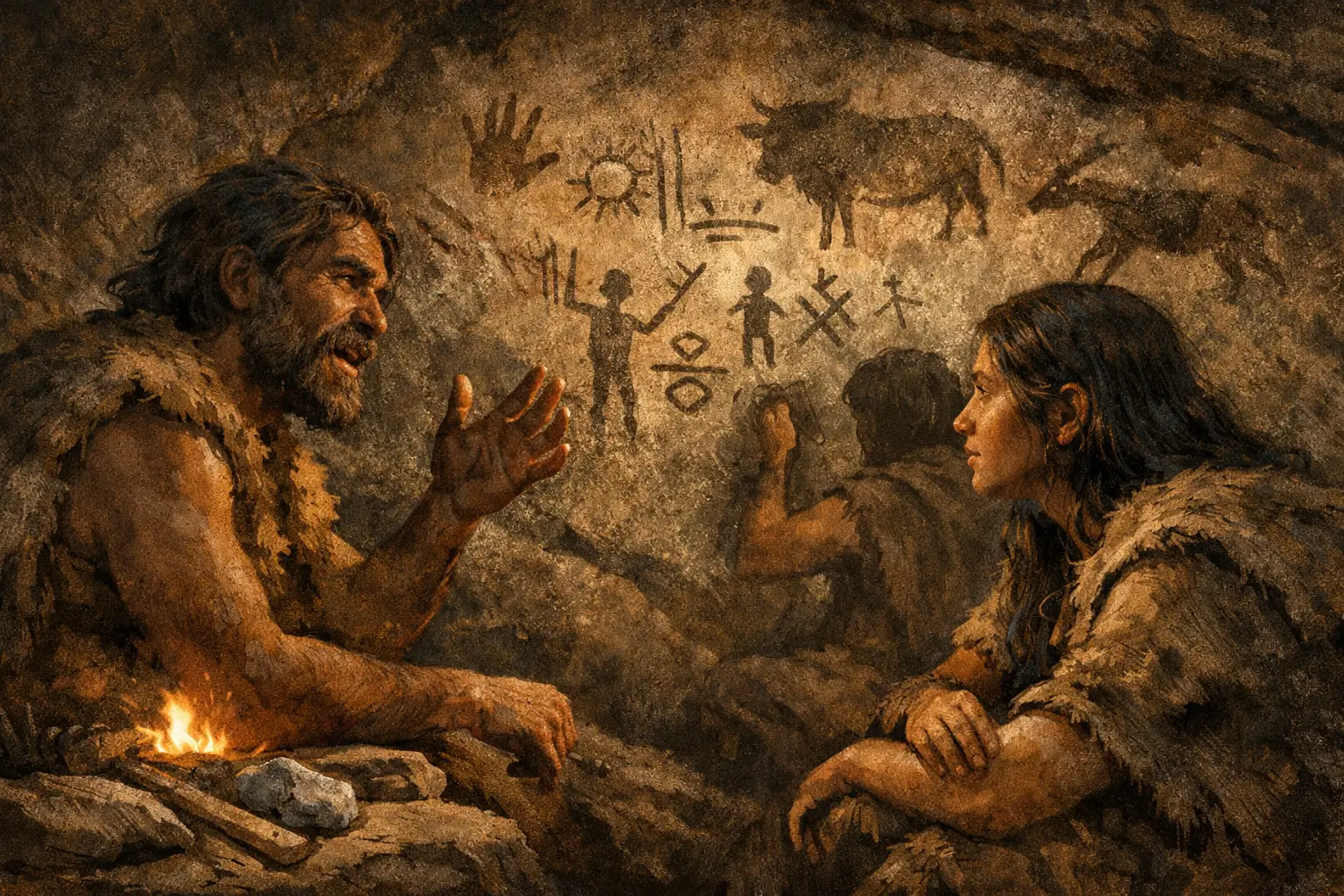
Cave paintings and symbols as early forms of communication
Cave paintings, carvings, and abstract symbols show that prehistoric humans could represent ideas beyond the immediate present.
These images may have conveyed stories, beliefs, or practical knowledge. Acting as a visual extension of spoken communication and reflecting symbolic thinking tied to language.
The significance of burial sites and their implications for language
Intentional burials, especially those involving grave goods or ritual placement. Point to shared beliefs and social meaning.
Such practices suggest the ability to discuss concepts like death, identity, and group memory. Ideas that almost certainly required structured language to develop and persist.
The Role of Comparative Linguistics
Comparative linguistics helps researchers trace relationships between languages and reconstruct aspects of their shared past.
While it cannot reach back to the very first spoken languages, it offers valuable insight into how languages change, split, and evolve over long periods of time.
Modern languages to infer prehistoric speech
Comparing similarities in sounds, grammar, and meaning across modern languages. Linguists can make informed inferences about earlier forms of speech.
These patterns reveal how languages may have developed from common ancestors and how core features of human language tend to persist over time.
Cognates and language families
By spotting recurring patterns across languages, researchers can trace deep linguistic relationships that stretch far beyond written history.
- Cognates are related words across languages that come from the same original source. Even if their pronunciation has changed over time.
- Regular sound patterns (rather than one-off similarities) show whether words are genuinely related.
- Language families are groups of languages linked by large numbers of cognates and shared structures.
- Major families, such as Indo-European and Afro-Asiatic. They reveal how languages spread through migration and contact.
- Reconstruction techniques allow linguists to infer features of ancient. Unwritten languages using modern evidence.
Limitations and challenges in comparative studies
Comparative linguistics has clear limits. It works best with written or well-documented languages and struggles to reach deep prehistory.
Language contact, borrowing, and chance similarities can also blur evidence. Meaning reconstructions are always educated approximations. Rather than exact recoveries of prehistoric speech.
The Impact of Neanderthals and Other Hominins
Language did not evolve in isolation within Homo sapiens. Other hominins, especially Neanderthals. Shared much of our biology and lived alongside early modern humans.
Raising important questions about their communicative abilities and their role in shaping human language.
Evidence of language use among Neanderthals
Neanderthals had brain structures, vocal anatomy, and hearing ranges similar to modern humans.
Finds such as complex tools, controlled use of fire, symbolic objects, and the FOXP2 gene suggest they were capable of structured communication and spoken language.
Theories on communication between species
Some researchers propose that early humans and Neanderthals could communicate at a basic level. Especially during periods of coexistence and interbreeding.
Communication may have combined speech, gesture, and shared cultural signals. Rather than fully developed, modern-style language.
Implications for understanding human evolution
If many hominin species used language-like systems, language may be far older and more widespread than once thought.
This challenges the idea of language as a sudden human innovation. Instead, it supports a gradual evolutionary process. Shaped by interaction, adaptation, and shared ancestry.
Theoretical Frameworks in Palaeolinguistics
Palaeolinguistics relies on theoretical models to study something that cannot be observed.
These frameworks help researchers link physical evidence, cognition, and social behaviour to explain how language could have emerged in deep prehistory.
Key theories and models used in the field
Palaeolinguistics draws on several theories to explain how language could emerge. Without records or direct evidence.
Each model highlights a different pressure that shaped early speech.
- Biological evolution models focus on changes in the brain, vocal tract, and hearing
- Cultural evolution theories emphasise learning, imitation, and social transmission
- Usage-based approaches argue grammar grew from repeated patterns of everyday communication
- Symbolic theories explore how humans learned to attach shared meaning to sounds and signs
The role of cognitive science in understanding language origins
Cognitive science helps explain the mental abilities that made language possible. Not just how it sounded.
- Studies how the brain processes sound, meaning, and structure
- Examines memory and pattern recognition in early communication
- Explains how language can be learned naturally through exposure and interaction
Interdisciplinary approaches combining linguistics, anthropology, and archaeology
Understanding language origins requires multiple perspectives working together.
- Linguistics analyses structure and change
- Anthropology examines social behaviour and culture
- Archaeology provides material evidence of symbolic thought
Modern Technology and Its Role
Modern technology has transformed how researchers study prehistoric language. Allowing them to test ideas that were once theoretical.
Digital tools now help uncover patterns in language, behaviour, and cognition that would be impossible to analyse by hand.
Advances in technology aiding palaeolinguistic research
New methods are giving researchers sharper ways to study the past.
- High-resolution brain imaging to study language processing
- Digital modelling of vocal tracts and hearing capabilities
- Databases mapping thousands of languages for large-scale comparison
- Computational simulations of language evolution over time
Use of AI and machine learning in language reconstruction
AI allows linguists to detect patterns humans might miss.
- Identifying sound changes across related languages
- Modelling how languages split and evolve
- Testing hypothetical ancestral language structures
- Analysing massive linguistic datasets
The future of technology in understanding prehistoric speech
As tools improve, research will become more precise and collaborative.
- More accurate evolutionary language models
- Better integration of linguistic and archaeological data
- Increased insight into how language emerged as a human trait
The Cultural Significance of Language
Language is far more than a communication tool.
It reflects how people see the world, how they organise society, and how they understand themselves and others. Every language carries traces of culture, values, and shared experience.
Language as a reflection of culture and identity
Language encodes how a community understands the world.
Even the earliest forms of speech would have reflected shared values, social roles, and ways of relating to nature and one another.
Through language, identity became something that could be expressed, reinforced, and passed down across generations.
How understanding prehistoric speech informs our view of early human societies
Studying prehistoric speech helps us move beyond tools and bones to see early humans as social beings.
Language would have supported cooperation, teaching, storytelling, and shared belief systems. Shaping how groups organised themselves and survived in challenging environments.
The connection between language and cognitive development
Language and thought evolved together. As early humans developed words and structure, they also gained new ways to reason, plan, and imagine.
This mutual growth suggests that language was not just a result of human intelligence but one of its driving forces.