
|
Getting your Trinity Audio player ready...
|
TL;DR: Nyangumarta is an Aboriginal Australian language from north-western Western Australia, carrying thousands of years of cultural knowledge, connection to Country and community identity.
In the vast north of Western Australia, between the red earth of the Pilbara and the edges of the Great Sandy Desert, Nyangumarta is still spoken.
Not archived.
Not just ceremonial.
Spoken.
While many Aboriginal languages have fallen silent, Nyangumarta has endured.
What is the Nyangumarta language?
Nyangumarta is an Aboriginal Australian language spoken in north-western Western Australia, particularly across the Pilbara region and parts of the Great Sandy Desert near Eighty Mile Beach.
It belongs to the Pama–Nyungan language family, the largest Indigenous language family in Australia.
Unlike many Indigenous languages that are no longer actively spoken, Nyangumarta is still used within community settings.
The language encodes:
- Detailed environmental knowledge
- Complex kinship relationships
- Oral histories and Dreaming narratives
- Cultural law and identity
Nyangumarta is not just a communication system.
It is a living link between people, land, and ancestry.
Importance of Aboriginal languages in Australia
Aboriginal languages are among the oldest continuous language traditions on Earth.
For tens of thousands of years, they have carried knowledge, law, identity and connection to Country across the Australian continent. Their importance goes far beyond communication. They shape culture, community and worldview.
Why Aboriginal languages matter:
- Cultural identity: Language anchors belonging, kinship systems and community identity.
- Connection to Country: Words encode landscapes, water sources, sacred sites and seasonal cycles.
- Ecological knowledge: Generations of environmental expertise are preserved within vocabulary and oral tradition.
- Law and governance: Customary law, social obligations and responsibilities are transmitted through language.
- Historical continuity: Each language represents thousands of years of uninterrupted human presence.
- Community wellbeing: Strong language use is linked to cultural pride and stronger social outcomes.
- Linguistic diversity: Aboriginal languages reflect one of the richest and most complex linguistic landscapes in the world.
Historical Context
To understand Nyangumarta, you have to understand time.
Not centuries.
Millennia.
Like many Aboriginal Australian languages, Nyangumarta developed over thousands of years through deep, continuous connection to land, law and community.
This historical context shapes everything about the language today.
Origins and historical development of the Nyangumarta language
Nyangumarta belongs to the Pama–Nyungan language family, which spans most of the Australian continent.
Within that vast linguistic network, it developed in relative geographic isolation across north-western Western Australia.
Over generations, the language evolved alongside:
- Seasonal movement patterns
- Trade routes between neighbouring groups
- Ceremonial exchange networks
- Intermarriage and kinship alliances
Like many Aboriginal languages, Nyangumarta was traditionally transmitted orally. There was no written system before European contact. Knowledge passed through:
- Storytelling
- Songlines
- Ceremony
- Daily life
Its structure reflects this oral tradition rhythmic, relational and deeply contextual.
The traditional territory of the Nyangumarta people
Nyangumarta Country stretches across parts of the Pilbara region and into areas bordering the Great Sandy Desert in north-western Western Australia.
It includes inland desert environments and coastal areas near Eighty Mile Beach.
This landscape is not incidental to the language. It shapes it.
Vocabulary encodes:
- Water sources and desert ecology
- Coastal features and tidal systems
- Animal behaviour and seasonal change
- Sacred sites and ancestral pathways
In Aboriginal worldviews, language and Country are inseparable. Words are not labels placed onto land. They emerge from it.
Historical significance and cultural heritage
Nyangumarta carries more than vocabulary. It carries law, cosmology and social structure.
Through the language, generations have preserved:
- Dreaming narratives
- Kinship systems
- Ceremonial protocols
- Ecological management knowledge
During the colonial period, many Aboriginal communities experienced forced relocation, mission systems and cultural suppression. Languages across Australia declined sharply as a result.
That Nyangumarta remains spoken today gives it particular historical weight.
It represents:
- Cultural resilience
- Survival through disruption
- Continuity of ancestral knowledge
Learn Nyangumarta: A Practical Starter Guide
If you want to begin learning Nyangumarta, the most effective way is to focus on three things:
- Sound system (pronunciation first)
- Core vocabulary you can immediately use
- Basic sentence structure
Because Nyangumarta is traditionally an oral language, listening and speaking are central. Think rhythm and clarity before speed.
Pronunciation Essentials
Nyangumarta uses sounds that don’t all exist in English.
Key Consonant Features
- Retroflex sounds (tongue curled slightly back):
- rt, rn, rl
- These are common in many Aboriginal languages.
- Ng can appear at the beginning of words (unlike English).
- Example: ngayu (I / me)
Say it like the “ng” in sing, but at the start.
Core Vocabulary
Memorise these first. Say them aloud.
Pronouns
| Nyangumarta | English |
| ngayu | I / me |
| nyuntu | you |
| ngarru | we |
Everyday Words
| Nyangumarta | English |
| ngurra | camp / home / place |
| kapi | water |
| marlu | kangaroo |
| warla | fire |
| wangka | speak / language |
Nature & Land
| Nyangumarta | English |
| yapa | person |
| jila | waterhole |
| marnin | good |
Basic Sentence Structure
Like many Aboriginal languages, Nyangumarta often uses Subject–Object–Verb (SOV) word order.
That means:
- I water drink
instead of - I drink water
Example 1
Ngayu kapi ngarnu.
I water drink.
= I am drinking water.
- ngayu = I
- kapi = water
- ngarnu = drink (past/present context depending on usage)
Example 2
Nyuntu marlu nyangu.
You kangaroo see.
= You saw a kangaroo.
- nyangu = saw
Linguistic Features
Nyangumarta is more than a regional language.
It reflects structural patterns found across many Aboriginal Australian languages, while maintaining features specific to its own speech community.
Its sound system, grammar and worldview-driven structure differ significantly from English.
Distinctive characteristics of Nyangumarta
Nyangumarta belongs to the Pama–Nyungan language family, the largest Indigenous language family in Australia. Like many languages in this group, it is:
- Agglutinative: meaning grammatical information is added through suffixes.
- Case-marking: word endings indicate grammatical roles (such as subject or object).
- Verb-final (SOV word order): sentences commonly follow Subject–Object–Verb order.
- Highly relational: kinship and social categories are linguistically encoded.
Phonetics and grammatical structure
Sound System (Phonetics)
Nyangumarta shares phonetic traits common in many Aboriginal languages:
- No contrast between “f” and “v” sounds
- No “th” sound as in English
- Extensive use of retroflex consonants (tongue curled back slightly)
- rt, rn, rl
- rt, rn, rl
- “Ng” can appear at the beginning of words
- Example: ngayu (“I”)
Vowel systems are typically smaller than English, often based on three core vowels (a, i, u), though length distinctions may occur.
The rhythm tends to be even and syllable-timed, unlike English, which is stress-timed.
Sentence Structure
A key structural feature is Subject–Object–Verb (SOV) order:
English: I see the kangaroo.
Nyangumarta pattern: I kangaroo see.
This verb-final structure is common across many Australian Aboriginal languages.
Case Marking
Instead of relying heavily on word order (like English), Nyangumarta uses suffixes to mark grammatical roles.
For example:
- The subject of a transitive verb may take an ergative ending.
- Objects and indirect objects may receive different suffixes.
This system allows flexible word order while maintaining clarity.
Comparison with other Aboriginal languages of Australia
Nyangumarta shares structural similarities with many languages across the continent, particularly within the Pama–Nyungan family:
| Feature | Nyangumarta | Many Other Aboriginal Languages |
| Verb-final structure | Yes | Very common |
| Case marking | Yes | Widespread |
| Retroflex consonants | Yes | Common |
| Small vowel inventory | Likely | Typical |
| Complex kinship vocabulary | Yes | Strong feature |
Cultural Significance
For the Nyangumarta people, language is not separate from culture. It is culture expressed. It carries law, history, identity and relationship to Country. Every word exists within a network of story, responsibility and ancestral knowledge.
To understand Nyangumarta is to understand how language sustains community across generations.
The role of language in Nyangumarta culture
Language shapes how knowledge is organised and passed on. In Nyangumarta culture, speech is tied to:
- Kinship systems
- Social obligations
- Ceremonial roles
- Respect relationships
Words define who you are allowed to speak to, how you address elders, and your responsibilities within the community.
Language is therefore not neutral. It guides behaviour.
Connections to storytelling, art, and traditional practices
Storytelling is central to Nyangumarta cultural life. Through oral narratives:
- Dreaming stories are transmitted
- Moral codes are reinforced
- Ancestral journeys are remembered
- Ecological knowledge is preserved
These stories are not simply myths. They map land, waterholes, trade routes and ceremonial sites.
Traditional practices such as hunting, gathering and seasonal movement also rely on linguistic precision. Words distinguish:
- Subtle differences in landscape
- Animal behaviour patterns
- Seasonal indicators
- Sacred sites
Language makes cultural practice possible.
Language as a vessel for cultural identity and continuity
When a language survives, identity survives.
For Nyangumarta speakers, the language affirms:
- Belonging to Country
- Ancestral continuity
- Community strength
- Cultural autonomy
Across Australia, colonisation disrupted language transmission through displacement and assimilation policies. Many Aboriginal languages declined sharply as a result.
Current Status
Nyangumarta is one of the Aboriginal languages of north-western Australia. One that has survived into the present day.
While speaker numbers are modest, the language remains culturally significant and continues to be used within community contexts.
Its current status reflects both resilience and vulnerability.
Estimated number of speakers today
Estimates suggest that fewer than 100 fluent speakers remain. With most being older adults. Some sources place the number slightly higher when including semi-speakers or those with partial knowledge.
Like many Aboriginal languages, Nyangumarta faces generational gaps:
- Elders often hold the strongest fluency
- Middle generations may understand more than they speak
- Younger speakers may be learning through revitalisation efforts
Regions where Nyangumarta is spoken
Nyangumarta is traditionally spoken in north-western Western Australia, particularly:
- Parts of the Pilbara region
- Areas bordering the Great Sandy Desert
- Coastal zones near Eighty Mile Beach
Some speakers now live in regional towns due to historical displacement and economic factors, but the language remains closely tied to its traditional Country.
Challenges faced by the language in contemporary society
Despite its resilience, Nyangumarta faces significant pressures:
- English dominance in education, media and employment
- Urban migration separating younger generations from Country
- Limited educational resources in the language
- Ageing fluent speaker base
- Historical impacts of assimilation policies
Modern life often reduces opportunities for everyday use. Without consistent intergenerational transmission, small languages can decline rapidly.
Revitalisation Efforts
Like many Aboriginal languages in Australia, Nyangumarta faces pressure from English dominance and generational language shift.
Preserving Nyangumarta is about more than saving words. It is about strengthening identity, restoring intergenerational transmission and keeping cultural knowledge alive.
Community initiatives aimed at preserving Nyangumarta
At the heart of revitalisation are the Nyangumarta people themselves.
Community-driven efforts often include:
- Recording elders’ speech and oral histories
- Developing local dictionaries and word lists
- Running on-Country cultural camps
- Teaching language through storytelling and song
- Producing printed and digital learning materials
On-Country programmes are especially important. Language is taught in context. Connected to landscape, waterholes, animals and sacred sites.
The role of education and language programmes
Education is central to long-term survival.
Language programmes may operate through:
- Local schools incorporating Nyangumarta into the curriculum
- Bilingual or language awareness initiatives
- Community workshops for children and young adults
- Adult learning groups reconnecting with heritage language
Even limited classroom exposure can increase familiarity and pride among younger generations.
Where possible, programmes focus not only on vocabulary, but on:
- Pronunciation
- Story traditions
- Kinship terms
- Cultural protocols
The goal is not simply academic learning, but living use.
Collaboration with linguists and cultural organisations
Partnerships with linguists and research institutions support revitalisation by:
- Documenting grammar and phonology
- Creating written resources
- Producing dictionaries and teaching materials
- Archiving recordings for future access
These collaborations are most effective when community-led and culturally guided.
The Future of Nyangumarta
The future of Nyangumarta is not predetermined. Like many Aboriginal languages, it stands at a crossroads. Vulnerable, yet still living
Its survival will depend on whether it continues to be spoken, taught and valued within community life.
Language futures are built deliberately. They require commitment, visibility and continuity.
Prospects for the language’s survival
Nyangumarta still has fluent speakers, cultural authority and documented resources. That foundation matters.
Its prospects improve when:
- Language is spoken in daily contexts
- Cultural camps reinforce on-Country learning
- Schools integrate language programmes
- Community-led documentation continues
However, small speaker numbers and generational gaps create urgency. Without active use, languages can decline rapidly. With consistent reinforcement, even small speech communities can stabilise and grow.
Importance of intergenerational transmission
The most important factor in language survival is simple:
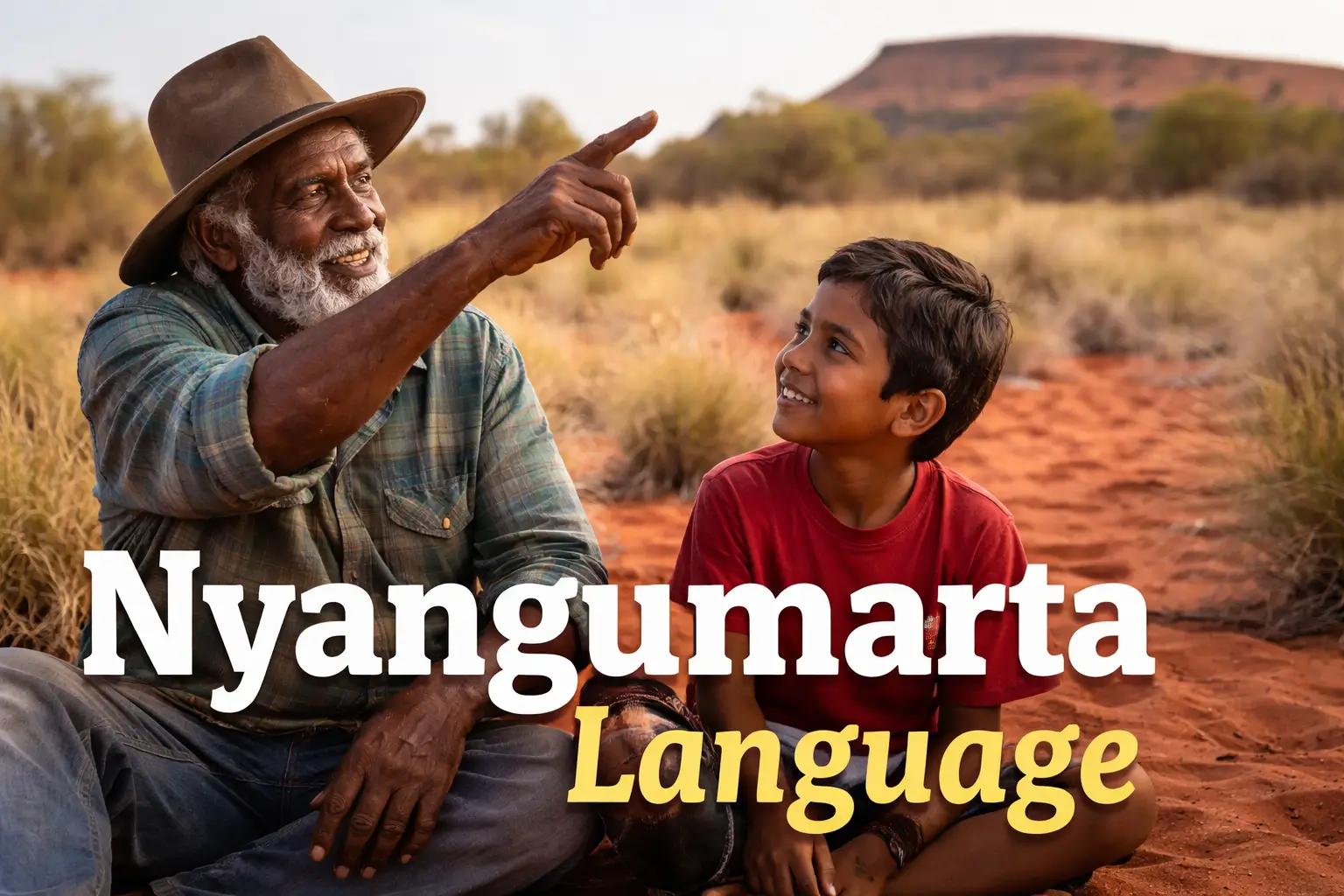
Children learning from elders.
Intergenerational transmission means:
- Grandparents speaking to grandchildren in language
- Youth participating in ceremony and storytelling
- Cultural knowledge being explained in its original linguistic form
When a language is only archived or studied academically, it weakens. When it is spoken at home, at gatherings, on Country.
Ways individuals can support language preservation
Support does not require fluency. It requires respect and awareness.
Individuals can:
- Learn basic vocabulary and pronunciation
- Support community-led language initiatives
- Share accurate information about Aboriginal languages
- Advocate for Indigenous language education
- Promote cultural recognition and inclusion
For non-Indigenous Australians, support also means recognising that Aboriginal languages are foundational to Australia’s heritage.
Nyangumarta FAQs
What is the Nyangumarta language?
Nyangumarta is an Aboriginal Australian language spoken in north-western Western Australia, particularly across the Pilbara region and areas near the Great Sandy Desert.
Where is Nyangumarta traditionally spoken?
Nyangumarta is traditionally spoken on Country in the Pilbara region of Western Australia, extending inland toward the Great Sandy Desert and coastal areas near Eighty Mile Beach. The language is closely tied to this landscape and its cultural sites.
How many people speak Nyangumarta today?
Fewer than 100 fluent speakers are estimated to remain, most of whom are older adults. Some younger community members are learning the language through revitalisation and cultural education programmes.
Why is Nyangumarta culturally important?
Nyangumarta preserves Dreaming narratives, kinship systems, customary law and detailed environmental knowledge. It serves as a living expression of identity, belonging and continuity for the Nyangumarta people.
What is being done to preserve Nyangumarta?
Community-led initiatives focus on recording elders, developing educational materials, running on-Country language camps and collaborating with linguists to document grammar and vocabulary.