
|
Getting your Trinity Audio player ready...
|
TL;DR: Mbabaram is an Aboriginal language from northern Queensland. Known because its word for “dog” happens to be dog. A rare and accidental coincidence with English.
What if an Aboriginal language had the exact same word for “dog” as English?
That’s what makes Mbabaram so famous. Spoken in northern Queensland, Mbabaram’s word for “dog” is dog. A coincidence so striking that it still surprises linguists today. There’s no borrowing, no colonial influence. It’s pure chance.
And behind that remarkable quirk lies a powerful story. All about language, identity, and the survival of Australia’s Indigenous heritage.
What is the Mbabaram language?
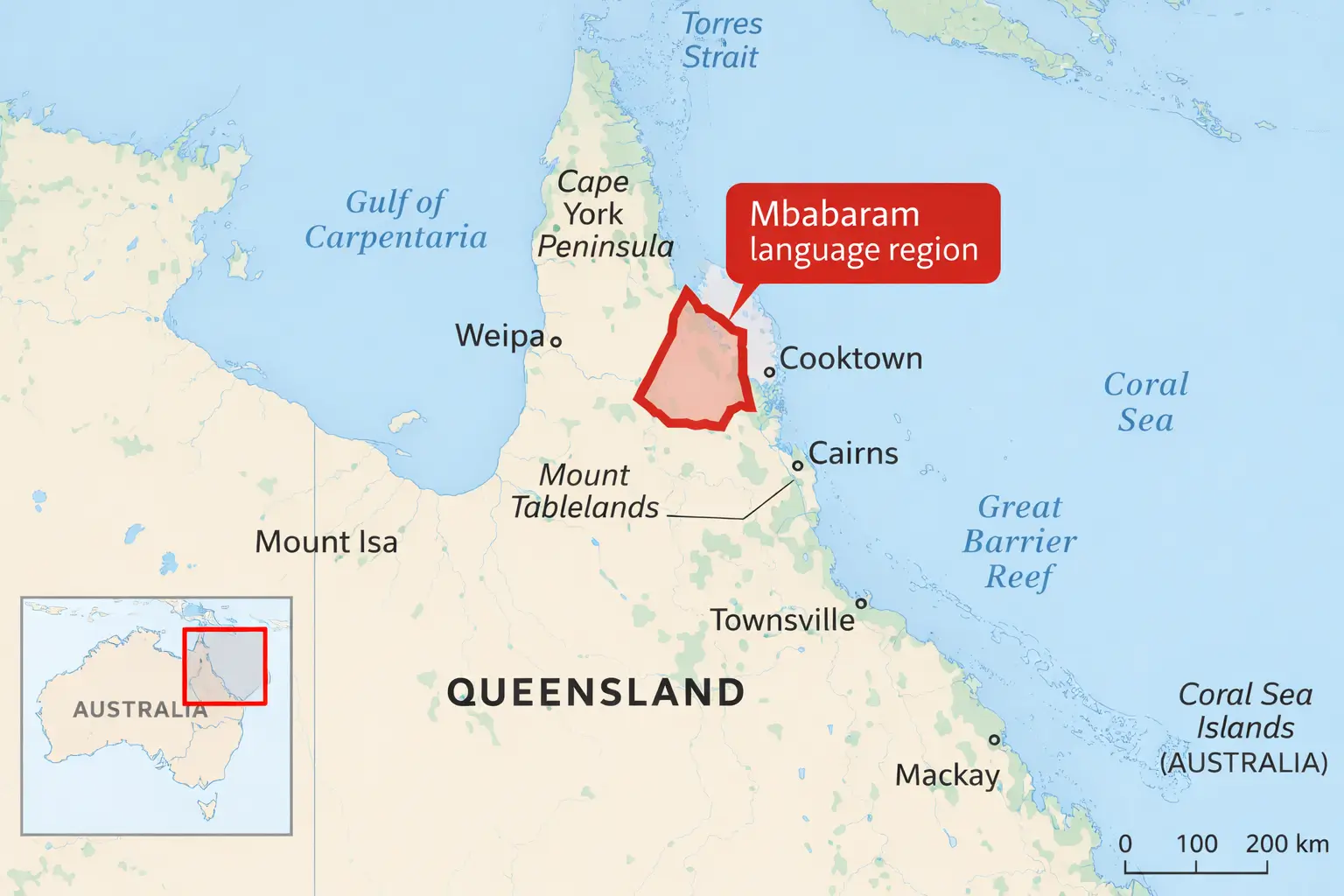
Mbabaram is an Aboriginal Australian language spoken in northern Queensland. Particularly around the Atherton Tablelands near the western edge of Cape York Peninsula.
It belongs to the Pama–Nyungan language family, which covers most of Australia. Like many Indigenous languages of the region, Mbabaram developed.
Mbabaram is considered critically endangered, with very few fluent speakers remaining. Documentation and linguistic research, have helped preserve knowledge of its vocabulary and structure. Ensuring it remains part of Australia’s cultural record.
Significance of the word for “dog” in the context of the language
Mbabaram’s word for dog sounds exactly like the English word but it’s a complete coincidence.
When linguist R. M. W. Dixon documented the language, he confirmed there was no English influence. The similarity developed independently.
That’s what makes it so important. It’s one of the clearest examples of how languages can produce identical words by chance. A reminder that similar sounds don’t mean a shared origin.
Historical Background of Mbabaram
Mbabaram is one of the many Aboriginal languages. One that developed over thousands of years on the Australian continent.
To understand the language properly, we need to look beyond vocabulary and grammar and explore the people, land, and history that shaped it.
ike all Indigenous Australian languages, Mbabaram is tied to place and community.
Origins of the Mbabaram language
Mbabaram belongs to the vast Pama–Nyungan language family. A language which covers most of Australia. It evolved independently long before European contact. Shaped by generations of oral transmission.
The language was not written down traditionally. It was passed from elders to younger members of the community through storytelling, ceremony, and everyday life.
This oral tradition meant that language and culture were inseparable. Mbabaram was not just a system of communication. A living expression of identity and knowledge.
Geographic region and cultural context
Mbabaram was traditionally spoken in northern Queensland. Particularly around the Atherton Tablelands near the western edge of Cape York Peninsula. This region is known for its rainforest, rivers, and rich biodiversity.
The environment influenced the language itself. Words reflected local flora, fauna, seasons, and landscape features.
In Aboriginal cultures, language encodes ecological knowledge. Knowing the land meant knowing the words that describe it. Mbabaram thus carried detailed information about survival, navigation, and seasonal change
Historical speakers and their lifestyle
The Mbabaram people lived as hunter-gatherers. Moving through their country according to seasonal cycles.
Their lifestyle was highly adapted to the rainforest and surrounding areas. Relying on deep environmental knowledge.
Social life revolved around kinship systems, ceremonies, and oral storytelling. Language played a central role in maintaining these structures.
From naming relatives correctly to transmitting Dreaming narratives. Ones explained the origins of the land and its laws.
Linguistic Features of Mbabaram
Mbabaram is more than a famous coincidence. Like many Aboriginal Australian languages, it has a rich sound system, flexible grammar, and vocabulary shaped by landscape and culture
Phonetics and phonology
Mbabaram’s sound system is typical of many Australian languages.
Consonants
- Many “t” and “n” sounds produced at different points in the mouth (dental, alveolar, retroflex).
- No “th” sound like English.
- No voiced vs voiceless contrast like English b/p in the same way.
Vowels
- Usually a simple three-vowel system: /a/, /i/, /u/
These can be short or long.
Grammar and syntax
Mbabaram grammar differs from English.
1. Word Order
While English usually follows Subject–Verb–Object (SVO), many Australian languages allow more flexible word order. Grammar is shown through endings rather than position.
Example (illustrative structure):
- Man dog see
- Dog man see
Both can mean “The man sees the dog” if case endings mark who is doing what.
2. Case Marking
Nouns often take suffixes to show grammatical roles.
For example (simplified model):
- man-u (man as subject)
- dog-a (dog as object)
These endings clarify meaning without relying on word order.
3. No Articles
There is no direct equivalent of “a” or “the”.
Unique vocabulary and expressions
Mbabaram vocabulary reflects the rainforest environment of northern Queensland. Words encode:
- Local animals
- Plants and food sources
- Landscape features
- Kinship relationships
The famous example:
- dog – dog (coincidental match with English)
Like many Aboriginal languages, Mbabaram also likely had:
- Detailed kinship terms (more specific than English “cousin” or “uncle”)
- Directional terms linked to land rather than left/right
- Words tied to seasonal cycles
The Significance of the Word for “Dog”
Few linguistic facts are as striking as Mbabaram’s word for “dog”. But beyond the famous coincidence lies a deeper cultural and comparative story.
To understand why this word matters, we need to look at the language itself and the role of dogs in Aboriginal life. Including how other Indigenous Australian languages refer to the same animal.
The word for “dog” in Mbabaram
In Mbabaram, the word for dog is dog.
It sounds identical to the English word, yet it developed. When linguist R. M. W. Dixon documented the language, he confirmed that this was not borrowing from English. A rare case of accidental similarity.
This example is now cited in linguistics as proof that similar words across languages do not say shared origins.
Cultural importance of dogs in Aboriginal communities
Dogs, particularly dingoes, have long played an important role in many Aboriginal communities. They were companions, hunting partners, protectors, and part of daily camp life.
Their presence was practical and symbolic: helping with hunting, providing warmth at night, and appearing in oral traditions that connected people to land and ancestry.
Understanding this cultural context adds depth to the word itself. It was not just a label for an animal, but a term tied to survival, kinship, and story.
Comparison with other Aboriginal languages
Most Aboriginal Australian languages use completely different words for dog. For example, many languages in central and northern Australia use forms like:
- ngayi
- warru
- mirri
These variations show that Mbabaram’s dog is not part of a wider pattern. It stands alone.
The Role of Mbabaram in Aboriginal Culture
Mbabaram was never just a way to communicate. Like all Aboriginal Australian languages, it carried law, memory, identity, and deep knowledge of Country.
To understand its importance, we need to see how language functions within culture. Not as a separate system, but as its foundation.
Language as a cultural identifier
For Aboriginal communities, language defines belonging. Speaking Mbabaram meant connection to a specific group, territory, and ancestral line. Language signalled kinship ties, social roles, and responsibilities.
It distinguished Mbabaram speakers from neighbouring groups while also linking them through shared traditions and exchange networks.
Losing a language is not simply losing words. It is losing a unique worldview.
Oral traditions and storytelling
Mbabaram, like many Indigenous languages, was traditionally passed down. Knowledge moved through stories, songs, and ceremony rather than written texts.
Dreaming narratives explained the origins of the land, animals, and social laws. These stories were not myths in the Western sense. They were frameworks for understanding reality and guiding behaviour.
Language preserved them with precision, rhythm, and meaning that translation cannot fully capture.
Connection to land and identity
In Aboriginal cultures, land and language are inseparable. Mbabaram encoded detailed knowledge of the Atherton Tablelands region. Its rivers, animals, seasonal changes, and sacred sites.
Place names carried history. Directional systems are often related to the landscape rather than abstract compass points. Speaking the language was a way of mapping the world and reaffirming identity.
Mbabaram thus represents more than a linguistic curiosity. It is a reminder that language is Country.
The Decline of the Mbabaram Language
Like many Aboriginal Australian languages, Mbabaram experienced a rapid and painful decline following European settlement.
What had been a living, intergenerational language for thousands of years became critically endangered within just a few generations.
Factors contributing to language endangerment
Language loss rarely happens overnight
In the case of Mbabaram, decline followed a gradual breakdown of traditional life, community structure, and intergenerational transmission.
When a language is no longer consistently spoken at home, its future becomes fragile.
Key contributing factors include:
- Displacement from traditional lands: Separation from Country disrupts cultural practices and everyday language use.
- Forced relocation to missions or settlements: Communities were often grouped with speakers of different languages, accelerating language shift.
- English-only schooling policies: Children were encouraged or forced to speak English instead of their ancestral language.
- Social stigma and punishment: Speaking Indigenous languages was sometimes discouraged or penalised.
- Economic and social pressure to assimilate: English became necessary for employment, education, and mobility.
- Intergenerational language shift: Parents began raising children primarily in English to help them adapt to dominant society.
Impact of colonisation and modernisation
Colonisation in Queensland brought land dispossession, violence, and the breakdown of traditional social structures.
Many Aboriginal people were moved onto missions or settlements where English was enforced.
Policies that discouraged or punished Indigenous language use accelerated the shift to English.
Over time, schooling, employment systems, and media further strengthened English as the dominant language, reducing everyday use of Mbabaram.
Current status of the language
Mbabaram is considered critically endangered. There are very few, if any, fluent speakers remaining.
Linguistic documentation, including work by R. M. W. Dixon, has preserved important records of its structure and vocabulary.
These materials provide a foundation for cultural preservation and potential revitalisation efforts.
Revitalisation Efforts for Mbabaram
Although Mbabaram is critically endangered, its story does not end with decline.
Across Australia, Indigenous communities, linguists, and educators are working to preserve and revitalise ancestral languages.
Even when fluent speakers are few, documentation, community memory, and renewed cultural pride can form the foundation for revival.
Community initiatives to preserve Mbabaram
Language revitalisation begins with community. For Mbabaram, preservation efforts focus on:
- Reconnecting younger generations with heritage through workshops and cultural programmes
- Using recorded linguistic materials to reconstruct vocabulary and pronunciation
- Involving elders and knowledge holders wherever possible in teaching and storytelling
- Reviving place names and traditional terms within local cultural contexts
Role of education and technology in language revival
Modern tools are playing an important role in Indigenous language preservation.
- School-based cultural education programmes can introduce Mbabaram vocabulary and history
- Digital archives and recordings preserve pronunciation and grammar for future learners
- Online dictionaries and learning apps make materials accessible beyond local communities
- Social media and video platforms help raise awareness and normalise Indigenous language use
Technology cannot replace living transmission, but it can support it. When combined with community leadership, it offers a powerful pathway toward cultural renewal.
Mbabaram in Contemporary Society
Mbabaram has very few fluent speakers today. It continues to hold cultural, academic, and symbolic importance.
In contemporary Australia, even endangered languages can shape identity, creative expression, and broader conversations about Indigenous heritage.
Usage in modern contexts
Mbabaram is not widely used in everyday conversation, but it appears in:
- Cultural education programmes in local communities
- Academic research and linguistic studies
- Discussions about language coincidence and historical linguistics
- Heritage documentation and archives
Even limited usage helps keep the language visible and recognised as part of Australia’s living cultural history.
Influence on art, music and literature
Across Australia, Indigenous languages influence contemporary creative work.
While Mbabaram may not have large-scale media presence, broader Aboriginal artistic movements often:
- Incorporate traditional words and place names
- Reference ancestral stories in visual art and performance
- Use language as a symbol of resilience and identity
Language revival efforts intersect with artistic expression. Where words become powerful markers of cultural continuity.
Learning Mbabaram
Learning Mbabaram today is less about fluency and more about connection.
As a critically endangered language, resources are limited, but even engaging with basic vocabulary, history, and cultural context helps preserve and honour its legacy.
Resources for those interested in the language
Mbabaram has very few fluent speakers, most available materials come from linguistic documentation. Interested learners can explore:
- Academic publications and fieldwork notes
- University archives and linguistic databases
- Recordings and vocabulary lists preserved by researchers
- Indigenous language resource centres in Queensland
Work by linguists such as R. M. W. Dixon has been especially important in preserving structured records of the language.
Language courses and community programmes
Unlike widely spoken languages, Mbabaram does not have mainstream language courses. But, learning may be supported through:
- Community-led cultural workshops
- Regional Indigenous language programmes
- School-based cultural education initiatives
- Collaboration between communities and universities
Revitalisation often begins with small groups reconnecting to heritage language in meaningful, practical ways.
Importance of learning Indigenous languages
Learning Mbabaram, even at a basic level, supports cultural preservation and awareness.
Endangered languages encode ecological knowledge, kinship systems, and worldviews that cannot be fully translated into English.
Engaging with endangered languages:
- Strengthens cultural identity
- Encourages respect for Indigenous heritage
- Supports revitalisation efforts
- Broadens understanding of linguistic diversity
In this way, learning Mbabaram is not only an academic exercise. It is an act of cultural recognition and continuity.
Mbabaram FAQs
What is Mbabaram best known for?
Mbabaram is famous because its word for “dog” is dog. A rare coincidence with English that developed and is often cited in linguistics.
Where was Mbabaram traditionally spoken?
Mbabaram was spoken in northern Queensland. Particularly around the Atherton Tablelands near the western edge of Cape York Peninsula.
Is Mbabaram related to English?
No. Mbabaram developed within the Pama–Nyungan language family. The similarity between its word for “dog” and English is accidental.
Why did the Mbabaram language decline?
The language declined due to colonisation, displacement, English-only schooling policies, and the gradual shift to English across generations.
Can Mbabaram still be learned today?
Mbabaram is critically endangered. Linguistic documentation and cultural initiatives provide resources for preservation and limited learning.