
|
Getting your Trinity Audio player ready...
|
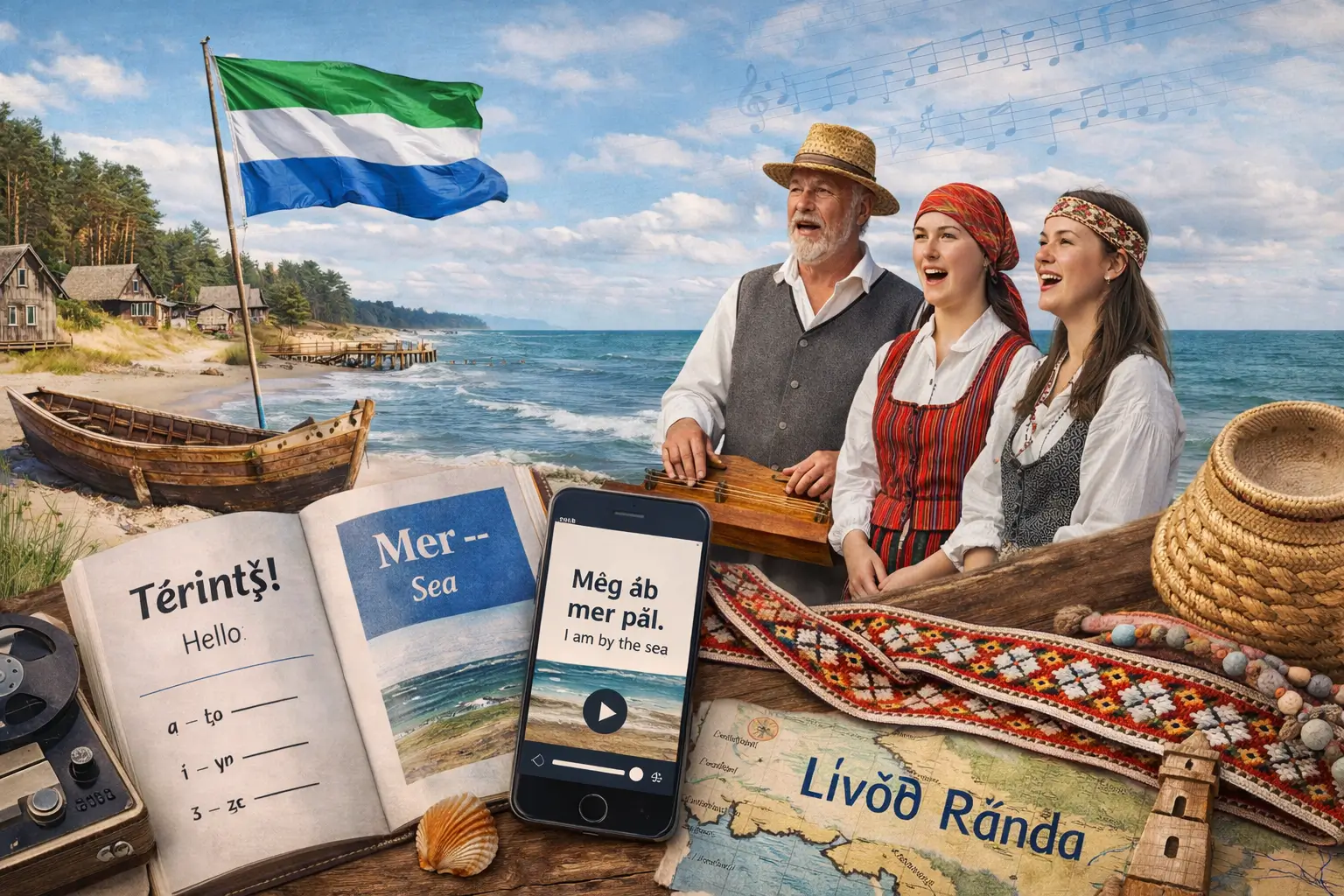
Once spoken along the windswept shores of the Baltic Sea. Livonian is one of Europe’s quietest linguistic miracles. A language that came close to disappearing altogether, yet never let go of life.
Often overshadowed by its larger neighbours. Livonian holds a unique place in Europe’s linguistic map.
It is not just a “minor” language. A key to understanding the deep history of the Baltic region is centuries of coastal culture. The fragile line between survival and extinction that many languages walk today.
What is the Livonian language?
The Livonian language is a near-lost Finno-Ugric language. Once spoken along Latvia’s Baltic Sea coast.
Related to Finnish and Estonian, it stands apart from the surrounding Baltic languages. It preserves features from one of Europe’s oldest language families.
By the late 20th century, Livonian had almost vanished. The last native speaker passed away in 2013.
Yet the language survived through recordings, written sources, and community effort. Today, people are reclaiming Livonian as a revitalised heritage language.
The importance of language preservation
Languages carry history, worldview, humour, environmental knowledge, and ways of thinking that exist nowhere else. Each one encodes how a community understands time, nature, relationships, and identity.
Preserving endangered languages protects cultural diversity in the same way biodiversity protects ecosystems. It strengthens communities and restores intergenerational links. It gives people a voice in their own heritage rather than reducing it to archives and footnotes.
Historical Background of the Livonian
Livonian is one of the oldest languages of the eastern Baltic region.
Long before modern national borders existed, Livonian-speaking communities lived along what is now northern Latvia, particularly the remote coastal areas facing the Baltic Sea.
The language belongs to the Finno-Ugric family, linking it to Finnish and Estonian rather than to Latvian or Lithuanian.
Origins and development of the Livonian language
Livonian language developed from its closest relatives. Forming its own sound system, grammar, and identity.
It retained Finno-Ugric features such as extensive case endings while also absorbing loanwords from neighbouring languages through trade and political rule.
Unlike many standardised languages, Livonian was primarily oral for much of its history.
Written forms only became common in the 19th and 20th centuries. Meaning that speakers preserved much of their structure. Through everyday speech rather than formal education or literature.
Cultural significance in the Baltic region
Livonian is more than a means of communication. It is a cultural anchor.
Traditional songs, place names, folklore, and fishing practices are tied to the language. Many coastal landmarks still carry Livonian names. Even in places where people no longer speak the language.
Its survival matters because it represents a non-Indo-European layer of Baltic history. Preserving Livonian helps protect a fuller, more accurate picture of the region’s cultural and linguistic diversity.
Decline in speakers and language endangerment
The decline of Livonian was rapid and devastating.
War, forced assimilation, population displacement. The dominance of Latvian pushed the language out of daily use. By the late 20th century, only a handful of older speakers remained.
The death of the last native speaker raised in Livonian in 2013 marked a symbolic low point but not the end.
The Livonian Language Today
Livonian exists today in a very different form from its past. It is no longer a community language spoken in daily life, but it is far from extinct.
Education, cultural revival, and modern documentation. Livonian has re-emerged as a learned and protected heritage language. One that symbolises survival rather than loss.
Current status and number of speakers
There are no longer any native speakers who learned Livonian as their first language in childhood.
However, today there are dozens of active speakers and learners. Along with a wider circle of people who understand or use Livonian in cultural, academic, or ceremonial contexts.
Geographic distribution and communities
Modern Livonian speakers are spread rather than concentrated.
Most are based in Latvia, particularly around the historic Livonian Coast. With Mazirbe remaining a symbolic cultural centre.
Smaller Livonian communities and learners can also be found elsewhere in Europe. Especially in Estonia and Finland, as well as among the diaspora and academic circles.
Comparison with other Baltic languages
Livonian stands apart from the region’s dominant languages.
Latvian and Lithuanian belong to the Baltic branch of the Indo-European family. While Livonian is Finno-Ugric, sharing deeper structural similarities with Finnish and Estonian.
This makes Livonian unique in Latvia. Its grammar, sound system, and vocabulary reflect a completely different linguistic ancestry. Offering rare insight into the pre-Indo-European history of the Baltic region.
| Feature | Livonian | Latvian | Lithuanian |
| Language family | Finno-Ugric | Indo-European (Baltic) | Indo-European (Baltic) |
| Closest relatives | Finnish, Estonian | Latvian dialects | Latvian, Old Baltic |
| Grammatical structure | Case-rich, agglutinative tendencies | Inflectional, fewer cases | Highly inflectional, archaic |
| Gender system | No grammatical gender | Masculine / feminine | Masculine / feminine |
| Sound system | Distinct vowel harmony and quantity contrasts | No vowel harmony | No vowel harmony |
| Core vocabulary | Finno-Ugric roots with Baltic and Germanic loans | Predominantly Baltic | Predominantly Baltic |
| Historical layer represented | Pre-Indo-European Baltic | Indo-European Baltic | Indo-European Baltic |
Learn the Livonian Language
Livonian can be learned today. It must be approached as a revitalised heritage language. Not a fully living community language.
With no remaining native speakers, learning Livonian relies on historical documentation, audio recordings, written sources, and modern teaching materials. Developed by linguists and the Livonian community.
Pronunciation and sound system (foundations)
Livonian pronunciation is central to learning the language, as it was transmitted orally.
Key characteristics:
- Stress falls on the first syllable
- Vowel length is contrastive (short vs long vowels can change meaning)
- The overall rhythm is closer to Estonian than to Latvian
- Pronunciation varies across historical dialects
Basic greetings and expressions
| Letter | Approximate value |
| a | a in father |
| e | e in bed |
| i | ee in see |
| o | o in more |
| u | oo in food |
| ā, ē, ī | long vowels (held longer) |
Personal pronouns (singular)
| Livonian | English |
| mēg | I |
| sinā | you |
| täm | he / she |
Core cultural vocabulary
| Livonian | English |
| kēl | language |
| mer | sea |
| kalā | fish |
| pūoga | boat |
| kuodā | home |
| rānda | coast |
Starter vocabulary (attested forms)
The following words and expressions are documented in Livonian sources. Using modern standard orthography.
| Livonian | English |
| Tēriņtš! | Hello |
| Tēriņtš pāva! | Good day |
| Aitõb! | Thank you |
| Jā | Yes |
| Ei | No |
| Nägõmõst! | Goodbye / See you |
Building simple Livonian sentences (introductory)
Livonian sentence structure is flexible. At beginner level, learners work with simple declarative patterns drawn from documented usage.
Example (learning model):
- Mēg āb mer pāl: I am by the sea.
Breakdown:
- mēg: I
- āb: is / am (copular form, simplified)
- Mer: sea
- pāl: at / by
This example is pedagogical. Natural usage may vary, and the verb “to be” is sometimes omitted or expressed differently depending on context.
Additional example:
- Täm āb kuodā pāl: He / she is at home.
How people learn Livonian in practice
Because there is no native-speaking community, learning Livonian prioritises:
- Listening to archival recordings
- Learning songs and fixed expressions
- Reading short texts and parallel translations
- Understanding grammatical structure rather than conversational speed
Songs play a particularly important role. They preserve pronunciation, rhythm, and traditional vocabulary.
What level of proficiency is realistic?
Learners can realistically achieve:
- Accurate pronunciation based on recordings
- Reading and listening comprehension
- Basic spoken usage in educational or cultural contexts
- Structural understanding of Livonian grammar
Native-level fluency and spontaneous daily conversation are not expected outcomes. In Livonian learning, participation and continuity are the primary goals.
Efforts in Revitalisation
The survival of Livonian today is the result of deliberate action.
With no remaining native-speaking community, revitalisation has depended on cultural commitment, education, and institutional backing.
What makes Livonian remarkable is not that it survives, but how coordinated and resilient these efforts have become.
Community initiatives and grassroots movements
Community-led initiatives drive Livonian revitalisation.
Descendants of Livonian families, cultural activists, and language enthusiasts organise festivals, summer camps, and cultural events. The language is used, heard, and celebrated there.
These spaces prioritise visibility and emotional connection. Helping the Livonian function as a shared identity rather than an academic subject.
Role of educational programmes and institutions
Education has been crucial to the survival of Livonian.
Universities, research institutes, and language centres have developed courses, grammars, dictionaries, and digital resources. Ones that make learning Livonian possible for new generations.
Summer schools and intensive courses provide immersive environments. Learners can use the language.
Government support and policies
Government recognition has given Livonian more protection.
In Latvia, Livonian is recognised as an indigenous language. Which supports funding for research, education, and cultural initiatives.
This recognition helps ensure that Livonian remains visible. Across cultural policy, signage, and heritage programmes.
The Role of Technology in Revitalisation
For a language without a large speech community, technology has become essential.
Digital tools have allowed Livonian to move. All beyond geography, connecting learners, researchers, and descendants across borders and generations.
In many ways, technology has given the language a second life. One that simply was not possible in the past.
Online resources and language-learning apps
Online resources have made Livonian accessible to anyone with an internet connection. Digital dictionaries, grammar guides, pronunciation recordings, and structured courses allow learners to study. Without needing a local teacher or community.
Livonian does not yet have mainstream commercial apps. Tailored online materials and university-backed platforms play a similar role. They lower the barrier to entry and ensure that learning the language is practical, not purely symbolic.
Social media and community engagement
Social media has helped Livonian feel present and alive.
Platforms like Facebook, Instagram, and YouTube are used to share phrases, sons, historical facts, and cultural events in Livonian. Often alongside Latvian or English translations.
Digital archives and preservation efforts
Digital archives are the backbone of Livonian preservation.
Audio recordings of native speakers, scanned manuscripts, folklore collections, and linguistic research. They have been digitised to protect them from physical loss.
These archives serve two purposes: they safeguard irreplaceable linguistic data. They provide authentic material for learners and researchers.
Cultural Revival through Livonian
The revival of Livonian is not driven by language lessons alone.
Culture has played an equally powerful role. Allowing Livonian to return as something felt and experienced, not just studied.
Through music, storytelling, and shared traditions, the language has regained emotional meaning and social presence.
Traditional music, folklore, and arts
Livonian songs, chants, and oral poetry preserve rhythms and themes rooted in coastal life, fishing, and the sea.
Folk music in particular has become a key medium for revitalisation, as lyrics allow the language to be heard, remembered, and passed on.
Visual arts, crafts, and contemporary creative projects. They draw on Livonian symbols and stories, blending tradition with modern expression.
Festivals and cultural events celebrating Livonian heritage
Festivals and gatherings provide physical spaces where Livonian culture can be lived.
Events held along the historic Livonian Coast. Especially in Mazirbe, bring together descendants, learners, and researchers. Supporters to celebrate language, music, and shared history.
Impact of language on identity and community cohesion
For many people, Livonian represents belonging.
Reconnecting with the language strengthens identity. Particularly for descendants who were separated from it by history and assimilation. Even partial knowledge of Livonian can carry deep symbolic value.
Language revival has also created new communities. Learners, activists, and cultural practitioners form networks around Livonian, proving that shared commitment.
Challenges Facing Livonian Revitalisation
Despite growing awareness and support, revitalising Livonian remains difficult.
The language faces structural, social, and cultural challenges. Those that cannot be solved by documentation alone.
These obstacles are essential to appreciating both the fragility and resilience of the revitalisation effort.
Societal attitudes towards minority languages
Minority languages often struggle against perceptions. They are impractical, outdated, or symbolic rather than useful.
For Livonian, this can mean limited everyday relevance outside cultural or academic settings. A language is seen as heritage rather than communication. The motivation to learn and use it regularly can weaken.
Economic and logistical barriers
Revitalisation requires resources. Funding for teachers, materials, events, and research is limited. Livonian has a very small pool of qualified instructors. Learners are dispersed, making regular in-person use difficult.
Many revitalisation activities rely on volunteers, short-term grants, or seasonal programmes. Which makes long-term planning challenging.
Balance between modernisation and tradition
A central challenge is deciding how Livonians should live in the modern world. Preserving traditional forms is important. A language must also adapt to contemporary life to remain relevant.
This creates tension between maintaining historical authenticity. Allowing change through new vocabulary, digital usage, and modern cultural expression.
Navigating this balance is ongoing and essential. If Livonian is to survive as a living language rather than a preserved artefact.
The Future of Livonian
Livonian’s future will not look like its past, and that is not a failure.
As a revitalised language, its survival depends on conscious use and education. Cultural relevance rather than intergenerational transmission alone.
The key question is no longer whether Livonian can return to everyday village use. But whether it can remain meaningful, spoken, and evolving.
Predictions for the language’s trajectory
Livonian is likely to remain a small but stable heritage language with a growing base of second-language speakers.
Its use will continue in cultural events, education, research, and music. Symbolic public spaces rather than daily household conversation.
Importance of continued support and engagement
Revitalisation is fragile. Without sustained funding, institutional backing, and community involvement, progress can stall.
Continued support ensures learning materials stay up to date and teachers receive proper training. Cultural activities remain visible and accessible.
Engagement also matters. A language survives when people choose to use it, share it, and take pride in it, not because it is archived.
Role of younger generations in language preservation
Younger generations are central to Livonian’s survival.
Through schools, summer camps, music, digital platforms, and social media. Young learners are redefining how Livonian fits into modern life.
Their involvement shifts the language from preservation to participation. Young people sing in Livonian, post it online, or incorporate it into contemporary culture. They ensure that the language is not remembered.
Livonian FAQs
Is Livonian an extinct language?
No. Livonian is critically endangered but not extinct. While there are no remaining native speakers, the language survives through recordings, written sources, education programmes, and a growing number of learners using it in cultural and academic contexts.
Can people still learn the Livonian language today?
Yes. Livonian can be learned as a revitalised heritage language. Learners study pronunciation, grammar, songs, and texts using documented materials, audio archives, and university or community-led courses rather than everyday immersion.
Where was Livonian traditionally spoken?
Livonian was traditionally spoken along Latvia’s northern Baltic Sea coast, particularly in small fishing villages on what is known as the Livonian Coast. This coastal environment strongly shaped the language and its vocabulary.
Why is Livonian different from Latvian and Lithuanian?
Livonian belongs to the Finno-Ugric language family, making it related to Finnish and Estonian rather than Latvian or Lithuanian, which are Indo-European Baltic languages. This gives Livonian a completely different grammatical structure and linguistic ancestry.
What is the future of the Livonian language?
Livonian’s future lies in continued revitalisation rather than a return to widespread daily use. With sustained community effort, education, and cultural engagement, the language is expected to remain a small but stable heritage language used in learning, music, research, and cultural life.