
|
Getting your Trinity Audio player ready...
|
That French word looks familiar – but French false friends change this. You translate it. And suddenly… your sentence makes no sense.
That’s the trap of false friends.
False friends in French are words that look like English, but mean something completely different.
They catch out beginners and advanced learners alike. Leading to misunderstandings, awkward moments, and mistranslations you don’t even realise you’ve made.
What are false friends?
False friends are words in two languages that look or sound similar but have different meanings.
In French and English, they often mislead learners because your brain assumes the meaning is the same. This can cause misunderstandings in reading, listening, and speaking, even at higher levels.
These similarities are accidental, not helpful, which is why they’re called false friends.
Learning to recognise false friends helps you:
- Avoid mistranslations
- Understand French more
- Speak with greater confidence and precision
Recognising false friends in language learning
Recognising false friends is a key skill for language learners. Especially when two languages share similar-looking words. These words feel familiar, which makes them easy to misinterpret. Their meanings don’t match.
If a sentence sounds odd, confusing, or off. It’s often because a familiar-looking word doesn’t mean what you expect it to mean.
To recognise false friends more easily:
- Pay attention to context rather than individual words
- Be cautious with words that look identical to English
- Check meanings when something sounds unnatural
- Notice patterns, false friends often appear in common, everyday vocabulary
French False Friends
French and English share thousands of words that look reassuringly similar. This shared history can feel like a shortcut.
French false friends sit quietly in everyday sentences, waiting for you to trust them too. They’re not rare edge cases. They’re common, familiar-looking words that can subtly change the meaning of what you read, hear, or say.
What are French false friends?
False friends are words in two languages that look or sound similar but mean different things. They tempt you into assuming meaning based on appearance rather than context.
In French, this often happens because many words resemble English closely enough to feel “safe”. Even when they’re not.
The danger isn’t that they’re hard to understand. It’s that they’re too easy to misunderstand. Your brain fills in the English meaning automatically, often without you noticing.
Why are they particularly tricky for French learners
French false friends are difficult because they don’t look difficult. The close relationship between French and English creates a sense of familiarity that encourages learners to translate quickly. Often, without realising they’ve misunderstood the word.
- Shared vocabulary creates false confidence: Many French and English words come from Latin or Norman French. Making them look almost identical and feel instantly recognisable.
- Early reading success can hide errors: Learners often understand the general idea of a text. Which masks small but important mistranslations.
- They appear in serious, high-stakes contexts. False friends are common in formal writing, news articles, and academic texts, where precision matters.
- One wrong word can change the meaning: A single false friend can distort an entire sentence, even if everything else is correct.
- They encourage translation instead of comprehension: Learners rely on instinct rather than context. Delaying the shift to thinking in French.
Common French False Friends
French false friends appear often in everyday language, reading texts, and formal writing.
Below are some of the most encountered French false friends. With clear explanations and context to show how their meanings differ from English.
Actuellement
- Looks like: Actually
- Real meaning: Currently / at the moment
- Example: J’habite actuellement à Paris. → I currently live in Paris. ❌ Not: I actually live in Paris.
Assister à
- Looks like: Assist
- Real meaning: To attend
- Example: Elle a assisté à la réunion. → She attended the meeting.
Demander
- Looks like: Demand
- Real meaning: To ask
- Example: Il a demandé de l’aide. → He asked for help.
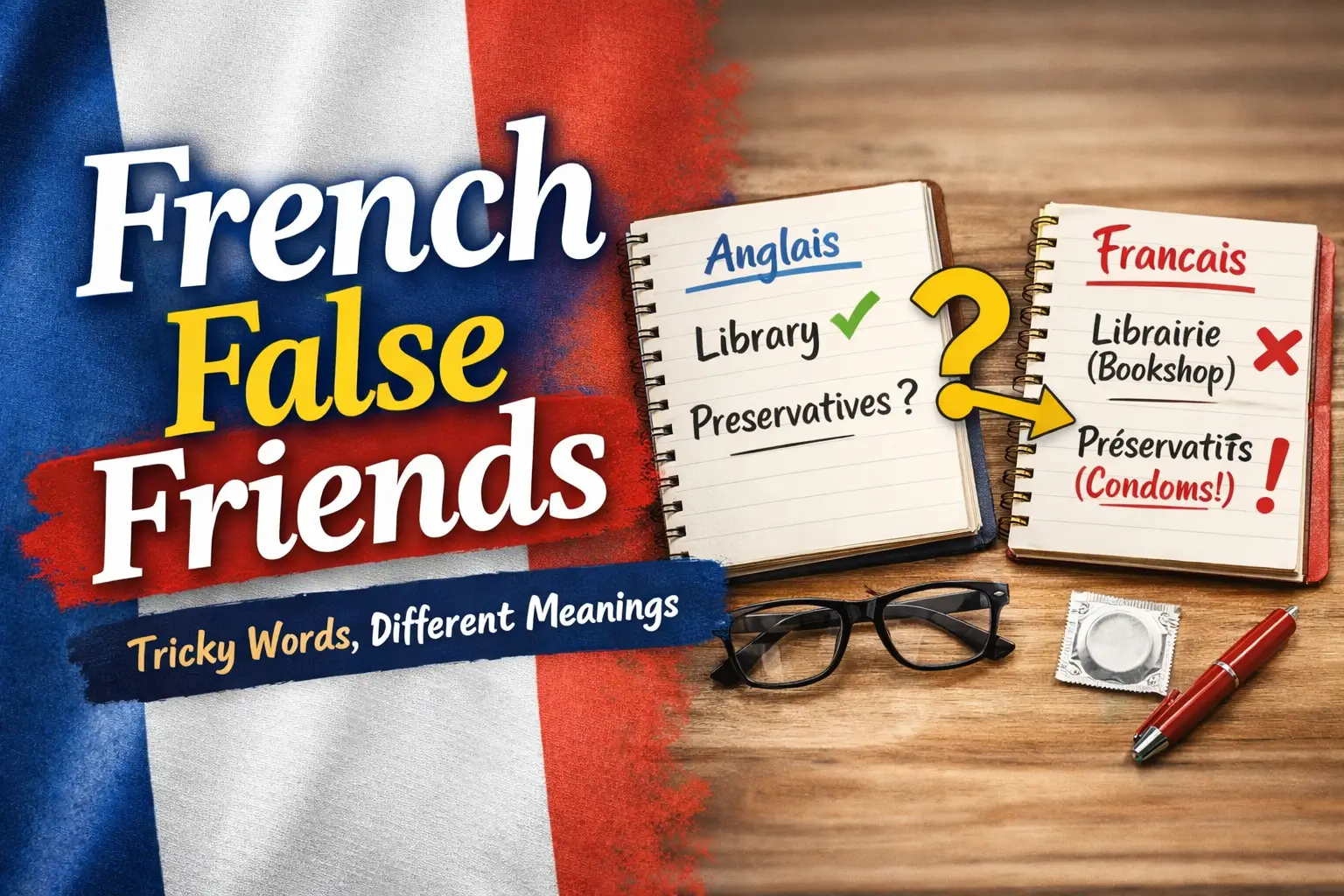
Librairie
- Looks like: Library
- Real meaning: Bookshop
- Example: J’ai acheté ce livre à la librairie. → I bought this book at the bookshop.
Préservatif
- Looks like: Preservative
- Real meaning: Condom
- Example: Il faut utiliser un préservatif. → You need to use a condom. (A classic example of why false friends matter.)
Sensible
- Looks like: Sensible (logical)
- Real meaning: Sensitive
- Example: Elle est très sensible aux critiques. → She is very sensitive to criticism.
Eventually
- English trap: Often translated as éventuellement
- Correct French meaning: Finally / in the end → finalement
- Example: Il a finalement compris. → He eventually understood.
Why context matters
False friends rarely cause problems in isolation. They cause problems in sentences. The surrounding words, tone, and situation usually make the real meaning clear. Only if you’re paying attention.
When you see a word that feels “too easy”, pause for a second. That moment of hesitation is often the difference between translating and understanding French.
The Impact of French False Friends on Communication
French false friends don’t just cause small vocabulary mistakes. They can seriously affect how messages are understood.
Because these words feel familiar, learners often don’t realise anything has gone wrong. The result is communication that sounds correct on the surface but carries the wrong meaning underneath.
How false friends can lead to misunderstandings
False friends encourage instant translation instead of real comprehension.
When a learner assumes a word means the same as its English look-alike. The sentence may still sound grammatical, but the meaning shifts.
This can lead to:
- Confusing or misleading statements
- Misinterpreting written information
- Responding inappropriately in conversations
Real-life anecdotes or examples of miscommunication
Many French learners have experienced moments where a false friend caused an unexpected reaction.
Saying Je suis sensible to mean “I’m sensible” can unintentionally suggest emotional sensitivity instead. Asking for une librairie when you want a library may send you to a bookshop rather than a place to study.
These moments are often harmless, sometimes embarrassing, and occasionally serious. Once a false friend confuses real life, it tends to stick, making learners more alert in the future.
The importance of context in language comprehension
Context is the most reliable defence against false friends. Words don’t exist in isolation. Their meaning depends on the situation, the surrounding vocabulary, and how they’re used.
Learning to read full sentences rather than individual words helps you catch false friends early. If a familiar word doesn’t quite fit the context, that’s your signal to pause and reconsider.
This shift from translating word-by-word to understanding meaning as a whole is essential for confident, accurate communication in French.
Strategies to Identify French False Friends
Spotting French false friends is a skill that improves with awareness and practice.
Rather than relying on instinct or visual similarity, effective learners use deliberate strategies to question familiar-looking words before accepting their meaning.
Tips for recognising false friends in vocabulary
False friends often reveal themselves when something feels too easy. Training yourself to notice that instinctive confidence is the first step towards avoiding mistakes.
- Be cautious with words that look almost identical to English
- Pause when a translation feels automatic rather than thought-through
- Question meanings that don’t quite fit the sentence
- Watch for false friends in formal or abstract vocabulary
Techniques for cross-referencing meanings
Checking meanings properly helps break the habit of mental translation and builds more accurate understanding over time.
- Use bilingual dictionaries to spot differences in usage
- Confirm meanings with monolingual French dictionaries
- Compare example sentences rather than single-word definitions
- Look for notes warning of false friends or misleading translations
Using language resources and tools effectively
The right tools make false friends easier to identify and remember, especially when used consistently.
- Use reputable online dictionaries with usage examples
- Save false friends in a dedicated vocabulary list
- Revisit mistakes you’ve made in real conversations or writing
- Use reading and listening practice to see words in context
Practice Makes Perfect: Exercises to Avoid French False Friends
Avoiding French false friends isn’t about memorising lists.
It’s about training your brain to slow down, check context, and choose meaning deliberately. The right practice turns awareness into instinct.
Suggested exercises for learners to practise
Targeted exercises help you notice false friends before they slip into your speech or writing.
- Rewrite short texts and underline words that look English
- Translate sentences twice: once quickly, once carefully. Then compare
- Create your own example sentences using common false friends
- Keep a “false friends mistake log” and review it weekly
Interactive activities (quizzes, flashcards)
Interactive practice reinforces correct meaning and makes false friends easier to remember.
- Use multiple-choice quizzes that test meaning in context
- Create flashcards with the French word on one side and a warning note on the other
- Sort words into “true friend” vs “false friend” categories
- Test yourself by correcting deliberately incorrect sentences
Resources for further practice (apps, websites)
Regular exposure to authentic French helps false friends stand out naturally.
- Online dictionaries with example sentences and usage notes
- Language-learning apps that include contextual exercises
- French news articles, blogs, or short stories for real-world exposure
- Writing tools or tutors that provide feedback on word choice
Learning from Mistakes: Common Pitfalls
Mistakes with French false friends are not a sign of poor ability.
They’re a normal part of learning. In fact, these errors often mark the moment when learners start moving beyond translation and towards real understanding.
Discussion of common mistakes made by learners
Most mistakes happen when learners rely on familiarity rather than meaning. Words that look reassuringly English are accepted without question, even when the context doesn’t fully support them.
Common pitfalls include:
- Translating automatically instead of reading for meaning
- Assuming similar-looking words always share meanings
- Missing subtle differences in tone or usage
- Overconfidence when reading formal or written French
How to learn from these errors
The key is not avoiding mistakes, but using them. Every false friend error highlights a gap between instinct and reality.
- Pause and analyse what went wrong
- Note the correct meaning and a clear example
- Revisit the mistake after a few days to reinforce learning
- Actively look for the word again in new contexts
Encouragement to embrace mistakes as part of the learning process
False friends are frustrating. They’re also valuable teachers. Each misunderstanding strengthens your awareness and sharpens your instincts.
Instead of feeling discouraged, treat these moments as proof that you’re engaging deeply with the language.
Progress in French doesn’t come from avoiding errors, but from recognising them, understanding them, and moving forward with greater clarity and confidence.
Cultural Context and French False Friends
Language doesn’t exist in isolation. It reflects culture, habits, and ways of thinking.
French false friends often confuse not just because of vocabulary differences, but because the cultural meaning behind a word isn’t the same as in English.
How cultural nuances affect the meaning of words
Many French words carry assumptions shaped by social norms, education, and history. When learners translate directly from English, they may miss these nuances and choose a word that is technically correct, but culturally inappropriate or misleading.
For example, some words sound neutral in English but feel more formal, emotional, or specific in French. Others reflect different attitudes to politeness, relationships, or institutions, which change how and when they’re used.
Examples of false friends influenced by culture
Some false friends exist because the concepts behind the words developed differently in French-speaking and English-speaking societies.
- Sensible: In French, it refers to emotional sensitivity, not practical judgement.
- Actuellement: Reflects a focus on present circumstances rather than contrast or emphasis.
- Librairie: Linked to France’s strong literary culture, meaning bookshop rather than library.
- Préservatif: A clear example of how cultural assumptions can lead to serious misunderstandings.
Cultural understanding in language learning
Culture helps you choose words that sound natural, not just correct. It reduces misunderstandings, improves tone, and makes communication smoother and more respectful.
Learning French isn’t only about vocabulary and grammar. It’s about learning how French speakers organise ideas, express emotions, and interpret meaning. Cultural awareness transforms false friends from confusing traps into valuable insights that enhance your overall fluency.
Resources for Further Learning
Building confidence with French false friends is much easier when you use the right resources.
Exposure, feedback, and real interaction help reinforce correct meanings and stop old habits from creeping back in.
Recommended books, websites, and apps for mastering french false friends
High-quality reference tools help you check meanings quickly and understand how words are actually used.
- WordReference: Excellent for spotting false friends, with usage notes and real examples
- Reverso Context: Shows words in full sentences, making differences in meaning clearer
- Duolingo: Useful for exposure, though false friends should always be double-checked
- Dedicated French grammar or vocabulary books that include false-friend warnings and examples
Online communities and forums for language learners
Discussing mistakes with other learners often highlights patterns you might miss on your own.
- Reddit language-learning communities where learners share real mistakes
- French-learning forums and Discord servers focused on usage and clarification
- Comment sections on French-learning blogs where native speakers often explain nuance
Language exchange opportunities to practise with native speakers
Nothing exposes false friends faster than real conversation. Native speakers will often pause, react, or correct you naturally.
- Tandem: Casual chat with native speakers
- HelloTalk: Text, voice notes, and corrections
- Italki: Structured practice with teachers who explain mistakes clearly
French False Friends FAQs
What are French false friends?
French false friends are words that look like English words but mean something different in French, which can cause easy misunderstandings.
Why do French false friends happen so often?
French and English share lots of Latin and Norman French roots, so many words look similar even when their meanings have changed over time.
What’s the quickest way to spot a false friend?
If a word feels “too obvious” and the sentence meaning seems slightly off, pause and check the context (or confirm in a dictionary with examples).
Are false friends only a beginner’s problem?
No. Advanced learners get caught too, especially when reading quickly, writing formally, or speaking under pressure.
How can I remember French false friends more easily?
Learn them in sentences, not lists. Keep a short “false friends” note, add your own examples, and review them with spaced repetition.