
|
Getting your Trinity Audio player ready...
|
TL;DR: English word stress is the key to sounding natural and being clearly understood, especially for Spanish speakers whose rhythm patterns differ from English. Mastering stress placement improves clarity, confidence, and overall fluency by aligning your speech with the strong–weak rhythm native listeners expect.
English pronunciation isn’t just about individual sounds. For many Spanish speakers, the real challenge isn’t “th” or “v”. It’s word stress.
- English is a stress-timed language, which means certain syllables are emphasised while others are reduced or even swallowed.
- Spanish, by contrast, is syllable-timed, with a more even rhythm.
That difference changes everything.
Misplaced stress can make clear sentences harder to understand, shift meanings entirely, or subtly signal a strong accent even when the sounds themselves are correct.
If you’ve ever been understood but still felt “not quite natural,” word stress may be the hidden issue holding you back.
The importance of word stress in English
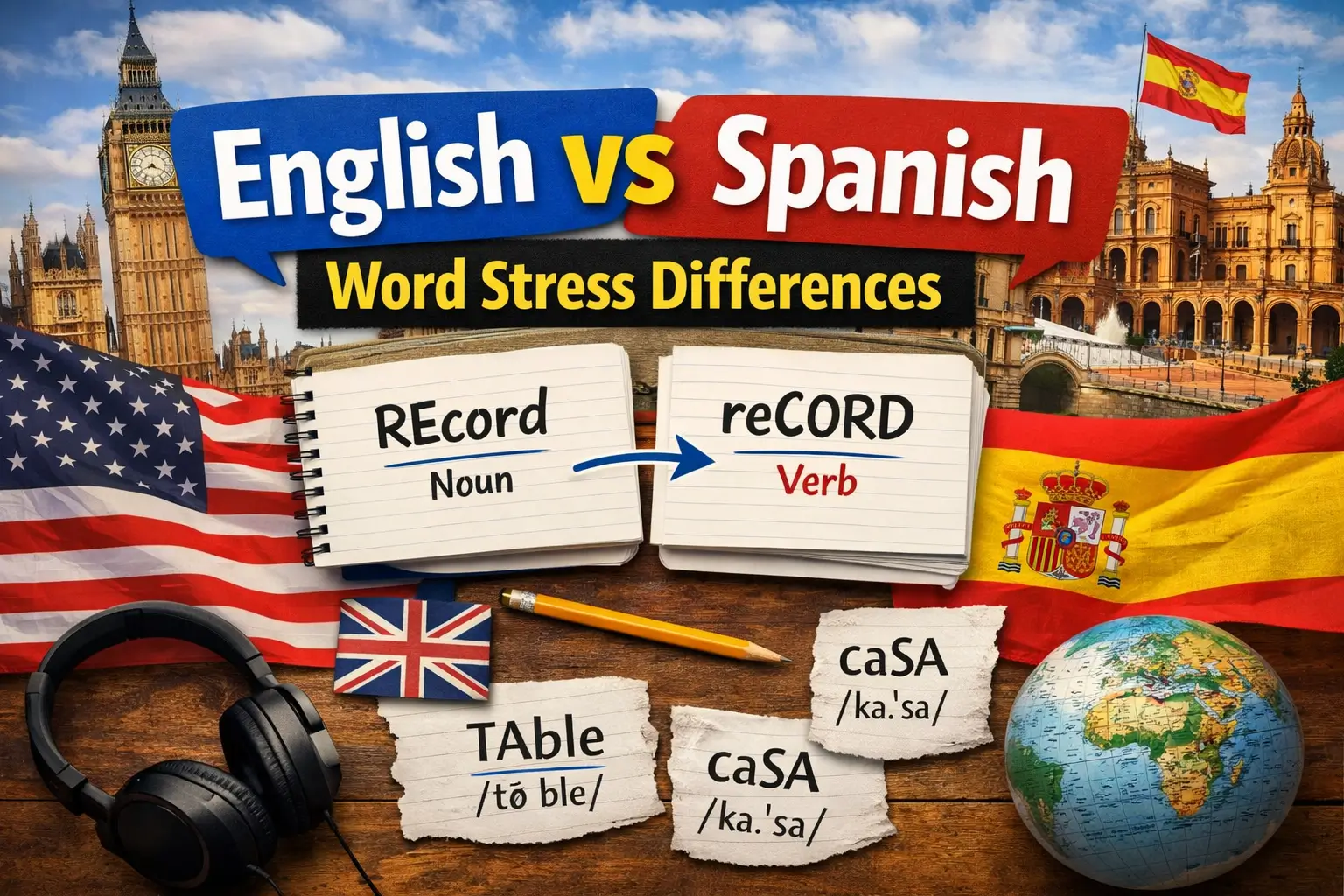
Word stress isn’t optional in English. It carries meaning. Shift the stress and you can change a word entirely: REcord (noun) vs reCORD (verb)
Native speakers rely on stress patterns instantly, often more than on individual sounds.
English is stress-timed, with strong and weak syllables creating rhythm. If every syllable is pronounced evenly, speech can sound flat and harder to follow.
Mastering word stress makes you clearer, more natural, and easier to understand.
The unique challenges faced by Spanish speakers
Spanish speakers often pronounce English sounds clearly, yet still feel misunderstood or “not quite natural.”
The issue usually isn’t vocabulary or grammar. It’s rhythm and stress. The structure of Spanish creates specific patterns that transfer directly into English.
- Syllable-timed rhythm: Spanish gives roughly equal length to each syllable, while English alternates between strong and weak beats.
- Clear vowel pronunciation: Spanish vowels stay strong and consistent, but English reduces many unstressed vowels to /ə/ (schwa).
- Predictable stress rules: Spanish stress follows clearer patterns, whereas English stress can shift unpredictably.
- Little vowel reduction: Spanish rarely weakens unstressed syllables, making English speech sound more even than native patterns.
- Meaning shifts through stress: English uses stress to distinguish nouns and verbs (REcord vs reCORD), which can feel unfamiliar.what
English Word Stress
To sound natural in English, you must understand how stress shapes words. English does not treat every syllable equally.
Some syllables are stronger, longer, and clearer. Others are shorter and weaker. This pattern creates the rhythm that defines spoken English.
What is word stress?
Word stress refers to the emphasis placed on one syllable within a word. That stressed syllable is said louder, slightly longer, and often at a higher pitch than the others.
For example:
- TAble
- comPUter
- imPORtant
- deCIsion
In each case, one syllable stands out. Native speakers do this automatically, and listeners rely on it to recognise words quickly.
Importance of word stress in English pronunciation
Word stress is not just about sounding polished. It directly affects meaning and clarity. In English, stress can change a word’s function:
- REcord (noun)
- reCORD (verb)
The spelling is identical, but the stress pattern signals the difference. Without correct stress, communication can slow down. Listeners must work harder to interpret what you mean.
Examples of word stress in English words
English stress patterns vary, but some common tendencies appear:
Two-syllable nouns and adjectives often stress the first syllable:
- TAble
- HAPpy
- DOCtor
Two-syllable verbs often stress the second syllable:
- reLAX
- arRIVE
- beGIN
Longer words usually have one primary stressed syllable:
- inforMAtion
- eduCAtion
- opporTUnity
The Role of Word Stress in Meaning
In English, stress is not decorative. It carries meaning.
Changing the stressed syllable can shift a word’s function, alter its grammatical role, or confuse the listener entirely.
Native speakers use stress as a shortcut to interpret meaning instantly.
How word stress can change the meaning of words
Some English words look identical in writing but change meaning depending on stress placement.
This is especially common with two-syllable words that function as both nouns and verbs.
When the stress moves, the role of the word moves with it. The pronunciation signals whether you are naming something or describing an action.
Examples of minimal pairs affected by stress
- REcord (noun) vs reCORD (verb)
- PREsent (noun/adjective) vs preSENT (verb)
- CONtract (noun) vs conTRACT (verb)
- OBject (noun) vs obJECT (verb)
- PERmit (noun) vs perMIT (verb)
In each case, the spelling stays the same. Only the stress changes and that small shift changes the meaning.
Implications for Spanish speakers learning English
For Spanish speakers, this can feel unfamiliar. Spanish stress does not typically change grammatical category in the same way.
Because Spanish is more predictable in its stress patterns, learners may instinctively apply the same rhythm to English words.
The result? Even if the sounds are correct, misplaced stress can cause hesitation or misunderstanding.
Focusing on stress patterns, not just individual sounds, is essential for clearer, more natural English.
Differences in Stress Patterns: English vs Spanish
One of the biggest pronunciation gaps between English and Spanish is not individual sounds. It is stress.
Both languages use stress, but they use it differently. Understanding these differences is key to sounding natural in English without losing clarity.
Stress patterns in Spanish
Spanish stress follows clearer and more predictable rules. In many cases, you can determine where the stress falls simply by looking at the word ending.
General tendencies include:
- Words ending in a vowel, -n, or -s are usually stressed on the second-to-last syllable (e.g. caSA, haBLAN).
- Words ending in other consonants are typically stressed on the last syllable (e.g. reloJ).
- Accent marks explicitly show irregular stress (e.g. inforMAción).
Because of this consistency, Spanish speakers develop strong instincts about where stress should fall.
Comparison of English and Spanish stress rules
English stress is far less predictable. While there are patterns, there are many exceptions, and spelling rarely shows stress.
Key differences include:
- Predictability: Spanish has clearer rules; English stress often must be memorised.
- Rhythm: Spanish is syllable-timed (more even rhythm); English is stress-timed (strong–weak pattern).
- Vowel reduction: English frequently weakens unstressed syllables; Spanish generally keeps vowels clear.
- Meaning shifts: English often changes meaning with stress (REcord vs reCORD); Spanish rarely does this systematically.
These structural differences create the “flat” effect Spanish speakers sometimes hear in their English.
Common misconceptions about stress in both languages
There are several misunderstandings that can slow progress:
- “If I pronounce every syllable clearly, I’ll sound better.” In English, this can actually reduce natural rhythm.
- “Stress is just about speaking louder.” It also involves length, pitch, and vowel quality.
- “Stress rules are random in English.” They are irregular, but patterns exist. Especially with word types and endings.
- “Spanish doesn’t have stress.” It does. It’s simply more consistent and less meaning-changing.
The Impact of Incorrect Word Stress
Incorrect word stress doesn’t just affect accent. It affects understanding. Even when grammar and vocabulary are correct, misplaced stress can slow communication, cause confusion, or force listeners to mentally “reconstruct” what was said.
Over time, this can shape both how others perceive you and how confident you feel speaking.
How misplacing stress can lead to misunderstandings
In English, listeners expect stress in certain positions. When it falls somewhere unexpected, the brain hesitates. The listener may momentarily search for a different word or meaning.
For example:
- Saying reCORD instead of REcord when you mean the noun.
- Stressing the wrong syllable in phoTOgraph, phoTOgrapher, or photoGRAphic.
- Giving equal stress to every syllable, which can make words harder to recognise quickly.
Real-life examples of communication breakdowns
These issues often appear in everyday situations:
- A student says I signed the conTRACT when they mean the noun, and the listener briefly thinks they’re talking about the action instead.
- A presentation includes repeated stress errors, making the speaker seem uncertain even when they are well prepared.
- In fast conversations, native speakers ask for repetition because the stress pattern does not match what they expect.
The psychological effects of being misunderstood
Repeated misunderstandings can affect confidence. Speakers may begin to:
- Avoid longer or more complex words.
- Speak more slowly than necessary.
- Feel anxious about contributing in meetings or group conversations.
Over time, this can limit participation and fluency development. Correcting word stress is therefore not just a technical improvement. It reduces friction, builds confidence, and makes communication feel easier and more natural.
Strategies for Mastering English Word Stress
Improving word stress is not about memorising endless rules. It’s about training your ear and adjusting your rhythm.
With focused practice, Spanish speakers can quickly become more natural and confident. The key is awareness, repetition, and listening actively.
Techniques for identifying stress patterns in English words
Before you can produce correct stress, you need to recognise it.
- Use a dictionary with phonetic transcription: Most reliable dictionaries mark the stressed syllable (ˈ).
- Listen before repeating: Focus on which syllable sounds stronger, longer, and clearer.
- Notice vowel reduction: Unstressed syllables often contain the schwa /ə/.
- Group words by type: Two-syllable nouns often stress the first syllable; many two-syllable verbs stress the second.
- Compare word families: PHOtograph, phoTOgrapher, photoGRAphic.
Train your ear first. Production improves faster once recognition is strong.
Practice exercises for Spanish speakers
These exercises specifically target rhythm transfer from Spanish to English.
1. Clap the stress
Say the word while clapping on the stressed syllable:
- imPORtant
- deCIsion
- TAble
2. Stretch the stressed syllable
Make the stressed syllable slightly longer:
- comPUUter
- eDUUcation
3. Reduce the weak syllables
Practise weakening unstressed vowels:
- aBOUT
- toDAY
4. Contrast pairs aloud
- REcord / reCORD
- CONtract / conTRACT
This helps retrain rhythm away from even syllable timing.
Resources for further learning
Consistent exposure is essential. These tools can help:
- Cambridge Dictionary: Clear audio with stress marking in phonetic transcription.
- Merriam-Webster: Useful for comparing British and American stress patterns.
- ELSA Speak: AI-based pronunciation feedback.
- Forvo: Real recordings from native speakers worldwide.
- YouGlish: Hear words used naturally in real video clips.
Mastering word stress is less about perfection and more about rhythm awareness.
The Role of Listening and Imitation
Word stress is learned through the ear as much as the mouth
You cannot master English rhythm by reading rules alone. You must hear it repeatedly and imitate it consciously. Listening trains recognition; imitation builds muscle memory.
Importance of listening to native speakers
Native speakers don’t pronounce every syllable equally. They stretch stressed syllables and reduce the rest. By listening carefully, you begin to notice:
- Which syllables are longer or louder
- Where vowels become weaker
- How stress creates the natural “beat” of English
Regular exposure helps you internalise this rhythm instead of translating Spanish timing into English.
Techniques for effective imitation of stress patterns
Imitation works best when it is deliberate.
- Shadowing: Play a short clip and repeat immediately, matching rhythm and timing.
- Pause-and-repeat: Stop after one sentence and copy it exactly.
- Slow-motion practice: Listen at 0.75x speed to identify stressed syllables clearly.
- Record yourself: Compare your rhythm to the original audio.
- Exaggerate stress at first: Over-stressing helps retrain your natural rhythm before refining it.
Focus on melody and rhythm, not just individual sounds.
Recommended listening materials
Choose materials with clear, natural speech.
Podcasts
- 6 Minute English: Short, structured episodes with clear pronunciation.
- The English We Speak: Excellent for noticing natural stress in phrases.
Web & Video Platforms
- BBC Learning English: Pronunciation-focused lessons and listening practice.
- TED Talks: Slower, well-articulated speech ideal for shadowing.
Songs: Songs are powerful because English stress naturally aligns with musical rhythm. Choose slower pop or acoustic tracks and follow the lyrics while listening.
The more you listen and imitate with intention, the more your speech shifts from evenly timed to naturally stress-based. Over time, rhythm becomes automatic rather than forced.
The Influence of Accent and Dialect
Word stress is not identical across all English varieties.
While the core patterns remain stable, regional accents and dialects can shift vowel quality, rhythm, and even which syllable sounds most prominent.
For learners, this adds another layer of complexity, especially when moving between British, American, Australian, or other English varieties.
How regional accents affect word stress
Most English dialects keep the primary stress in the same position, but they may:
- Change vowel sounds within stressed syllables
- Reduce unstressed vowels differently
- Alter rhythm and speech pace
- Emphasise certain syllables slightly more strongly
For example, British and American English often share stress placement in words like imPORtant or deCIsion, but the vowel quality and overall rhythm can differ noticeably.
The challenge of adapting to different English dialects
Spanish speakers may initially find it confusing when the same word sounds different across regions.
A word that felt “clear” in one accent may feel harder to recognise in another because of:
- Faster speech tempo
- Stronger vowel reduction
- Regional pronunciation patterns
This can create the impression that stress has changed, even when it has not.
Tips for navigating accent variations
Accent variation is normal in English. Once you understand stress patterns, adapting to different dialects becomes much easier and far less intimidating.
- Focus on stress position first – Identify which syllable is strongest before analysing vowel differences.
- Expose yourself to multiple accents – Avoid training your ear on only one variety.
- Practise with diverse media – Mix British and American podcasts, news clips, and interviews.
- Choose a model accent for speaking – Consistency builds confidence, even if you understand many varieties.