
|
Getting your Trinity Audio player ready...
|
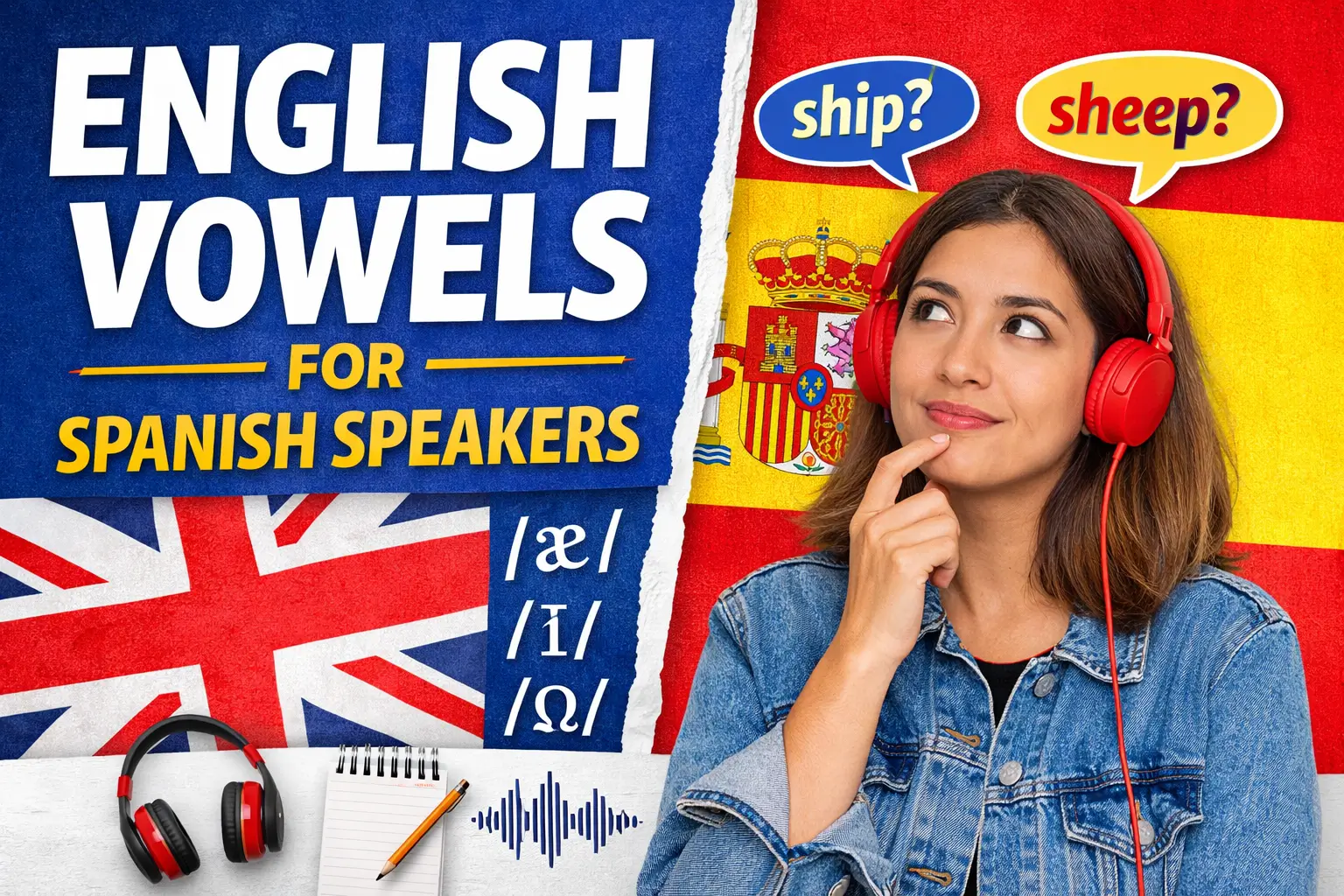
TL;DR: English has many more vowel sounds than Spanish, and small differences in length and stress can change meaning (ship vs sheep). English Vowel Errors are common for Spanish speakers, who often merge similar vowels or skip reductions. Train your ear, practise minimal pairs, and focus on stress to sound clearer and more natural.
English vowels look simple on paper, but English Vowel Errors are surprisingly common.
They’re not.
For Spanish speakers, vowels are often the biggest hidden obstacle to sounding clear and natural in English. Not grammar. Not vocabulary. Vowels.
Spanish has five pure, stable vowel sounds. English? Around 20, depending on accent. Some are short. Some are long. Some glide. Some barely exist in Spanish at all.
That difference changes everything.
A small shift in vowel length can turn ship into sheep. A slight change in mouth position can transform full into fool. These aren’t minor details. They affect clarity, confidence, and comprehension.
The importance of vowels in English
Vowels carry English.
They shape meaning. They control rhythm. They determine clarity.
In many cases, a single vowel sound is the only difference between two completely different words: ship and sheep, full and fool, cap and cup. Consonants may frame a word, but vowels define it.
- For Spanish speakers, this is especially important. Spanish vowels are consistent and stable, five clear sounds that rarely change.
- English vowel errors, however, shift in length, tension, and mouth position. Some are short and relaxed. Others are long and stretched. Some glide from one sound to another.
This complexity affects:
- Pronunciation clarity: Small vowel changes can completely alter meaning.
- Listening comprehension: If you can’t hear the difference, you can’t produce it accurately.
- Accent and natural rhythm: English is stress-timed, and vowels change depending on stress.
Challenges Spanish speakers face with English vowels
Why does live sound different from leave? Why does cup not sound like cap? Do native speakers barely pronounce some vowels at all?
The challenge isn’t effort. Its structure. English vowel errors work very differently, and that difference creates predictable difficulties.
Here are the main challenges Spanish speakers face:
- Too many vowel sounds: Spanish has five clear vowel sounds. English has around 20, depending on the accent. This makes it difficult to categorise and distinguish them accurately.
- Length differences (short vs long vowels): In Spanish, vowel length doesn’t change meaning. In English, it does. Ship vs sheep or full vs fool are completely different words.
- Minimal pairs that sound “the same” at first: Sounds like /ɪ/ and /iː/ or /ʌ/ and /æ/ can be hard to hear, which makes them hard to pronounce correctly.
- The schwa (/ə/) and weak vowels: English reduces unstressed vowels to a neutral sound. Spanish rarely reduces vowels, so this feels unnatural and unclear.
- Diphthongs (gliding vowels): English vowels often move from one sound to another within the same syllable (e.g. /eɪ/ in face). Spanish vowels are usually more stable.
- Stress-timed rhythm: English rhythm changes vowel quality depending on stress. Spanish is syllable-timed, meaning vowels stay more consistent.
English Vowel Sounds
English vowels are the core of pronunciation.
They shape meaning, rhythm, and clarity. While consonants give structure to words, vowels carry the sound. If a vowel changes, the word often changes with it.
For Spanish speakers, understanding how English vowels really work is the key to clearer speech and stronger listening skills.
What are English vowel sounds?
English vowel sounds are produced with an open vocal tract — no strong blockage of airflow, unlike most consonants.
But here’s the important part: English doesn’t just have five vowel sounds.
Depending on accent (for example, General American or Received Pronunciation), English typically has around 14–20 distinct vowel sounds, including:
- Short vowels (e.g. /ɪ/ in sit, /ʊ/ in book)
- Long vowels (e.g. /iː/ in see, /uː/ in blue)
- Diphthongs (gliding vowels like /eɪ/ in face or /aɪ/ in time)
- The schwa /ə/ (the relaxed, neutral vowel in about or teacher)
These sounds differ in:
- Length
- Tongue height
- Tongue position (front, central, back)
- Lip rounding
- Tension
Comparison of English and Spanish vowel systems
Spanish has five stable vowel sounds: /a, e, i, o, u/.
They are:
- Consistent
- Clear
- Rarely reduced
- Not length-dependent
English, in contrast, has:
- Multiple versions of similar vowel sounds
- Length distinctions that change meaning
- Frequent vowel reduction in unstressed syllables
- Diphthongs that glide between sounds
For example:
- Spanish /i/ covers both English sit /ɪ/ and seat /iː/
- Spanish /a/ often replaces both cap /æ/ and cup /ʌ/
- Spanish vowels stay strong in unstressed syllables, while English often reduces them to /ə/
This mismatch is why many English words can sound “the same” to Spanish speakers at first. The categories simply don’t align.
Importance of accurate vowel pronunciation in effective communication
Vowel accuracy directly affects:
- Clarity: Mispronouncing a vowel can create a completely different word.
- Listening comprehension: If you can’t hear the difference, you can’t respond correctly.
- Confidence: Clear vowels reduce repetition and misunderstanding.
- Natural rhythm: English stress patterns depend heavily on vowel reduction.
Consider these pairs:
- ship vs sheep
- full vs fool
- hat vs hot
- live vs leave
The consonants are identical. Only the vowel changes.
In real conversation, listeners rely on those subtle differences instantly. If vowels are unclear, communication slows down.
Mastering English vowels doesn’t mean losing your identity or accent.
It means gaining precision.
And precision leads to confidence.
The Short ‘i’ vs. the Long ‘ee’
For many Spanish speakers, this is the most important vowel contrast in English.
And one of the most confusing.
At first, bit and beat can sound almost identical. But to native listeners, they are completely different words. The difference is small, yet powerful.
The short ‘i’ sound in English (as in “bit”)
The short /ɪ/ sound appears in words like:
- bit
- sit
- live
- ship
- fill
This sound is:
- Short and relaxed
- Produced with the tongue slightly high and forward
- Less tense than Spanish /i/
- Made with relaxed lips
It is not the same as the Spanish “i”.
Spanish /i/ is tense and clear. English /ɪ/ is shorter and more relaxed, almost softer.
The long ‘ee’ sound in English (as in “beat”)
The long /iː/ sound appears in words like:
- beat
- seat
- leave
- sheep
- feel
This sound is:
- Longer in duration
- Tense and stretched
- Produced with the tongue high and forward
- Slightly smiling lip position
Length matters.
In English, vowel length can change meaning. Holding the sound slightly longer makes the difference between two words.
Common errors made by Spanish speakers, with examples
Because Spanish has only one /i/ sound, it often replaces both English /ɪ/ and /iː/.
This leads to confusion such as:
- ship sounding like sheep
- live sounding like leave
- sit sounding like seat
- fill sounding like feel
In conversation, this can cause misunderstandings:
- “I live here” may sound like “I leave here.”
- “The ship is ready” may sound like “The sheep is ready.”
The issue isn’t just pronunciation.
It’s perception.
If you can’t clearly hear the difference between /ɪ/ and /iː/, your brain treats them as the same category.
Short and relaxed.
Long and tense.
That small distinction makes a big difference.
The ‘æ’ Sound in English
The /æ/ sound is one of the most recognisable features of English pronunciation.
It’s also one of the most difficult for Spanish speakers.
Why?
Because it doesn’t really exist in Spanish.
That means your brain tries to replace it with something familiar, usually /a/. And that small substitution can completely change how a word sounds.
The ‘æ’ sound (as in “cat”)
The /æ/ vowel appears in words like:
- cat
- man
- bad
- laugh (in many accents)
- hat
This sound is:
- Short
- Fronted (tongue positioned forward)
- Very open
- Produced with the jaw lowered more than for Spanish /a/
It’s sometimes described as a “wide” vowel. Your mouth should feel more open and slightly stretched than it does in Spanish.
If you say Spanish “a”, your mouth is open, but not quite wide enough.
Comparison with Spanish vowel sounds
Spanish has a single /a/ sound.
It’s:
- Stable
- Central
- Not especially fronted
- Not length-dependent
English /æ/ is different:
- It’s more fronted in the mouth
- The jaw drops slightly more
- The tongue is flatter and more forward
- It has a distinct “bright” quality
Because Spanish doesn’t have this sound category, learners often replace /æ/ with /a/.
Common mistakes and tips for correct pronunciation
- cat sounding like cut
- man sounding like men
- bad sounding closer to bard or bud
- Over-rounding the lips (which English /æ/ does not require)
Tips to improve:
- Drop your jaw slightly more than in Spanish.
- Keep your tongue forward, not central.
- Avoid rounding your lips.
- Practise minimal pairs like:
- cat vs cut
- man vs men
- bad vs bed
A useful trick: Smile slightly and lower your jaw at the same time. That helps create the forward, open quality of /æ/.
It may feel exaggerated at first.
That’s normal.
The ‘ʌ’ Sound vs. the ‘o’ Sound
For Spanish speakers, these two vowels can feel almost identical.
But in English, they belong to completely different sound categories.
One is central and relaxed.
The other is back and rounded.
Confusing them can turn cup into cop and that changes meaning instantly.
Let’s look at them clearly.
The ‘ʌ’ sound (as in “cup”)
The /ʌ/ vowel appears in words like:
- cup
- love
- money
- sun
- luck
This sound is:
- Short
- Central (the tongue sits in the middle of the mouth)
- Relaxed
- Produced with unrounded lips
It’s sometimes called the “uh” sound.
The ‘o’ sound (as in “cot”)
The vowel in cot is typically /ɒ/ in British English or /ɑː/ in many American accents.
It appears in words like:
- cot
- hot
- lot
- dog
- box
This sound is:
- Back in the mouth
- More open than /ʌ/
- Often produced with some lip rounding (especially in British English)
- Deeper in quality
It feels heavier and further back than /ʌ/.
Errors made by Spanish speakers and strategies for improvement
Because Spanish has a clear /o/ sound and no /ʌ/ sound, learners often:
- Pronounce cup like cop
- Say love closer to lob
- Use a strong Spanish /o/ instead of a neutral central vowel
- Over-round the lips when producing /ʌ/
This happens because the brain substitutes the closest familiar vowel.
How to improve:
- For /ʌ/, relax your mouth completely. No rounding. Keep the sound central.
- Think of it as a quick, neutral “uh”, short and soft.
- Practise minimal pairs:
- cup vs cop
- luck vs lock
- cut vs cot
- Record yourself and check whether your lips round when they shouldn’t.
A helpful physical cue:
- If your lips are rounding, you’re probably producing an “o” sound.
- If your mouth feels relaxed and neutral, you’re closer to /ʌ/.
The ‘ɪ’ vs. ‘i’ Distinction
This is one of the most important vowel contrasts in English.
And one of the most overlooked.
To many Spanish speakers, sit and seat sound almost identical at first. But to native listeners, they are completely different words.
The distinction isn’t about spelling.
It’s about length, tension, and precision.
The difference between the ‘ɪ’ sound (as in “sit”) and the ‘i’ sound (as in “see”)
Although both sounds are produced with the tongue high and forward in the mouth, they are not the same.
/ɪ/ – as in sit
- Short
- Relaxe
- Slightly lower and looser than Spanish /i/
- Lips neutral
Words: sit, live, ship, fill, bit
/iː/ – as in see
- Long
- Tense
- Tongue high and firmly positioned
- Slightly spread lips (almost a soft smile)
Words: see, leave, sheep, feel, beat
The key differences are:
- Length: /iː/ is noticeably longer
- Tension: /iː/ is tighter and more controlled
- Energy: /ɪ/ is quicker and more relaxed
In English, length changes meaning. That makes this contrast essential.
Common difficulties for Spanish speakers
Spanish has one clear /i/ sound.
It’s closer to English /iː/ than to /ɪ/.
Because there is no separate /ɪ/ category in Spanish, learners often:
- Pronounce ship like sheep
- Say live like leave
- Merge sit and seat
- Hold /ɪ/ too long
This isn’t a pronunciation problem alone.
It’s a listening problem first.
If your brain groups both sounds into one category, your mouth will do the same
Practice exercises to master the distinction
Minimal Pair Listening
Listen to pairs and identify which word you hear:
- ship / sheep
- live / leave
- fill / feel
- bit / beat
Focus on length and tension, not spelling.
Length Contrast Drill
Say the words out loud:
- sit (short, quick)
- seat (long, stretched)
Exaggerate at first. Make seat clearly longer.
Overtraining helps build awareness.
Physical Awareness Exercise
For /ɪ/:
- Keep your mouth relaxed.
- Say it quickly.
For /iː/:
- Slight smile.
- Hold the sound for one full second.
Feel the difference in muscle tension.
Sentence Practice
- “The ship is leaving.”
- “Sheep eat green leaves.”
- “I live here.”
- “Please leave early.”
Record yourself and compare.
Precision in this distinction dramatically improves clarity.
Short and relaxed.
Long and tense.
The ‘ɔ’ Sound and Its Variations
The /ɔ/ sound is one of those vowels that feels simple until you realise it changes depending on accent.
For Spanish speakers, it can blend with /o/, /ɒ/, or even /ɑː/. But in English, subtle differences in mouth position and lip rounding create distinct sounds that listeners notice immediately.
Understanding /ɔ/ isn’t just about pronunciation.
It’s about recognising variation.
The ‘ɔ’ sound (as in “thought”)
The /ɔː/ vowel appears in words like:
- thought
- law
- caught
- talk
- bought
In many British accents, it is:
- Long
- Back in the mouth
- Rounded (lips slightly forward)
- Produced with a lowered jaw
It has a deeper, fuller quality than Spanish /o/.
In many American accents, this sound may be shorter or may merge with other vowels depending on the region.
Variations in pronunciation and regional differences
English accents treat this vowel differently.
In many forms of British English (Received Pronunciation):
- caught and cot are different
- /ɔː/ is long and clearly rounded
In many forms of American English:
- cot and caught may sound the same (a phenomenon known as the cot–caught merger)
- The vowel may be closer to /ɑ/
- Lip rounding may be reduced
This means learners may hear:
- thought with strong rounding in the UK
- thought with less rounding in parts of the US
Both can be correct, depending on the accent.
Consistency matters more than copying every variation.
Common errors and how to address them
- Replacing /ɔː/ with a pure Spanish /o/
- Not rounding the lips enough (in British-style pronunciation)
- Confusing caught with cot
- Shortening the vowel too much
Because Spanish /o/ is stable and mid-back, learners often underestimate how open and rounded English /ɔː/ can be.
How to improve:
- Drop your jaw slightly more than for Spanish /o/.
- Round your lips gently (especially if aiming for British pronunciation).
- Hold the vowel slightly longer.
- Practise minimal pairs:
- caught vs cot
- law vs low
- walk vs work
If your lips are barely moving, you may be too close to Spanish /o/.
If the sound feels deeper and rounder, you’re closer to /ɔː/.
Mastering this vowel isn’t about memorising one “correct” version.
It’s about understanding how English uses space in the mouth and adjusting with intention.
The Role of Stress and Intonation
Pronouncing vowels correctly is only half the story.
In English, stress and intonation change how vowels sound. A vowel in a stressed syllable is strong and clear.
- For Spanish speakers, this is a major shift. Spanish rhythm is syllable-timed, meaning each syllable is pronounced more evenly.
- English is stress-timed, meaning some syllables are strong and others are reduced.
Understanding this difference transforms pronunciation.
Importance of stress in English vowel pronunciation
In English, stressed syllables:
- Are louder
- Are longer
- Have clearer vowel quality
- Carry the main meaning of the word
Unstressed syllables:
- Are shorter
- Often contain the schwa /ə/
- Sound weaker and more relaxed
Compare:
- PHOtograph
- phoTOGraphy
The stress shifts and the vowel changes with it.
How intonation influences vowel sounds
Intonation is the rise and fall of pitch in a sentence.
It affects:
- Whether a statement sounds confident or uncertain
- Whether a sentence is a question or a statement
- Which word carries emphasis
For example:
- “I didn’t say he stole the money.”
Stress on different words changes meaning entirely.
When a word is emphasised, its vowel becomes:
- Longer
- Clearer
- More energetic
Unemphasised words shrink. Their vowels often reduce to /ə/.
Spanish intonation tends to be more even and syllable-driven. English uses pitch movement and reduction to create rhythm and meaning.
This is why English speech can sound like it has “waves”.
Tips for Spanish speakers to improve stress and intonation
Clear vowels improve pronunciation.
Correct stress and natural intonation make it sound fluent.
When you combine both, your English stops sounding translated — and starts sounding alive.
Learn word stress with vocabulary
When learning a new word, always learn which syllable is stressed. Don’t memorise it flat.
Practise reduction
Say common phrases naturally:
- a cup of tea → “a cuppa tea” (notice the reduced vowels)
- going to → “gonna” (in informal speech)
Mark stressed syllables visually
Write words like this:
- comPUter
- imPORtant
- aBOUT
This trains awareness.
Shadow native speech
Listen to short audio clips and repeat immediately, copying rhythm and pitch, not just words.
Think in rhythm, not syllables
English beats follow stressed syllables. Try tapping your hand only on the strong syllables when speaking.
Practical Tips for Improvement
English vowels is the first step.
Improving them requires consistent, focused practice.
The good news? You don’t need complicated tools. You need awareness, repetition, and smart listening.
Recommended resources for practising English vowels
Use tools that help you both hear and see the difference between sounds.
- IPA charts with audio: Interactive phonemic charts let you click and hear each vowel clearly.
- YouGlish: Hear real examples of words in context from thousands of videos.
- BBC Learning English: Clear pronunciation guides, especially helpful for British English.
- Rachel’s English (YouTube): Excellent breakdowns of American vowel contrasts.
- Minimal pair practice websites: Search specifically for “minimal pairs /ɪ/ /iː/ practice” or similar.
When choosing resources, prioritise those that include audio. Reading about vowels is useful, but hearing them is essential.
Importance of listening to and mimicking native speakers
Listening trains perception.
Mimicking trains production.
Shadowing, repeating immediately after a native speaker, is one of the most effective techniques. Don’t just copy words. Copy:
- Length
- Mouth movement
- Stress
- Intonation
Pay attention to how vowels change in fast speech. Notice how unstressed vowels weaken.
Over time, your ear becomes sharper. And when your ear improves, your pronunciation follows.
Consistency beats intensity.
Five focused minutes a day will improve your vowels more than an hour once a month.
English Vowel Errors FAQs
Why are English vowels so difficult for Spanish speakers?
English has many more vowel sounds than Spanish, and small differences in length or mouth position can completely change meaning. Spanish has five stable vowels, while English has around 14–20, including short, long, and reduced sounds.
What is the difference between /ɪ/ and /iː/?
/ɪ/ is short and relaxed (sit, ship), while /iː/ is long and tense (seat, sheep). Length and tension matter in English, and confusing them can change the word entirely.
Why do unstressed vowels sound different in English?
English is stress-timed, meaning stressed syllables are strong and clear, while unstressed syllables often reduce to the schwa /ə/. Spanish doesn’t reduce vowels in the same way, which makes this feature challenging.
How can I practise difficult vowel contrasts effectively?
Use minimal pairs (e.g. ship vs sheep), record yourself, compare with native audio, and practise short daily sessions. Focus on one vowel contrast at a time.
Will improving my vowels reduce my accent?
It won’t remove your accent, and it doesn’t need to. But improving vowel precision will make your speech clearer, more natural, and easier to understand.