
|
Getting your Trinity Audio player ready...
|
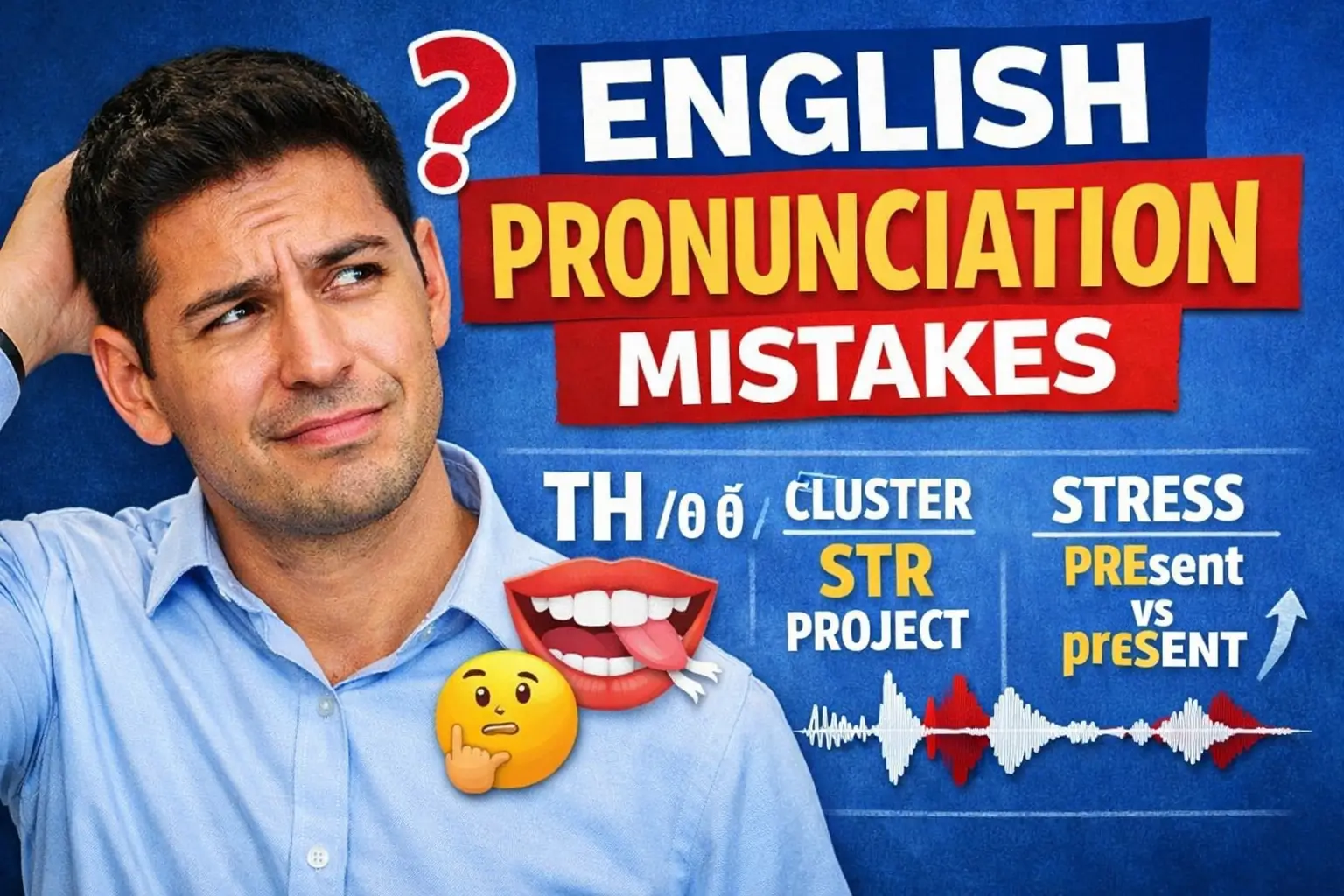
TL;DR: Most English Pronunciation Mistakes made by Latin American professionals aren’t grammar problems. They’re sound, stress and rhythm issues. Common challenges include vowel distinctions, consonant clusters, “th” sounds and English stress patterns.
Languages are more than words. They carry memory, identity, logic, humour, emotion and entire ways of seeing the world.
From single words that flip an argument in seconds to grammar systems that reveal how we learned something, languages constantly challenge what we think communication looks like.
English pronunciation in professional settings
In professional settings, pronunciation isn’t about perfection. It’s about clarity. If people can’t understand you quickly, your ideas lose impact.
Clear English pronunciation builds credibility, speeds up communication and reduces costly misunderstandings. In meetings, interviews and presentations, being understood the first time signals confidence and competence.
It’s not about changing your accent. It’s about being clear, precise and professional when it matters most.
Common challenges faced by Latin American professionals
For many Latin American professionals, English is not the problem, pronunciation is.
You might have strong grammar, a wide vocabulary and solid professional experience, yet still feel misunderstood in meetings or interviews.
Here are some of the most common challenges:
- Vowel sound confusion: English has many more vowel sounds than Spanish or Portuguese, making words like ship and sheep difficult to distinguish clearly.
- Word stress patterns: Placing stress on the wrong syllable (e.g. PRO-ject vs pro-JECT) can make familiar words harder to recognise.
- Sentence rhythm and connected speech: English is stress-timed, meaning some syllables are reduced or blended, which can make speech sound “flat” or overly segmented.
- Consonant clusters :Words like strengths or world can be challenging because similar combinations rarely exist in Latin-based languages.
- Final consonant sounds: Dropping or softening final sounds (e.g. saying projec instead of project) can affect clarity, especially in professional contexts.
- Confidence under pressure: Even with strong language skills, nerves in interviews or presentations can amplify pronunciation difficulties.
The Influence of Native Language
Your first language doesn’t disappear when you learn English. It shapes how you hear, process and produce new sounds. This isn’t a weakness; it’s how the brain works.
We rely on familiar sound patterns to interpret unfamiliar ones. The challenge comes when English uses sounds, rhythms or stress patterns that don’t exist in Spanish or Portuguese.
Common phonetic features in Latin American languages
Most Latin American professionals grow up speaking Spanish or Portuguese, which share several phonetic traits:
- Five clear vowel sounds (a, e, i, o, u) that are consistent and stable.
- Syllable-timed rhythm, where each syllable is pronounced more evenly.
- Clear consonant endings, but fewer complex consonant clusters.
- Predictable word stress patterns, often marked with written accents.
- Strong, pure vowel pronunciation, without the diphthongs common in English.
How these features affect English pronunciation
English operates differently:
- It has many more vowel sounds, including subtle distinctions that change meaning.
- It uses a stress-timed rhythm, where some syllables are reduced or almost disappear.
- It includes frequent consonant clusters, especially at the beginning and end of words.
- Word stress can shift meaning and isn’t always predictable from spelling.
As a result, English may sound unclear or “fast” to Latin American speakers, while their own English may sound more evenly stressed or segmented.
Examples of specific sounds that are challenging
Some patterns consistently cause difficulty:
- /ɪ/ vs /iː/ – ship vs sheep
- /ʌ/ – the vowel in cut or luck, which doesn’t exist in Spanish
- Word-final consonants – project, worked, asked
- Consonant clusters – strengths, world, texts
- Word stress shifts – PREsent (noun) vs preSENT (verb)
- The “th” sounds /θ/ and /ð/ – think, and this
These aren’t random mistakes. They’re predictable transfers from the native language system. And because they’re predictable, they’re absolutely trainable.
Vowel Sounds: The Most Common Pitfalls
If there’s one area that causes the most confusion for Latin American professionals, it’s vowels.
English has around 12–20 vowel sounds (depending on accent), while Spanish has just five. That means your brain is trying to squeeze many English sounds into a much smaller system.
The result? Words that look different on paper can sound almost identical when spoken, and that can change the meaning completely.
Distinction between short and long vowels
In English, vowel length matters. Small differences in sound duration and mouth position can completely change a word.
- Ship /ɪ/ vs Sheep /iː/
- Full /ʊ/ vs Fool /uː/
- Cut /ʌ/ vs Cart /ɑː/
Short vowels are typically more relaxed and centralised. Long vowels are tenser and held slightly longer.
Common mispronunciations of English vowel sounds
Some patterns appear again and again:
- Pronouncing beach and bitch the same way
- Saying live and leave identically
- Replacing the /ʌ/ sound (luck, company) with /a/
- Confusing /æ/ in cat with /a/
- Flattening diphthongs like /eɪ/ in make or /əʊ/ in go
These mistakes don’t mean your English is weak. They simply show your native vowel system is doing what it’s designed to do: simplify unfamiliar sounds.
Tips for mastering English vowel pronunciation
Improving vowels requires precision and awareness.
- Train your ear first. If you can’t hear the difference, you won’t produce it. Minimal pair listening exercises are powerful.
- Focus on mouth position. English vowels often require wider jaw movement or tighter lip shaping.
- Lengthen long vowels consciously. Slight exaggeration during practice builds muscle memory.
- Record yourself. Compare your pronunciation to a native model.
Consonant Clusters: A Pronunciation Challenge
Consonant clusters are one of the biggest pronunciation hurdles for Latin American professionals. English allows multiple consonants to sit together without a vowel in between.
When clusters feel unnatural, speakers often insert an extra vowel (es-trategy instead of strategy) or drop a final sound (projec instead of project).
Consonant clusters in English
A consonant cluster is when two or more consonants appear together in a word without a vowel separating them.
They can appear:
- At the beginning: strategy, project, strong
- In the middle: extra, complex, abstract
- At the end: tasks, world, helped, months
English especially loves final clusters, which are critical in business vocabulary: worked, asked, clients, reports.
Specific clusters that Latin American professionals struggle with
Some combinations are particularly challenging:
- /str/: strategy, structure
- /spr/: spread, spring
- /ks/: asks, texts
- /rld/: world
- Past tense endings: worked, launched, managed
- Plural endings: clients, products, results
Final clusters are especially important in professional English because they often signal tense, quantity or meaning.
Strategies for practising consonant clusters
The key is controlled, step-by-step practice.
- Break the word down slowly. For strengths, practise strength first, then add the final /s/.
- Add rhythm. Clap or tap for each sound to avoid skipping consonants.
- Practise backwards. Start with the final sound and build the word in reverse.
- Use business vocabulary. Train with words you actually use at work.
- Slow down deliberately. Speed comes after accuracy.
Clusters feel difficult because they require new muscle coordination. With repetition and focused practice, they become automatic
The “TH” Sound: A Notorious Difficulty
Few sounds cause as much frustration as “th”. It appears constantly in English, in everyday words like think, this, three, there and with.
Yet for many Latin American professionals, it simply doesn’t exist in their native sound system.
What are the “TH” sounds (/θ/ and /ð/)?
English actually has two different “th” sounds:
- /θ/ – voiceless, as in think, three, month
- /ð/ – voiced, as in this, that, those
Both sounds are made by placing the tip of your tongue lightly between your teeth and pushing air out.
The difference?
- /θ/ uses only air.
- /ð/ uses air + vibration in the throat.
These sounds are common in English but rare in Spanish and Portuguese, which is why they feel unnatural at first.
Common substitutions made by Latin American speakers
Because the “th” sounds don’t exist in most Latin American varieties of Spanish or Portuguese, speakers often replace them with familiar sounds:
- /θ/ → /t/ or /s/ (think → tink or sink)
- /ð/ → /d/ (this → dis)
- In some cases, /f/ (three → free)
These substitutions are understandable, but they can reduce clarity, especially in professional contexts where precision matters.
Techniques for improving the pronunciation of “TH”
Improvement comes from awareness and repetition.
- Practise the tongue position. Gently place the tip of your tongue between your teeth, don’t hide it behind them.
- Exaggerate at first. Slightly over-pronounce the movement to build muscle memory.
- Use minimal pairs. Practise contrasts like think vs tink, then vs den.
- Check voicing. Touch your throat to feel the vibration for /ð/.
- Use phrases, not single words. Practise in context: Thank you, This month, That’s the plan.
The “th” sound feels awkward because it’s new.
Stress and Intonation Patterns
You can pronounce every individual sound correctly and still be hard to understand. Why? Because English doesn’t just depend on sounds, it depends on rhythm.
Stress and intonation shape meaning, highlight key information and signal confidence.
In professional settings, they can make the difference between sounding hesitant and sounding authoritative.
Importance of stress and intonation in English
English is a stress-timed language. That means certain words are emphasised, while others are reduced or spoken quickly.
Stress helps listeners identify:
- The most important word in a sentence
- The difference between nouns and verbs (PREsent vs preSENT)
- Emotion, certainty and intention
- Whether something is a question, statement or contrast
Intonation, the rise and fall of the voice, adds nuance. A falling tone sounds confident and final.
Differences in stress patterns between English and Latin American languages
Spanish and Portuguese are generally syllable-timed. Each syllable receives more equal emphasis, creating a smoother, more even rhythm.
English, by contrast:
- Reduces unstressed syllables (photograph → PHO-to-graph)
- Changes meaning through stress shifts
- Frequently compresses small words (to, for, of)
- Uses stronger pitch variation
As a result, English spoken with a syllable-timed rhythm may sound flat or overly segmented to native listeners. Even if every word is correct.
Exercises to enhance stress and intonation skills
Improving rhythm requires active listening and imitation.
- Mark the stressed words. Underline key content words in a sentence before speaking.
- Shadow native speakers. Listen and repeat immediately, copying rhythm and pitch.
- Practise contrast stress. “I said the client, not the manager.”
- Record and compare. Notice where your voice stays flat.
- Use business phrases. Train with real meeting language to build practical confidence.
Mastering stress and intonation doesn’t remove your accent. It makes your speech clearer, sharper and more dynamic.
The Role of Accent Reduction
Accent reduction is often misunderstood. It isn’t about erasing your identity or sounding “native.” It’s about improving clarity, intelligibility and confidence in high-stakes communication
Understanding what accent reduction entails
Accent reduction focuses on:
- Improving vowel accuracy
- Strengthening word stress and sentence rhythm
- Clarifying consonant sounds
- Reducing sound substitutions that affect meaning
- Increasing awareness of intonation patterns
It does not mean losing your cultural background. Everyone has an accent. The goal is to make sure your message is understood quickly and easily.
Benefits of accent reduction for professional communication
Clearer pronunciation leads to tangible advantages:
- Fewer misunderstandings in meetings
- Greater confidence during presentations
- Stronger first impressions in interviews
- Faster-paced, smoother conversations
- Increased credibility in leadership roles
In global business environments, communication speed matters. When listeners don’t have to decode your speech, they focus on your ideas.
Resources and methods for effective accent reduction
Progress requires consistent, targeted practice.
- Work with a pronunciation coach for personalised feedback
- Use minimal pair exercises to sharpen sound distinctions
- Record and analyse your speech regularly
- Practise shadowing to improve rhythm and intonation
- Focus on work-specific vocabulary rather than random word lists
Accent reduction is a skill-building process. With structured practice, improvement is not only possible. It’s predictable.
Listening Skills: The Key to Improvement
Before you can fix your pronunciation, you need to hear what’s different. Most pronunciation challenges aren’t production problems. They’re listening problems.
If your ear doesn’t clearly detect the contrast between sounds, your mouth won’t reproduce it accurately.
Active listening trains your brain to notice detail: vowel length, stress placement, connected speech and subtle consonant endings. Once your ear sharpens, pronunciation improves faster and more naturally.
Importance of active listening in mastering pronunciation
Passive listening isn’t enough. Active listening means:
- Paying attention to how words are pronounced, not just what they mean
- Noticing stress patterns and reductions
- Identifying sound differences in minimal pairs
- Observing rhythm and pitch movement
When you actively listen, you start recognising why ship and sheep feel different, or why worked sounds almost like one syllable.
Recommended resources for improving listening skills
To build stronger listening precision:
- Business-focused podcasts to hear real professional rhythm
- News programmes (BBC, NPR, etc.) for clear, standard pronunciation
- Audiobooks with transcripts so you can follow along
- Pronunciation apps that focus on minimal pairs
- YouTube talks or interviews with subtitles for comparison
The key is exposure to consistent, high-quality models of spoken English.
How to incorporate listening practice into daily routines
You don’t need hours of study. You need consistency.
- Listen during your commute or workout
- Pause and repeat short sections aloud
- Shadow one or two sentences each day
- Focus on one sound pattern per week
- Record yourself copying a short clip
Five to ten minutes of focused listening daily is more powerful than occasional long sessions. Train your ear first and your pronunciation will follow.
English Pronunciation Mistakes FAQs
What are the most common English Pronunciation Mistakes for Latin American professionals?
The most common English Pronunciation Mistakes involve vowel distinctions (like ship vs sheep), “th” sounds, consonant clusters (worked, clients), and incorrect word stress. These patterns are predictable and can be improved with focused practice.
Does having an accent affect professional credibility?
Having an accent does not reduce credibility. However, unclear pronunciation can affect how easily others understand you. The goal isn’t to remove your accent. It’s to improve clarity and intelligibility in professional situations.
Why are English vowel sounds so difficult?
English has many more vowel sounds than Spanish or Portuguese. Subtle differences in length and mouth position can change meaning, which makes vowels one of the biggest pronunciation challenges.
How long does it take to improve pronunciation?
With consistent daily practice (10–15 minutes of focused listening and speaking), noticeable improvement can happen within a few weeks. Long-term refinement depends on consistency and targeted training.
What’s the fastest way to fix pronunciation problems?
The fastest progress comes from improving listening skills first, practising minimal pairs, recording yourself, and focusing on high-frequency professional vocabulary rather than random word lists.