
|
Getting your Trinity Audio player ready...
|
TL;DR: You don’t need to sound native, you need to sound clear. This guide explains why English pronunciation is challenging for Spanish speakers (vowels, stress, rhythm, and sound differences) and gives you practical strategies, exercises, and a simple daily routine to improve clarity, listening, and confidence fast.
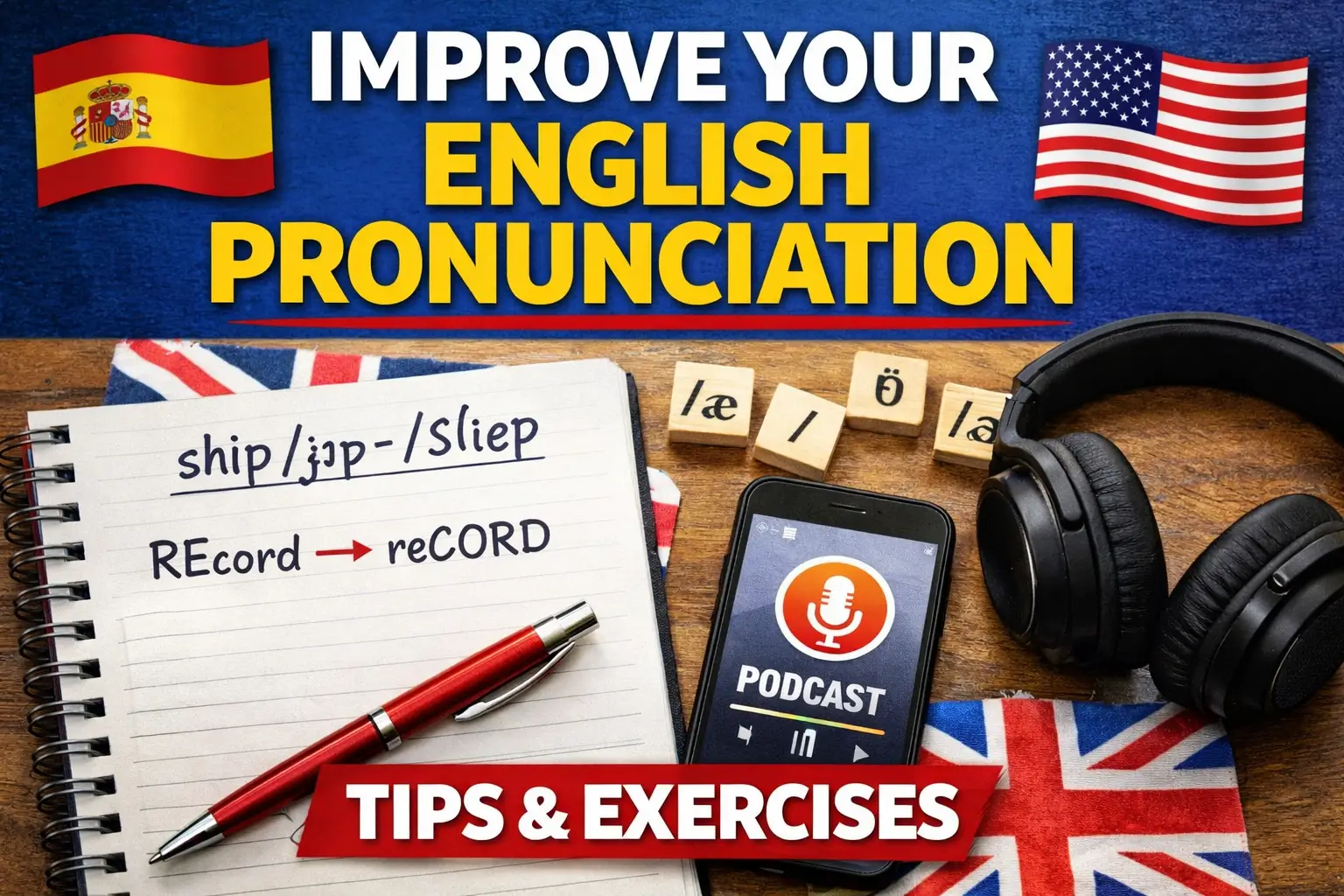
You don’t need to sound native. You need to sound clear. Good English Pronunciation can help you achieve this clarity.
Many Spanish speakers master English grammar and vocabulary. Yet still feel misunderstood. The issue isn’t ability. It’s pronunciation. English and Spanish follow different sound systems, rhythms, and stress patterns. Without understanding those differences, progress feels slow and frustrating.
This guide shows you exactly what’s causing the problem and how to fix it.
You’ll learn how English rhythm works, why vowels like ship and sheep matter, how word stress changes meaning, and how to build a simple daily routine that improves clarity fast.
Clearer pronunciation. Better listening. More confidence.
Importance of pronunciation in language learning
Pronunciation is not about sounding native. It is about being understood. You can know the grammar and vocabulary, but if your sounds, stress, or rhythm are unclear, communication breaks down.
For Spanish speakers, small differences in English vowels and word stress can completely change meaning (ship vs sheep, PREsent vs preSENT).
Clear pronunciation improves both speaking and listening, because when you can produce sounds accurately, you recognise them more easily in real speech.
Challenges faced by Spanish speakers
Spanish speakers often find English pronunciation frustrating. Not because it is harder, but because it works differently. The sound systems, rhythm, and spelling patterns of the two languages do not match, which creates predictable pronunciation difficulties.
Here are the main challenges:
- Limited vowel system transfer: Spanish has five clear vowel sounds, while English has many more. This leads to confusion between sounds like ship and sheep or full and fool.
- Stress-timed vs syllable-timed rhythm: English reduces unstressed syllables and emphasises key words. Spanish gives more equal timing to each syllable, which can make English sound flat or overly even.
- Word stress placement: In English, stress can change meaning (PREsent vs preSENT). Spanish speakers may stress the wrong syllable or pronounce all syllables equally.
- Consonant clusters: English allows multiple consonants together (school, strengths). Spanish speakers often add a vowel sound (e.g. eschool).
- Sounds that don’t exist in Spanish: English sounds like /v/, /z/, /ʃ/, and /θ/ can be difficult because there is no direct equivalent in Spanish.
- Inconsistent spelling: English spelling does not always match pronunciation, which makes it harder to predict how new words should sound.
Why Spanish Speakers Struggle with English Pronunciation
Spanish speakers do not struggle with English pronunciation because they lack ability. They struggle because the two languages are built on different sound systems. The way English organises vowels, stress, rhythm, and spelling is fundamentally different from Spanish.
Different Rhythm Systems
English is stress-timed, meaning stressed syllables are emphasised and unstressed syllables are reduced. Spanish is syllable-timed, where each syllable is pronounced more evenly. This difference often makes English sound “flat” or overly regular when spoken with Spanish timing.
A Much Larger Vowel System
Spanish has five clear vowel sounds. English has many more, including subtle distinctions like ship vs sheep or cat vs cut. These contrasts do not exist in Spanish, which makes them harder to hear and produce accurately.
Consonant Clusters
English allows multiple consonants together (e.g. school, next, worlds). Spanish typically separates consonants with vowels, so learners may insert extra sounds, such as saying eschool instead of school.
Unpredictable Spelling
In Spanish, spelling and pronunciation usually match closely. In English, the same letters can represent different sounds, and the same sound can be spelled in different ways. This makes pronunciation less intuitive and harder to predict.
Word Stress That Changes Meaning
In English, stressing the wrong syllable can change the meaning of a word (REcord vs reCORD). Spanish stress patterns are more consistent and predictable, so learners may not naturally notice or apply English stress rules.
English Phonetics
If you want to improve your pronunciation properly, not just guess your way through it, you need to understand the sound system behind English.
This is where phonetics becomes powerful. It gives you a clear map of how sounds are produced, how they differ, and why certain mistakes happen.
For Spanish speakers especially, phonetics explains the “why” behind common pronunciation problems.
What is Phonetics and why does it matter?
Phonetics is the study of speech sounds: how they are produced in the mouth, how they are heard, and how they function in language. Instead of focusing on spelling, phonetics focuses on sound.
This matters because English spelling can be misleading. For example:
- Though
- Through
- Thought
- Tough
These words look similar but sound completely different. If you rely only on spelling, pronunciation becomes confusing.
Phonetics helps you separate letters from sounds and focus on how words are actually spoken.
Key differences between English and Spanish sounds
English and Spanish are built on different sound systems and that’s where most pronunciation problems begin.
More vowel sounds
Spanish has five clear vowels. English has many more, including small contrasts that change meaning (ship vs sheep, full vs fool). These distinctions don’t exist in Spanish, so they require conscious training.
Consonant clusters
English stacks consonants together (strengths, texts). Spanish usually separates them, which is why extra vowels often appear (e.g. eschool).
Vowel reduction
English weakens unstressed syllables using the schwa /ə/. Spanish keeps vowels clear and strong, so this reduction can feel unnatural.
The International Phonetic Alphabet (IPA)
The International Phonetic Alphabet (IPA) is a system of symbols that represent sounds. Not letters. Each symbol corresponds to one specific sound.
For example:
- /iː/ as in sheep
- /ɪ/ as in ship
- /æ/ as in cat
- /ə/ as in the first syllable of about
Learning the full IPA is not necessary. But recognising common English vowel and consonant symbols can dramatically improve your accuracy.
Most modern dictionaries include IPA transcriptions, which show you exactly how a word is pronounced.
Vowel Sounds: A Comparative Analysis
Vowels are the biggest pronunciation challenge for Spanish speakers learning English.
The reason is simple: Spanish has five stable vowel sounds, while English has many more, including subtle contrasts that change meaning.
If vowel sounds are unclear, communication breaks down quickly.
English vowel sounds
English has a wide range of short vowels, long vowels, and diphthongs. Small differences in tongue position or mouth shape can create completely different words:
- ship /ɪ/ vs sheep /iː/
- full /ʊ/ vs fool /uː/
- cat /æ/ vs cut /ʌ/
These distinctions are essential. Even if your grammar is correct, incorrect vowel length or quality can cause confusion.
Common Spanish vowel sounds and their English equivalents
Spanish vowels are consistent and clearly pronounced:
- /a/
- /e/
- /i/
- /o/
- /u/
There are only five, Spanish speakers may “map” multiple English vowels onto one Spanish sound. For example:
- English /ɪ/ and /iː/ may both sound like Spanish /i/
- English /æ/ and /ʌ/ may both resemble Spanish /a/
This merging of sounds leads to common misunderstandings.
Tips for mastering difficult vowel sounds
Mastering English vowels takes focused practice, but once you control them, your clarity improves immediately.
- Practise minimal pairs: Train your ear with word pairs like ship/sheep or bit/beat.
- Focus on length: In English, vowel length often matters. Hold long vowels slightly longer.
- Use a mirror: Notice mouth shape and tongue position. English vowels often require wider or more central mouth placement.
- Learn key IPA symbols: Recognising symbols like /ɪ/, /iː/, /æ/, and /ʌ/ helps you read pronunciation accurately in dictionaries.
- Record yourself: Compare your pronunciation with native audio and adjust gradually.
Consonant Sounds: Key Differences
Consonants may seem easier than vowels, but for Spanish speakers, certain English consonants cause consistent problems.
The challenge isn’t speaking clearly. It’s that English includes sounds and combinations that Spanish either doesn’t use or organises differently.
English consonant sounds
English contains several consonant sounds that either don’t exist in Spanish or function differently. It also allows consonants to combine in ways that feel unnatural at first.
For example:
- Words like school, spring, and strengths contain consonant clusters.
- English distinguishes between sounds like /b/ and /v/, or /s/ and /z/.
- Some sounds are produced in different parts of the mouth compared to Spanish.
Consonants that are particularly challenging for Spanish speakers
Some of the most difficult sounds include:
- /v/ as in very: often confused with /b/.
- /z/ as in zoo: Spanish does not use a voiced “z” in the same way.
- /ʃ/ as in she: similar but not identical to Spanish “sh” variations.
- /ʒ/ as in measure: a sound that does not exist in standard Spanish.
- /θ/ and /ð/ as in think and this: especially challenging depending on dialect.
Consonant clusters are also difficult. Spanish speakers may insert a vowel before or between consonants, saying eschool instead of school.
Techniques for improving consonant pronunciation
Improving consonants often leads to immediate gains in clarity. Especially in professional or academic settings where precision matters.
- Slow down clusters: Break words into parts (s-chool, s-pr-ing) before saying them smoothly.
- Practise minimal pairs: Train distinctions like berry vs very or sip vs zip.
- Focus on mouth position: Notice lip and tongue placement, especially for /v/, /θ/, and /ð/.
- Use shadowing: Repeat short phrases from native audio, paying attention to crisp final consonants.
- Record and compare: Listening to yourself helps you notice subtle substitutions.
Word Stress and Intonation Patterns
Even if your individual sounds are correct, incorrect stress or flat intonation can make your English difficult to follow.
For Spanish speakers, rhythm and emphasis are often the real challenge. English relies heavily on stress and pitch changes to signal meaning, importance, and emotion.
Importance of stress in English pronunciation
In English, stress is not optional. It changes meaning.
For example:
- PREsent (noun) vs preSENT (verb)
- REcord (noun) vs reCORD (verb)
If the wrong syllable is stressed, the word may be misunderstood.
At sentence level, English also emphasises key words while reducing others:
- I WANT to go.
- I want to GO.
The stressed word carries the main message. Spanish tends to pronounce syllables more evenly, so English stress patterns must be trained deliberately.
Differences in intonation between English and Spanish
English is stress-timed and uses rising and falling pitch patterns to show meaning:
- Rising tone for yes/no questions
- Falling tone for statements
- Pitch changes to show surprise, doubt, or emphasis
Spanish generally maintains a more even rhythm and pitch pattern. This can make English sound flat or less expressive when spoken with Spanish timing.
Intonation affects how confident, engaged, or natural you sound, even when your grammar is correct.
Practical exercises for practising stress and intonation
Mastering stress and intonation transforms your English from technically correct to naturally fluent.
- Mark stressed syllables: Underline the stressed syllable in new vocabulary.
- Clap the rhythm: Say sentences while clapping only the stressed words.
- Contrast meaning through stress: Change the stressed word in a sentence and notice how meaning shifts.
- Shadow native speech: Repeat short clips, copying pitch and rhythm exactly.
- Record and compare:Listen for pitch movement, not just pronunciation.
Connected Speech in English
If you’ve ever felt that native English speakers talk “too fast”, the problem is usually not speed, it’s connected speech.
In natural conversation, English words do not sound separate and fully pronounced. They link together, weaken, and sometimes even disappear.
Linking Sounds
In spoken English, words flow into each other.
- Go on → “go-won”
- Turn off → “tur-noff”
- Pick it up → “pi-kit-up”
When one word ends in a consonant and the next begins with a vowel, they usually connect smoothly. This makes speech faster and more fluid.
Weak Forms
Many common words are pronounced in a reduced way when they are not stressed:
- to → /tə/
- for → /fə/
- of → /əv/
- and → /ən/
For example: I want to go often sounds like I wanna go in casual speech.
Spanish speakers often pronounce these words too clearly, which can make speech sound unnatural or overly formal.
Reductions and Contractions
English frequently shortens common phrases:
- going to → gonna
- want to → wanna
- did you → didja
- don’t you → doncha
These are not “incorrect”. They are part of everyday spoken English.
Why Connected Speech Matters
Without understanding connected speech:
- Native speech sounds too fast
- Listening becomes harder
- Your own speech may sound rigid
When you learn how English links and reduces sounds, conversations become easier to follow and your pronunciation immediately sounds smoother and more natural.
Common Pronunciation Mistakes
Spanish speakers often make predictable pronunciation errors in English. Not because they are careless, but because they naturally transfer patterns from Spanish. Recognising these mistakes is the first step towards correcting them.
Confusing Similar Vowel Sounds
Spanish has only five vowel sounds, multiple English vowels may be pronounced the same.
Examples:
- ship vs sheep
- bit vs beat
- full vs fool
These pairs require different tongue positions and vowel lengths in English.
How to fix it:
- Practise minimal pairs daily
- Focus on vowel length (short vs long)
- Use IPA in dictionaries to check accuracy
2. Misplacing Word Stress
English word stress can change meaning.
Examples:
- REcord (noun) vs reCORD (verb)
- PREsent vs preSENT
Spanish stress patterns are more regular, so English stress must be learned deliberately.
How to fix it:
- Mark stressed syllables when learning new words
- Listen carefully to pronunciation in dictionaries
- Practise saying long words slowly before speeding up
3. Adding Vowels to Consonant Clusters
English allows multiple consonants together. Spanish does not.
Examples:
- eschool instead of school
- estop instead of stop
This happens because Spanish words rarely begin with “s + consonant” combinations.
How to fix it:
- Break the word into parts (s-chool, s-top)
- Practise slowly without inserting extra sounds
- Repeat short cluster drills regularly
4. Ignoring the Schwa Sound
English reduces many unstressed syllables to the schwa /ə/.
Examples:
- about
- teacher
- support
Spanish speakers often pronounce every vowel clearly, which makes English sound unnatural.
How to fix it:
- Identify unstressed syllables
- Practise reducing them
- Listen for weak vowel sounds in native speech
5. Flat Intonation
English uses pitch variation to signal meaning, emphasis, and emotion. Spanish rhythm can make English sound overly even.
How to fix it:
- Copy native intonation patterns
- Practise stressing key words in sentences
- Record yourself and compare with native audio
The Role of Listening in Pronunciation
Pronunciation does not improve just by speaking more. It improves by listening better.
If you cannot clearly hear the difference between sounds, stress patterns, or rhythm, you will struggle to reproduce them accurately. For Spanish speakers, training the ear is just as important as training the mouth.
Listening teaches you what English actually sounds like in real life. Not in slow classroom speech, but in natural conversation. The more accurately you hear English, the more naturally you will spek it.
Importance of active listening for improving pronunciation
Passive listening (having English in the background) helps exposure. Active listening builds pronunciation.
Active listening means:
- Paying attention to vowel length and quality
- Noticing which syllables are stressed
- Listening for weak forms (to, for, of)
- Hearing linking between words
For example, if you repeatedly hear I wanna go instead of I want to go, your brain begins to recognise reduced forms automatically. Over time, this changes how you speak.
Recommended resources: podcasts, songs, and videos
Choose resources that include natural but clear speech.
Podcasts
- BBC Learning English
- The English We Speak (BBC)
- 6 Minute English
These provide manageable length and often include transcripts.
Songs
- Pop songs with clear vocals
- Slower acoustic versions
- Songs where lyrics are easy to find
Music helps you internalise rhythm and stress patterns naturally.
Videos
- Interviews with subtitles
- TED Talks
- YouTube channels focused on pronunciation
Watching facial movement also helps you notice mouth positioning.
Exercises to enhance listening skills
Improving pronunciation starts with improving perception. When you train your ear consistently, your speech becomes clearer, more natural, and more confident.
- Minimal pair listening drills: Focus on distinguishing sounds like ship/sheep or bit/beat.
- Shadowing: Listen to a short sentence and repeat immediately, copying rhythm and stress.
- Dictation practice: Write down exactly what you hear. This sharpens sound recognition.
- Stress identification: Listen to a sentence and mark which words are emphasised.
- Replay short clips: Repeat the same 10–15 seconds multiple times until you notice details.
Practical Exercises for Improvement
Pronunciation improves with deliberate practice, not random repetition.
Short, focused sessions done consistently are far more effective than occasional long study sessions.
The goal is to train your ear, adjust your mouth position, and build natural rhythm step by step.
Daily practice routines for pronunciation
Consistency matters more than intensity. Daily repetition builds muscle memory. A structured 15-minute routine can make a noticeable difference:
- 5 minutes – Minimal pairs: Practise contrasting sounds like ship/sheep or bit/beat. Focus on hearing and producing the difference clearly.
- 5 minutes – Shadowing: Listen to a short clip and repeat immediately, copying stress, rhythm, and intonation.
- 3 minutes – Reading aloud: Mark stressed words and reduced syllables before reading a short paragraph.
- 2 minutes – Record and review: Listen to yourself and compare with native audio. Notice vowel clarity and stress placement.
Interactive exercises and tools (apps, websites)
Technology can accelerate improvement when used actively:
- Online dictionaries with audio and IPA to check pronunciation instantly
- Pronunciation apps for minimal pair drills and stress training
- YouTube pronunciation channels for mouth-position demonstrations
- Speech-to-text tools to test clarity, if it misunderstands you, adjust and try again
The key is engagement, not passive scrolling.
Importance of feedback and self-assessment
Without feedback, mistakes become habits. Regular self-assessment helps you notice patterns you may not hear in real time.
- Record yourself weekly and compare progress
- Ask native speakers to identify unclear words
- Focus on one problem area at a time (vowels, stress, clusters)
Pronunciation is physical and perceptual. With consistent practice and honest feedback, improvement is steady and measurable.
How to Practise and Improve Your Pronunciation
Improving pronunciation is not about trying to sound perfect. It is about building clarity step by step.
The most effective approach combines listening, repetition, feedback, and consistency. Small daily adjustments lead to noticeable long-term improvement.
1. Train Your Ear First
You cannot pronounce what you cannot hear. Start by actively listening for:
- Vowel differences (ship vs sheep)
- Word stress patterns
- Reduced sounds like the schwa
- Linking between words
Use short audio clips and replay them several times. Focus on one feature at a time.
2. Practise with Intention
Instead of repeating random sentences, choose a clear focus:
- One vowel contrast
- One consonant cluster
- One stress pattern
Practise slowly, exaggerate slightly, then return to natural speed. Controlled repetition builds accuracy.
3. Use Shadowing
Shadowing means listening to a sentence and repeating it immediately, copying rhythm, stress, and intonation.
This trains muscle memory and helps you internalise natural English patterns. Start with short sentences. Gradually increase the length as you gain confidence.
4. Record and Analyse Yourself
Recording yourself is one of the fastest ways to improve. Compare your speech with native audio and listen for:
- Vowel clarity
- Stress placement
- Smooth linking
- Final consonant pronunciation
Even small adjustments can make a big difference.
5. Get Real Feedback
Speak with native or fluent speakers whenever possible. Ask them to point out unclear words rather than correcting everything. Focus on clarity first, perfection later.
Pronunciation improves through consistent, focused practice. With the right approach, progress is steady and your confidence grows alongside your clarity.
Engaging with Native Speakers
There is only so much you can improve alone. Real progress happens when you use pronunciation in live conversation.
Speaking with native English speakers forces you to apply what you have practised. In real time, with real reactions. It builds clarity, confidence, and adaptability.
Benefits of speaking with native English speakers
Conversation reveals which pronunciation issues actually affect communication and which do not.
- Immediate feedback: You quickly notice when something is unclear.
- Exposure to natural rhythm: You hear stress, linking, and reductions in authentic speech.
- Increased listening ability: Real conversation trains your ear faster than isolated exercises.
- Confidence building: The more you are understood, the more naturally you speak.
Tips for finding language-exchange partners
Look for partners who are patient and willing to correct gently. Clear communication about your goal (improving pronunciation) helps set expectations.
- Use language exchange platforms and apps
- Join local or online conversation groups
- Participate in community events or professional meetups
- Connect with colleagues who are open to practising
Approaching conversations as pronunciation practice opportunities
Do not just “chat”. Practise intentionally.
- Focus on one pronunciation goal per conversation
- Ask your partner to repeat words you mishear
- Request correction on specific sounds (e.g. /v/, word stress)
- Notice how native speakers reduce and link words
After the conversation, reflect on what was difficult and practise it separately.
When used deliberately, conversations become powerful pronunciation training sessions. Not just social interaction.
A Simple 15-Minute Daily Pronunciation Routine
You don’t need hours of study to improve your pronunciation. What you need is consistency.
A focused 15-minute routine done every day is far more effective than occasional long sessions. The key is deliberate, structured practice.
Here’s a simple routine you can follow:
English Pronunciation FAQs
Why is English pronunciation hard for Spanish speakers?
English and Spanish follow different sound systems. English has more vowel contrasts, frequent vowel reduction, complex consonant clusters, and stress-timed rhythm
Spanish has five consistent vowels and a syllable-timed rhythm. These structural differences, not lack of ability, explain most pronunciation challenges.
What English sounds don’t exist in Spanish?
Several English sounds have no direct equivalent in Spanish, including:
- /ɪ/ as in ship
- /ʊ/ as in book
- /æ/ as in cat
- /ʌ/ as in cut
- /v/ as in very
- /z/ as in zoo
- /θ/ and /ð/ as in think and this
These sounds do not exist in Spanish, they must be trained deliberately.
How can Spanish speakers improve their accent?
Improvement comes from focused practice, not repetition alone. Effective strategies include:
- Training vowel contrasts with minimal pairs
- Learning word stress patterns
- Practising connected speech and reductions
- Shadowing native audio
- Recording and analysing your own speech
Consistency matters more than long study sessions.
What is the schwa sound?
The schwa /ə/ is the most common vowel sound in English.
It appears in unstressed syllables, such as the first syllable in about or the second syllable in teacher.
It is a short, neutral sound. Spanish does not use vowel reduction in the same way, which makes the schwa unfamiliar but essential to natural English rhythm.
Why does English rhythm sound different?
English is stress-timed, meaning stressed syllables are emphasised while unstressed syllables are reduced.
Spanish is syllable-timed, where each syllable is pronounced more evenly.
This difference in rhythm is one of the main reasons English can sound fast or uneven to Spanish speakers and why Spanish timing can make English sound flat.