
|
Getting your Trinity Audio player ready...
|
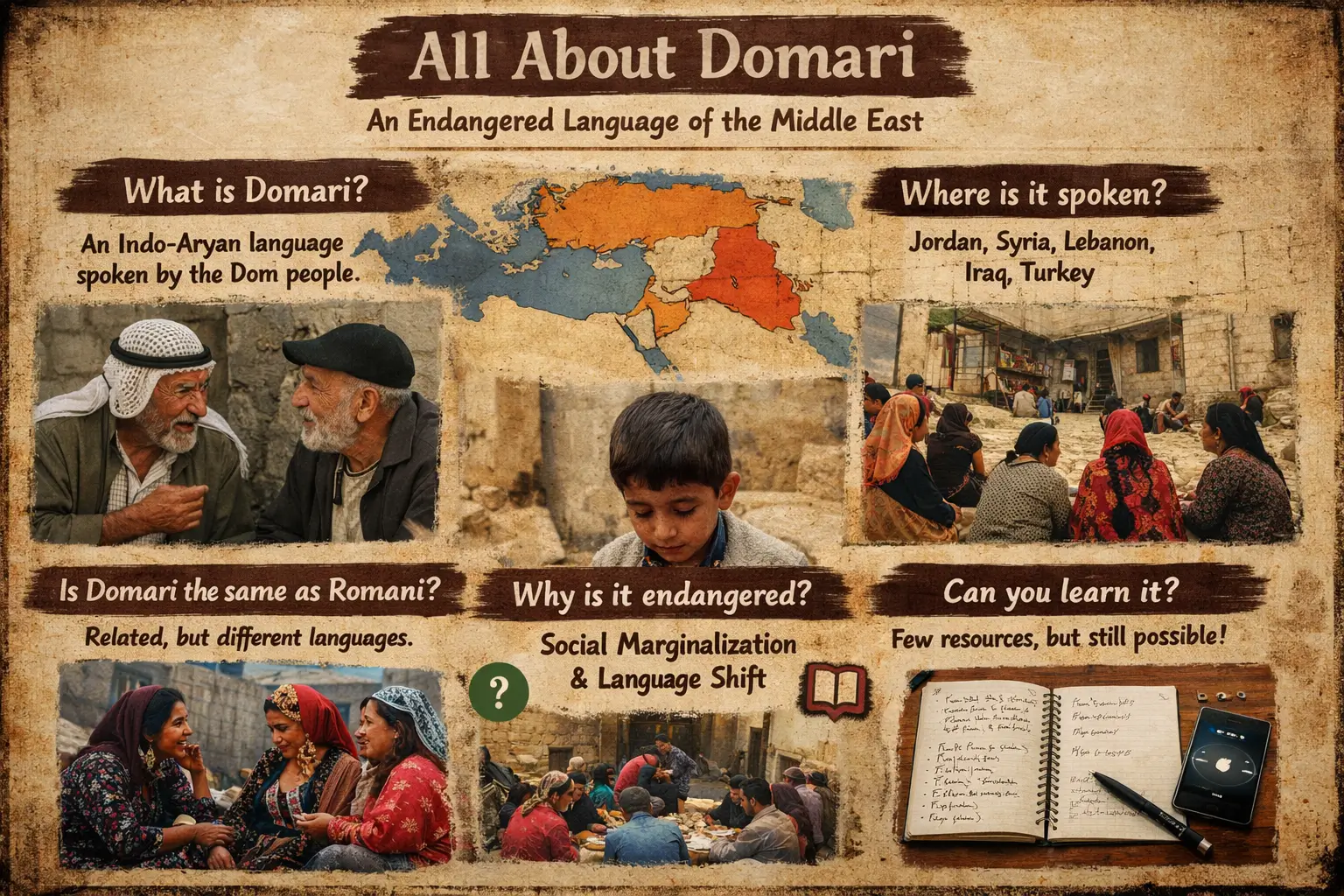
TL;DR: Domari is an endangered Indo-Aryan language spoken by small Dom communities across the Middle East. It has deep historical roots but is declining due to social marginalisation, language shift to Arabic, and lack of institutional support.
Most people have never heard of Domari.
Yet it has travelled thousands of miles, survived centuries of migration, and adapted across cultures.
Domari is an Indo-Aryan language spoken by the Dom people in parts of the Middle East.
Its roots trace back to the Indian subcontinent, but over time, it absorbed Arabic, Kurdish, Turkish, and Persian influences, becoming something of its own.
Today, it is rarely written, rarely taught, and not passed to the next generation.
That is what makes it overlooked. And endangered.
Domari and its significance
Domari is more than a small community language.
It is evidence of migration.
An Indo-Aryan language now spoken in the Middle East, it carries traces of a journey from the Indian subcontinent. Over time, it absorbed Arabic, Kurdish, Turkish and Persian. It influences becoming a living record of cultural contact.
For the Dom people, Domari holds identity, memory, and belonging. It carries stories, humour, and history that do not survive in translation.
When Domari declines, it is not vocabulary that disappears.
It is continuity.
The Romani people and their presence in the Middle East
The Romani people are associated with Europe.
But their history begins much further east.
Originating in the Indian subcontinent over a thousand years ago, Romani groups migrated westward. While many settled in Europe, related communities remained across the Middle East, including groups known as the Dom and the Lom.
Today, Romani-related communities can be found in countries such as Turkey, Syria, Lebanon, Jordan and Iraq.
Their presence in the region is long-standing, though often marginalised. Many communities have faced social exclusion, economic hardship, and pressure to assimilate into dominant cultures.
It is important, but not to collapse all these groups into one identity.
Historical Background of Domari
Domari did not emerge in isolation.
It is the result of movement, adaptation, and centuries of contact across regions. To understand the language today, we need to look at where it began, how its speakers travelled, and how history shaped the way it sounds and functions now.
Origins of the Domari language
Domari belongs to the Indo-Aryan branch of the Indo-European language family.
Linguistic evidence links it to languages of northern India. Particularly those spoken around a thousand years ago. Core vocabulary, grammatical structures, and sound patterns all point to South Asian origins.
Over time, as communities migrated westward, Domari separated from related varieties. While it shares distant ancestry with Romani, it developed. Forming its own distinct linguistic identity.
Historical migration patterns of Romani communities in the Middle East
Historical and linguistic research suggests that Dom communities began moving west from the Indian subcontinent around the early medieval period.
Unlike many Romani groups who continued into Europe, Dom groups settled across the Middle East. Today, Dom communities can be found in countries such as Jordan, Syria, Lebanon, Iraq, and Turkey.
Over centuries, communities adapted to new social environments while maintaining elements of their linguistic heritage.
Domari travelled with them.
Influence of surrounding languages and cultures on Domari
As Dom communities settled in Arabic-, Kurdish-, Turkish-, and Persian-speaking regions, Domari absorbed elements from each.
Large portions of its modern vocabulary come from Arabic. Certain grammatical features reflect long contact with dominant regional languages. Pronunciation patterns in different areas vary depending on local influence.
This process, known as language contact, is common when minority languages exist alongside powerful national languages.
Domari today is thus layered:
- South Asian roots
- Middle Eastern vocabulary
- Regional variation shaped by geography
Linguistic Features of Domari
Domari is not just historically interesting, it is distinctive.
Its sounds, structure, and vocabulary reveal both its Indo-Aryan origins and its long life in the Middle East.
Examining its features helps us understand how languages evolve under pressure. While still retaining a core identity.
Phonetics and phonology of Domari
Domari preserves several sound patterns typical of Indo-Aryan languages. Including consonant distinctions that trace back to South Asia.
At the same time, centuries of contact with Arabic and other regional languages have influenced pronunciation. In many varieties:
- Arabic loanwords shape everyday vocabulary
- Local accents affect stress and rhythm
- Certain original sounds have shifted or simplified
Unique vocabulary and grammatical structures
Domari retains a grammatical backbone that reflects its Indo-Aryan heritage.
For example:
- Word order is often flexible but tends toward subject–object–verb patterns in traditional forms
- Noun endings can mark relationships between words
- Verb forms show tense and aspect through inflection
But, a large part of modern vocabulary comes from Arabic. Everyday terms, especially for administration, religion, and urban life, are often borrowed.
This blend creates a layered linguistic system. South Asian structure with Middle Eastern vocabulary.
Comparison with other Romani languages
Domari is often confused with Romani, the language spoken by Roma communities in Europe.
They are related but not the same.
Both descend from Indo-Aryan ancestors, yet they split centuries ago. As Romani developed in Europe under Slavic, Greek, and other influences, Domari evolved in Arabic-speaking regions.
Key differences include:
- Different loanword sources (Arabic vs. European languages)
- Divergent sound changes
- Separate dialect networks
It is more accurate to describe Domari and Romani as linguistic cousins. Rather than variants of a single language.
Learn Domari
Domari is primarily an oral language and is not standardised. The variety best documented by linguists is Jerusalem Domari. The examples below reflect that variety where possible.
Because Domari is endangered, learning even basic structures contributes to awareness and preservation.
Pronouns (Core Foundation)
Personal pronouns in Jerusalem Domari:
- ama – I
- tuma – you (singular)
- huwa – he
- hiya – she
- amna – we
- tumna – you (plural)
- huma – they
Basic Sentence Structure
Traditional Domari shows Indo-Aryan roots and often follows:
Subject – Object – Verb (SOV)
Example pattern:
- ama kitab čerom
- I book read-PAST
- “I read the book.”
The verb often comes at the end.
However, heavy Arabic contact means some variation exists in modern speech.
Present Tense (Basic Pattern)
Verbs are conjugated with endings.
Using the verb “to go” (kar-):
- ama karom – I go
- tuma karos – you go
- huwa karo – he goes
Notice the verb endings change according to the subject.
Common Vocabulary
These are cited in descriptions of Jerusalem Domari:
- xabar – news / information
- čhavo – boy
- čhavi – girl
- ker – house
- pani – water
- manuš – person
You may notice some words resemble Romani, because both share Indo-Aryan ancestry.
Numbers (1–10)
Jerusalem Domari numerals (attested forms):
- 1 – yek
- 2 – duj
- 3 – trin
- 4 – štar
- 5 – pandž
- 6 – šov
- 7 – efta
- 8 – oxto
- 9 – enja
- 10 – deš
These clearly show Indo-Aryan roots, though some forms reflect contact influence.
Negation
Negation is formed using:
ma (not)
Example:
- ama ma karom
- I not go
- “I do not go.”
The Cultural Significance of Domari
Domari is not just a linguistic system.
For many Dom communities, it is a marker of identity. A way of signalling belonging in societies where they have often been marginalised. Even where fluency has declined, the language still carries emotional and symbolic weight.
Understanding Domari means looking beyond grammar. It means looking at how language operates inside family life, memory, and tradition.
Role of language in community identity and traditions
For minority communities, language often functions as a boundary and a bridge.
In many Dom families, Domari has traditionally been used in:
- Intra-community communication
- Family conversations
- Expressions of humour and intimacy
- Cultural knowledge passed between generations
Because Dom communities have faced social exclusion across parts of the Middle East. Maintaining a distinct language has reinforced group cohesion.
Even in places such as Jordan, Syria and Lebanon, where Arabic dominates public life. Domari has functioned as a private cultural space.
Oral traditions and storytelling in Domari
Domari, like many endangered languages, is primarily oral.
Stories, family histories, songs, jokes, and proverbs have circulated through speech rather than writing. Oral tradition serves several purposes:
- Preserving collective memory
- Teaching moral values
- Reinforcing social norms
- Strengthening intergenerational bonds
Written literature in Domari is limited. Oral storytelling plays a particularly important role in cultural continuity.
Festivals and rituals where Domari is used
There is no single pan-Dom religious calendar or unified cultural festival structure. Dom communities are diverse and often share religious practices with surrounding populations.
However, Domari has traditionally been used in:
- Family celebrations
- Marriage contexts
- Community gatherings
- Informal musical and storytelling settings
In many cases, its use is situational rather than institutional. It may appear in songs, jokes, or private exchanges, even when the broader event takes place in Arabic.
Current Status of Domari
Domari is classified as severely endangered.
Exact figures are difficult to confirm. Estimates often suggest tens of thousands of ethnic Dom people across the Middle East. The number of fluent Domari speakers is much lower, and in many communities, limited to older generations.
Language shift is accelerating.
Number of speakers and demographic distribution
Dom communities are spread across parts of the Middle East, particularly in:
- Jordan
- Syria
- Lebanon
- Iraq
- Turkey
Domari is not uniformly spoken across these regions. In some areas, it survives only among elders. In others, it has shifted heavily toward Arabic in daily use.
Factors contributing to the decline of the language
Several pressures drive the decline of Domari:
Social marginalisation
Dom communities have faced stigma and discrimination. This often encourages linguistic assimilation for safety and mobility.
Lack of formal education in Domari
There are no widespread schooling systems teaching the language. Children are educated in the majority of languages.
Urbanisation and migration
Movement into cities increases exposure to dominant languages and reduces community isolation.
Intergenerational break
Perhaps most critical: many parents no longer send Domari to their children.
Comparison with other endangered languages in the region
Domari is not alone.
Across the Middle East and surrounding regions. Several minority languages face similar pressures, including:
- Western Neo-Aramaic
- Suret
- Mandaic
Like Domari, these languages struggle with:
- Small speaker populations
- Displacement and conflict
- Dominance of national languages
- Limited written standardisation
Challenges Facing Domari Speakers
Domari is endangered for linguistic reasons but the deeper causes are social.
Language decline rarely happens in isolation. It is usually tied to inequality, marginalisation, and limited access to power.
For many Dom communities across the Middle East, these pressures affect whether Domari is spoken, transmitted, or abandoned.
Socioeconomic factors affecting language use
In many countries where Dom communities live, including Jordan, Syria, and Lebanon. Economic insecurity plays a significant role in language shift.
When communities face:
- Limited access to stable employment
- Restricted housing options
- Barriers to healthcare or documentation
- Informal or precarious labour conditions
there is strong pressure to prioritise the dominant language for survival.
Stigmatisation and discrimination against Romani communities
Dom communities are related to wider Romani diasporas. Though they are distinct from European Roma groups.
Across different regions, they have experienced social stigma.
Negative stereotypes and exclusion can lead speakers to conceal their identity, including their language.
In such contexts:
- Public use of Domari may decline
- Younger speakers may feel shame rather than pride
- Intermarriage and assimilation speed up language loss
Lack of educational resources and support for language preservation
Domari has no widespread standardised curriculum. There are:
- Very few textbooks
- Limited written literature
- Minimal institutional funding
- Almost no formal schooling in the language
Unlike some minority languages that enjoy revitalisation policies, Domari lacks sustained state-backed preservation initiatives.
Without:
- Literacy materials
- Teacher training
- Media presence
- Community-led educational programmes
intergenerational transmission depends on the home.
Efforts to Revitalise Domari
Domari is endangered but it is not invisible.
Revitalisation does not always begin with large government programmes. In many cases, it begins quietly. In homes, community networks, academic partnerships, and small cultural projects.
For Domari, preservation efforts are emerging in modest but meaningful ways.
Community initiatives and grassroots movements
In several Dom communities, revitalisation starts at the local level.
This can include:
- Elders sharing vocabulary and stories with younger relatives
- Informal language circles within families
- Cultural gatherings where Domari is encouraged
- Community-led documentation of oral traditions
Because Domari has traditionally been oral, preserving stories, songs, and everyday speech is central to keeping it alive.
Role of technology and social media in language preservation
Technology has changed what is possible for endangered languages.
Even without formal state support, Domari speakers and researchers can now:
- Record oral histories
- Share vocabulary lists online
- Create small social media groups for language exchange
- Archive materials for wider access
Platforms like YouTube, Facebook groups, and messaging apps. They allow speakers to connect across borders. Important for communities spread across countries such as Jordan, Lebanon, and Turkey.
Collaboration with linguists and cultural organisations
Academic documentation plays an important role in preservation.
Linguists have worked with Dom communities to:
- Record grammar and vocabulary
- Produce descriptive studies of specific varieties
- Develop writing systems for research purposes
- Archive audio recordings
Documentation ensures that even if speaker numbers decline, the language is not lost without record. Effective preservation often depends on partnership:
- Community leadership
- Scholarly expertise
- Cultural advocacy
When these align, endangered languages gain both visibility and structural support.
The Role of Education in Language Preservation
For endangered languages, survival depends on one key factor:
Intergenerational transmission.
If children do not learn the language, it fades within decades. Education, formal or informal. It can interrupt that decline and create a new generation of speakers.
For Domari, this remains one of the greatest challenges and opportunities.
Importance of teaching Domari in schools
At present, Domari is not taught in formal school systems in countries where Dom communities live. Including Jordan and Lebanon.
Most Dom children are educated in Arabic or other majority languages.
Introducing Domari into schools even as:
- A heritage language subject
- A cultural studies module
- An after-school programme
could significantly strengthen transmission.
Research across endangered language contexts shows that when children see their language recognised in education, it:
- Increases pride
- Reduces stigma
- Improves engagement
- Encourages family use at home
Education legitimises a language. Without it, survival depends almost on private spaces.
Global Perspectives on Language Endangerment
Domari’s situation is not unique.
Across the world, thousands of languages face similar pressures. Shrinking speaker numbers, limited institutional support, and growing dominance of global languages. Looking beyond one region helps place Domari within a much wider global pattern.
Language endangerment is not rare. It is structural.
Comparison with other endangered languages worldwide
It is estimated that nearly half of the world’s roughly 7,000 languages are at risk of disappearing within this century.
Examples include:
- Ainu language in Japan
- Livonian language in Latvia
- Yuchi language in United States
Despite differences in geography and history, these languages often share common pressures:
- Urbanisation
- Economic migration
- Education systems favouring dominant languages
- Media globalisation
- Social stigma
The role of international organisations in language preservation
International bodies have increasingly recognised language loss as a cultural issue.
UNESCO, for example, classifies languages by endangerment level and promotes awareness through initiatives such as the International Decade of Indigenous Languages.
Such organisations:
- Fund documentation projects
- Support community-led revitalisation
- Encourage multilingual education policies
- Highlight linguistic diversity as cultural heritage
Importance of cultural diversity and multilingualism
Every language encodes:
- Unique ecological knowledge
- Oral histories
- Cultural values
- Distinct ways of structuring thought
When a language disappears, humanity loses a particular way of interpreting the world.
Multilingualism strengthens societies by:
- Encouraging cross-cultural understanding
- Preserving heritage identities
- Supporting cognitive flexibility
- Protecting intangible cultural heritage
Domari, like many endangered languages, represents more than communication. It represents diversity.
Domari Language FAQs
What is Domari?
Domari is an endangered Indo-Aryan language spoken by the Dom people in parts of the Middle East. It shares distant historical roots with Romani but developed after early migrations from the Indian subcontinent.
Where is Domari spoken today?
Domari is spoken in small communities across countries. It is such as Jordan, Syria, Lebanon, Iraq and Turkey. Speaker numbers are uncertain, and fluency is often strongest among older generations.
Is Domari the same as Romani?
No. Domari and Romani are related but distinct languages. Both belong to the Indo-Aryan branch of the Indo-European family. Yet they separated centuries ago and evolved under different regional influences.
Why is Domari endangered?
Domari is endangered due to social marginalisation, economic pressure, and the dominance of majority languages such as Arabic. In many communities, intergenerational transmission has weakened. Meaning children are no longer learning the language at home.
Are there written materials in Domari?
Domari has limited written tradition and no standardised spelling system. Some academic works document specific varieties. The language may be written in Arabic or Latin scripts, but it remains oral.