
|
Getting your Trinity Audio player ready...
|
TL;DR: The Chemehuevi language is critically endangered, with few fluent speakers remaining, but revitalisation efforts are underway through community programmes, elder recordings, and youth engagement. Its future depends on younger generations embracing the language and continuing to carry Chemehuevi culture, identity, and knowledge forward.
In the vast silence of the Mojave Desert, one language carries generations of history: Chemehuevi.
Spoken by the Chemehuevi people, this Native American language encodes deep knowledge of desert life, landscape, and identity.
Part of the Uto-Aztecan family, Chemehuevi connects to a wider linguistic network across the American West. Yet it remains uniquely shaped by the Mojave.
Today, it stands as both a symbol of cultural resilience and a reminder of the urgency of language preservation.
Who are the Chemehuevi people?
The Chemehuevi are a Native American people of the Mojave Desert and wider Great Basin region, traditionally linked to the Southern Paiute.
For generations, they survived through expert knowledge of desert land, water, plants, and wildlife.
Today, many are part of the Chemehuevi Indian Tribe along the Colorado River in California, continuing efforts to protect their culture, history, and language.
Importance of language in cultural identity
Language is more than a tool for communication. It is a living expression of who a people are. It carries history, worldview, humour, memory, and belonging.
When a community speaks its ancestral language, it keeps its identity alive across generations.
Why language matters for cultural identity:
- Preserves history: Oral traditions, migration stories, and collective memory are embedded in language.
- Encodes worldview: Grammar and vocabulary reflect how a community understands nature, relationships, and time.
- Strengthens belonging: Speaking the language builds connection between generations and reinforces community ties.
- Protects cultural knowledge: Ecological knowledge, ceremonies, and traditional practices are often inseparable from the original language.
- Affirms self-identity: Using an ancestral language reinforces pride, resilience, and cultural continuity.
Historical Background
To understand the Chemehuevi people, you have to understand movement, land, and survival.
Their history is not written in stone monuments, but in desert trails, river crossings, and oral tradition. The Mojave was never empty. It was mapped in memory, story, and language.
Origins of the Chemehuevi tribe
The Chemehuevi are part of the Southern Paiute branch of the Numic peoples, within the wider Uto-Aztecan language family.
Linguistic and oral history evidence suggests their ancestors moved southward from the Great Basin centuries ago, gradually adapting to new desert territories.
Geographic location and environment of the Mojave Desert
The Mojave Desert is a land of extremes: scorching summers, scarce water, wide horizons. For outsiders, it can seem hostile. For the Chemehuevi, it was home.
They lived across areas that are now southeastern California, southern Nevada, western Arizona, and parts of Utah.
Survival depended on precise ecological knowledge: seasonal plant gathering, small-game hunting, and intimate awareness of springs and river systems, especially along the Colorado River.
Historical interactions with other tribes and settlers
The Chemehuevi were not isolated. They traded, intermarried, and interacted with neighbouring Indigenous groups, including other Southern Paiute bands and tribes along the Colorado River.
The arrival of European and later American settlers in the 18th and 19th centuries brought dramatic change. Disease, displacement, and military conflict disrupted traditional life.
Over time, Chemehuevi communities were forced onto reservations, including what is now represented by the Chemehuevi Indian Tribe.
The Chemehuevi Language
Language is where history lives. Chemehuevi is not just a way of speaking. It is a system shaped by migration, desert life, and centuries of cultural continuity
To understand it, we need to look at where it fits linguistically, what makes it distinctive, and how it relates to the languages around it.
Linguistic classification and family
Chemehuevi belongs to the Numic branch of the Uto-Aztecan language family. A vast language family that stretches from the western United States down into Mexico.
Within Numic, it is closely related to Southern Paiute varieties.
This means Chemehuevi shares deep structural roots with neighbouring Great Basin languages, including similarities in grammar, sound systems, and core vocabulary.
Unique features of the Chemehuevi language
Chemehuevi is known for its rich verb system and detailed suffixes that express tense, aspect, and relationships between speakers.
Like many Numic languages, it uses agglutination, meaning words are often built by adding meaningful suffixes onto a root.
It also contains specialised vocabulary connected to desert ecology: plants, animals, water sources, and seasonal cycles.
Comparison with neighbouring languages
Chemehuevi sits inside a wider linguistic network. Closely related to some languages, structurally distant from others.
It shares deep roots with Southern Paiute varieties, but understanding is not automatic. Move further out, and the differences become sharper.
| Language / Group | Language Family | Relationship to Chemehuevi | Mutual Intelligibility |
| Southern Paiute varieties | Uto-Aztecan (Numic) | Very closely related | Partial, not automatic |
| Shoshone | Uto-Aztecan (Numic) | More distantly related | Limited |
| Comanche | Uto-Aztecan (Numic) | Distant Numic relative | Very limited |
| Yuman languages (Colorado River region) | Yuman family | Unrelated | None |
Cultural Significance of Chemehuevi
Language is the backbone of Chemehuevi culture. It carries memory, belief, humour, survival knowledge, and identity.
When Chemehuevi is spoken, culture is not being described. It is being lived.
Role of language in storytelling and oral traditions
Storytelling is central to Chemehuevi heritage. Traditional narratives pass down origin stories, moral lessons, survival strategies, and ancestral history.
These stories are not simply translated ideas. They are shaped by the rhythms, metaphors, and structures of the language itself.
Certain meanings, humour, and cultural references only fully exist in Chemehuevi. When the language is preserved, the stories remain intact in their original power.
Connection between language and spirituality
For many Indigenous communities, language and spirituality are deeply intertwined, and Chemehuevi is no exception.
Ceremonial expressions, sacred narratives, and references to the natural world carry spiritual significance that cannot be separated from the words used to express them.
The language encodes relationship, between people, land, ancestors, and the unseen world. Speaking it reinforces those bonds.
Preservation of cultural practices through language
Cultural practices, from traditional ecological knowledge to craft techniques and social customs, are embedded in vocabulary and expression.
Names of plants, animals, seasonal events, and kinship terms reflect generations of lived experience in the Mojave Desert.
When younger generations learn Chemehuevi, they are not only learning words. They are inheriting a framework for understanding community, responsibility, and place.
Current Status of the Chemehuevi Language
Chemehuevi, like many Indigenous languages in North America, is critically endangered.
While its cultural significance remains strong, fluent speakers are now few, and most are elders.
The future of the language depends on revitalisation, education, and community commitment.
Number of speakers and demographic trends
Today, only a small number of fluent Chemehuevi speakers remain, primarily among older generations.
Intergenerational transmission, children learning the language naturally at home, has significantly declined over the past century.
Younger community members may recognise words or phrases, but full fluency is rare. This generational gap is one of the most urgent issues facing the language.
Efforts to revitalise the language
Chemehuevi is endangered, but it is not forgotten. Across the community, people are working to bring the language back into daily life, classrooms, and conversations.
- Tribal leadership and programmes: The Chemehuevi Indian Tribe supports language initiatives, including classes and cultural education.
- Recording elders: Fluent speakers are being recorded to preserve pronunciation, stories, and traditional knowledge.
- Learning materials: Dictionaries, lesson resources, and teaching tools are being developed for new learners.
- Workshops and cultural camps: Community events create spaces where language and culture are practised together.
- Digital access: Online resources and media help younger generations connect with the language in modern ways.
Challenges faced in language preservation
Revitalising Chemehuevi is urgent and complex.
- Few fluent speakers remain: Most are elders, limiting immersive learning opportunities.
- Generational gaps: Many younger members did not grow up speaking the language at home.
- Limited funding and resources: Sustained programmes require long-term support.
- Historical suppression: Boarding school policies and forced assimilation disrupted transmission.
- English dominance: Education, media, and daily life operate largely in English.
Educational Initiatives
Reviving Chemehuevi depends on one key factor: teaching it.
Across schools, community spaces, and homes, education is becoming the bridge between elder speakers and the next generation.
Language programmes in schools and communities
Local initiatives are introducing Chemehuevi through community classes, after-school programmes, and cultural education projects.
Some programmes combine language learning with traditional skills, such as storytelling, crafts, and environmental knowledge, so students learn words in meaningful context.
Community-based teaching is especially powerful because it connects language to identity, not just curriculum.
Use of technology and media in language learning
Technology is helping close the gap between generations.
Audio recordings of fluent speakers, digital dictionaries, online lessons, and social media content make the language more accessible than ever.
For younger learners, hearing Chemehuevi through apps, videos, or recorded stories creates new pathways for engagement.
Digital tools cannot replace elders, but they can amplify their voices.
Role of Chemehuevi elders in teaching
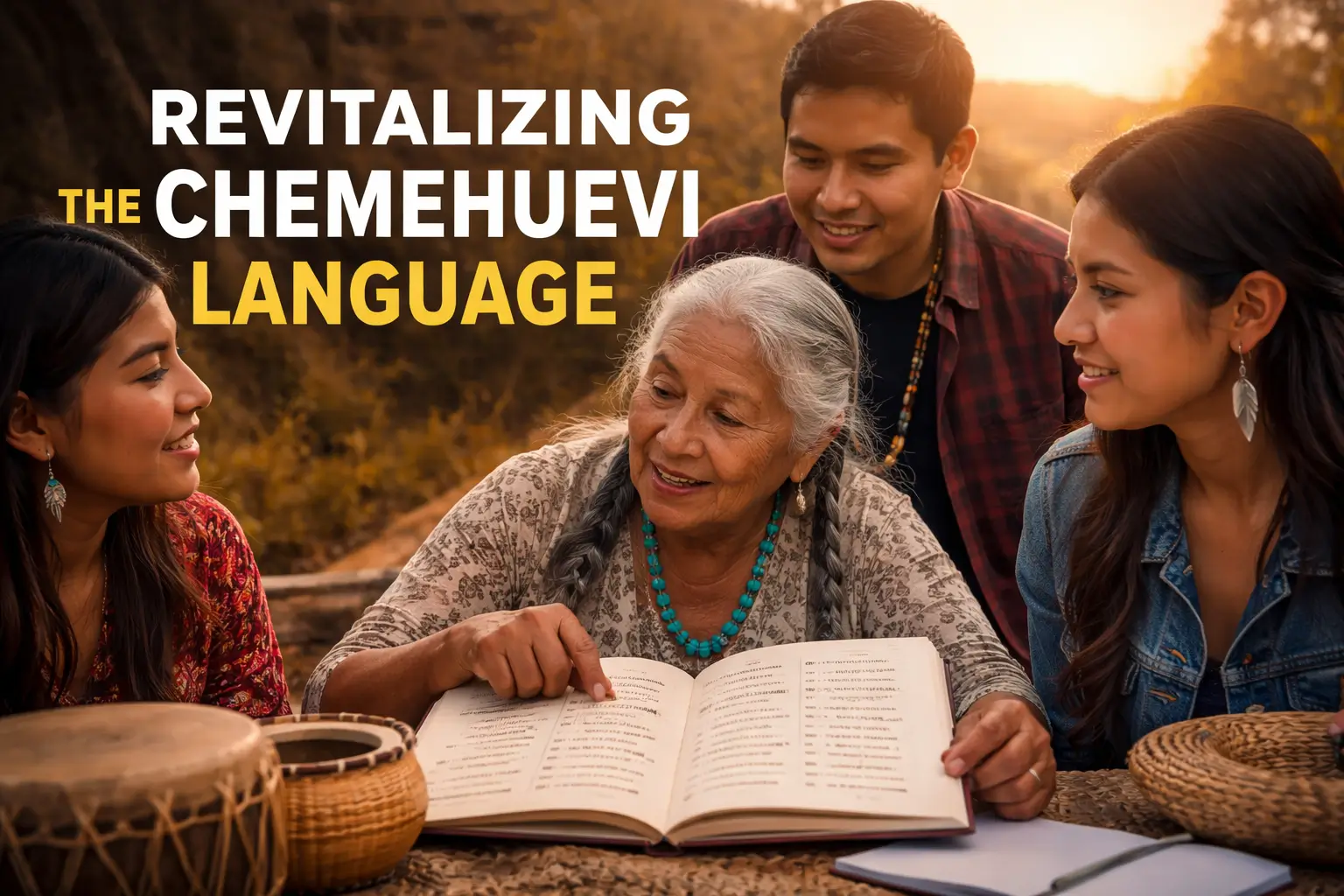
Elders are at the heart of revitalisation. They are not just speakers; they are living archives of pronunciation, storytelling styles, cultural nuance, and spiritual expression.
When elders teach, they pass on more than vocabulary. They pass on worldview, humour, and memory.
Supporting and recording their knowledge is one of the most important steps in ensuring Chemehuevi continues into the future.
Community Involvement
A language cannot survive in isolation. It lives in conversations, gatherings, laughter, and shared memory.
For Chemehuevi, community involvement is not optional in revitalisation, it is the foundation.
Importance of community engagement in language preservation
When families, youth, and elders actively use Chemehuevi together, the language moves from archive to everyday life. Community engagement creates accountability, pride, and shared purpose.
Language preservation works best when it is visible. Spoken at events, taught to children, and supported collectively rather than left to a small group of learners.
Events and gatherings that promote the language
Cultural festivals, storytelling evenings, workshops, and language camps create spaces where Chemehuevi is heard naturally.
At these gatherings, language is tied to song, craft, food, and ceremony.
Hearing even short phrases in public spaces reinforces identity and encourages younger generations to participate without fear or hesitation.
Collaborations with other tribes and organisations
Partnerships strengthen revitalisation efforts.
Collaboration with neighbouring tribes, educational institutions, and cultural organisations allows for shared resources, training, and documentation support.
The Chemehuevi Indian Tribe also works within broader Indigenous networks, recognising that many communities face similar challenges in language preservation.
Together, community and collaboration turn revitalisation from a fragile effort into a sustained movement.
Resources for Learning Chemehuevi
Learning Chemehuevi requires curiosity, respect, and connection to community-led resources.
It is an endangered language, materials are not as widely available as those for global languages but meaningful tools do exist.
Books, dictionaries, and online resources
While published materials are limited, several foundational resources support learners:
- Chemehuevi dictionaries and word lists: Often developed through linguistic documentation projects.
- Recorded audio archives: Pronunciation recordings of fluent elders help learners hear authentic speech patterns.
- Academic publications: Linguistic studies provide insight into grammar and structure.
- Tribal websites and media: The Chemehuevi Indian Tribe may share updates, educational materials, or cultural content.
- University language archives: Some institutions host digitised recordings and documentation from field research.
Language courses and workshops
Formal courses are not widespread, but community-led learning opportunities exist:
- Tribal language classes: Offered through local programmes when available.
- Community workshops: Focused sessions combining language with cultural practice.
- Cultural immersion camps: Language taught alongside traditional knowledge and storytelling.
- Guest lectures or special sessions: Occasionally hosted by universities or cultural organisations.
These settings provide not only vocabulary, but context and cultural grounding.
Cultural centres and museums
Language lives in cultural spaces as much as in classrooms:
- Tribal cultural centres: May host events, storytelling sessions, or educational programmes.
- Regional museums: Exhibits on Mojave and Great Basin Indigenous cultures sometimes include Chemehuevi language materials.
- Community gatherings and festivals: Informal but powerful environments to hear and practise the language.
For endangered languages like Chemehuevi, learning is not just academic. It is relational. The most valuable resource is connection to the community itself.
The Future of the Chemehuevi Language
The future of Chemehuevi is not predetermined.
Like many endangered languages, its survival depends on collective effort, intergenerational commitment, and long-term support.
While the number of fluent speakers is small, the will to preserve the language remains strong.
Prospects for revitalisation and growth
Revitalisation is challenging, but possible. Documentation projects, community classes, and digital tools are building a foundation that did not exist a generation ago.
As more materials are created and more young people engage with the language, even gradual growth can shift momentum.
Success may not mean universal fluency, but increased visibility, daily use, and cultural pride.
Vision for the future of Chemehuevi culture and language
The long-term vision is not only to archive Chemehuevi, but to hear it spoken, at home, at gatherings, in classrooms, and in cultural ceremonies.
Organisations such as the Chemehuevi Indian Tribe continue to support initiatives that protect both language and identity.
The hope is clear: a future where Chemehuevi remains a living voice of the Mojave, carried forward with pride and purpose.