
TL;DR: Bimoba is an Indigenous language spoken in northern Ghana that’s under threat due to language shift, urbanisation, and education systems favouring dominant languages like English. While older generations remain fluent, fewer young people actively speak it, putting long-term survival at risk.
Bimoba is more than a language. Its identity. History. Belonging.
Spoken in northern Ghana, it carries generations of stories, traditions, and knowledge. But today, it’s under pressure.
As younger speakers shift to dominant languages for school, work, and opportunity, Bimoba is slowly being pushed aside.
And when a language fades, it’s not just words that disappear. It’s culture, memory, and connection.
This isn’t just a story of decline. It’s a wake-up call.
Here’s why Bimoba is under threat, and why it still matters.
Historical Context of the Bimoba Language
Bimoba didn’t appear overnight. It’s the result of generations of movement, adaptation, and cultural continuity.
To understand why it matters today, and why it’s at risk, you need to look at where it came from and how it has survived.
Origins and development of the Bimoba language
Bimoba belongs to the Gur (or Mabia) language family, a group of languages spoken across parts of West Africa.
It developed alongside the Bimoba people as they settled in what is now northern Ghana and nearby regions.
There was no formal writing system shaping it, just people, communities, and everyday use. This made Bimoba highly adaptive, but also vulnerable
Cultural significance within the Bimoba community
Bimoba isn’t just spoken, it’s lived.
It carries traditional knowledge, social norms, and community values. Stories, proverbs, and oral histories are passed down in Bimoba, shaping how people understand the world and their place in it.
From ceremonies and family life to conflict resolution and storytelling, the language plays a central role.
Historical factors influencing language preservation
Bimoba has survived for centuries, but not without pressure.
Colonial influence introduced dominant languages into education and administration, reducing the need and status of local languages like Bimoba. Later, modernisation, urban migration, and formal schooling reinforced this shift.
English, in particular, became the language of opportunity. As a result, many families prioritised it for their children, often at the expense of passing on Bimoba.
Current Status of the Bimoba Language
Bimoba is still spoken, but its future isn’t guaranteed. Like many Indigenous languages, it sits in a fragile middle ground: present, but under pressure.
To understand where it’s heading, you need to look at who speaks it, where it’s used, and how it compares to other languages in the region.
Number of speakers and demographic trends
Bimoba is spoken by tens of thousands of people, primarily within the Bimoba ethnic group. On the surface, that might sound stable but the real story is in the age split.
Older generations tend to be fluent and use the language daily. Younger speakers, however, are shifting. Many understand Bimoba but don’t speak it confidently, especially in formal or mixed settings.
Geographic distribution of Bimoba speakers
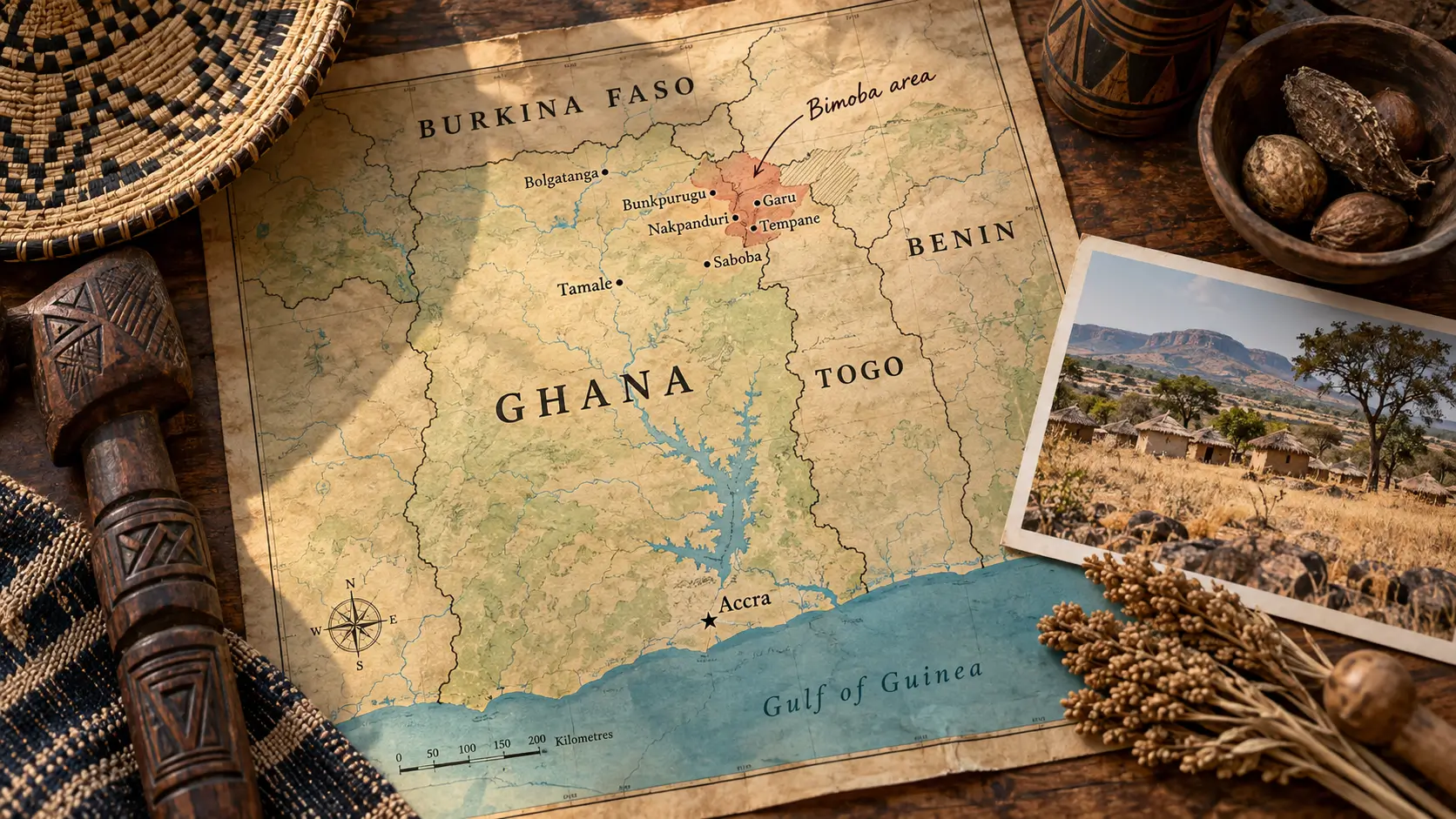
Bimoba is mainly spoken in north-eastern Ghana, particularly in the Upper East Region near the border with Togo. It’s also found across the border in parts of northern Togo, where related communities live.
In rural areas, Bimoba remains part of daily life, used at home, in local markets, and within the community.
But in urban centres, the picture changes. Languages like English and dominant regional languages take over, pushing Bimoba into more limited, informal use.
Comparison with other indigenous languages in the region
Bimoba isn’t alone in this struggle.
Across northern Ghana and neighbouring regions, many Indigenous languages face similar challenges. Declining use among younger generations, limited presence in education, and competition from dominant languages.
Some languages with larger speaker bases or stronger institutional support are holding on more firmly. Others, especially smaller or less-documented ones, are declining faster.
Factors Contributing to the Threat
Bimoba isn’t disappearing by accident.
A mix of social, economic, and systemic pressures is slowly pushing it out of everyday life. None of these factors acts alone, but together, they accelerate language shift.
Globalisation and cultural assimilation
Globalisation brings connection, but it also brings pressure to conform.
Dominant languages like English carry clear advantages: education, jobs, media, and global access. Over time, they start to feel more “useful” than local languages like Bimoba.
As a result, families and communities may prioritise these dominant languages, especially for younger generations. Bimoba becomes something you understand but don’t actively use.
Urbanisation and migration patterns
Movement changes language.
As people leave rural communities for towns and cities, they enter environments where Bimoba isn’t widely spoken. To integrate, they switch to more common languages, often English or regional lingua francas.
This shift becomes permanent. Children raised in urban areas may grow up with little exposure to Bimoba, especially if it’s not used at home.
The more people move, the more the language disconnects from daily life.
Educational policies and language instruction
School shapes language habits early.
In many cases, formal education prioritises dominant or official languages. Bimoba is rarely used as a medium of instruction, and often isn’t taught at all.
This sends a clear signal: some languages matter more than others.
When children spend most of their day learning, reading, and writing in another language, Bimoba becomes secondary, something informal, not academic or “valuable.”
Impact of Language Loss
When a language fades, the loss runs deeper than vocabulary. It reshapes identity, weakens cultural continuity, and affects how people see themselves and their place in the world. For the Bimoba community, the stakes are personal, cultural, and long-term.
Cultural identity and heritage erosion
Language anchors identity.
Bimoba carries names, meanings, and ways of expressing belonging that don’t fully translate into other languages. When fewer people speak it, that connection begins to loosen.
Traditions become harder to pass on in their original form. Cultural expressions lose nuance. Over time, identity shifts, from something lived and shared to something remembered.
Loss of traditional knowledge and practices
Knowledge lives in language.
Bimoba holds oral histories, environmental understanding, and community practices that were never written down. Farming techniques, healing knowledge, and social rules are much of it encoded in words, phrases, and stories.
When the language declines, this knowledge doesn’t transfer cleanly into another language. Some of it is simplified. Some of it disappears entirely.
Psychological effects on the Bimoba community
Language loss affects how people feel, not just how they communicate.
When a language is seen as less valuable, its speakers can start to feel the same way. This can lead to reduced confidence, especially among younger generations who may feel caught between identities.
There’s also a sense of disconnection. Without the language, ties to elders, history, and community can weaken.
Efforts to Revitalise the Bimoba Language
Bimoba isn’t fading quietly. Across communities and beyond, people are actively working to keep it alive.
hese efforts may be small in scale, but they’re powerful where it matters most: everyday use, visibility, and pride.
Community initiatives and grassroots movements
Revival starts at home.
Local communities are leading the charge by keeping Bimoba in daily conversation at home, in markets, and during cultural events.
Elders play a key role, passing down stories, proverbs, and traditions to younger generations.
Role of technology and social media
Digital spaces are opening new doors.
Social media platforms are giving Bimoba a place to be seen and heard, through videos, voice notes, storytelling, and everyday conversation. Even small amounts of content help normalise the language in modern contexts.
Messaging apps, audio recordings, and online communities make it easier for younger speakers to engage with Bimoba, especially if they’ve grown up with limited exposure.
Collaboration with linguists and cultural organisations
Documentation strengthens survival.
Linguists and cultural organisations are working to record Bimoba, its sounds, grammar, vocabulary, and oral traditions. This creates a lasting record and helps build resources for education and revitalisation.
These collaborations can lead to dictionaries, learning materials, and research that support long-term preservation. More importantly, they help validate the language, showing that it has value beyond the community itself.
Government and Institutional Support
Reviving a language takes more than passion. It needs structure, policy, and long-term investment.
For Bimoba, government and institutional support can either accelerate its survival or leave communities to carry the burden alone.
Current policies regarding indigenous languages
Policy shapes priority.
In Ghana, Indigenous languages are recognised, but support is uneven.
While some local languages appear in early education or broadcasting, many, especially smaller ones like Bimoba, receive limited formal backing.
English dominates in schools, government, and official communication. That creates a clear hierarchy: local languages at home, global languages everywhere else.
Funding and resources for language preservation
Support needs investment.
Language preservation relies on funding for materials, training, and community programmes. For Bimoba, resources are often limited or inconsistent.
That means fewer textbooks, fewer trained teachers, and fewer structured learning opportunities. Most preservation work depends on local effort rather than sustained financial backing.
When funding is scarce, progress slows, even when motivation is high.
Case studies of successful language revitalisation programmes
Success leaves clues.
Languages around the world have shown that revival is possible with the right support. Take the Māori language in New Zealand. Through immersion schools (Kōhanga Reo), media presence, and strong government backing, Māori has seen a significant revival.
Similarly, the Welsh language in the United Kingdom has benefited from bilingual education, official status, and widespread media use, leading to growing numbers of speakers.
The Role of Education in Language Preservation
If a language isn’t taught, it doesn’t last. Education is where habits form, confidence builds, and languages either survive or fade.
For Bimoba, the classroom could be the difference.
Importance of bilingual education
Bilingual education protects without limiting.
When children learn in both Bimoba and a dominant language like English, they don’t fall behind; they gain more. They develop stronger cognitive skills, deeper cultural awareness, and the ability to move between worlds.
More importantly, it normalises Bimoba. It tells students: this language matters.
Without that validation, it’s easy for younger generations to abandon it.
Curriculum development for Bimoba language instruction
A language needs structure to scale.
Right now, Bimoba is mostly passed down informally. That works. Until it doesn’t.
To sustain it long-term, it needs clear learning materials: textbooks, reading guides, writing systems, and standardised content.
A structured curriculum would allow Bimoba to be taught consistently in schools, not just spoken at home.
It would also help preserve grammar, vocabulary, and oral traditions in a form that can be shared and repeated.
Training teachers and community educators
Teaching the language starts with training the teachers.
Even if schools want to include Bimoba, they need people who can teach it confidently. That means training educators. Both formally and within the community.
Elders and fluent speakers can play a huge role here. With the right support, they can become cultural educators, bridging the gap between tradition and formal learning.
How Individuals Can Help
Saving a language isn’t just a government job. It happens through everyday actions, small, consistent, and personal.
You don’t need to be a fluent speaker to make a difference.
Promoting awareness and advocacy
Awareness creates value.
Talk about Bimoba. Share content. Highlight its importance in conversations, articles, and online spaces. The more visible a language is, the harder it is to ignore.
Advocacy also means challenging the idea that some languages matter less. Every time Bimoba is recognised as valuable, it strengthens its place in the world.
Engaging with the Bimoba community
Connection keeps languages alive.
If you’re part of the community, use Bimoba. At home, with family, in daily life. If you’re outside it, listen, learn, and support respectfully.
Attend cultural events. Engage with stories, music, and traditions. Language lives through people, not just words.
Supporting language learning initiatives
Support builds sustainability.
Back projects that teach and document Bimoba, whether that’s educational programmes, community classes, or digital resources.
Even simple actions help: using learning materials, supporting creators, or encouraging younger speakers to practise.
When more people invest time and attention, the language gains momentum and a future.
Bimoba Language FAQs
What is the Bimoba language?
Bimoba is an Indigenous language spoken mainly in north-eastern Ghana and parts of northern Togo. It belongs to the Gur (Mabia) language family and plays a key role in the cultural identity of the Bimoba people.
Why is the Bimoba language under threat?
Bimoba is under threat because younger generations are shifting to dominant languages like English for education, work, and daily communication. Urbanisation and limited use in schools have also reduced its everyday use.
How many people speak Bimoba today?
Bimoba is spoken by tens of thousands of people, but fluency is strongest among older generations. Fewer young people actively speak it, which puts its long-term survival at risk.
Why is it important to preserve the Bimoba language?
Preserving Bimoba protects cultural identity, oral traditions, and traditional knowledge that cannot be fully translated into other languages. Losing it would mean losing a unique way of understanding the world.
Can the Bimoba language be saved?
Yes, but it requires action. Community use, bilingual education, better resources, and increased awareness can all help keep Bimoba alive for future generations.