
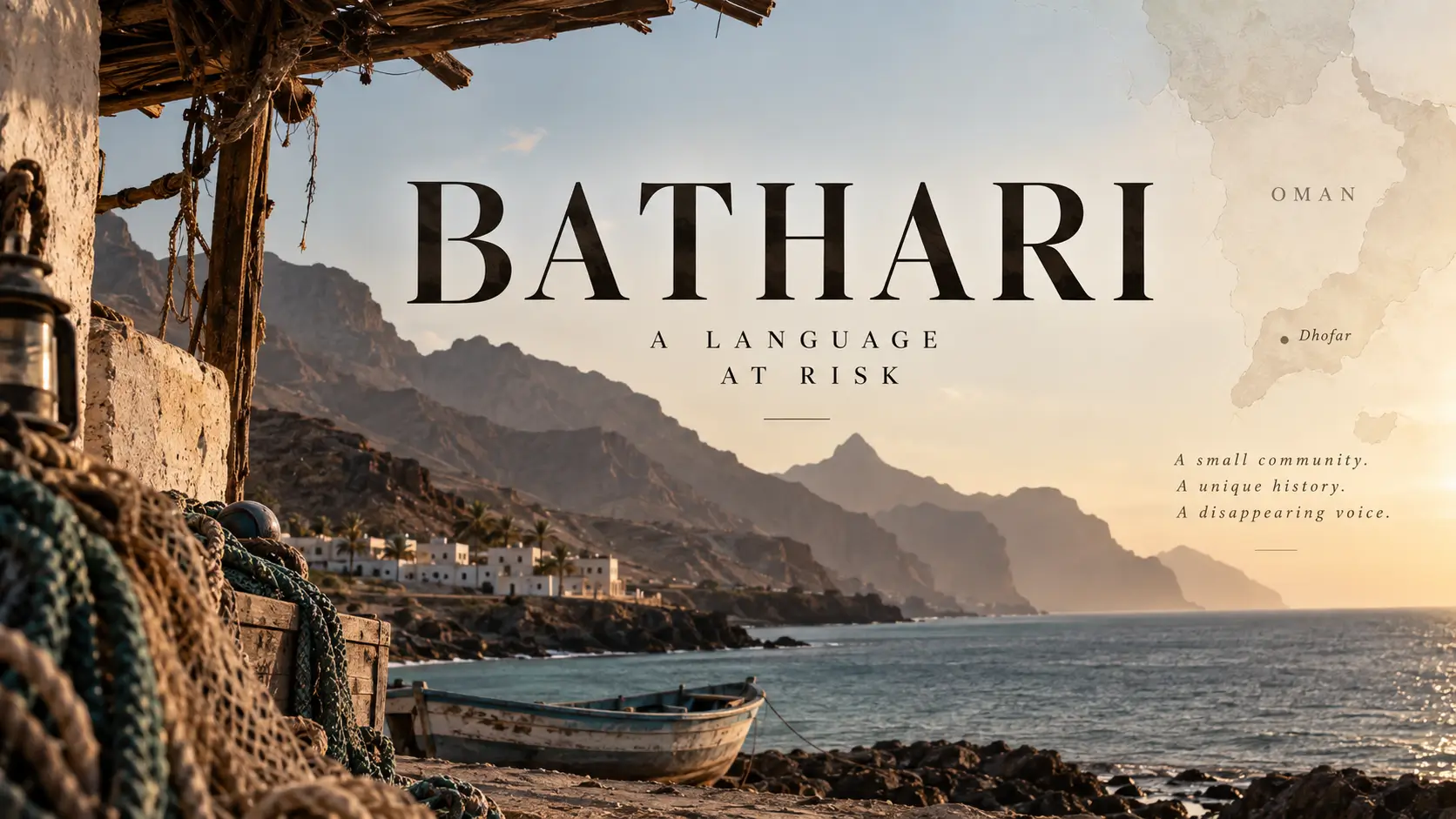
TL;DR: Bathari is a critically endangered language from southern Oman, spoken by fewer than 100 people. Rich in history and coastal culture, it’s fading fast as younger generations switch to Arabic. With little support and growing pressure from modern life, it could disappear within a generation.
On the windswept coast of southern Oman, the Bathari language is slipping into silence. Fewer than a hundred speakers remain, and with each passing year, its voice grows quieter.
This isn’t just another endangered language. Bathari is a living record of coastal life, tradition, and identity, shaped over centuries and carried in stories that exist nowhere else on Earth.
Now, it’s at a tipping point. Without urgent attention, Bathari could disappear within a single generation, taking an entire world of knowledge with it.
Historical Background
Bathari didn’t emerge in isolation. It’s the product of centuries of movement, trade, and cultural exchange along Oman’s southern coast.
To understand why it exists, and why it’s now endangered, you have to look at the region’s history, its people, and the forces that shaped their way of life.
Origins of the Bathari language
Bathari belongs to the Modern South Arabian languages, a small and ancient branch of the Semitic language family. Unlike Arabic, these languages developed separately and preserve features that have long disappeared elsewhere.
Linguists believe Bathari evolved among small coastal communities in Dhofar, particularly among fishing and seafaring groups. Its vocabulary reflects this environment, with rich terminology tied to the sea, weather patterns, and local ecology.
For generations, it was passed down orally, rooted in daily life rather than written tradition.
Historical context of Oman and its linguistic diversity
Oman has long been a crossroads of cultures, and its linguistic landscape reflects that.
While Arabic became dominant through religion, governance, and education, regions like Dhofar maintained a patchwork of minority languages, including Bathari, Mehri, and Harsusi.
The rugged mountains and isolated coastal areas allowed smaller language communities to survive for centuries without being fully absorbed into the Arabic-speaking majority.
Influence of trade and migration on language development
Oman’s position along the Indian Ocean made it a key player in ancient trade networks. For centuries, Omani sailors travelled between East Africa, India, and the Arabian Peninsula, bringing back goods, ideas, and linguistic influences.
Bathari likely absorbed elements from these interactions, even as it remained distinct. At the same time, migration and increased contact with Arabic-speaking populations gradually shifted language use.
Geographic Distribution
Bathari isn’t spread across Oman; it survives in fragments.
Its speakers are concentrated in a few remote coastal pockets, making it one of the most geographically restricted languages in the region.
This limited distribution is a major reason why it’s so vulnerable today.
Regions in Oman where Bathari is spoken
Bathari is primarily spoken along the south-eastern coast of Oman, particularly in parts of the Dhofar Governorate.
Small fishing communities between Hasik, Shalim, and the coastal stretches near the Arabian Sea have historically been its stronghold.
These areas are relatively isolated, with harsh terrain and limited infrastructure. That isolation once helped preserve Bathari, allowing it to survive outside the influence of dominant languages like Arabic.
Today, however, increased connectivity and modernisation are eroding that protection.
Demographics of Bathari speakers
Bathari has fewer than 100 speakers, and most are older adults. The language is rarely passed down to children, which puts it in a critically endangered position.
Younger generations in these communities tend to speak Arabic as their first language, using it for education, work, and daily communication. As a result, Bathari is often reserved for informal conversations among elders.
This age imbalance is a clear warning sign. When a language loses its younger speakers, its future becomes uncertain.
Comparison with other regional languages
Bathari is part of a small group of Modern South Arabian languages, which includes Mehri, Harsusi, and Shehri (Jibbali). Compared to these, Bathari is by far the most endangered.
- Mehri has tens of thousands of speakers across Oman and Yemen
- Shehri (Jibbali) is widely spoken in Dhofar
- Harsusi has a small but more stable speaker base
Bathari, in contrast, has only a tiny, shrinking community.
While its sister languages face challenges, Bathari is closest to disappearing entirely, making it one of the most fragile linguistic legacies in the Arabian Peninsula.
Linguistic Features
Bathari may be small in numbers, but linguistically, it’s rich and distinctive.
As part of the Modern South Arabian family, it preserves sounds and structures that feel ancient compared to modern Arabic.
These features don’t just make Bathari different. They offer a rare glimpse into how Semitic languages once sounded and worked.
Phonetics and phonology of Bathari
One of the first things linguists notice about Bathari is its sound system.
It includes consonants that don’t exist in standard Arabic, alongside a range of emphatic and fricative sounds that give the language its distinct texture.
- Bathari uses lateral fricatives (a rare sound type, similar to a “sl” hiss)
- It has emphatic consonants, produced deeper in the throat
- Vowel patterns can shift meaning, much like in other Semitic languages
These features make Bathari challenging for outsiders to learn, but incredibly valuable for linguists studying sound evolution.
Unique grammatical structures
Bathari follows a Semitic root-and-pattern system, where most words are built from a set of consonants that carry core meaning. Different patterns are then applied to create variations in tense, voice, or grammatical function.
- Verbs often encode tense, gender, and number in a single word
- Word order can be flexible, though verb-first structures are common
- Pronouns are frequently attached directly to verbs or nouns
Vocabulary and expressions specific to Bathari
Bathari vocabulary is deeply tied to its environment. Living along the coast has shaped a lexicon rich in marine life, weather, and navigation, areas where precision matters.
- Multiple words for types of fish, tides, and sea conditions
- Terms describing winds and seasonal changes unique to the region
- Expressions rooted in oral storytelling and community life
Cultural Significance
Bathari isn’t just spoken. It’s lived. For the communities along Oman’s southern coast, the language carries memory, identity, and meaning that go far beyond words.
It connects people to their past, shapes how stories are told, and anchors traditions that have been passed down for generations.
Role of Bathari in local traditions and folklore
Bathari has long been the language of oral tradition. Stories, proverbs, and local knowledge have been shared through speech, not writing, making the language itself the vessel that carries them forward.
- Folktales often reflect life by the sea, survival, and community values
- Proverbs pass down practical wisdom and cultural norms
- Knowledge about nature, like fishing cycles or weather patterns, is embedded in spoken language
Connection between language and identity
For Bathari speakers, the language is a marker of who they are and where they come from. It distinguishes their community within Oman’s broader Arabic-speaking society.
- Speaking Bathari signals belonging and shared heritage
- It reinforces ties to family, place, and ancestry
- Losing the language can create a sense of cultural disconnection, especially for younger generations
Bathari in music, poetry, and storytelling
Like many oral cultures, Bathari thrives in spoken and performed expression. Songs, poems, and stories bring the language to life, often blending rhythm, memory, and emotion.
- Traditional songs may accompany fishing, travel, or communal events
- Poetry captures emotion, history, and social commentary
- Storytelling sessions strengthen community bonds and shared identity
Current Status
Bathari is no longer a stable, living language, it’s in rapid decline.
What was once passed naturally from one generation to the next now survives in fragments, spoken by a shrinking group of older speakers.
The warning signs are clear: without intervention, Bathari is at risk of disappearing within decades.
Number of speakers and age demographics
Bathari has fewer than 100 speakers, and most are older adults.
Fluent speakers are typically from the older generation, while younger people in the same communities overwhelmingly use Arabic.
- Very few, if any, children are learning Bathari as a first language
- Speakers often use the language only in limited, informal settings
- Intergenerational transmission, the key to survival, has largely broken down
When speakers stop passing a language on, it enters its most critical stage.
Factors contributing to language decline
Multiple factors are driving Bathari’s decline. It’s the result of long-term social and economic shifts.
- Language shift to Arabic: Arabic dominates education, media, and public life
- Modernisation and mobility: Younger generations move away from traditional coastal lifestyles
- Lack of formal support: No widespread education, media, or institutional backing for Bathari
- Perceived opportunity: Arabic is often seen as more useful for jobs and social mobility
Comparison with other endangered languages
Bathari isn’t alone, but it is among the most vulnerable. Across the world, people are putting thousands of languages at risk, but each one faces a different situation.
- Some languages, like Mehri, still have large speaker bases and active use
- Others have revitalisation efforts, including education and digital resources
- Bathari, by contrast, has very few speakers and minimal support structures
This puts it in the most critical category of endangerment. Without urgent documentation and revitalisation, it risks becoming another silent entry on the growing list of lost languages.
Efforts for Preservation
Bathari may be critically endangered, but speakers and communities haven’t forgotten it. Small, often fragile efforts are working to document and protect what remains.
The challenge is scale: preservation is happening, but not yet at the level needed to secure the language’s future.
Initiatives by local communities and organisations
Most preservation work begins at the community level. Elders, speakers, and local advocates play a vital role in keeping Bathari alive, even if only in limited settings.
- Informal efforts to pass down words, stories, and expressions
- Collaboration with linguists to record speech and document vocabulary
- Oral history projects capture stories before communities lose them
These initiatives are crucial, but they often rely on limited resources and external support.
Role of the Omani government in language preservation
The Omani government recognises the country’s cultural diversity, but support for minority languages such as Bathari remains relatively limited compared with Arabic.
- Focus is largely on preserving heritage at a national level, rather than on specific languages
- Cultural and academic institutions support some documentation and research
- There is no widespread integration of Bathari into formal education or media
This means preservation efforts are often indirect, protecting culture broadly, rather than actively revitalising the language itself.
Educational programmes and resources available
One of the biggest gaps in Bathari preservation is education. Without structured learning opportunities, it’s difficult for younger generations to engage with the language.
- Very few (if any) formal teaching programmes for Bathari
- Limited availability of written materials, dictionaries, or learning tools
- Growing potential for digital documentation and online resources
For Bathari to survive, it needs more than preservation; it needs active transmission. That means creating ways for new speakers to learn, use, and value the language in everyday life.
Challenges to Revitalisation
Saving Bathari isn’t just about documenting it; it’s about changing the conditions that caused its decline in the first place. And that’s where things get difficult.
Social pressures, economic realities, and global influences all work against the language, making revitalisation an uphill battle.
Societal attitudes towards Bathari
One of the biggest barriers isn’t linguistic, it’s perception. Many communities no longer see Bathari as essential.
- Younger speakers often prioritise Arabic for education and opportunity
- People often view Bathari as less practical or outdated.
- Social pressure may discourage using it in public or formal settings
Economic and political factors affecting language use
People often choose a language based on survival. People naturally gravitate towards the language that offers the most opportunities.
- Arabic dominates employment, education, and government
- Limited economic incentives to learn or use Bathari
- No strong policy framework specifically supporting Bathari revitalisation
The impact of globalisation on local languages
Globalisation accelerates language loss by expanding the reach of dominant languages and cultures.
- Media, technology, and education reinforce Arabic and global languages like English
- Traditional lifestyles, where Bathari once thrived, are changing rapidly
- Cultural homogenisation reduces the space for smaller languages to survive
The result is a gradual shift away from local identity markers, including language.
For Bathari, this means competing not just with Arabic, but with the wider forces shaping the modern world.
Bathari Language FAQs
What is the Bathari language?
A small coastal community in southern Oman speaks Bathari, a critically endangered Modern South Arabian language known for its unique sounds and deep cultural roots.
How many people still speak Bathari?
Fewer than 100 people speak Bathari today, and most are older adults, with very few younger speakers learning the language.
Why is Bathari disappearing?
Bathari is declining due to a shift towards Arabic, lack of education and media support, and broader pressures from modernisation and globalisation.
Where do people speak Bathari?
Small, isolated coastal communities in the Dhofar region of southern Oman, particularly fishing communities, speak the language.
Can we save the Bathari language?
Yes, but only with urgent action, including documentation, education, and community-led efforts to pass the language on to younger generations.