
|
Getting your Trinity Audio player ready...
|
TL;DR: Alamblak is a rare language spoken in the Sepik region of Papua New Guinea. Known for its unusual grammar and strong oral traditions, it reflects the culture of its speakers. While languages like Tok Pisin and English create pressure, community use and linguistic documentation help support their preservation.
Hidden deep in the Sepik region of Papua New Guinea, Alamblak is one of the world’s lesser-known languages.
Spoken by only a small community, it offers a fascinating glimpse into the incredible linguistic diversity of the region.
Like many languages of Papua New Guinea, Alamblak has unique grammatical structures and cultural connections that make it valuable not just for communication.
Papua New Guinea’s linguistic diversity
Papua New Guinea is the most linguistically diverse country on Earth.
With more than 800 languages spoken across its islands and mountainous landscapes, it represents an extraordinary concentration of human linguistic heritage.
This diversity developed over thousands of years as communities lived in relative isolation. Allowing languages to evolve in unique and often highly complex ways.
Alamblak is a unique language
Among Papua New Guinea’s many languages, Alamblak stands out as particularly distinctive.
Spoken by a small community in the Sepik region, it has unusual grammatical features and a structure that differs significantly from many neighbouring languages.
For linguists, Alamblak offers valuable insight into how human language can evolve in diverse and unexpected ways.
The Origins of Alamblak
Like many languages in Papua New Guinea, its development is closely tied to the region’s geography, history, and the cultural traditions of the people who speak it.
Over generations, isolation between communities allowed languages such as Alamblak to evolve in unique and complex ways.
Historical context of the Alamblak language
Alamblak belongs to the group of languages spoken in the Sepik region of northern Papua New Guinea, an area known for its extraordinary linguistic diversity.
Many of these languages developed independently over long periods, often with limited outside influence.
The indigenous people and their cultural background
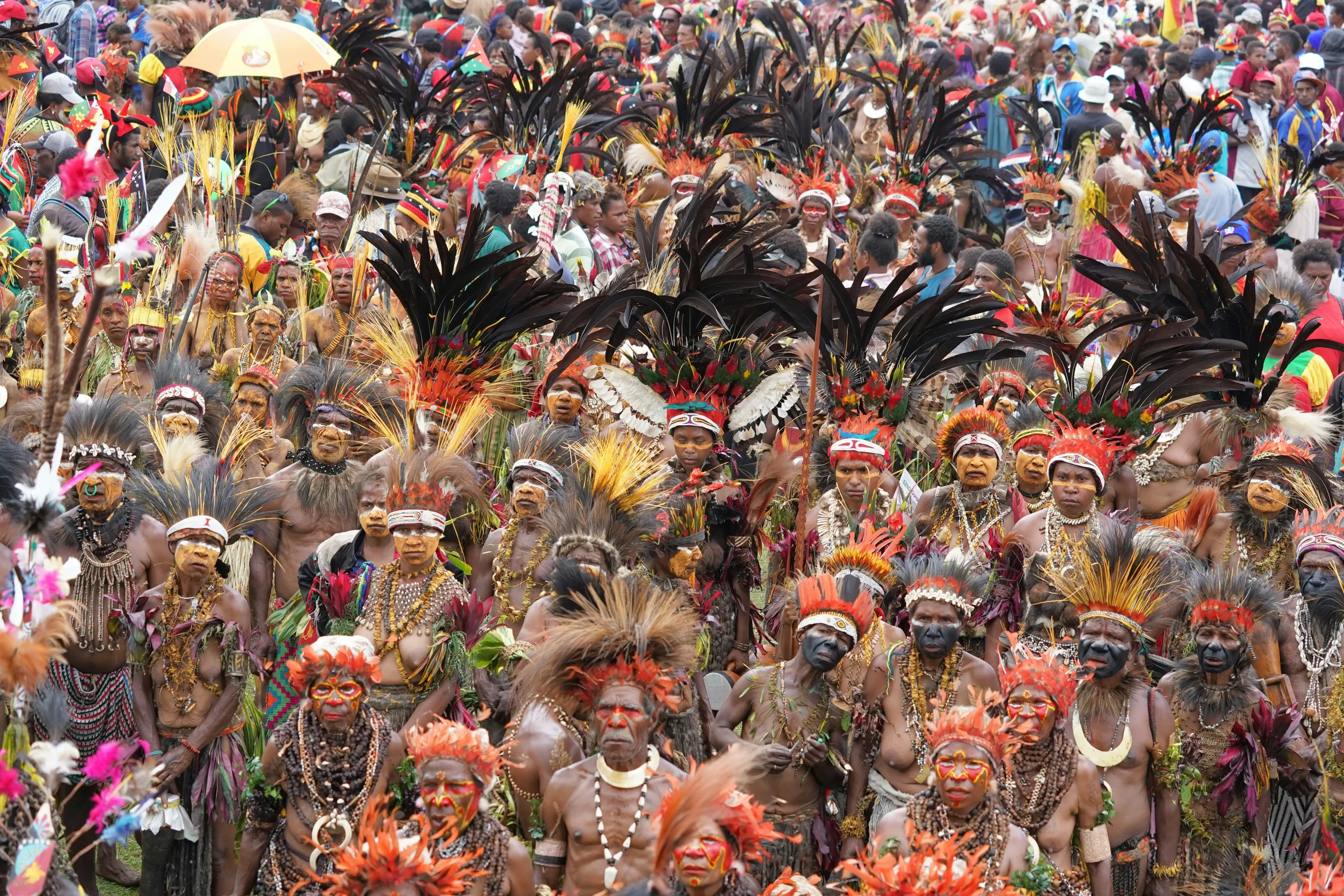
The Alamblak language is spoken by indigenous communities who live along the Sepik River region.
Language plays an important role in preserving their traditions, oral histories, and social practices.
Stories, rituals, and everyday communication all reinforce cultural identity, making the language a central part of community life and heritage.
Geographic distribution and its impact on language development
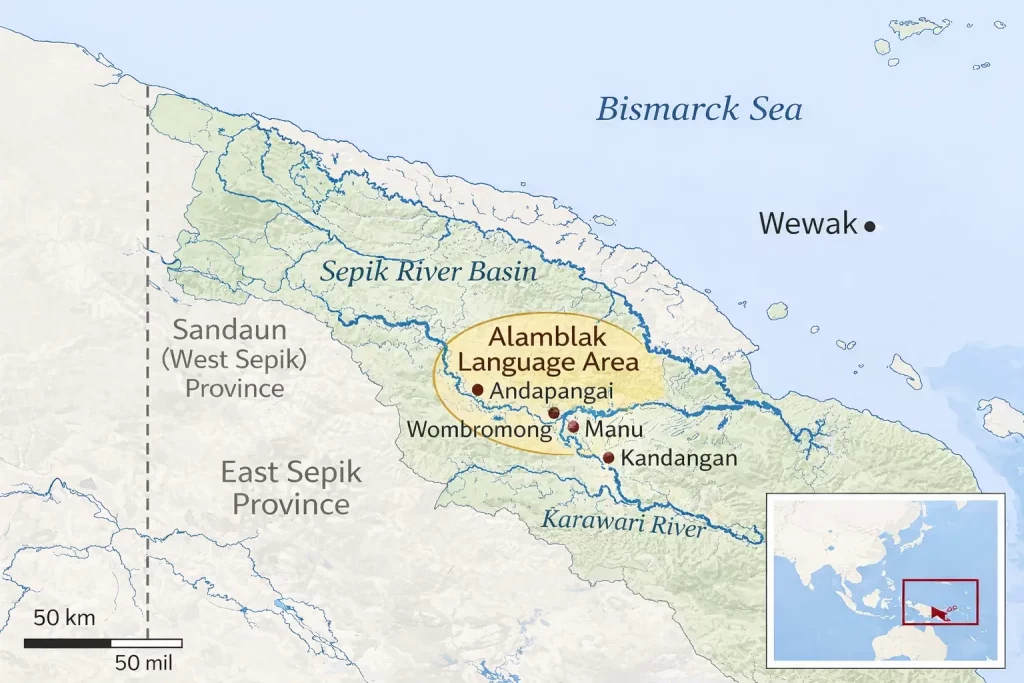
Geography has played a major role in shaping Alamblak. Relatively remote villages speak the language, surrounded by rivers, forests, and challenging terrain.
This isolation limited interaction with neighbouring groups and allowed the language to develop unique linguistic features.
As a result, Alamblak differs noticeably from nearby languages, illustrating how physical landscapes can influence the evolution of language over time.
Linguistic Features of Alamblak
Alamblak is particularly interesting to linguists because of its unusual structure and sound system. Compared with many well-known languages, Alamblak demonstrates how differently humans can organise language.
From distinctive sounds to unique grammatical patterns, Alamblak demonstrates the remarkable variety found in the languages of Papua New Guinea.
Phonetics and phonology: Sounds of Alamblak
The sound system of Alamblak includes a range of consonants and vowels typical of many Papuan languages, but with its own distinctive patterns of pronunciation.
These phonetic features shape the way speakers pronounce and recognise words, giving Alamblak its distinctive sound.
| Vowel | Example pronunciation |
| /a/ | similar to the “a” in father |
| /e/ | similar to the “e” in bed |
| /i/ | similar to the “ee” in see |
| /o/ | similar to the “o” in go |
| /u/ | similar to the “oo” in food |
Common consonant sounds in Alamblak include:
- p, b
- t, d
- k, g
- m, n
- w, y
These sounds combine to form relatively simple syllable structures such as CV (consonant-vowel) and CVC, which are common across many languages in Papua New Guinea.
Grammar and syntax: Structure of the language
One of the most striking features of Alamblak is its grammar.
The language uses a complex system of markers that help indicate relationships between words in a sentence.
Rather than relying strictly on word order, Alamblak often uses grammatical markers to clarify meaning. This allows speakers to express ideas in flexible ways while still maintaining clarity.
Elongated / Upright Class
Used for things that are long, tall, or vertically oriented.
Examples include:
- trees
- spears
- long tools
- upright posts
Compact / Rounded Class
Used for things that are short, round, or compact.
Examples include:
- fruit
- stones
- small animals
- eggs
These classifications influence agreement markers in verbs and pronouns, helping speakers identify which noun a sentence refers to.
Vocabulary: Unique words and expressions
Alamblak vocabulary reflects the environment and culture of the people who speak it.
Many words reflect local traditions, the natural environment, and everyday life in the Sepik region.
As with many indigenous languages, certain expressions capture ideas or cultural concepts that do not translate easily into other languages. Making the vocabulary an important part of the community’s identity and worldview.
The Role of Alamblak in Cultural Identity
For the communities that speak it, Alamblak is far more than a way to communicate. The language closely reflects the identity, traditions, and shared history of the people living in the Sepik region.
Through everyday conversation, ceremonies, and storytelling, speakers use the language to preserve knowledge passed down through generations.
Connection between language and cultural practices
People embed Alamblak deeply in daily life and cultural practices.
Traditional activities such as fishing, hunting, farming, and community gatherings all rely on language to share knowledge and coordinate social roles.
Many cultural practices include specialised vocabulary and expressions that reflect:
- local customs,
- environmental knowledge,
- and social relationships within the community.
Oral traditions and storytelling in Alamblak
Storytelling preserves knowledge and cultural values.
Elders often share stories about ancestors, local history, and the natural world using the Alamblak language.
These stories not only entertain but also teach younger generations about traditions, moral lessons, and the environment around them.
Example: The Origin of the Nrwit Communication Drum
One well-known Alamblak story explains the origin of the nrwit, a type of wooden slit drum used to send messages between villages.
According to the myth, a man once tried to create a way to communicate with relatives living far away. He carved a drum from a tree and struck it, hoping the sound would carry across the forest. However, the drum produced only a weak sound and no one heard the message.
His mother (or grandmother in some versions of the story) criticised him for choosing the wrong type of tree. To teach him, she transformed herself into a special tree, planting herself head-first into the ground. The man then cut this tree and carved a new drum from it. This time the drum produced a clear, powerful sound that could travel long distances through the forest.
From that moment on, the story says, Alamblak people used this particular tree to make nrwit drums, which became an important tool for communication between communities.
The significance of language in community cohesion
Language also plays a key role in strengthening social bonds.
Speaking Alamblak reinforces a shared sense of belonging among community members and connects people to their cultural roots.
In smaller and more remote communities, maintaining the language preserves collective identity and ensures that traditions, knowledge, and values pass to future generations.
Current Status of Alamblak
Like many indigenous languages in Papua New Guinea, a relatively small population speaks Alamblak.
While the language remains an important part of community life in certain villages of the Sepik region, social change and increasing use of national languages have created challenges for its long-term survival.
Number of speakers and demographic trends
Linguistic surveys estimate that roughly 1,500–2,000 people speak Alamblak, primarily in villages along the Sepik River region of northern Papua New Guinea.
Most speakers live in small rural communities where they continue to use the language in daily life.
Younger speakers increasingly use Tok Pisin or English for education, trade, and government communication.
Factors contributing to language endangerment
Several factors contribute to the vulnerability of Alamblak. One of the main influences is the growing dominance of Tok Pisin, Papua New Guinea’s widely spoken lingua franca.
As people travel, attend school, or work outside their villages, they often rely on Tok Pisin or English instead of their local language.
Migration to towns, exposure to national media, and changing lifestyles can also reduce opportunities for younger generations to learn and use Alamblak regularly.
Efforts to document and preserve Alamblak
Although a relatively small community speaks Alamblak, linguists and researchers have taken steps to document and study the language. Documentation helps preserve its grammar, vocabulary, and cultural knowledge.
- Linguistic research and fieldwork: Researchers have conducted field studies in the Sepik region to analyse Alamblak’s grammar, sound system, and vocabulary.
- Academic publications: Detailed linguistic descriptions, including grammar studies, have been produced to document how the language works.
- Recording oral traditions: Some documentation efforts include recording traditional stories, cultural practices, and spoken narratives in Alamblak.
- Language archives and databases: Materials related to Alamblak are preserved in linguistic archives and research databases to support future study.
- Cultural preservation through documentation: Recording the language also helps preserve knowledge about the traditions and worldview of the Alamblak-speaking community.
Language Revitalisation Initiatives
Although Alamblak remains spoken in parts of the Sepik region, like many smaller languages, it faces pressure from widely used languages such as Tok Pisin and English.
Revitalisation efforts aim to support the continued use of Alamblak while preserving knowledge of the language for future generations.
Community-led projects to promote Alamblak
Local communities play the most important role in maintaining the language.
In villages where Alamblak is spoken, elders and community members help pass the language to younger generations through everyday conversation, storytelling, and participation in cultural traditions.
Informal teaching within families and community gatherings helps keep the language active in daily life.
Role of linguists and researchers in preservation
Linguists contribute by documenting the language and working with local speakers to record grammar, vocabulary, and oral traditions.
Fieldwork conducted in the Sepik region has resulted in academic descriptions of Alamblak. Those that provide valuable resources for researchers and communities interested in preserving the language.
Educational programmes and resources available
Papua New Guinea has historically supported vernacular language education, encouraging the use of local languages in early schooling in some communities.
While specific formal programmes for Alamblak are limited, broader educational initiatives promote indigenous languages.
This helps create opportunities for local languages to be used in learning materials, literacy efforts, and cultural education.
The Impact of Globalisation on Alamblak
Globalisation has brought new opportunities for communication, education, and economic development, but it has also created challenges for smaller languages like Alamblak.
As national and global languages become more dominant, many indigenous languages face increasing pressure in everyday life.
Influence of dominant languages and cultures
In Papua New Guinea, Tok Pisin and English are widely used for education, government, and trade.
As a result, many Alamblak speakers rely on these languages when interacting outside their communities.
Over time, this can reduce the use of Alamblak in public settings, particularly among younger generations who grow up using national languages at school and in the media.
Challenges faced by Alamblak speakers in a modern context
Modern life often requires speakers to move between multiple languages.
While Alamblak may still be used at home or within the village, speakers frequently switch to Tok Pisin or English in workplaces, schools, and urban areas.
Migration, education systems, and increased exposure to national media can gradually shift language use away from smaller indigenous languages.
Balancing tradition with contemporary influences
Despite these challenges, many communities continue to value Alamblak as an important part of their cultural identity.
Maintaining the language alongside national languages allows speakers to participate in modern society while still preserving their heritage.
Alamblak represents both a living cultural tradition and a reminder of the linguistic diversity that exists within Papua New Guinea.
Comparative Analysis with Other Languages
Studying Alamblak alongside neighbouring languages helps linguists better understand how languages develop in regions with high linguistic diversity.
Papua New Guinea contains hundreds of languages, many of which evolved in relative isolation. Making comparisons especially valuable for identifying shared patterns and unique features.
Similarities and differences with neighbouring languages
Alamblak is spoken in the Sepik region, an area known for its dense concentration of distinct languages.
Like many nearby languages, Alamblak shares some general characteristics common to Papuan languages, such as relatively small vowel systems and complex grammatical structures.
Its semantic noun classification system, which groups nouns based on conceptual categories like shape or physical properties, is unusual even within the region.
| Feature | Alamblak | Neighbouring Sepik Languages |
| Geographic location | Spoken in the Sepik region of northern Papua New Guinea | Also concentrated in the Sepik River basin and surrounding areas |
| Language family | Generally classified within the Sepik language group (Papuan languages) | Many also belong to Sepik language families, though some are unrelated |
| Vowel system | Relatively small vowel inventory (around five vowels) | Similar small vowel systems are common across many Papuan languages |
| Grammar complexity | Uses complex grammatical markers and agreement systems | Many neighbouring languages also have complex grammatical structures |
| Noun classification | Uses a semantic classification system based on characteristics like shape or physical properties | Most nearby languages do not use this exact system, making Alamblak unusual |
| Mutual intelligibility | Not mutually intelligible with nearby languages | Most Sepik languages are also not mutually intelligible with one another |
Insights gained from studying Alamblak in a broader linguistic context
Linguists often study Alamblak to understand how language structure can vary across human societies.
Its classification system and grammatical patterns provide useful examples of how languages can organise meaning in ways that differ significantly from widely spoken languages such as English.
The role of language families in understanding Alamblak
Alamblak is generally classified as part of the Sepik language group, sometimes referred to within the broader set of Papuan languages.
Language families help linguists trace historical relationships between languages, identify shared features, and reconstruct how languages may have evolved.
The Future of Alamblak
The future of Alamblak will largely depend on how successfully the language continues to be passed down to younger generations.
Like many small endangered languages, its survival is closely tied to community use, cultural pride, and ongoing documentation efforts.
Predictions for the language’s survival
Alamblak is still spoken within its local communities, which gives it a stronger chance of survival than languages that have already lost everyday speakers.
However, increasing use of Tok Pisin and English may gradually reduce the number of fluent speakers if younger generations rely more heavily on these languages in education and work.
Importance of community engagement in language preservation
Community involvement is one of the most important factors in language preservation.
When families speak Alamblak with children and use it in daily life, cultural traditions and linguistic knowledge remain alive.
Elders, storytellers, and community leaders often play a crucial role by sharing oral histories, encouraging younger generations to value their linguistic heritage.
Potential for revitalisation and growth
Although small languages face pressure from dominant languages, revitalisation is possible when communities, educators, and researchers work together.
Documentation, educational resources, and cultural initiatives can help strengthen
awareness of the language.
Small efforts, such as recording stories, creating teaching materials, or promoting the
language within the community. They can contribute to preserving Alamblak for future generations.
Alamblak Language FAQs
What is the Alamblak language?
Alamblak is an indigenous language spoken in the Sepik region of northern Papua New Guinea. It is used by a small community and is known for its unusual grammatical features, including a noun classification system based on characteristics such as shape and physical properties.
How many people speak Alamblak?
Estimates suggest that around 1,500–2,000 people speak Alamblak. Most speakers live in rural villages along the Sepik River, where the language is still used in everyday communication.
Why is Alamblak linguistically important?
Alamblak is particularly interesting to linguists because of its semantic noun classification system, which groups nouns according to conceptual categories rather than traditional grammatical gender. This makes it a valuable language for studying how human languages organise meaning.
Is Alamblak an endangered language?
Alamblak is considered vulnerable because it is spoken by a relatively small population and faces pressure from more widely used languages such as Tok Pisin and English. However, it continues to be used within local communities.
Where can people learn more about Alamblak?
Most information about Alamblak comes from linguistic research and academic studies of Sepik languages. Documentation, including grammatical descriptions and recordings of oral traditions. They help preserve knowledge of the language and support future research and cultural preservation.