|
Getting your Trinity Audio player ready...
|
TL;DR: Language acquisition is the process of developing the ability to understand and use language through exposure, interaction and practice. It is usually implicit, meaning people absorb sounds, vocabulary and grammar without consciously studying every rule.
Every healthy child, anywhere in the world, learns to speak within a few years without lessons, textbooks or grammar drills.
By listening, copying and experimenting, children turn sounds into words, words into sentences and sentences into meaning. This remarkable process is called language acquisition.
But how does it happen, and why does learning a language feel so different in adulthood?
What is Language Acquisition?
Language acquisition is the process through which people develop the ability to understand and use language. It usually happens naturally through exposure, interaction and repeated use, rather than through formal instruction.
This is different from language learning.
Acquisition is largely implicit: we absorb patterns, sounds and meanings without consciously studying the rules. Language learning is more explicit, involving activities such as memorising vocabulary, studying grammar and practising set exercises.
In practice, the two processes often work together. Formal learning can help explain the rules, while acquisition turns that knowledge into language that feels natural and automatic.
Get answers like this for your language questions
Your personal AI language tutor — adapts to your native language, your level, and the words that actually trip you up.
First Language Acquisition vs. Second Language Acquisition
First language acquisition begins in infancy. Children absorb their native language through constant exposure and interaction, developing an instinct for sounds, grammar and meaning without formally studying them.
Second language acquisition begins after that first language is already established. Learners often combine natural exposure with conscious study, translation and grammar practice.
Children usually benefit from more immersion and less fear of mistakes.
Adults have less time and stronger habits from their first language, but they can use explanations, strategies and pattern recognition more effectively.
The Stages of Child Language Development
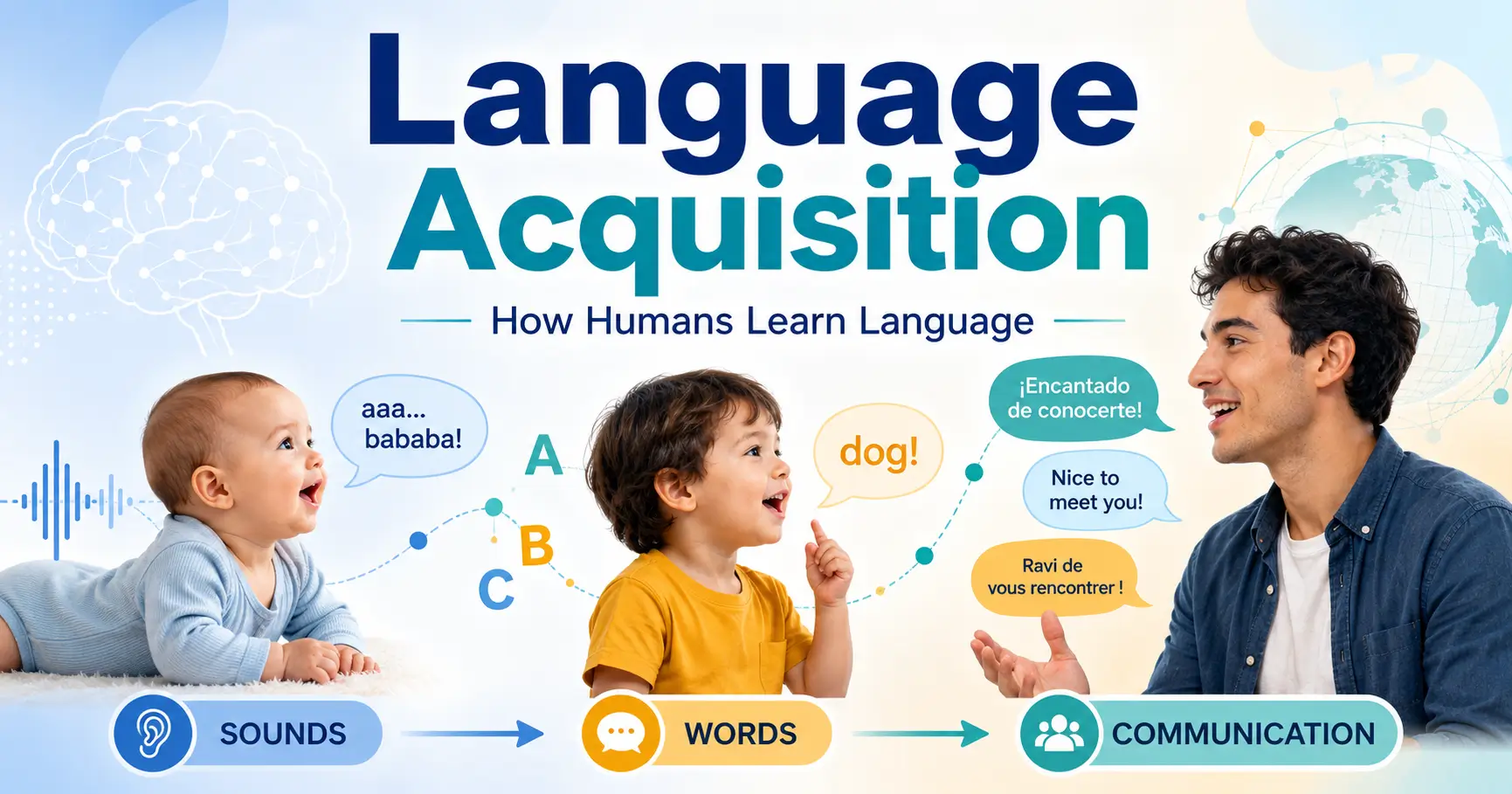
Children typically move through several recognisable stages as language develops:
- Babbling: Babies experiment with sounds such as ba, da and ma, gradually learning the rhythm and sound patterns of the language around them.
- One-word stage: A single word can carry a full meaning. “Milk” might mean “I want milk”, while “dog” could mean “There is a dog”.
- Two-word stage: Children begin combining words into simple phrases such as “more juice” or “mummy go”. Grammar is limited, but the meaning is often clear.
- Grammar explosion: Vocabulary grows rapidly and sentences become longer and more structured. Children start using word endings, pronouns and more complex grammar, often making logical mistakes such as goed instead of went.
These stages vary from child to child, but the overall pattern is remarkably consistent across languages.
Major Theories of Language Acquisition
Researchers have proposed several explanations for how humans acquire language:
Nativist theory:
Associated with Noam Chomsky, this view argues that humans are born with an innate capacity for language. Children learn too quickly and receive too little direct instruction for imitation alone to explain their progress.
Behaviourist theory:
Behaviourists argue that language develops through imitation, repetition and reinforcement. Children copy the speech they hear and gradually strengthen forms that produce the desired response.
Interactionist theory:
This approach emphasises social interaction. Children acquire language by communicating with parents and others who respond, simplify speech and help them connect words with meaning.
Usage-based theory:
Closely related to interactionist ideas, this view suggests that children learn by noticing patterns in the language they hear. Frequently repeated phrases gradually become templates for creating new sentences.
Most researchers now accept that language acquisition involves a combination of natural cognitive abilities, exposure, pattern recognition and social interaction.
The Critical Period Hypothesis
The critical period hypothesis suggests that childhood is the easiest time to acquire language because the brain is especially adaptable.
Earlier learners are more likely to develop native-like pronunciation and grammar, but there is no single deadline after which learning becomes impossible. Researchers increasingly describe several sensitive periods, with different language skills becoming harder at different rates.
Adults can still become highly fluent. They may need more deliberate practice, but stronger reasoning, motivation and learning strategies can help close the gap.
How Adults Acquire a Second Language Differently
Adults usually learn a second language more consciously than children acquire their first. They study grammar, memorise vocabulary and use explanations to understand patterns.
Their first language also shapes the process. Familiar sounds and structures can help, but differences in pronunciation, word order or grammar can lead to mistakes through language transfer.
Motivation matters more too. Adults often learn for work, travel or relationships, and progress depends heavily on how consistently they use the language.
The quality of input is just as important as the amount. Clear, meaningful language, especially when combined with conversation and feedback, is far more useful than passive exposure alone.
Bilingual and Multilingual Acquisition
Children can acquire two or more languages from birth, building separate but connected systems for each. They quickly learn which language to use with different people and in different situations.
Bilingualism does not cause language delay. A child may know fewer words in each language when they are measured separately, but their total vocabulary across both languages can be just as strong.
Mixing languages is also normal, it shows that children are using every word available to communicate, not that they are confused.
Development depends largely on regular, meaningful exposure. One language may become stronger than another, but with enough interaction, children are fully capable of developing both.
What the Science Means for Language Learners Today
Adults may not acquire languages exactly as children do, but the same basic conditions still help.
- Comprehensible input matters. Learners need language that is challenging enough to introduce something new, but clear enough to understand through context.
- Consistency beats intensity. Regular contact with a language helps the brain notice patterns and retrieve words more automatically. Ten or twenty minutes each day is often more useful than one long session each week.
- Communication should come early. Speaking before you feel completely ready helps turn passive knowledge into usable language. Mistakes are not evidence that learning has failed; they are part of how the brain tests and refines new patterns.
The most effective approach usually combines meaningful input, repeated exposure, active use and helpful feedback.
Language Acquisition Is a Lifelong Human Ability
Children and adults acquire language differently, but both are driven by the same basic need: to understand others and be understood.
Children benefit from an adaptable brain and constant immersion. Adults bring stronger reasoning skills, clearer goals and the ability to choose effective learning strategies. Age can influence how a language is acquired, but it does not make fluency unreachable.
Understanding the science makes language learning feel less mysterious. Progress comes from hearing language you understand, encountering it often and using it without waiting for perfection.
Explore our language-learning tools to put these principles into practice, or continue with our guides to how AI is changing language learning and AI vs traditional language-learning methods.
Language Acquisition FAQs
What is language acquisition?
Language acquisition is the process of developing the ability to understand and use a language through exposure, interaction and practice. It usually happens partly unconsciously as the brain notices patterns in sounds, words and grammar.
What is the difference between language acquisition and language learning?
Language acquisition is largely implicit and develops through meaningful exposure and communication. Language learning is more explicit, involving activities such as studying grammar rules, memorising vocabulary and completing exercises.
What are the main stages of language acquisition in children?
Children typically progress through babbling, the one-word stage, the two-word stage and a period of rapid vocabulary and grammar development. The timing varies, but the general sequence is similar across languages.
What is the critical period for language acquisition?
The critical period hypothesis suggests that childhood is the easiest time to acquire language naturally. However, there is no fixed age after which learning becomes impossible, and adults can still reach a high level of fluency.
Can adults acquire a language naturally?
Yes. Adults can acquire language through understandable input, conversation and repeated exposure, although they often combine this with conscious study. They may learn differently from children, but they are still capable of becoming highly proficient.