
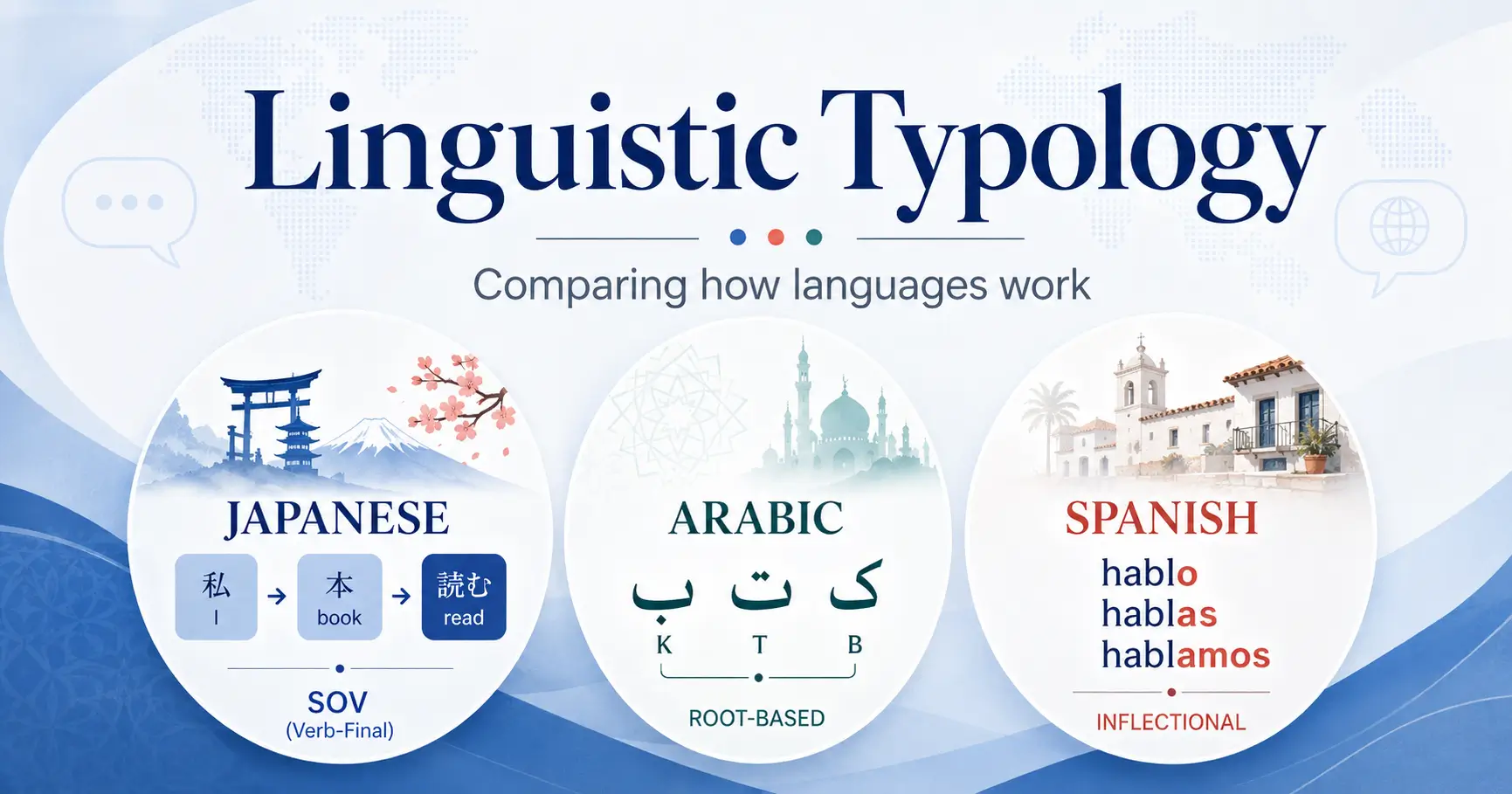
Japanese, Arabic and Spanish can express the same ideas, but they work very differently beneath the surface. Linguistic typology explores how Japanese often puts the verb last, Arabic builds words from consonant roots, and Spanish uses verb endings to show who is acting and when.
Linguists compare these structural patterns through linguistic typology. Instead of grouping languages only by ancestry, typology looks at how they organise words, sentences and grammar.
What is Linguistic Typology?
Linguistic typology classifies languages by their structural features rather than their history. It examines patterns such as word order, grammar, sounds and word formation.
For example, English and Spanish usually use subject–verb–object order, while Japanese often places the verb last. Typology helps linguists compare these patterns across unrelated languages and identify common or unusual structures.
Learn about linguistic typology with your tutor
Your personal AI language tutor — adapts to your native language, your level, and the words that actually trip you up.
Typology vs. Genetic Classification
Typological classification groups languages by how they work. Genetic classification groups them by shared ancestry.
Spanish, French and Italian are Romance languages because they developed from Latin. English and German belong to the Germanic family.
Typology looks beyond these family links. English and Spanish are unrelated genealogically, yet both commonly use subject–verb–object order. In simple terms, genetic classification asks which languages are related, while typology asks which languages are structurally similar.
Why Linguists Classify Languages by Structure
Classifying languages by structure helps linguists understand both what languages share and how widely they can differ. By comparing thousands of languages, researchers can identify possible language universals, such as patterns that appear across unrelated language families.
Typology also reveals the full range of human linguistic variation, including different word orders, grammatical systems and ways of forming words. These findings support research into how people acquire languages and help developers build more effective natural language processing tools for languages beyond English.
Word Order Typology (SVO, SOV, VSO)
One of the most common ways to compare languages is by the usual order of the subject, verb and object in a sentence.
English and Spanish generally use subject–verb–object (SVO) order:
- English: “She reads the book.”
- Spanish: “Ella lee el libro.”
Japanese and Korean typically use subject–object–verb (SOV) order, placing the verb at the end:
- Japanese: “She the book reads.”
Irish and Welsh commonly use verb–subject–object (VSO) order, beginning with the action:
- Irish: “Reads she the book.”
These categories describe the most common pattern, not an unbreakable rule. Languages may change their word order for emphasis, questions or particular grammatical structures.
Why Word Order Affects How a Language “Feels” to Learn
Word order shapes how learners process a sentence. An English speaker learning Japanese may need to hold the subject and object in mind until the verb appears at the end. A learner of Irish or Welsh must become comfortable hearing the action before the person performing it.
This is one reason some languages feel less intuitive than others: learners are not only memorising new words but also reorganising how they expect information to appear
Morphological Typology: Isolating, Agglutinative, Fusional, Polysynthetic
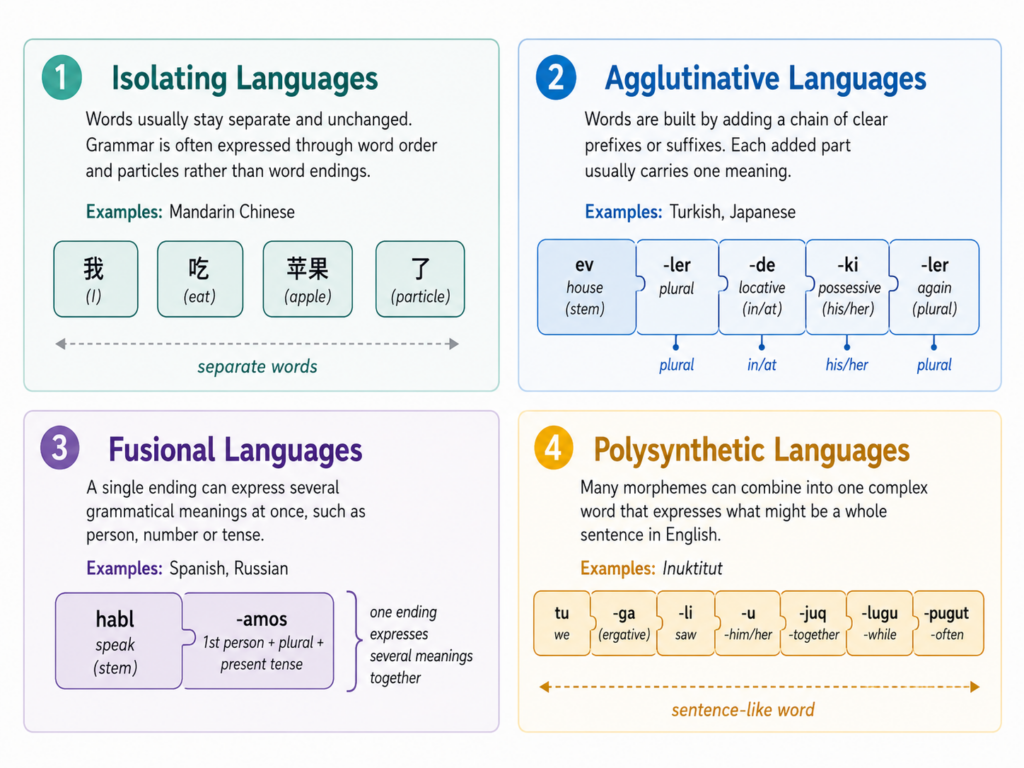
Morphological typology compares languages by how they combine meaningful units, known as morphemes, to form words. The four classic types are isolating, agglutinative, fusional and polysynthetic, although many languages combine features from more than one category.
Isolating Languages
Isolating languages tend to use separate words rather than changing word endings. Mandarin Chinese is a common example: grammatical meaning is often expressed through word order and additional particles rather than inflexion.
Agglutinative Languages
Agglutinative languages build words by attaching a series of clear prefixes or suffixes, with each usually carrying one meaning. Turkish and Japanese can express tense, possession, politeness and other information through chains of endings.
Fusional Languages
In fusional languages, a single ending may express several grammatical meanings at once. Spanish verb endings, for example, can show the person, number and tense, while Russian noun endings may indicate number, gender and grammatical case.
Polysynthetic Languages
Polysynthetic languages can combine many morphemes into a single complex word. In languages such as Inuktitut, one word may communicate an idea that would require an entire sentence in English.
These categories are useful comparisons rather than strict boxes. A language may be mostly agglutinative or fusional while still showing features associated with other types.
Other Key Typological Features
Linguists compare languages across many features beyond word order and morphology.
Phonological typology examines how sound systems differ. Mandarin and Vietnamese are tonal languages, meaning pitch can change a word’s meaning. English and Spanish use pitch for emphasis and intonation, but not usually to distinguish individual words.
Languages can also be pro-drop or non-pro-drop. Spanish often omits the subject pronoun because the verb ending already identifies the speaker:
Hablo español means “I speak Spanish”. English normally requires the pronoun: “Speak Spanish” would be understood as a command.
Head-Initial vs. Head-Final Languages
A phrase’s head is its central word, while other words provide additional information. Head-initial languages tend to place the head first, whereas head-final languages place it later.
English is largely head-initial, using structures such as “in the house”. Japanese is mostly head-final and places equivalent information before the head. This pattern affects prepositions, verb placement and the overall structure of sentences.
Language Universals: What All Languages Have in Common
Despite their differences, languages are not endlessly unpredictable. Linguists have found recurring patterns that appear across many unrelated languages, known as language universals.
Joseph Greenberg’s influential research showed that these patterns are often implicational rather than absolute. In other words, if a language has one feature, it is likely to have another. For example, languages that place verbs before objects also tend to place prepositions before nouns.
These universals suggest that human languages are shaped by shared cognitive and communicative pressures. No single rule applies perfectly to every language, but the patterns help linguists understand which structures are common, rare or unlikely.
Why Linguistic Typology Matters for Language Learners
A language’s typological profile can reveal where learners are most likely to struggle. An English speaker learning another SVO language may find the sentence structure familiar, even when the vocabulary is not.
A pro-drop language requires learners to identify subjects from verb endings. An SVO language delays the verb until the end, while agglutinative or highly inflected languages pack more meaning into each word.
Typology does not decide whether a language is easy or difficult. It shows which habits learners will need to change.