|
Getting your Trinity Audio player ready...
|
TL;DR: English has 12 main tenses: present, past and future, each used in simple, continuous, perfect and perfect continuous forms. Simple tenses show facts, habits or completed actions. Continuous tenses show actions in progress. Perfect tenses connect one time to another. Perfect continuous tenses show how long something has been happening.
Most English learners start with the basics: past, present and future. But to really understand how English works, you need to go one step further.
English has 12 main tenses, and each one helps you show whether an action is finished, ongoing, repeated, temporary, or connected to another point in time.
That might sound complicated at first, but it becomes much easier when you see the patterns clearly.
By the end, you won’t just know the names of the tenses, you’ll understand when to use them, how they work, and how to avoid the common mistakes that make English grammar feel harder than it needs to be.
What Are the 12 English Tenses? (Quick Overview)
English tenses help us show when something happens and how that action relates to time.
At the simplest level, English has three main time frames: past, present and future. But each time frame can be used in four different ways, depending on whether the action is simple, ongoing, completed, or has continued over a period of time.
That is how we get the 12 English tenses:
3 time frames × 4 aspects = 12 tenses
Once you understand this structure, English grammar becomes much easier to organise. Instead of trying to memorise 12 separate forms, you can see them as a pattern.
The 3 Time Frames
The three time frames tell us when an action happens:
| Time frame | Meaning | Example |
| Present | Something happening now, generally, or regularly | I study English. |
| Past | Something that happened before now | I studied English yesterday. |
| Future | Something that will happen later | I will study English tomorrow. |
These time frames are the foundation of English tenses. However, they do not give the full meaning on their own. To understand the exact meaning of a tense, we also need to look at aspect.
The 4 Aspects
The four aspects tell us how an action happens in relation to time:
| Aspect | Meaning | Example |
| Simple | A fact, habit, repeated action, or completed event | I study English. |
| Continuous | An action in progress at a specific time | I am studying English. |
| Perfect | An action completed before another time, often with a result | I have studied English. |
| Perfect continuous | An action that started earlier and continued for a period of time | I have been studying English. |
The aspect changes the focus of the sentence. For example, “I study”, “I am studying”, “I have studied” and “I have been studying” all use the present time frame, but each one gives a different meaning.
Summary Table (all 12 at a glance)
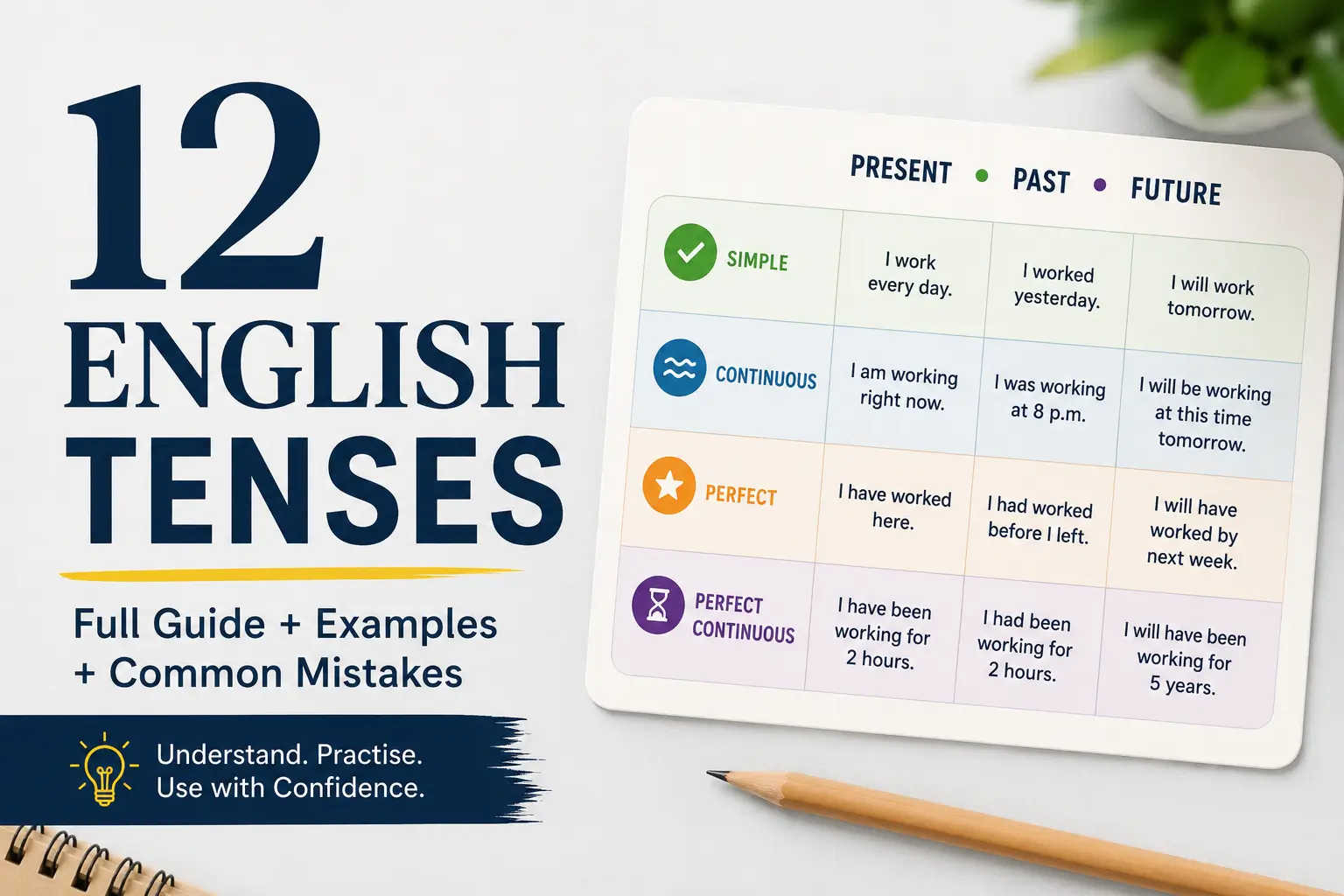
Here is a quick English tenses chart showing all 12 tenses, their basic structure and a simple example.
| Time frame | Simple | Continuous | Perfect | Perfect continuous |
| Present | I study. | I am studying. | I have studied. | I have been studying. |
| Past | I studied. | I was studying. | I had studied. | I had been studying. |
| Future | I will study. | I will be studying. | I will have studied. | I will have been studying. |
This table gives you the full system at a glance. In the next sections, we will break down each tense one by one, with clearer explanations, examples and common usage tips.
Get answers like this for your language questions
Your personal AI language tutor — adapts to your native language, your level, and the words that actually trip you up.
Present Tenses
The present tenses are used to talk about actions, habits, facts, experiences, and situations connected to the present. However, “present” does not always mean “happening right now”. Some present tenses describe regular actions, while others describe actions in progress, life experiences, or actions that started in the past and continue now.
Present Simple
The present simple is used for habits, facts, routines, general truths, and repeated actions.
Structure:
subject + base verb
For he, she and it, add -s or -es to the verb.
| Subject | Verb form | Example |
| I / you / we / they | base verb | I drink coffee. |
| he / she / it | verb + s/es | She drinks coffee. |
Examples:
- She drinks coffee every morning.
- They live in London.
- The sun rises in the east.
- I study English after work.
When to use the present simple:
Use the present simple when you are talking about something that happens regularly, something that is generally true, or something that is part of a routine.
Common mistake:
Many learners forget to add -s or -es with he, she and it.
Incorrect: She drink coffee every morning.
Correct: She drinks coffee every morning.
Present Continuous
The present continuous is used for actions happening now, temporary situations, and changes happening around the present time.
Structure:
am/is/are + verb-ing
| Subject | Form | Example |
| I | am + verb-ing | I am studying. |
| he / she / it | is + verb-ing | She is studying. |
| you / we / they | are + verb-ing | They are studying. |
Examples:
- They are watching a film right now.
- I am working on a new project this week.
- She is learning English at the moment.
- The weather is getting colder.
When to use the present continuous:
Use the present continuous when an action is happening now, around now, or for a temporary period of time.
Common mistake:
Some learners use the present continuous with stative verbs. Stative verbs usually describe thoughts, feelings, possession, senses, or states, so they are not normally used in the continuous form.
Incorrect: I am knowing the answer.
Correct: I know the answer.
Incorrect: She is liking this song.
Correct: She likes this song.
Present Perfect
The present perfect connects the past with the present. It is used for past actions that have a result or relevance now, life experiences, and actions that happened at an unspecified time before now.
Structure:
have/has + past participle
| Subject | Form | Example |
| I / you / we / they | have + past participle | I have visited Paris. |
| he / she / it | has + past participle | She has visited Paris. |
Examples:
- I have visited Paris twice.
- She has finished her homework.
- We have seen that film before.
- They have lived here for five years.
When to use the present perfect:
Use the present perfect when the exact time is not the main focus, or when a past action is connected to the present.
For example:
- I have lost my keys.
This means the keys are lost now. - She has finished her work.
This means the work is complete now.
Common mistake:
Learners often confuse the present perfect with the past simple. Use the past simple when you mention a finished time, such as yesterday, last week, in 2020, or two days ago.
Incorrect: I have visited Paris last year.
Correct: I visited Paris last year.
Correct: I have visited Paris twice.
Present Perfect Continuous
The present perfect continuous is used for actions that started in the past and continue into the present, or actions that have recently stopped but still have a present result.
Structure:
have/has + been + verb-ing
| Subject | Form | Example |
| I / you / we / they | have been + verb-ing | I have been studying. |
| he / she / it | has been + verb-ing | She has been studying. |
Examples:
- She has been studying for three hours.
- I have been learning English since January.
- They have been working all day.
- He has been running, so he is tired.
When to use the present perfect continuous:
Use the present perfect continuous when you want to emphasise the duration of an action, especially with words like for and since.
- Use for with a length of time: for three hours, for two years, for a long time.
- Use since with a starting point: since Monday, since 2020, since I was a child.
Common mistake:
Some learners use the present simple or present continuous when they should use the present perfect continuous for an action that started in the past and is still continuing.
Incorrect: I am studying English since January.
Correct: I have been studying English since January.
Incorrect: She studies for three hours.
Correct: She has been studying for three hours.
Past Tenses
The past tenses are used to talk about actions, situations, and events that happened before now. Some past tenses describe completed actions, while others show that something was in progress, happened before another past event, or continued for a period of time before something changed.
Past Simple
The past simple is used for completed actions that happened at a specific time in the past.
Structure:
subject + past form of verb
| Verb type | Form | Example |
| Regular verbs | verb + -ed | I worked yesterday. |
| Irregular verbs | irregular past form | He went home. |
Examples:
- He called me yesterday.
- We visited Rome last summer.
- She finished the report two hours ago.
- They moved house in 2021.
When to use the past simple:
Use the past simple when the action is finished and the time is clear, either because you say it directly or because the context makes it obvious.
Common time expressions include yesterday, last week, two years ago, in 2020, and when I was younger.
Common mistake:
Many learners use the present perfect when they should use the past simple with a finished time expression.
Incorrect: I have seen him yesterday.
Correct: I saw him yesterday.
Incorrect: She has moved house in 2021.
Correct: She moved house in 2021.
Past Continuous
The past continuous is used for an action that was in progress at a specific moment in the past. It is also often used for a longer background action that was interrupted by a shorter action.
Structure:
was/were + verb-ing
| Subject | Form | Example |
| I / he / she / it | was + verb-ing | I was cooking. |
| you / we / they | were + verb-ing | They were cooking. |
Examples:
- I was cooking when she arrived.
- They were watching TV at 8 p.m.
- She was studying while her brother was playing games.
- We were walking home when it started to rain.
When to use the past continuous:
Use the past continuous when you want to show that an action was already happening at a particular past moment.
It is often used with the past simple:
- The past continuous describes the longer action: I was cooking.
- The past simple describes the shorter interrupting action: she arrived.
Common mistake:
Learners sometimes use the past simple for both actions, which can make the timing less clear.
Less clear: I cooked when she arrived.
Clearer: I was cooking when she arrived.
Another common mistake is using the wrong form of was or were.
Incorrect: They was watching TV.
Correct: They were watching TV.
Past Perfect
The past perfect is used for an action that was completed before another action or point in the past.
Structure:
had + past participle
| Subject | Form | Example |
| all subjects | had + past participle | They had left. |
Examples:
- They had left before we got there.
- I had already eaten when he called.
- She had finished the course before she started her new job.
- We had never visited London before that trip.
When to use the past perfect:
Use the past perfect when you are talking about two past actions and you want to show which one happened first.
For example:
- They had left before we got there.
This means they left first, and we arrived later.
Common mistake:
Learners sometimes use the past simple for both actions when the order needs to be clear.
Less clear: They left before we got there.
Clearer: They had left before we got there.
However, do not overuse the past perfect. If the order is already obvious, the past simple is often enough.
Natural: I woke up, got dressed and went to work.
Unnatural: I had woken up, had got dressed and had gone to work.
Past Perfect Continuous
The past perfect continuous is used for an action that continued for a period of time before another past action or point in time.
Structure:
had + been + verb-ing
| Subject | Form | Example |
| all subjects | had been + verb-ing | He had been working. |
Examples:
- He had been working there for five years before he quit.
- I had been studying for hours when my friend called.
- They had been waiting for 30 minutes before the bus arrived.
- She had been feeling unwell, so she went home early.
When to use the past perfect continuous:
Use the past perfect continuous when you want to emphasise the duration of an action before another past event.
It is especially common with for and since:
- He had been working there for five years before he quit.
- She had been living in Madrid since 2019 when she moved back home.
Common mistake:
Learners often use the past continuous instead of the past perfect continuous when they need to show duration before another past event.
Incorrect: He was working there for five years before he quit.
Correct: He had been working there for five years before he quit.
Incorrect: They were waiting for 30 minutes before the bus arrived.
Correct: They had been waiting for 30 minutes before the bus arrived.
Future Tenses
The future tenses are used to talk about actions, events, predictions, plans, and situations that happen after now.
In English, the future is often formed with will, but different future tenses show different meanings. Some describe a simple future action, while others describe an action in progress, an action completed before a future point, or an action that continues up to a future time.
Future Simple (Will)
The future simple is used for predictions, spontaneous decisions, promises, offers, and future facts.
Structure:
will + base verb
| Subject | Form | Example |
| all subjects | will + base verb | I will call you. |
Examples:
- I will call you tomorrow.
- She will probably pass the exam.
- They will arrive at 6 p.m.
- Don’t worry, I will help you.
When to use the future simple:
Use the future simple when you are making a prediction, deciding something at the moment of speaking, making a promise, or talking about something you believe will happen.
For example:
- I think it will rain tomorrow.
- I’m tired. I will go to bed early.
- I will send you the file tonight.
Common mistake:
Learners sometimes add to after will, but this is incorrect. After will, use the base form of the verb.
Incorrect: I will to call you tomorrow.
Correct: I will call you tomorrow.
Another common mistake is using wills with he, she or it. Will does not change.
Incorrect: She wills call you.
Correct: She will call you.
Future Continuous
The future continuous is used for actions that will be in progress at a specific moment in the future.
Structure:
will + be + verb-ing
| Subject | Form | Example |
| all subjects | will be + verb-ing | I will be working. |
Examples:
- This time next week, I’ll be sitting on a beach.
- At 8 p.m., they will be watching the match.
- She will be studying when you arrive.
- We will be travelling all day tomorrow.
When to use the future continuous:
Use the future continuous when you want to show that an action will already be happening at a certain future time.
For example:
- At 10 a.m. tomorrow, I will be taking my exam.
This means the exam will be in progress at 10 a.m.
Common mistake:
Learners sometimes use the future simple when they need to show that an action will be in progress.
Less clear: At 10 a.m., I will take my exam.
Clearer: At 10 a.m., I will be taking my exam.
Another common mistake is forgetting be.
Incorrect: I will studying tomorrow morning.
Correct: I will be studying tomorrow morning.
Future Perfect
The future perfect is used for actions that will be completed before a specific point in the future.
Structure:
will + have + past participle
| Subject | Form | Example |
| all subjects | will have + past participle | She will have finished. |
Examples:
- By Friday, she will have finished the report.
- I will have completed the course by the end of the month.
- They will have arrived before dinner.
- By next year, we will have saved enough money.
When to use the future perfect:
Use the future perfect when you are looking ahead to a future point and talking about something that will already be complete by then.
It is often used with time expressions such as by Friday, by next year, by the time, and before.
For example:
- By 6 p.m., I will have finished work.
This means the work will be complete before or at 6 p.m.
Common mistake:
Learners sometimes use the future simple when they need to emphasise completion before a future time.
Less clear: By Friday, she will finish the report.
Clearer: By Friday, she will have finished the report.
Another common mistake is using the base verb instead of the past participle.
Incorrect: She will have finish the report.
Correct: She will have finished the report.
Future Perfect Continuous
The future perfect continuous is used to show the duration of an action up to a specific point in the future.
Structure:
will + have + been + verb-ing
| Subject | Form | Example |
| all subjects | will have been + verb-ing | They will have been waiting. |
Examples:
- By next year, they will have been married for 20 years.
- By 5 p.m., I will have been working for eight hours.
- She will have been studying English for two years by June.
- By the time he arrives, we will have been waiting for an hour.
When to use the future perfect continuous:
Use the future perfect continuous when you want to emphasise how long an action will have continued up to a future point.
It is commonly used with for plus a length of time:
- for 20 years
- for eight hours
- for two months
- for a long time
For example:
- By next month, I will have been living here for five years.
This means that, at that future point, the action will have continued for five years.
Common mistake:
Learners often use the future continuous instead of the future perfect continuous when they need to show duration up to a future point.
Incorrect: By 5 p.m., I will be working for eight hours.
Correct: By 5 p.m., I will have been working for eight hours.
Another common mistake is forgetting been.
Incorrect: They will have married for 20 years.
Correct: They will have been married for 20 years.
Incorrect: I will have studying for two hours.
Correct: I will have been studying for two hours.
Get answers like this for your language questions
Your personal AI language tutor — adapts to your native language, your level, and the words that actually trip you up.
The 12 English Tenses Chart (Free Download)
One of the easiest ways to understand English grammar tenses is to see them together in one clear chart. Instead of learning each tense in isolation, a chart helps you compare the structure, meaning, signal words and examples side by side.
You can use the English tenses chart below as a quick reference when writing, speaking, revising grammar, or checking which tense fits a sentence.
| Tense | Structure | Common signal words | Example |
| Present simple | subject + base verb (+ s/es) | always, usually, often, sometimes, every day | She drinks coffee every morning. |
| Present continuous | am/is/are + verb-ing | now, right now, at the moment, currently | They are watching a film right now. |
| Present perfect | have/has + past participle | already, yet, just, ever, never, before | I have visited Paris twice. |
| Present perfect continuous | have/has + been + verb-ing | for, since, all day, recently, lately | She has been studying for three hours. |
| Past simple | subject + past form of verb | yesterday, last week, ago, in 2020 | He called me yesterday. |
| Past continuous | was/were + verb-ing | while, when, at 8 p.m., all morning | I was cooking when she arrived. |
| Past perfect | had + past participle | before, after, already, by the time | They had left before we got there. |
| Past perfect continuous | had + been + verb-ing | for, since, before, all day | He had been working there for five years before he quit. |
| Future simple | will + base verb | tomorrow, next week, soon, later | I will call you tomorrow. |
| Future continuous | will + be + verb-ing | this time tomorrow, at 8 p.m., next week | This time next week, I’ll be sitting on a beach. |
| Future perfect | will + have + past participle | by Friday, by then, before, by the time | By Friday, she will have finished the report. |
| Future perfect continuous | will + have + been + verb-ing | for, since, by next year, by the time | By next year, they will have been married for 20 years. |
You can also turn this table into a downloadable PDF or printable image so you can keep it near your desk, save it on your phone, or use it when studying.
How to Use the Chart
Start by choosing the time frame: present, past, or future. Then ask what you want to show about the action.
Are you describing a habit or fact? Use a simple tense.
Are you describing an action in progress? Use a continuous tense.
Are you showing that something was completed before another time? Use a perfect tense.
Are you focusing on how long an action continued? Use a perfect continuous tense.
For example, if you want to talk about a routine, you might say:
- I study English every evening.
If you want to talk about something happening now, you might say:
- I am studying English right now.
If you want to talk about an experience, you might say:
- I have studied English before.
If you want to emphasise duration, you might say:
- I have been studying English for two years.
The chart works best when you do not just memorise the forms. Instead, compare the examples and notice how the meaning changes when the tense changes.
Signal Words Cheat Sheet
Signal words can help you identify which tense to use, but they are not perfect rules. Think of them as useful clues. The meaning of the sentence is always more important than one individual word.
| Signal word or phrase | Often used with | Example |
| always / usually / often | Present simple | She usually studies in the evening. |
| every day / every week | Present simple | I practise English every day. |
| now / right now | Present continuous | They are speaking now. |
| at the moment / currently | Present continuous | I am currently learning English. |
| already | Present perfect / past perfect | She has already finished. |
| yet | Present perfect | Have you finished yet? |
| just | Present perfect | I have just arrived. |
| ever / never | Present perfect | Have you ever visited London? |
| for | Perfect continuous tenses / perfect tenses | I have been studying for two hours. |
| since | Perfect continuous tenses / perfect tenses | She has lived here since 2020. |
| yesterday | Past simple | He called me yesterday. |
| last week / last year | Past simple | We travelled last year. |
| ago | Past simple | I started two years ago. |
| while | Past continuous | She was reading while I was cooking. |
| when | Past continuous / past simple | I was cooking when she arrived. |
| before / after | Past perfect / past simple | They had left before we arrived. |
| tomorrow | Future simple | I will call you tomorrow. |
| this time tomorrow | Future continuous | This time tomorrow, I will be flying to Spain. |
| by Friday / by next year | Future perfect / future perfect continuous | By Friday, I will have finished the project. |
| by the time | Perfect tenses | By the time you arrive, I will have been waiting for an hour. |
The most important signal words to remember are for and since. Use for with a length of time, such as “for two hours” or “for five years”. Use since with a starting point, such as “since Monday”, “since 2020”, or “since I was a child”.
—
H2: Common Mistakes English Learners Make With Tenses
Even when you understand the 12 English tenses, it is still easy to choose the wrong one in real sentences. Many mistakes happen because two tenses look similar, or because the learner translates directly from their first language.
Here are some of the most common tense mistakes English learners make and how to avoid them.
Present Perfect vs. Past Simple
One of the biggest mistakes is confusing the present perfect and the past simple.
Use the past simple when the action is finished and the time is clear or specific.
- I visited Paris last year.
- She finished the report yesterday.
- We met in 2020.
Use the present perfect when the exact time is not important, or when the past action is connected to the present.
- I have visited Paris twice.
- She has finished the report.
- We have met before.
The key difference is this:
| Use | Tense | Example |
| Finished action at a specific past time | Past simple | I saw him yesterday. |
| Past experience or action with present relevance | Present perfect | I have seen him before. |
Common mistake:
Incorrect: I have seen him yesterday.
Correct: I saw him yesterday.
Incorrect: She has visited London in 2022.
Correct: She visited London in 2022.
If you use a finished time expression, such as yesterday, last week, two years ago, or in 2020, the past simple is usually the correct choice.
Will vs. Going To
English learners often use will for every future sentence, but English has different ways to talk about the future.
Use will for predictions, promises, offers, and decisions made at the moment of speaking.
- I think it will rain tomorrow.
- I will help you with your homework.
- I’m tired. I will go to bed early.
Use going to for plans, intentions, and predictions based on present evidence.
- I am going to study tonight.
- She is going to start a new job next month.
- Look at those clouds. It is going to rain.
| Use | Form | Example |
| Spontaneous decision | will | I’ll call him now. |
| Plan or intention | going to | I’m going to call him tonight. |
| General prediction | will | I think they will win. |
| Prediction based on evidence | going to | They’re playing badly. They’re going to lose. |
Common mistake:
Less natural: I will visit my parents this weekend.
More natural if it is already planned: I am going to visit my parents this weekend.
Both can sometimes be grammatically possible, but the meaning changes. Will often sounds more immediate or less planned, while going to usually sounds more intentional.
Continuous With Stative Verbs
Another common mistake is using continuous tenses with stative verbs.
Stative verbs describe states, feelings, thoughts, possession, or senses. They are not usually used in continuous forms because they do not describe actions in progress.
Common stative verbs include:
| Type | Examples |
| Thoughts | know, believe, understand, remember |
| Feelings | like, love, hate, prefer, want |
| Possession | have, own, belong |
| Senses | see, hear, smell, taste |
| States | be, seem, need, mean |
Common mistake:
Incorrect: I am knowing the answer.
Correct: I know the answer.
Incorrect: She is liking this song.
Correct: She likes this song.
Incorrect: This bag is belonging to me.
Correct: This bag belongs to me.
However, some verbs can be both stative and active, depending on the meaning.
- I have a car.
This means possession, so it is stative. - I am having lunch.
This means eating, so it is an action. - I think you are right.
This means opinion, so it is stative. - I am thinking about the problem.
This means a mental action happening now.
Forgetting the Third-Person “S” in the Present Simple
In the present simple, verbs change with he, she and it. This is a small grammar point, but it is one of the most common mistakes in English.
| Subject | Correct form |
| I / you / we / they | work |
| he / she / it | works |
Common mistake:
Incorrect: She work in a school.
Correct: She works in a school.
Incorrect: He like football.
Correct: He likes football.
Incorrect: My brother study English.
Correct: My brother studies English.
Remember: if the subject is he, she, it, or one person or thing, add -s or -es in the present simple.
Using the Present Continuous Instead of the Present Perfect Continuous
Learners often use the present continuous when they talk about an action that started in the past and continues now. In many cases, the present perfect continuous is better.
Use the present continuous for something happening now or around now.
- I am studying English right now.
- She is working this week.
Use the present perfect continuous for something that started in the past and is still continuing.
- I have been studying English for two years.
- She has been working here since 2021.
Common mistake:
Incorrect: I am studying English since 2022.
Correct: I have been studying English since 2022.
Incorrect: He is working here for five years.
Correct: He has been working here for five years.
Use for with a length of time and since with the starting point.
- for two years
- for three hours
- since Monday
- since 2020
Overusing the Past Perfect
The past perfect is useful, but many learners use it too often. You only need the past perfect when you want to show that one past action happened before another past action.
Useful:
- They had left before we arrived.
- She had already eaten when I called.
But if the order of events is already clear, the past simple is often more natural.
Natural: I woke up, had breakfast and went to work.
Unnatural: I had woken up, had had breakfast and had gone to work.
Use the past perfect when it adds clarity. Do not use it for every past action.
Mixing Tenses Without a Clear Reason
Another common problem is switching between tenses in the same paragraph without a clear reason. This can make writing confusing.
Confusing:
- Yesterday, I go to the shop and I bought some food. Then I am meeting my friend.
Clearer:
- Yesterday, I went to the shop and bought some food. Then I met my friend.
Tense changes are not always wrong, but they should match the meaning. If you are telling a story about the past, stay mostly in past tenses. If you are talking about current habits, stay mostly in present tenses.
Before changing tense, ask yourself: has the time changed, or am I accidentally switching forms?
Quick Rule to Remember
When choosing a tense, do not start with the grammar name. Start with the meaning.
Ask yourself:
- Is the action in the present, past, or future?
- Is it simple, ongoing, completed, or continuing over time?
- Is there a signal word such as yesterday, since, for, already, or by the time?
- Is the exact time important?
- Is the action connected to now?
These questions will help you choose the correct tense more naturally.
Get answers like this for your language questions
Your personal AI language tutor — adapts to your native language, your level, and the words that actually trip you up.
How to Practice English Tenses (Without Memorising Tables)
Learning the 12 English tenses does not mean memorising grammar tables for hours. Tables are useful for understanding the structure, but real progress comes from using tenses in context.
The goal is to recognise why a tense is being used, then practise it in speaking, writing, listening and reading. When you connect grammar to real situations, English tenses become much easier to remember.
Tense-Focused Journaling Exercise
One of the best ways to practise English tenses is through short, focused journaling. Instead of writing randomly, choose one tense and write five to ten sentences using that tense.
Start with simple prompts like these:
| Tense focus | Journal prompt | Example sentence |
| Present simple | Write about your daily routine. | I wake up at 7 a.m. every day. |
| Present continuous | Write about what is happening around you now. | I am sitting at my desk and drinking coffee. |
| Present perfect | Write about life experiences. | I have visited three countries. |
| Present perfect continuous | Write about something you have been doing recently. | I have been learning English for two years. |
| Past simple | Write about yesterday. | I cooked dinner and watched a film. |
| Past continuous | Write about what was happening at a specific time. | At 8 p.m., I was talking to my friend. |
| Past perfect | Write about two past events and show which happened first. | I had finished my work before I went out. |
| Future simple | Write predictions or promises. | I will practise English tomorrow. |
A good exercise is to write the same idea in different tenses and notice how the meaning changes.
For example:
- I study English every day.
- I am studying English right now.
- I have studied English for two years.
- I have been studying English since 2022.
This helps you stop seeing tenses as separate rules and start seeing them as different ways to express meaning.
Conversation Prompts by Tense
Speaking practice is one of the fastest ways to make grammar feel natural. Choose one tense, answer a few questions aloud, and then try to continue the conversation using the same tense.
Here are some tense-focused conversation prompts:
| Tense | Conversation prompt |
| Present simple | What do you usually do in the morning? |
| Present continuous | What are you doing this week? |
| Present perfect | What is something you have done that you are proud of? |
| Present perfect continuous | What have you been working on recently? |
| Past simple | What did you do last weekend? |
| Past continuous | What were you doing at 8 p.m. yesterday? |
| Past perfect | What had you already done before you started work today? |
| Past perfect continuous | What had you been doing before you changed your plans? |
| Future simple | What do you think will happen this year? |
| Future continuous | What will you be doing this time tomorrow? |
| Future perfect | What will you have achieved by the end of the year? |
| Future perfect continuous | What will you have been doing for a long time by next year? |
To make this more effective, record yourself answering. Then listen back and check three things:
- Did you use the correct tense structure?
- Did the tense match the meaning?
- Did your sentence sound natural?
You do not need to speak perfectly. The aim is to become more aware of how tenses work in real communication.
Use Shadowing to Absorb Tenses Naturally
Shadowing means listening to a sentence and repeating it shortly after the speaker. It helps you learn grammar, rhythm, pronunciation and sentence patterns at the same time.
Choose a short clip from a podcast, YouTube video, TV show or language-learning resource. Listen to one sentence, pause, repeat it aloud, and notice the tense.
For example:
- “I’ve been working on this all week.”
- “She was waiting outside.”
- “We’ll be leaving soon.”
Do not only ask, “What does this sentence mean?” Also ask, “Why did the speaker choose this tense?”
This turns listening practice into grammar practice without making it feel like a textbook exercise.
Watch TV With Subtitles and Hunt for Tenses
TV shows, films and interviews are useful because they show English tenses in real situations. Watch with English subtitles and look for examples of the tenses you are learning.
You can make this simple:
- Choose one tense before you start watching.
- Write down three examples you hear.
- Pause and ask why that tense was used.
- Create your own sentence using the same pattern.
For example, if you are practising the present perfect, listen for sentences like:
- “I’ve never seen that before.”
- “She’s already left.”
- “Have you finished yet?”
This helps you connect grammar to real speech, not just written examples.
Recommended Resources
You do not need dozens of resources to improve your English tenses. A few good tools, used consistently, are much more useful.
| Resource type | How to use it |
| Grammar guides | Use them to understand the rule and check examples. |
| English subtitles | Use them to notice tenses in real conversations. |
| Journaling | Use it to practise forming sentences correctly. |
| Conversation practice | Use it to make grammar automatic when speaking. |
| AI tutors or language partners | Use them to correct your tense mistakes and give you new prompts. |
For serious progress, combine three types of practice:
- Input: read and listen to English regularly.
- Output: write and speak using specific tenses.
- Feedback: check your mistakes and rewrite or repeat the sentence correctly.
This is much more effective than memorising a chart alone. The chart gives you the structure, but practice helps you use the tenses naturally.