
|
Getting your Trinity Audio player ready...
|
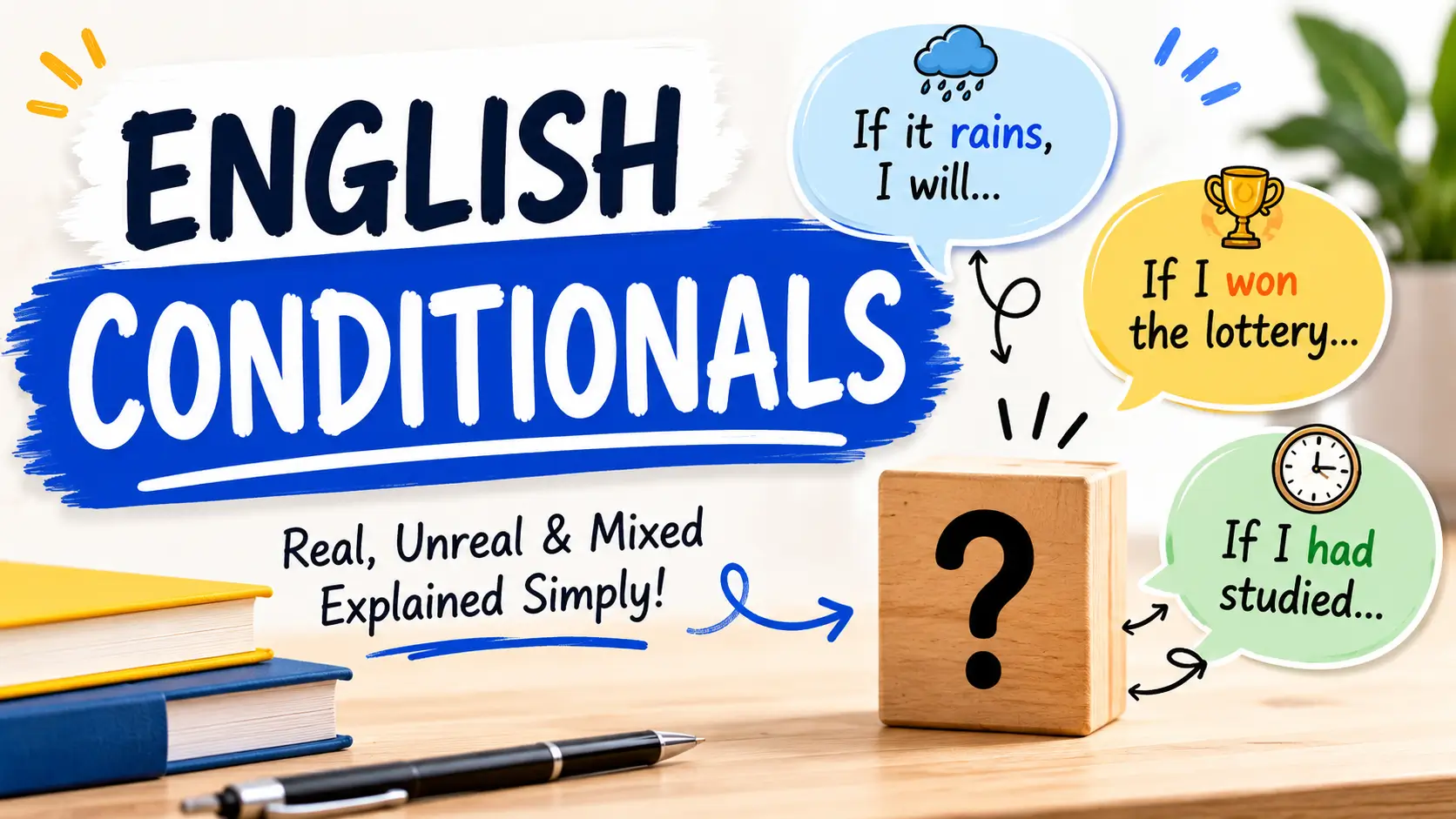
TL;DR: English conditionals help you talk about causes, consequences, possibilities, hypothetical situations, and past regrets. If you want to understand or use conditions in English, it’s useful to know the different types: real conditionals describe likely or factual situations, unreal conditionals explore imaginary or unlikely scenarios, and mixed conditionals connect different time periods, often showing how past actions affect the present.
English conditionals can seem intimidating at first, but they follow clear patterns that are surprisingly easy to master once you understand the basics.
From talking about real possibilities and plans to imagining hypothetical situations and past regrets, conditionals help you express a wide range of ideas in everyday English.
Importance of understanding conditionals for effective communication
Conditionals play a vital role in effective communication because they allow us to discuss possibilities, consequences, hypothetical situations, advice, plans, and past regrets.
Whether you’re making predictions, giving suggestions, negotiating, or explaining cause and effect, conditionals help you express ideas clearly and accurately.
A strong understanding of conditionals also improves both spoken and written English, enabling you to communicate more naturally and understand native speakers with greater confidence.
Get answers like this for your language questions
Your personal AI language tutor — adapts to your native language, your level, and the words that actually trip you up.
What Are Conditionals?
Conditionals are one of the most important grammar structures in English. They allow us to talk about causes and consequences, future possibilities, imaginary situations, and even events that could have happened differently in the past.
By understanding how conditionals work, you can express ideas more clearly and communicate with greater accuracy in both everyday conversations and formal writing.
The structure of conditional sentences
Conditional sentences are made up of two parts: the if clause (the condition) and the main clause (the result).
The if clause introduces a situation or condition, while the main clause explains what happens if that condition is met. Together, these clauses create a logical relationship between an action and its outcome.
Importance of the “if” clause and the main clause
The if clause and the main clause work together to give a conditional sentence its meaning.
The if clause tells us what must happen first, while the main clause shows the consequence or result.
The role of each clause is essential for using conditionals correctly and expressing ideas about real, unreal, and hypothetical situations with confidence.
Real Conditionals
Real conditionals are used to talk about situations that are possible, likely, or generally true. They describe real-world conditions and the results that can reasonably be expected if those conditions occur.
Native speakers use real conditionals frequently when discussing future plans, giving advice, explaining routines, and describing cause-and-effect relationships.
Explanation of real conditionals
A real conditional describes a situation that has a genuine possibility of happening. The result depends on whether the condition is met.
The situation is realistic, real conditionals are commonly used in everyday conversations, instructions, predictions, and practical discussions.
Structure: “If + present simple, will + base verb”
The most common structure for a real conditional is:
\text{If + Present Simple, Will + Base Verb}
The condition appears in the if clause, while the expected result appears in the main clause.
Examples:
- If it rains, we will stay indoors.
- If you study regularly, you will improve your English.
- If she arrives early, we will start the meeting on time.
Examples of real conditionals in everyday situations
Real conditionals appear in many everyday contexts where a future result depends on a possible action or event.
Examples:
- If I finish work early, I will go to the gym.
- If you don’t water the plants, they will die.
- If they win the match, they will qualify for the final.
- If we leave now, we will catch the train.
These sentences describe situations that could realistically happen.
Usage scenarios: facts, habits, and general truths
Real conditionals are not only used for future possibilities. They can also describe facts, routines, and general truths when the result is always true under certain conditions.
Facts and General Truths
- If you heat water to 100°C, it boils.
- If you don’t eat, you get hungry.
- If ice melts, it becomes water.
Habits and Routines
- If I have time after work, I go for a walk.
- If she feels stressed, she listens to music.
- If they visit their grandparents, they stay for the weekend.
In these cases, the conditional expresses something that regularly happens or is universally true rather than a specific future event.
Unreal Conditionals
Unreal conditionals are used to talk about imaginary, unlikely, or impossible situations. Unlike real conditionals, they describe events that are not true now or are unlikely to happen in the future.
These structures allow speakers to discuss dreams, wishes, hypothetical scenarios, and situations that exist only in the imagination.
Definition and explanation of unreal conditionals
An unreal conditional describes a situation that is contrary to reality or unlikely to occur. Instead of discussing real possibilities, it explores what would happen if circumstances were different.
Native speakers frequently use unreal conditionals when giving advice, imagining alternative outcomes, or talking about personal goals and ambitions.
Structure: “If + past simple, would + base verb”
The standard structure for an unreal conditional is:
\text{If + Past Simple, Would + Base Verb}
Although the English verb in the if clause uses the past simple, the sentence usually refers to a present or future situation rather than the past.
Examples:
- If I had more free time, I would learn another language.
- If she lived closer, she would visit more often.
- If they won the lottery, they would travel around the world.
Examples of unreal conditionals in hypothetical situations
Unreal conditionals are useful when imagining situations that are not currently true.
Examples:
- If I were a millionaire, I would start my own charity.
- If we had a bigger house, we would invite more guests.
- If he spoke Spanish fluently, he would apply for the job.
- If they knew the answer, they would tell us.
These examples describe situations that are imagined rather than real.
Usage scenarios: wishes, dreams, and unlikely events
Unreal conditionals often appear when people talk about things they would like to happen or situations that are unlikely to become reality.
Wishes
- If I had more spare time, I would read more books.
- If she were here, we would celebrate together.
Dreams and Ambitions
- If I could live anywhere in the world, I would choose New Zealand.
- If we had unlimited funding, we would expand the project globally.
Unlikely Events
- If it snowed in the desert, everyone would be surprised.
- If humans could fly naturally, transport would look very different.
By using unreal conditionals, speakers can explore possibilities beyond current reality and express ideas about what might happen under different circumstances.
Get explanations like this for your English questions
Personalised to your native language and level. Free to start, no card needed.
Mixed Conditionals
Mixed conditionals combine elements of different conditional structures to connect two different time periods.
They are commonly used when a past action affects a present situation, or when a present situation influences a hypothetical past outcome.
While they can seem more advanced than other conditionals, mixed conditionals allow speakers to express complex relationships between past and present events with precision
Explanation of mixed conditionals
A mixed conditional links a condition from one time frame with a result from another.
Most often, it describes how a different action in the past would have changed the present. Mixed conditionals help us explore alternative realities and explain the lasting effects of past decisions
Structure variations: combining elements of real and unreal conditionals
The most common mixed conditionals combine a past unreal condition with a present unreal result:
\text{If + Past Perfect, Would + Base Verb}
Examples:
- If I had studied medicine, I would be a doctor now.
- If she had accepted the offer, she would work there today.
- If they had left earlier, they would be here now.
A less common variation describes how a present condition affects a hypothetical past result:
\text{If + Past Simple, Would Have + Past Participle}
Examples:
- If I were more organised, I would have finished the project on time.
- If he spoke French, he would have understood the conversation.
- If we lived closer, we would have attended the event.
Examples of Mixed Conditionals to Illustrate Complex Scenarios
Mixed conditionals are useful when cause and effect occur in different time periods.
Examples:
- If I had taken that job, I would live in London now.
- If she had learned to drive earlier, she would be more independent today.
- If they weren’t so busy now, they would have joined us last weekend.
- If he had saved more money, he wouldn’t be worried about expenses today.
These sentences show how one situation influences another across time.
Usage scenarios: past actions affecting present situation
The most common use of mixed conditionals is to discuss how past decisions continue to influence the present.
Career and Education
- If I had gone to university abroad, I would have a larger professional network now.
- If she had studied engineering, she would work in a different industry today.
Relationships and Personal Choices
- If we had met earlier, we would know each other much better now.
- If he had moved closer to his family, he would see them more often today.
Life Outcomes
- If they had invested in the company years ago, they would be wealthy now.
- If I had learned Spanish sooner, I would feel much more confident travelling today.
Mixed conditionals are particularly valuable because they allow speakers to analyse decisions, reflect on outcomes, and describe the lasting consequences of actions across different points in time.
Common Mistakes with Conditionals
Conditionals can be challenging because they require specific verb forms and clear distinctions between real and hypothetical situations.
Many English learners understand the basic concepts but make mistakes when choosing the correct tense or conditional type. These common errors can help you use conditionals more accurately and naturally.
Frequent errors learners make
One of the most common problems is mixing the structures of different conditionals.
Learners may use the wrong verb tense, include will in the if clause, or confuse situations that are real with those that are hypothetical. These mistakes can make sentences sound unnatural or change their intended meaning.
Incorrect: If it will rain, we will stay inside.
Correct: If it rains, we will stay inside.
Incorrect: If I would have more time, I would travel more.
Correct: If I had more time, I would travel more.
Misusing verb tenses in conditional sentences
Each conditional type follows a specific tense pattern. Using the wrong tense is one of the most frequent errors learners make.
Incorrect: If I study hard, I would pass the exam.
Correct: If I study hard, I will pass the exam.
Incorrect: If she had a car, she will drive to work.
Correct: If she had a car, she would drive to work.
Incorrect: If they had left earlier, they would arrive on time.
Correct: If they had left earlier, they would have arrived on time.
Learning the standard structures for each conditional type helps prevent these errors and improves grammatical accuracy.
Confusing real and unreal conditionals
Another common mistake is using a real conditional when the situation is imaginary, or using an unreal conditional when the situation is realistic.
Real Conditional (possible situation):
- If I save enough money, I will buy a new laptop.
Unreal Conditional (imaginary situation):
- If I had a million pounds, I would buy a yacht.
Learners sometimes mix these forms:
Incorrect: If I save enough money, I would buy a new laptop.
Correct: If I save enough money, I will buy a new laptop.
Whether a situation is realistic or hypothetical is essential for choosing the correct conditional structure.
Before forming a sentence, ask yourself whether the condition is likely to happen or whether it exists only in your imagination. This simple step can help you avoid many common conditional errors.
Tips for Mastering Conditionals
Conditionals become much easier once you stop memorising rules and start recognising patterns in real English.
Regular practice, exposure to authentic examples, and active use of conditional structures can help you build confidence and use them naturally in both speaking and writing
Practical strategies for learning and practising conditionals
Focus on understanding when each condition is used rather than simply memorising formulas.
Start by identifying whether a situation is real, hypothetical, or connected to the past. This makes it much easier to choose the correct structure.
Some effective learning strategies include:
- Learn one conditional type at a time before moving to the next.
- Create your own example sentences based on real-life situations.
- Pay attention to conditionals in books, films, podcasts, and conversations.
- Practise transforming sentences from one conditional type to another.
- Use conditionals regularly when speaking about plans, goals, and possibilities.
The more often you use conditionals in meaningful contexts, the more natural they will become.
Engaging activities and exercises to reinforce understanding
Active practice helps turn grammar knowledge into real communication skills. Try activities that encourage you to think about conditions and results in different situations.
Sentence Completion
- If I had more free time, I would…
- If it rains tomorrow, I will…
- If I had studied harder, I would have…
What Would You Do? Scenarios
Imagine hypothetical situations and discuss your responses.
- What would you do if you won the lottery?
- What would you do if you could travel anywhere in the world?
Story Building
Create short stories using multiple conditional sentences to describe possible outcomes and alternative scenarios.
Error Correction
Review incorrect conditional sentences and identify the mistakes. This helps reinforce the correct structures and improves accuracy.
Resources for further study (books, websites, apps)
A variety of resources can help you continue developing your understanding of conditionals and English grammar as a whole.
Books
- English Grammar in Use by Raymond Murphy
- Practical English Usage by Michael Swan
- Advanced Grammar in Use by Martin Hewings
Websites
Apps
Combining grammar study with regular reading, listening, speaking, and writing practice will help you improve conditionals quickly and use them confidently in real-world communication.
Get explanations like this for your English questions
Personalised to your native language and level. Free to start, no card needed.
Real-Life Applications of Conditionals
Conditionals are not just grammar rules found in textbooks. They are an essential part of everyday communication, helping us discuss possibilities, consequences, plans, advice, and hypothetical situations.
Whether you’re having a casual conversation, writing a story, or making a persuasive argument, conditionals allow you to express complex ideas clearly and naturally.
How conditionals are used in everyday conversations
Native speakers use conditionals constantly in daily life. They help people make plans, give advice, discuss possibilities, and imagine different outcomes.
Examples:
- If the weather is nice, we’ll go to the park.
- If you need help, just let me know.
- If I had more time, I’d learn another language.
- If we had left earlier, we wouldn’t have missed the train.
From simple decisions to hypothetical discussions, conditionals make conversations more flexible and expressive.
Importance in writing: storytelling, persuasive writing, and more
Conditionals play an important role in many forms of writing because they allow writers to explore possibilities, consequences, and alternative outcomes.
Storytelling
Writers use conditionals to create tension, explore “what if” scenarios, and show how different choices could affect a story.
- If the character had listened to the warning, the disaster might have been avoided.
Persuasive Writing
Conditionals help writers demonstrate potential benefits or consequences.
- If governments invest more in education, future generations will have greater opportunities.
Academic and Professional Writing
Conditionals are often used to discuss theories, predictions, recommendations, and hypothetical situations.
- If the proposed strategy is implemented, productivity could increase significantly.
Examples from literature and media
Conditionals appear frequently in books, films, television, speeches, and song lyrics because they help express possibility, regret, imagination, and consequence.
Literature
Authors often use conditionals to explore alternative outcomes and character decisions.
- If he had known the truth, he would have acted differently.
Films and Television
Characters regularly use conditionals when making plans, discussing risks, or imagining different futures.
- If we don’t leave now, we’ll be too late.
- If I were you, I’d take the opportunity.
Media and Advertising
Advertisers often use conditionals to highlight benefits and encourage action.
- If you sign up today, you’ll receive a free trial.
- If you’re looking for better results, this solution could help.
By recognising conditionals in everyday communication, you’ll start to understand how naturally they are used and become more confident using them yourself.
Get explanations like this for your English questions
Personalised to your native language and level. Free to start, no card needed.
Conditions in English FAQs
What are conditionals in English grammar?
Conditionals are sentence structures used to describe a condition and its result. They typically contain an if clause and a main clause, allowing speakers to discuss real situations, possibilities, hypothetical events, and past outcomes.
What is the difference between real and unreal conditionals?
Real conditionals describe situations that are possible or likely to happen, while unreal conditionals describe imaginary, unlikely, or impossible situations. Real conditionals often use “will” for future results, whereas unreal conditionals commonly use “would”.
What are mixed conditionals used for?
Mixed conditionals connect different time periods, usually showing how a past action affects a present situation. They are useful for discussing the lasting consequences of decisions and events.
Can I use “will” in the if clause?
In most standard conditional sentences, “will” should not be used in the if clause. For example, “If it rains, we will stay inside” is correct, while “If it will rain, we will stay inside” is generally incorrect.
Why are conditionals important in everyday English?
Conditionals are essential because they help people discuss possibilities, make plans, give advice, express wishes, describe consequences, and explore hypothetical situations. They are commonly used in conversations, writing, media, and professional communication.