|
Getting your Trinity Audio player ready...
|
TL;DR: The Blagar language is an indigenous language spoken primarily on Pura Island in eastern Indonesia. Although it remains an important part of the Blagar people’s cultural identity, it faces growing challenges from language shift, limited institutional support, and socioeconomic change. Efforts to preserve Blagar include community-led initiatives, linguistic documentation, and educational projects.
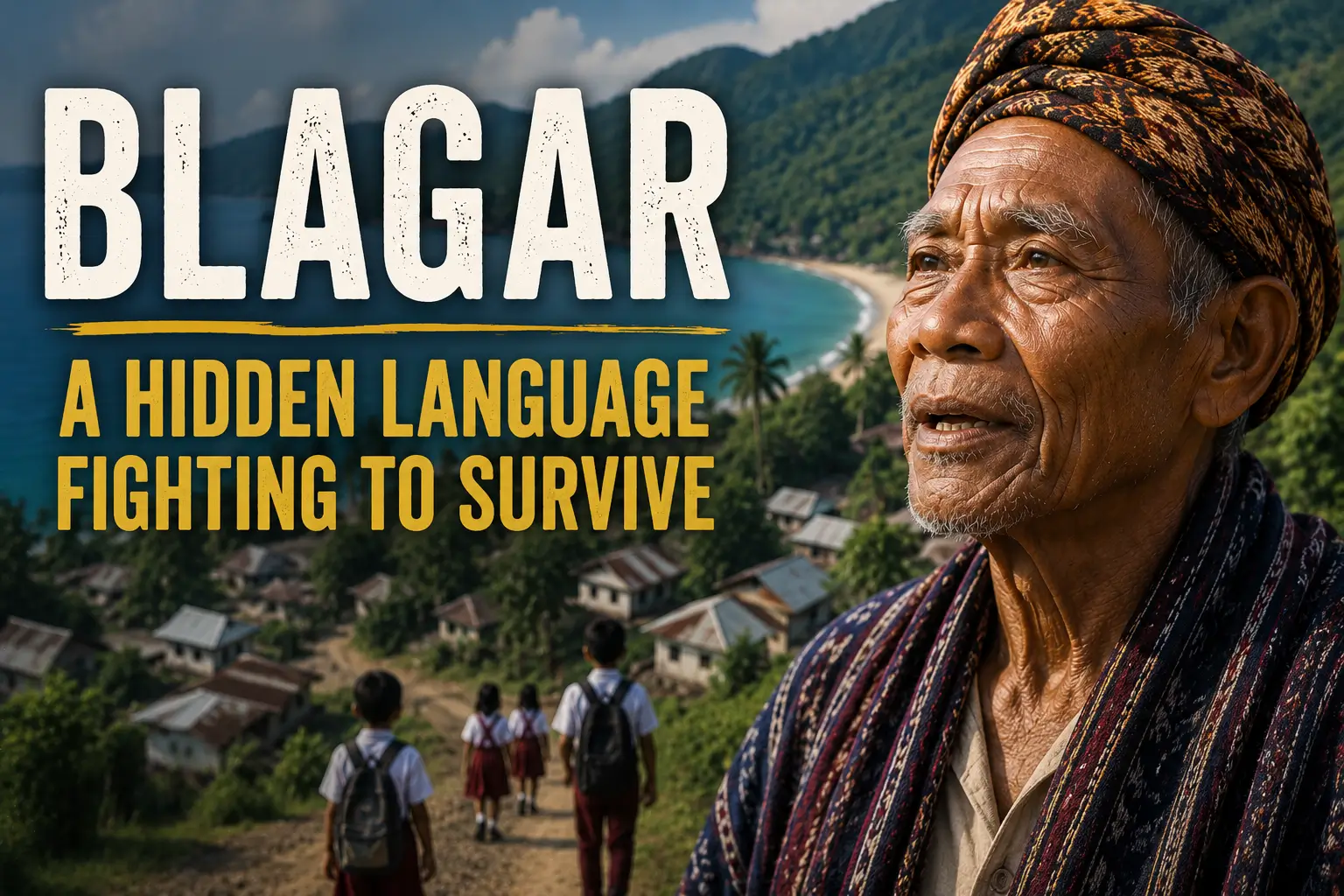
A community on the small Indonesian island of Pura speaks the Blagar language, but its linguistic heritage faces increasing threats.
While it may be unfamiliar to most of the world, Blagar represents centuries of history, culture, and identity passed from one generation to the next.
Today, however, the language faces growing challenges. As younger speakers shift towards more dominant languages, Blagar risks becoming another entry on the long list of endangered languages fighting to survive in the modern world.
The Origins of Blagar
Blagar speakers have passed down their language through generations, making it a central part of their history and cultural identity.
Understanding where the language comes from, how it has developed, and why it remains culturally important provides valuable insight into both the Blagar community and the challenges facing indigenous languages today.
Historical background
The Blagar language is spoken by the Blagar people of Pura Island, a small volcanic island in Indonesia’s Alor Archipelago.
It belongs to the Alor-Pantar language family, a group of indigenous languages that are unrelated to the Austronesian languages spoken across much of Indonesia.
Linguists believe these languages have deep roots in the region, with their origins stretching back thousands of years.
Cultural significance within the Blagar community
For generations, Blagar has been at the heart of community life.
The language carries traditional knowledge, oral histories, folklore, songs, and cultural practices that help preserve the identity of the Blagar people.
It serves as a living connection between past and present, helping each generation pass cultural traditions and local wisdom on to the next.
Evolution of the language over time
Like all living languages, Blagar has changed over time. Contact with neighbouring communities, trade, migration, and the spread of Indonesian have all influenced its development.
Many Blagar speakers are bilingual, using both Blagar and Indonesian in different aspects of daily life.
While the language remains an important part of local identity, changing social and educational environments have contributed to a gradual decline in its use among younger generations
Current Status of Blagar
The Blagar language remains an important part of life for many people on Pura Island, but its future is uncertain.
Like numerous indigenous languages around the world, Blagar faces declining speaker numbers and increasing competition from more dominant languages.
Its current status helps highlight both the challenges it faces and the urgency of preservation efforts.
Number of speakers today
Recent linguistic research estimates that several thousand people speak Blagar, primarily within the Alor Archipelago of eastern Indonesia.
Exact figures vary between sources, but the number of fluent speakers remains relatively small compared to Indonesia’s major languages.
The greatest concern is not the total number of speakers alone but the declining transmission of the language to younger generations.
Geographic distribution
Blagar is spoken mainly on Pura Island, located between Alor and Pantar Islands in East Nusa Tenggara Province.
Smaller communities of Blagar speakers also live on neighbouring islands due to migration and family connections.
However, the language’s geographic range remains limited, making it particularly vulnerable to social and demographic changes.
Comparison with other endangered languages
While Blagar is not among the world’s most critically endangered languages, it faces many of the same challenges that affect minority languages worldwide.
Similar to languages such as Kusunda and Ayapaneco, Blagar faces pressure from dominant national languages, changing educational systems, and shifting cultural priorities.
Unlike some languages with only a handful of older speakers remaining, Blagar still retains an active speech community. This gives it a stronger foundation for long-term preservation if revitalisation efforts continue
Factors Contributing to Endangerment
The decline of the Blagar language is not the result of a single issue.
Instead, a combination of social, economic, and cultural pressures has changed how successive generations use the language.
These challenges are common among endangered languages worldwide and continue to threaten the long-term survival of Blagar.
Globalisation and cultural assimilation
As education, media, technology, and migration connect Indonesia more closely, many younger Blagar speakers encounter Indonesian and other dominant languages from an early age.
While these languages provide access to wider opportunities, they can also reduce the use of Blagar in daily life.
Over time, families may choose to prioritise national or regional languages, leading to a gradual shift away from their ancestral language.
Lack of institutional support
Blagar receives limited support within formal institutions.
Indonesian is the primary language used in schools, government services, and much of public life, leaving few opportunities for Blagar to be taught or used in official settings.
Without strong educational programmes, language resources, or government-backed preservation initiatives, maintaining fluency among younger generations becomes increasingly difficult.
Socioeconomic challenges faced by the Blagar community
Economic factors also play a significant role in language endangerment. Many young people leave their local communities in search of education, employment, or better opportunities elsewhere.
As people move away from traditional Blagar-speaking environments, they often rely more heavily on dominant languages for work and communication.
This can weaken intergenerational language transmission and reduce the number of situations in which Blagar is actively spoken.
The Role of Language in Identity
Language is far more than a way to communicate. For the Blagar people, it is a vital part of their cultural identity, connecting individuals to their history, traditions, and community.
As the language faces increasing pressure, concerns extend beyond words themselves to the potential loss of cultural knowledge and social bonds
How Blagar shapes cultural identity
Blagar reflects the unique heritage of the community that speaks it.
Through the language, cultural values, oral traditions, local knowledge, and historical experiences are passed from one generation to the next.
Speaking Blagar helps reinforce a sense of belonging and preserves a distinct identity within Indonesia’s rich linguistic and cultural landscape
Personal stories from Blagar speakers
Many Blagar speakers view the language as an important link to their ancestors and community traditions.
Elders often use it to share stories, songs, and cultural practices that cannot always be fully expressed in other languages.
While documented personal accounts remain limited, language preservation efforts frequently highlight the pride many speakers feel in maintaining their linguistic heritage despite growing external pressures.
The impact of language loss on community cohesion
When a language declines, communities risk losing more than vocabulary and grammar.
Language loss can weaken connections between generations, reduce access to traditional knowledge, and erode cultural practices that rely on shared understanding.
For the Blagar community, preserving the language helps strengthen social cohesion, maintain cultural continuity, and ensure that future generations remain connected to their heritage
Efforts to Revitalise Blagar
Despite the challenges facing the Blagar language, there are growing efforts to document, preserve, and promote its use.
While resources remain limited, community members, educators, and researchers recognise the importance of ensuring that future generations can continue to speak and understand the language.
Community initiatives and grassroots movements
Local communities play the most important role in keeping Blagar alive.
Families, elders, and community leaders help preserve the language by continuing to use it in daily life, cultural events, storytelling, and traditional ceremonies.
These grassroots efforts strengthen intergenerational language transmission and help maintain the cultural identity tied to the language
Educational programmes and language classes
Although Blagar is not widely taught within Indonesia’s formal education system, language documentation projects and local educational initiatives have helped raise awareness of its importance.
Linguists and cultural organisations have worked alongside local communities to record vocabulary, grammar, and oral traditions. Creating valuable resources that can support future language-learning programmes.
Use of technology and social media in preservation efforts
Modern technology offers new opportunities for language preservation.
Digital archives, audio recordings, online dictionaries, and social media platforms can help document and share Blagar with wider audiences.
Technology-based initiatives for Blagar remain relatively limited compared to larger endangered-language projects. Digital tools have the potential to make learning resources more accessible and encourage younger generations to engage with their linguistic heritage.
The Importance of Documentation
Documenting endangered languages is one of the most effective ways to preserve them for future generations.
Even when a language faces declining use, detailed records of its vocabulary, grammar, pronunciation, and cultural traditions can help ensure that valuable knowledge is not lost.
For Blagar, linguistic documentation plays a crucial role in both preservation and revitalisation efforts.
Linguistic research and its role in preservation
Linguists have studied Blagar to better understand its structure, history, and relationship to other languages in the Alor-Pantar language family.
This research helps create written records of the language while also increasing awareness of its cultural significance.
By documenting how Blagar is spoken today, researchers provide important resources that can support education, revitalisation, and future academic study
Projects aimed at recording and archiving the language
A number of language documentation projects have focused on recording Blagar speakers and preserving linguistic data. These efforts often include audio recordings, word lists, dictionaries, grammatical descriptions, and collections of oral histories.
Such archives help safeguard the language and provide future generations with access to authentic examples of how Blagar is spoken and used within the community.
Collaborations with universities and linguistic organisations
Much of the research on Blagar has been carried out through partnerships between local communities, universities, and linguistic organisations.
These collaborations bring together academic expertise and community knowledge to create more comprehensive records of the language.
Researchers can help ensure that documentation efforts respect cultural traditions while contributing to the long-term preservation of Blagar and other endangered languages.
Global Perspectives on Language Preservation
The challenges facing Blagar are not unique.
Thousands of languages around the world are at risk of disappearing, prompting communities, governments, and organisations to develop innovative approaches to language preservation.
Examining these efforts provides valuable lessons for protecting Blagar and other endangered languages
Case studies of other endangered languages
Several endangered languages have experienced remarkable revitalisation efforts.
The Māori language in New Zealand has seen significant growth through immersion schools, media broadcasting, and government support. Similarly, Welsh has benefited from bilingual education, official recognition, and widespread public use.
In North America, many Indigenous communities have launched language nests, digital resources, and community-led teaching programmes to strengthen language transmission among younger generations.
Lessons learned from successful revitalisation efforts
Successful language revitalisation efforts often share several key characteristics. Strong community involvement is essential, as languages are most effectively preserved when they remain part of everyday life.
Educational programmes, especially those aimed at children, help create new generations of speakers. Official recognition, accessible learning resources, and the use of technology can also significantly increase a language’s chances of survival.
These lessons highlight the importance of combining cultural pride with practical opportunities to learn and use the language.
The role of international organisations in supporting language diversity
International organisations play an important role in promoting linguistic diversity and raising awareness of language loss.
Organisations such as UNESCO support research, documentation, and advocacy efforts designed to protect endangered languages worldwide.
Through initiatives, funding programmes, and global awareness campaigns, these organisations encourage governments and communities to recognise linguistic diversity as an essential part of humanity’s cultural heritage.
How You Can Help
Protecting endangered languages is not solely the responsibility of governments, linguists, or local communities.
Individuals around the world can also play a role in raising awareness, supporting preservation efforts, and helping ensure that linguistic diversity continues to thrive.
Even small actions can contribute to the long-term survival of languages such as Blagar.
Ways to support the Blagar language and community
One of the most effective ways to help is by supporting organisations and researchers working with indigenous communities to document and preserve endangered languages.
Sharing information about Blagar, supporting cultural initiatives, and promoting respect for indigenous languages can also help increase public awareness of the challenges these communities face.
Resources for learning about and promoting Blagar
Although learning resources for Blagar are limited, linguistic research papers, endangered language databases, and academic publications provide valuable information about the language and its speakers.
Exploring these resources helps support a wider understanding of Blagar and highlights the importance of preserving lesser-known languages around the world.
Encouraging awareness and advocacy
Raising awareness remains one of the most powerful tools for language preservation.
By discussing endangered languages, sharing educational content, and advocating for stronger protections for indigenous communities, individuals can help bring greater attention to the issue of language loss.
Increased awareness often leads to greater support for documentation, revitalisation, and cultural preservation efforts. This helps languages like Blagar remain part of the world’s linguistic heritage for future generations.
Blagar Language FAQs
What is the Blagar language?
The Blagar language is an indigenous language spoken primarily on Pura Island in Indonesia’s Alor Archipelago. It belongs to the Alor-Pantar language family and is an important part of the cultural heritage of the Blagar people.
Is the Blagar language endangered?
Yes. While Blagar is still spoken by several thousand people, its use is declining among younger generations as Indonesian becomes more dominant in education, media, and everyday life.
Where is the Blagar language spoken?
Blagar is mainly spoken on Pura Island in East Nusa Tenggara Province, Indonesia. Smaller groups of speakers can also be found on nearby islands due to migration and family connections.
Why is the Blagar language important?
The language preserves traditional knowledge, oral histories, cultural practices, and community identity. It serves as a vital link between generations and helps maintain the unique heritage of the Blagar people.
What is being done to preserve the Blagar language?
Preservation efforts include linguistic research, language documentation projects, community-led initiatives, and the creation of educational and digital resources that help record and promote the language for future generations.