
|
Getting your Trinity Audio player ready...
|
TL;DR: The Bora language is a rare indigenous language spoken in parts of the Amazon rainforest in Peru and Colombia. Deeply connected to cultural identity, storytelling, and ancestral knowledge, Bora is now endangered due to language shift, modernisation, and declining numbers of younger speakers.
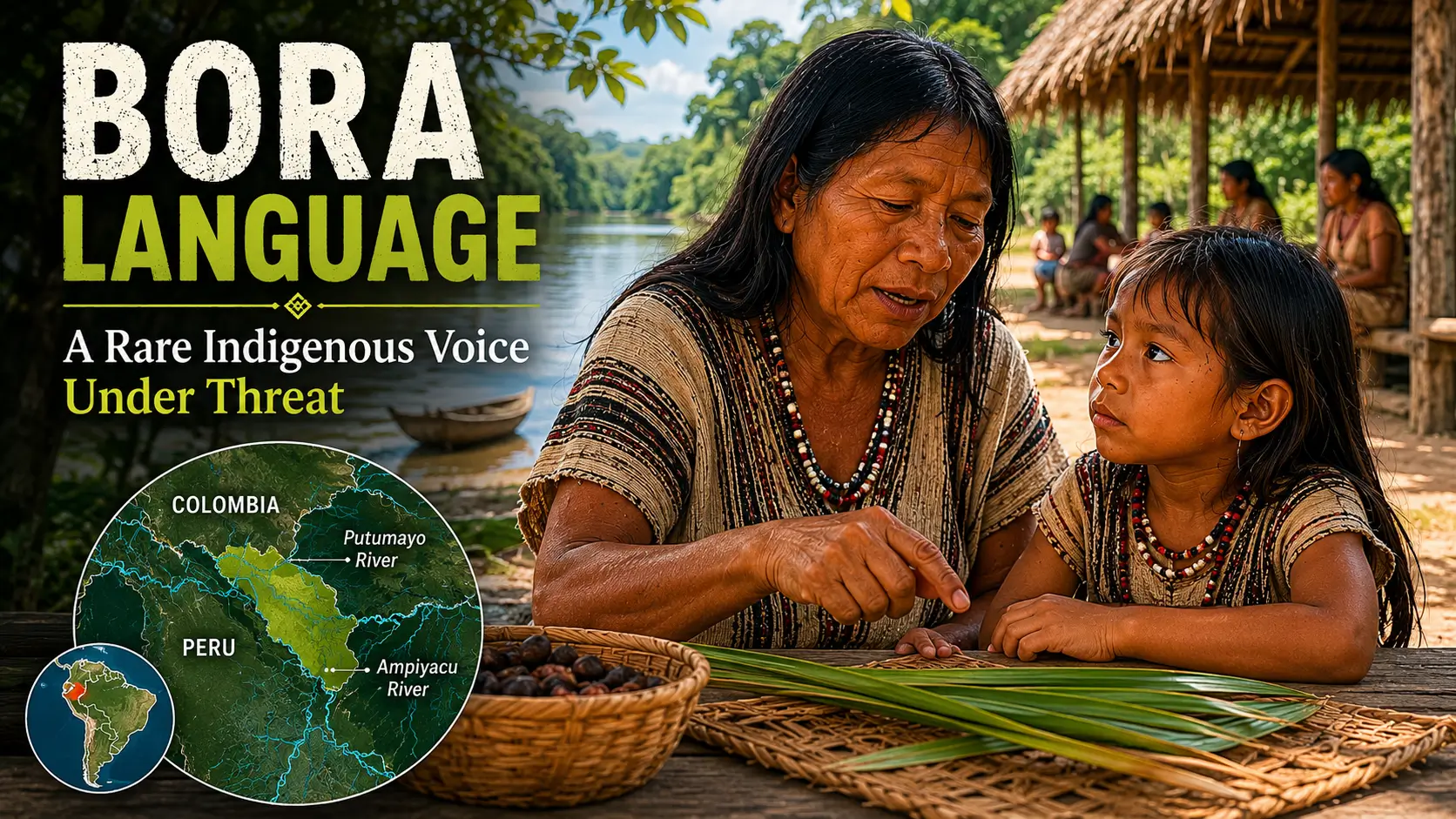
Deep in the Amazon rainforest, the Bora language is fighting for survival.
Spoken by small indigenous communities in Peru and Colombia, Bora carries generations of culture, storytelling, and ancestral knowledge, yet today, it is at risk of disappearing.
As younger generations shift toward dominant languages like Spanish, Bora has become one of many endangered indigenous voices under threat. But preserving it means protecting far more than words alone.
Historical Context of the Bora Language
The Bora language has a long and deeply rooted history within the Amazon rainforest.
Spoken for generations by indigenous communities in Peru and Colombia, the language reflects centuries of culture, survival, and connection to the natural world. However, historical pressures and modern language shifts have placed Bora under growing threat.
Origins and development of the Bora language
The Bora language belongs to the Bora–Witoto language family and developed among isolated Amazonian communities over hundreds of years.
Its evolution was shaped by oral tradition, community life, and the unique environment of the rainforest, helping preserve identity and communication across generations.
The cultural and social role of Bora among its speakers
For Bora communities, the language has traditionally been central to storytelling, ceremonies, songs, and everyday life.
Much of their history, spiritual beliefs, and ancestral knowledge has been passed down orally, making Bora an important part of cultural preservation and community identity.
Historical events impacting the language’s transmission
Over time, several historical events disrupted the transmission of the Bora language.
Colonisation and the Amazon rubber boom caused displacement and exploitation across indigenous communities, while the growing dominance of Spanish in schools and public life reduced the number of younger fluent speakers.
Today, Bora faces ongoing challenges as fewer people continue to learn and use the language regularly.
The Current Status of the Bora Language
Today, the Bora language remains one of the many endangered languages of the Amazon.
While the language is still spoken within some communities, the number of fluent speakers has steadily declined, raising concerns about its long-term survival.
Number of speakers and demographic information
The Bora language is spoken by a relatively small population, with estimates suggesting only a few thousand speakers remain across Peru and Colombia.
Most fluent speakers are older generations, while younger people are increasingly growing up speaking Spanish instead.
Geographic distribution of Bora speakers
Bora speakers are mainly found in remote Amazon rainforest regions, particularly near the Putumayo and Ampiyacu river areas in Peru, as well as parts of southern Colombia.
Many Bora communities live in isolated settlements where indigenous traditions and cultural practices remain closely tied to daily life.
Comparison with other indigenous languages in the region
Like many Amazonian indigenous languages, Bora faces pressure from dominant national languages and modernisation.
However, some larger indigenous languages in the region, such as Quechua or Asháninka, have significantly more speakers and stronger institutional recognition.
Bora remains far more vulnerable to language loss due to its smaller speaker base and limited visibility outside indigenous communities.
Cultural Significance of the Bora Language
The Bora language is deeply connected to the identity, traditions, and worldview of its speakers.
Like many indigenous languages, Bora carries cultural knowledge that cannot always be fully translated into dominant global languages, making its preservation especially important.
Role of language in preserving traditions and stories
For generations, Bora has been used to pass down oral history, myths, songs, ceremonies, and ancestral knowledge.
Storytelling plays a major role within Bora communities, helping preserve cultural memory and teaching younger generations about their history, values, and relationship with the rainforest.
Unique expressions and concepts in Bora that reflect cultural identity
The Bora language contains expressions and ways of describing the world that are closely tied to Amazonian life and indigenous traditions.
Many words reflect deep connections to nature, community, spirituality, and the environment, offering insights into how Bora speakers understand and experience the world around them.
The impact of language loss on cultural heritage
When a language disappears, much more is lost than vocabulary alone.
The decline of Bora threatens traditional knowledge, oral history, cultural practices, and unique ways of thinking that have existed for centuries.
Preserving the language helps protect the identity and heritage of Bora communities for future generations.
Threats to the Bora Language
Despite its cultural importance, the Bora language faces growing pressure from social, economic, and linguistic changes.
Like many endangered indigenous languages, Bora is at risk as younger generations increasingly shift toward dominant national languages.
Factors contributing to language endangerment
One of the biggest threats to Bora is the declining number of young fluent speakers.
Globalisation, migration, media influence, and the dominance of Spanish have reduced the everyday use of the language in many communities.
As older generations pass away, traditional knowledge and oral history are also at risk of disappearing.
The role of education systems in language preservation or decline
Education systems have played a mixed role in the survival of Bora.
In many cases, schools have historically prioritised Spanish over indigenous languages, discouraging younger people from speaking Bora regularly.
However, bilingual and intercultural education programmes have begun to support indigenous language preservation in some areas, helping communities maintain their linguistic heritage.
Socioeconomic challenges faced by Bora-speaking communities
Many Bora-speaking communities live in remote regions with limited access to healthcare, education, infrastructure, and economic opportunities.
These challenges can increase pressure to adopt dominant languages for work, education, and social mobility.
As a result, younger generations may view Spanish as more practical for their future, accelerating the language shift away from Bora.
Efforts to Revitalise the Bora Language
Although the Bora language remains endangered, communities and organisations are working to preserve and revitalise it for future generations.
These efforts aim to keep the language alive through education, documentation, and cultural pride.
Community initiatives aimed at language preservation
Many Bora communities continue to protect their language through storytelling, traditional ceremonies, music, and intergenerational teaching.
Local initiatives focused on teaching children and encouraging everyday language use have become increasingly important in maintaining Bora within families and communities.
Role of technology and social media in language revitalisation
Technology has created new opportunities for endangered language preservation.
Social media, online videos, digital dictionaries, and educational content can help younger generations engage with Bora in modern ways.
Even small online communities can play a valuable role in increasing visibility and awareness of endangered indigenous languages.
Collaboration with linguists and cultural organisations
Linguists, researchers, and cultural organisations have also contributed to documenting the Bora language through recordings, written materials, and academic research.
These collaborations help preserve vocabulary, grammar, pronunciation, and oral traditions, creating resources that may support future language revitalisation efforts.
Case Studies of Successful Language Revitalisation
While many indigenous languages remain endangered, some communities around the world have successfully revitalised their native languages through education, activism, and cultural pride.
These examples offer valuable lessons for the future of the Bora language.
Examples of other indigenous languages that have been successfully revitalised
Languages such as the Māori language and the Hebrew language are often cited as major revitalisation success stories. In New Zealand, Māori language programmes, media, and education initiatives helped increase the number of speakers and strengthen cultural identity.
Similarly, Hebrew was successfully revived from primarily religious use into a modern everyday language spoken by millions.
Other indigenous languages, including the Hawaiian language and the Welsh language, have also seen growth through bilingual education, media representation, and government support.
Lessons learned from these case studies that could apply to Bora
These revitalisation efforts show that language recovery is possible when communities actively teach younger generations and create opportunities to use the language daily.
Education, media visibility, digital resources, and official recognition can all help strengthen endangered languages over time.
For Bora, even small-scale efforts such as local language classes, online content, and cultural programmes could help preserve the language and encourage younger speakers to continue using it.
The importance of community involvement in revitalisation efforts
Community involvement is often the most important factor in language revitalisation.
Successful programmes usually begin within the community itself, with elders, families, and local leaders passing down knowledge and encouraging pride in cultural identity.
Without active community participation, long-term language preservation becomes far more difficult.
The Role of Government and Policy
Government policy plays a major role in whether endangered languages survive or disappear.
For the Bora language, stronger legal protections and long-term support could help preserve the language for future generations.
Existing policies supporting indigenous languages
Countries such as Peru and Colombia have introduced policies recognising indigenous languages and cultural rights.
In some regions, bilingual education programmes and intercultural initiatives aim to support indigenous communities and encourage the preservation of native languages within schools and public life.
The need for stronger legal protections for the Bora language
Despite these efforts, many endangered languages like Bora still receive limited practical support.
A lack of funding, resources, trained teachers, and educational materials can make language preservation difficult. Stronger protections are needed to ensure Bora is actively taught, documented, and promoted within Indigenous communities.
Recommendations for policymakers to support language preservation
Policymakers can help protect Bora by increasing investment in bilingual education, supporting indigenous-led cultural programmes, and funding language documentation projects.
Expanding digital resources, teacher training, and community initiatives could also help younger generations continue learning and using the language in everyday life.
How Individuals Can Help
Protecting endangered languages is not only the responsibility of governments and organisations.
Individuals can also play an important role in supporting the survival of the Bora language and other indigenous languages around the world.
Ways to support Bora language speakers and initiatives
People can support Bora-speaking communities by donating to indigenous organisations, sharing educational resources, supporting ethical cultural projects, and helping amplify indigenous voices online.
Even small actions that increase visibility can contribute to long-term language preservation efforts.
Importance of raising awareness about language endangerment
Many endangered languages disappear quietly, often without wider public attention.
Raising awareness helps highlight the cultural importance of languages like Bora and encourages greater support for preservation programmes, education initiatives, and indigenous rights.
Encouraging the learning and use of indigenous languages
Learning even a small amount of an indigenous language can help promote respect, visibility, and cultural appreciation.
Encouraging younger generations to speak and value indigenous languages is especially important, as community use remains one of the strongest ways to keep endangered languages alive.
Bora Language FAQs
What is the Bora language?
The Bora language is an indigenous language spoken by Bora communities in parts of Peru and Colombia, particularly within the Amazon rainforest region.
Is the Bora language endangered?
Yes. The Bora language is considered endangered due to the declining number of fluent speakers and the growing dominance of Spanish among younger generations.
Where is the Bora language spoken?
Bora is mainly spoken in remote Amazonian areas near the Putumayo and Ampiyacu river regions of Peru and southern Colombia.
Why is the Bora language important?
The Bora language helps preserve cultural identity, oral traditions, ancestral knowledge, and indigenous history. It reflects the unique worldview and heritage of Bora-speaking communities.
Can endangered languages like Bora be revitalised?
Yes. Community education, language documentation, digital resources, and cultural preservation programmes can all help revitalise endangered languages and encourage younger generations to continue speaking them.